4 Month Old Won’t Sleep Unless Held? Proven 5-Day Fix
The 4-Month Sleep Regression Is Real : And It Has a Specific, Step-by-Step Solution
- What Is the 4-Month Sleep Regression? (And Why It Is Permanent)
- Why Does My 4 Month Old Won’t Sleep Unless Held in My Arms?
- Is This Really the Regression, or Something Else?
- What the 4-Month Regression Feels Like (You Are Not Alone)
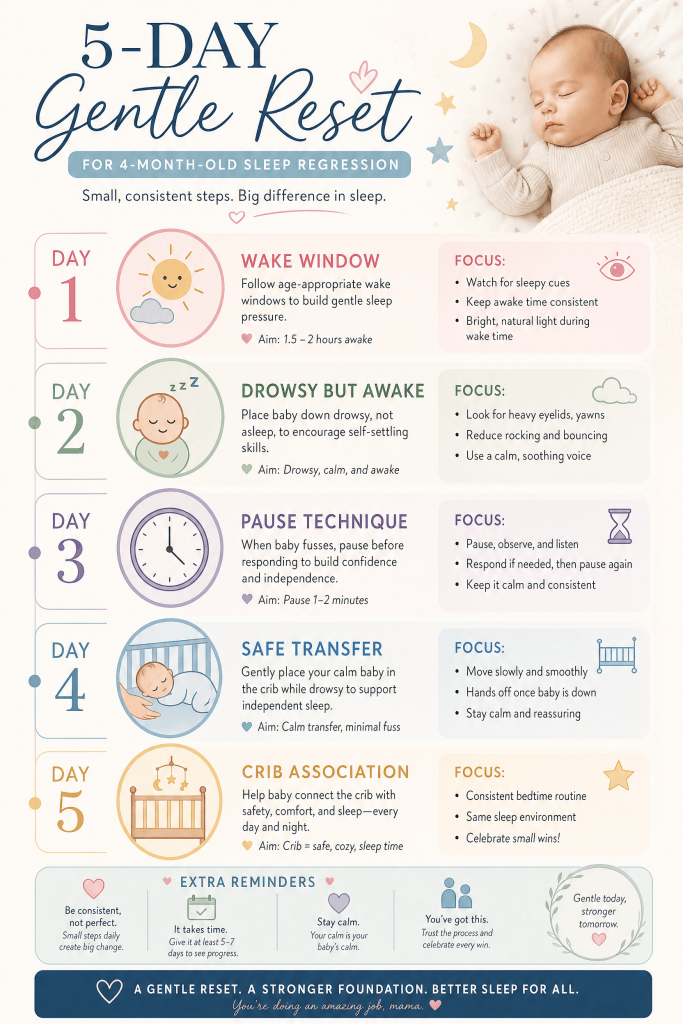
- The 5-Day Gentle Reset: How to Break the Arms-Only Sleep Association
- Day 1 : Lock In the Wake Window
- Day 2 : Drowsy But Awake Practice (4-Month Version)
- Day 3 : The Pause Technique
- Day 4 : The Safe Transfer Protocol
- Day 5 : Crib Association Practice (Daytime Only)
- What NOT to Do During the 4-Month Regression
- The Cycle-Linking Framework: Think in 45-Minute Blocks
- When Will My Baby Sleep Through the Night Again?
- Step-by-Step Action Plan: Your First 7 Nights
- The Quick-Reference Cheat Sheet
- Key Takeaways: Everything You Need to Remember
- FAQ — People Also Ask
- Why is my 4 month old won’t sleep unless held ?
- Is it OK to hold my baby to sleep at 4 months?
- How do I break the held-to-sleep habit at 4 months?
- Can the 4-month regression cause permanent sleep problems?
- When does the 4-month sleep regression end?
- Summary: What to Do Tonight If Your 4 Month Old Won’t Sleep Unless Held
Medical Disclaimer: This article is for informational purposes only and does not replace professional medical advice. Always consult your pediatrician before changing your baby’s sleep routine, especially if you suspect a medical issue. Sleep recommendations follow AAP safe sleep guidelines.
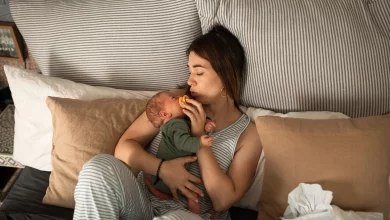
If your 4 month old won’t sleep unless held, you are not failing as a parent, your baby’s brain just permanently rewired itself overnight, and nobody warned you it was coming.
This is the 4-month sleep regression the most disruptive sleep change in the entire first year, and the core reason so many parents search baby won’t sleep unless held at 3 AM. Unlike other regressions that come and go in days, this one is permanent. Your baby’s sleep architecture has changed for good, which means the old tricks that worked in the newborn phase will not come back.
The good news: once you understand exactly what changed and why, the fix is specific, gentle, and works within 5 days for most families.
Here is everything you need to know about why your 4 month old won’t sleep unless held, and the step-by-step reset that finally works.
A 4 month old won’t sleep unless held because their brain just permanently shifted to adult-like sleep cycles, waking briefly between each 45-minute cycle. They need a familiar sensation being held to fall back asleep. The fix is not sleep training in the traditional sense; it is teaching your baby to link sleep cycles on a flat surface using the 5-Day Reset method below. According to the AAP, the safest place for a baby to sleep is alone, on their back, on a firm flat surface.
What Is the 4-Month Sleep Regression? (And Why It Is Permanent)
The 4-month sleep regression is not a phase that passes on its own.
Before 4 months, newborns cycle through sleep differently from adults, they drop straight into deep sleep, which is why they could sleep through noise, movement, or being transferred to a crib. At around 16 weeks, the brain undergoes a neurological reorganization. According to the American Academy of Pediatrics (AAP), infant sleep architecture matures significantly in the first 6 months, shifting from a two-stage cycle to a multi-stage adult-like pattern that includes light sleep, REM sleep, and deep sleep.
What this means practically: your baby now wakes briefly at the end of every 45-minute sleep cycle, just like adults do. The difference is that adults can put themselves back to sleep without noticing. Your baby cannot, not yet. They need whatever condition was present when they first fell asleep. If that condition was your arms, they will cry for your arms every 45 minutes, all night long.
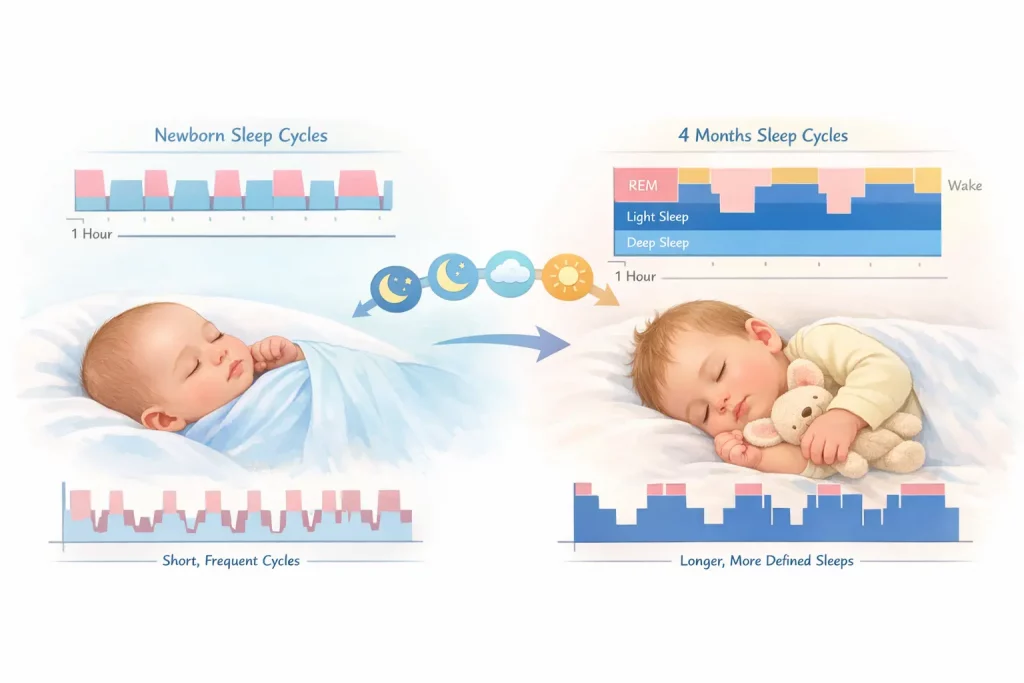
This is called a sleep association, and the most intense version of it is why your 4 month old won’t sleep unless held in your arms and wakes the moment you attempt a transfer.
Why Does My 4 Month Old Won’t Sleep Unless Held in My Arms?
Your 4 month old won’t sleep unless held in your arms because being held is their primary sleep association, the sensory anchor their brain links to the feeling of falling asleep.
Think of it this way: if you fell asleep with your pillow and woke up to find it gone, you would reach for it before going back to sleep. Your baby falls asleep to the warmth, heartbeat, motion, and scent of being held. When they cycle into light sleep and those conditions are gone, their brain triggers an alert: something is wrong, wake up.
This is not a manipulation tactic. It is pure neurology.
The parental arm trap compounds quickly:
- Each time you hold baby to sleep, the association strengthens
- The association becomes harder to break with every passing week
- By 5–6 months, a reinforced arms-only sleep association is significantly harder to break, if you are already there, read our guide on 6-month-old won’t sleep unless held for the age-specific reset.
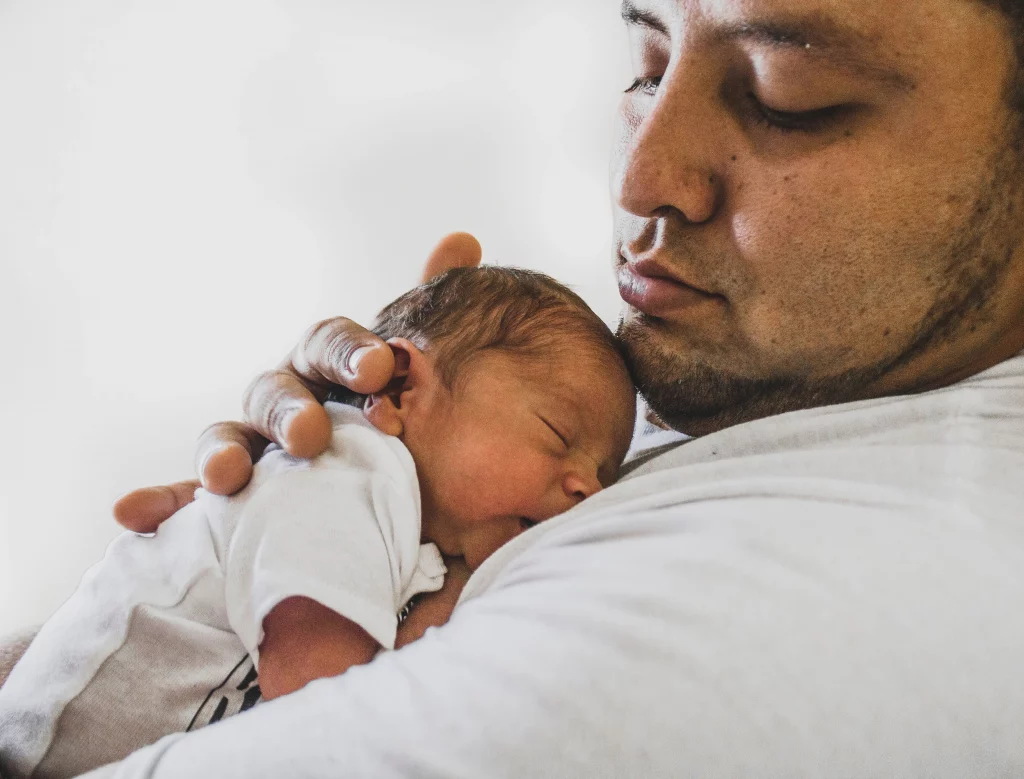
This is why the 4-month window matters. Acting now, gently, not harshly is far easier than waiting.
Is This Really the Regression, or Something Else?
Before assuming the issue is purely the 4-month sleep regression held to sleep pattern, rule these out:
| Symptom | Possible Cause | Action |
|---|---|---|
| Tugging at ear + fever | Ear infection | Call pediatrician same day |
| Excessive gas, arching back | Reflux or gas pain | Discuss with pediatrician |
| Feeding constantly + sleep disruption | Growth spurt (common at 3–4 months) | Feed on demand for 3–5 days |
| Clicking sound while feeding | Tongue or lip tie | Request pediatric assessment |
| Suddenly fine after 5–7 days | True regression resolving | Continue safe sleep practices |
If none of the above apply and your baby is healthy, gaining weight, and hitting milestones, this is almost certainly the regression.
What the 4-Month Regression Feels Like (You Are Not Alone)
Before the fix, let me say this plainly: this regression is brutal. Parents in the thick of it describe:
- A baby who slept 4–5 hour stretches in week 6 and now wakes every 45 minutes
- A baby who can only be placed down once fully deeply asleep, and even then wakes within 20 minutes
- Exhaustion so complete that safe sleep habits start to feel impossible to maintain
- Partners taking shifts just to survive the night
According to a 2021 study published in Sleep Medicine Reviews, parental sleep deprivation in the first year of a child’s life significantly affects cognitive function, mood regulation, and relationship quality. You are not overreacting. This is genuinely hard.
And the fix below is built specifically for parents running on empty.
The 5-Day Gentle Reset: How to Break the Arms-Only Sleep Association
This is the core method for when your 4 month old won’t sleep unless held. It is not cry-it-out. It works by gradually replacing the held-to-sleep association with a flat-surface association over 5 days.
Before you start:
- Confirm your baby is healthy (rule out ear infection, growth spurt, reflux)
- Choose a 5-day stretch with no travel, visitors, or major schedule changes
- Ensure crib meets AAP safe sleep standards: firm flat mattress, no loose bedding, on their back
Day 1 : Lock In the Wake Window
Why you start here: A baby who is put down at the wrong moment of their sleep pressure cycle will fight sleep no matter what you do. A 4-month-old’s wake window is 1.5 to 2 hours maximum.
- Set a consistent morning wake time (same time every day)
- Count 1.5–2 hours from wake time → that is your next nap window
- Watch for sleep cues: eye rubbing, slowing of movement, glazed stare, reduced smiling
- Begin your sleep routine before the overtired crying starts, not after
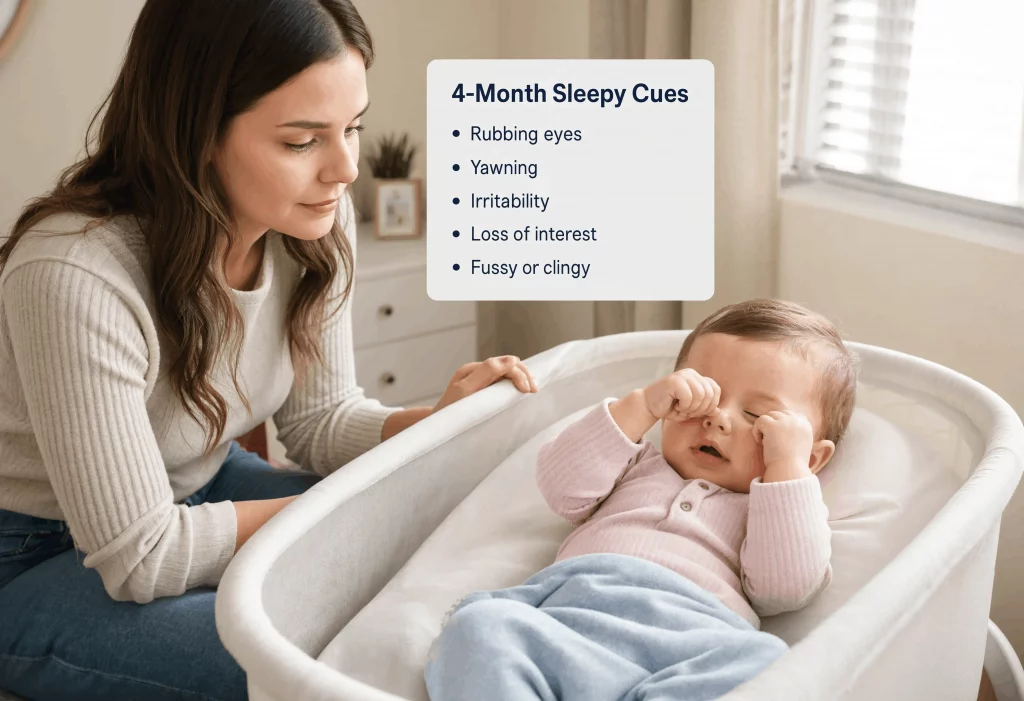
A baby put down in the right window requires far less holding to fall asleep.
Day 2 : Drowsy But Awake Practice (4-Month Version)
The drowsy-but-awake window at 4 months is very short, roughly 90 seconds to 3 minutes. It is not the same as for a 6-month-old or older baby.
- Complete your full sleep routine: feed, dim lights, swaddle or sleep sack, white noise on
- When baby’s eyes go heavy but are still open, place them in the crib
- Keep your hand firmly on their chest for 60–90 seconds
- If crying escalates beyond fussing within 2 minutes, pick up and soothe, then try again
You are not expected to succeed on Day 2. You are teaching your baby that the crib is a safe, familiar surface, not a threatening one.
Day 3 : The Pause Technique
When your 4 month old won’t sleep unless held and wakes at night, the instinct is to pick them up immediately. The Pause changes this.
The Pause: When baby wakes and fusses, wait 60–90 seconds before responding.
This is not abandonment, it is giving your baby the chance to practice linking sleep cycles on their own. According to research from the Journal of Developmental and Behavioral Pediatrics, brief pauses before responding to nighttime waking are associated with improved sleep consolidation without increased infant stress markers.
- If fussing turns to crying before 90 seconds: respond, soothe, do not pick up immediately
- Place your hand on chest first, many babies at this age resettle with touch alone
- If crying escalates: pick up, soothe to calm (not sleep), replace in crib
Day 4 : The Safe Transfer Protocol
For a complete breakdown of every transfer mistake and how to avoid it, see our full guide on the safe transfer protocol that works even for the lightest sleepers
This addresses the specific moment when the 4-month sleep regression held to sleep pattern breaks down: the transfer.
The warm-hand transfer:
- Hold baby until fully asleep (deeply limp)
- Keep one hand on their chest throughout the entire transfer
- Lower them slowly : feet first, then bottom, then back, then head last
- Keep your hand on chest for a full 60 seconds after contact with mattress
- Withdraw hand in slow increments fingertip pressure last
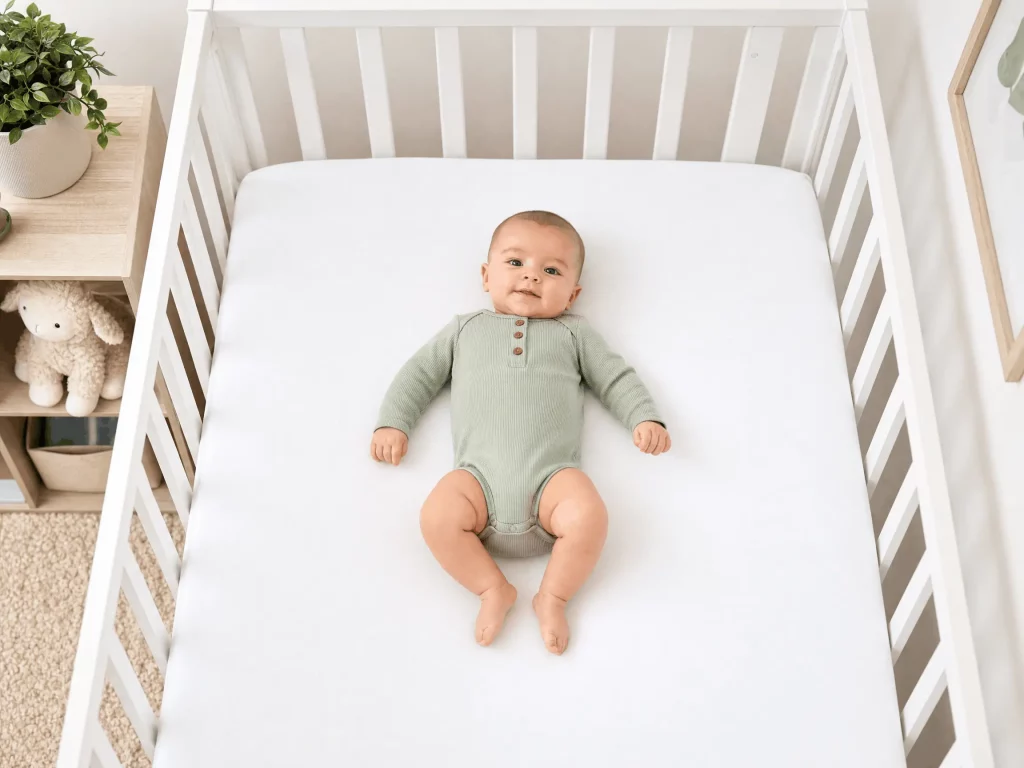
The sheet-warming trick: Place a microwaved heating pad (removed before baby goes in) on the crib sheet for 5 minutes before transfer. The temperature differential, warm sheet versus cold sheet is one of the most common reasons transfers fail.
Day 5 : Crib Association Practice (Daytime Only)
On Day 5, add one daytime session where your baby is placed in the crib while awake and happy not at naptime, not when tired.
- 5–10 minutes maximum
- Sit next to crib, make eye contact, talk softly
- This is not a nap attempt, it is crib familiarity training
Babies who see the crib only when they are being forced to sleep learn to associate it with distress. Babies who see the crib while happy and safe begin to treat it as a neutral, familiar space.
What NOT to Do During the 4-Month Regression
Most guides tell you what to do. Here is what makes the 4-month sleep regression held to sleep pattern significantly worse and what most parents accidentally do without realizing:
- Skipping the wake window and putting baby down too late → overtired babies fight harder to fall asleep and wake more often
- Feeding to sleep every single time → adds a feeding layer on top of the held-to-sleep association, doubling the problem
- Switching between methods every 2 nights → the brain needs consistency; switching creates confusion that extends the regression by weeks
- Co-sleeping as a permanent fix (unsafe) → the AAP advises against bed-sharing due to suffocation risk : a firm, flat, separate surface is the safest sleep environment for babies under 12 months
- Letting baby sleep unsupervised in a swing or car seat → AAP guidelines state that inclined sleepers and car seats are not safe for unsupervised sleep due to positioning risks
Important: According to the American Academy of Pediatrics safe sleep guidelines, babies should always be placed on their back, on a firm, flat surface, in their own sleep space, free of loose bedding, pillows, and positioners.
The Cycle-Linking Framework: Think in 45-Minute Blocks
One concept competitors consistently miss: parents who understand cycle linking have dramatically more success than parents who are simply trying to “get the baby to sleep longer”
Your baby’s sleep cycle at 4 months is approximately 45 minutes. At the end of each cycle, there is a brief arousal. Your goal is not to prevent waking, it is to make the conditions at cycle end match the conditions at sleep onset so that your baby can slip back into the next cycle.
The math:
- A 6-hour stretch = 8 linked cycles
- If baby needs to be held for every link = 8 wake-ups
- If baby can self-link 3 of those = 3 wake-ups instead of 8
- Progress, not perfection, is what you are building toward
Even partial success in the first week, going from 8 wake-ups to 4 is significant. Track it.
When Will My Baby Sleep Through the Night Again?
This is the question every parent is actually asking when they search for “why does my 4 month old won’t sleep unless held in my arms“
Honest answer: most babies who address the 4-month regression proactively sleep in 4–6 hour stretches within 3–4 weeks of consistent work. Babies whose regression is left unaddressed can continue waking 6–10 times per night until 8–12 months.
According to a 2020 study in Infant Behavior and Development, babies whose sleep associations were addressed at 4 months showed significantly better sleep consolidation at 6 months compared to those whose sleep environment remained unchanged.
You do not need perfection. You need consistency.
Step-by-Step Action Plan: Your First 7 Nights
Print this. Put it on the fridge. When it is 3 AM and your 4 month old won’t sleep unless held, you will not have the bandwidth to remember what to do next.
Night 1–2: Observation only Do not change anything yet. Count how many times your 4 month old wakes unless held through the night. Write it down. This is your baseline.
Night 3: Wake window audit Shift the last wake window of the day to exactly 1.75 hours before your target bedtime. Watch for sleep cues at the 90-minute mark. Begin your bedtime routine before cues appear, not after.
Night 4: Add the Pause When your 4 month old won’t sleep unless held and wakes at night, wait 60–90 seconds before responding. Place your hand on their chest first. Pick up only if crying fully escalates.
Night 5–6: Drowsy-but-awake attempt at one nap Choose the first nap of the day only. After your full nap routine, place your 4-month-old in the crib while their eyes are still partially open. Keep your hand on their chest for 90 seconds. If it fails, pick up and try tomorrow. Do not attempt this for all naps yet.
Night 7: Warm-hand transfer practice At the longest sleep stretch of the night (usually the first), practice the full transfer sequence: feet first, slow lower, 60-second chest contact, fingertip withdrawal. Even one successful transfer per night is a win worth tracking.
The Quick-Reference Cheat Sheet
Save this to your phone before tonight’s bedtime routine.
| Situation | What to Do |
|---|---|
| 4 month old won’t sleep unless held at bedtime | Check wake window first, most overtiredness masquerades as a holding preference |
| Baby wakes after exactly 45 minutes | Normal cycle arousal, try The Pause before picking up |
| Transfer fails every single time | Use the sheet-warming trick + slow the lowering speed |
| 4 month old only sleeps in your arms for naps | Focus on nap 1 only with drowsy-but-awake; let other naps stay contact naps for now |
| Baby cries within 2 min of crib placement | Pick up, soothe to calm (not sleep), try again, do not let it escalate |
| 4-month sleep regression held to sleep pattern getting worse | Audit the wake window, an overtired baby holds longer and harder |
| Partner wants to try cry-it-out | Redirect to the Pause, extinction before 6 months is not recommended by most pediatric guidelines |
| Two weeks in and no progress | Rule out ear infection, reflux, or growth spurt before continuing |
Key Takeaways: Everything You Need to Remember
If you read nothing else, save this. Here is the complete picture of why your 4-month-old won’t sleep unless held — and what to do about it:
- The change is neurological and permanent. At 16 weeks, your baby’s brain reorganized into adult-like sleep cycles. This is normal development, not a problem you caused.
- Being held became a sleep association. Your 4 month old won’t sleep unless held because that is the condition their brain learned to associate with falling asleep. Every 45 minutes, when they cycle into light sleep, they need that condition back.
- The fix is gradual, not overnight. The 5-Day Gentle Reset works by replacing the held-to-sleep association with a crib-surface association, one small step per day.
- Consistency beats perfection. Parents who apply the same method every night for 10 days see far better results than those who switch strategies every 2 nights.
- The wake window is your first lever. A 4 month old who won’t sleep unless held and is also overtired is twice as hard to settle. Fix the wake window first, before anything else.
- You are not creating bad habits by responding. Gentle responsiveness at 4 months is developmentally appropriate. You are teaching safety, not dependency.
FAQ — People Also Ask
Why is my 4 month old won’t sleep unless held ?
Your 4 month old won’t sleep unless held because their brain just permanently reorganized into adult-like sleep cycles. They now wake briefly between each 45-minute cycle and need their original falling-asleep condition being held to return to sleep. This is the 4-month sleep regression, and it affects nearly all babies at this age.
Is it OK to hold my baby to sleep at 4 months?
Holding your baby to sleep is not harmful in itself, but it can create a strong sleep association that becomes harder to break over time. The AAP recommends placing babies on a firm, flat surface on their back for all sleep. If your 4 month old won’t sleep unless held every night, starting gentle practice now is easier than addressing it at 6 or 8 months.
How do I break the held-to-sleep habit at 4 months?
The most effective method for breaking the 4-month sleep regression held to sleep habit is the 5-Day Gentle Reset described above: start with wake window alignment, introduce drowsy-but-awake practice, apply the Pause technique, use the warm-hand transfer, and build crib familiarity during happy awake time. Expect 2–3 weeks to see consistent improvement.
Can the 4-month regression cause permanent sleep problems?
The neurological change at 4 months is permanent, your baby’s sleep architecture does not go back to the newborn pattern. However, the sleep problems are not permanent. Babies who build independent sleep skills at this stage typically sleep through the night reliably by 5–6 months.
When does the 4-month sleep regression end?
With no intervention, the regression can persist for weeks to months because the sleep association that drives it only gets stronger with time. With the gentle reset method above, most parents see meaningful improvement within 5–10 days and consistent 4–6 hour stretches within 3–4 weeks.
Summary: What to Do Tonight If Your 4 Month Old Won’t Sleep Unless Held
You do not have to overhaul everything at once. Start with one thing tonight:
- Check the wake window is your baby overtired before you start the bedtime routine? Shift bedtime 20 minutes earlier.
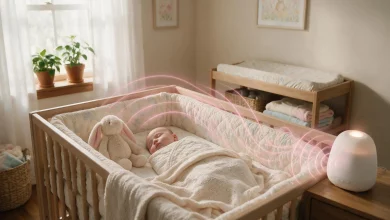
- Add white noise if you are not using it, start tonight. A dedicated machine at 65 dB can reduce wake-ups on the first night.
- Try the warm-hand transfer once even if it fails, you practiced. It will be slightly easier tomorrow.
The 4 month old won’t sleep unless held problem feels endless at 3 AM. It is not. Your baby’s brain is developing exactly as it should, it just needs you to guide it toward independent sleep, gently and consistently, over the next few weeks.
You are not doing this wrong. You just needed the right framework.
Medical Disclaimer: This article is for informational purposes only and is not a substitute for professional medical advice, diagnosis, or treatment. Always consult your pediatrician with questions about your baby’s sleep, health, or development. Safe sleep guidance follows current AAP recommendations.