

Contents
Picture a Tuesday afternoon in the cereal aisle: a toddler drops to the floor screaming because his mom opened his granola bar from the “wrong end.” A woman near the yogurt gave me a look. I gave her a tight smile and thought, is something wrong with him, or with me?
Neither, it turns out. That meltdown over a granola bar wrapper was textbook toddler development, and it’s exactly the kind of moment that leaves parents figuring out what’s actually normal toddler behavior at each age, and what’s worth a closer look.
This isn’t a quick-tip list. It’s the full toddler behavior guide for ages 1 to 4, the hub for everything else we’ve written about toddler development on this site. Below, you’ll find a complete toddler behavior by age breakdown with a toddler behavior chart you can bookmark, the five most common toddler behavior problems and solutions (with links to our full guides on each), what never works no matter how many times you try it, and the approach that actually changes things.
This toddler behavior guide breaks down what’s normal toddler behavior at 12-18 months, 18-24 months, 2-3 years, and 3-4 years using a simple toddler behavior chart, plus the five most common toddler behavior problems and what’s really behind each one. The short version: toddler tantrums and meltdowns are an underdeveloped brain asking for help, not defiance. Match your response to your toddler’s age and behavior usually improves faster than punishment ever did.
Medical Disclaimer: This toddler behavior guide is for general informational purposes only and isn’t a substitute for professional medical or psychological advice. If you’re worried about your toddler’s development, behavior, or safety, talk to your pediatrician, they know your child’s history and can rule out anything else going on.
Quick Answer:
Toddler behavior problems, tantrums, hitting, ignoring you, refusing food, clinging to your leg, are normal stages of toddler brain development between ages 1 and 4, not signs of a “bad kid” or bad parenting. The prefrontal cortex, the part of the brain that controls impulse control and emotional regulation, doesn’t fully mature until the mid-20s, so toddlers physically can’t “calm down” the way you’re asking them to yet. The fix isn’t more punishmen, it’s connection-based responses matched to your child’s age and stage, which is exactly what this toddler behavior guide covers below.
Why Does My Toddler Act Out? The Brain Science Behind “Bad” Behavior
Why does my toddler act out over things that seem so small? Because your toddler’s brain is running on the parts that are already built, and the parts that aren’t finished yet are the ones you need most: impulse control, patience, and “use your words.”
Picture the brain in two layers. The bottom layer (the amygdala and brainstem) handles big emotions and survival instincts, and it’s fully online from birth. The top layer (the prefrontal cortex) handles logic, patience, and “wait your turn” and that layer isn’t fully wired until a person’s mid-20s.
So when your 2-year-old screams because you cut their toast into the wrong shape, their bottom-layer brain has just declared a five-alarm emergency, and their top-layer brain doesn’t have the wiring yet to talk them down. That’s not manipulation. That’s not “getting away with it.” That’s toddler brain development, full stop.
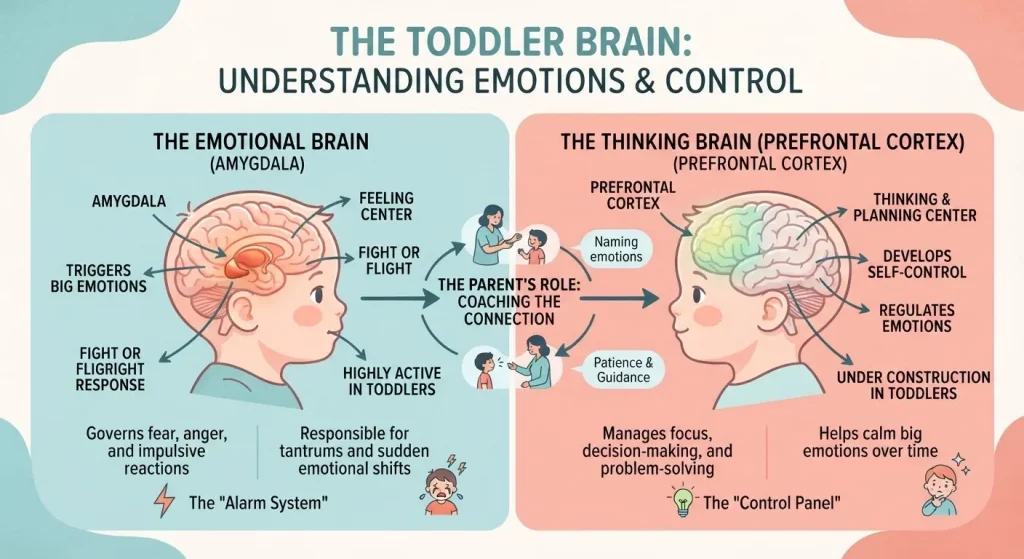
For many parents, this reframe changes everything. Instead of asking “why is he doing this to me,” ask “what’s actually going on for him right now”: hunger, tiredness, overstimulation, or too much change too fast. Often one of those four is the real answer, and that reframe is the foundation of everything else in this toddler behavior guide.
Toddler Behavior Problems and Solutions by Age: What’s Normal at Each Stage
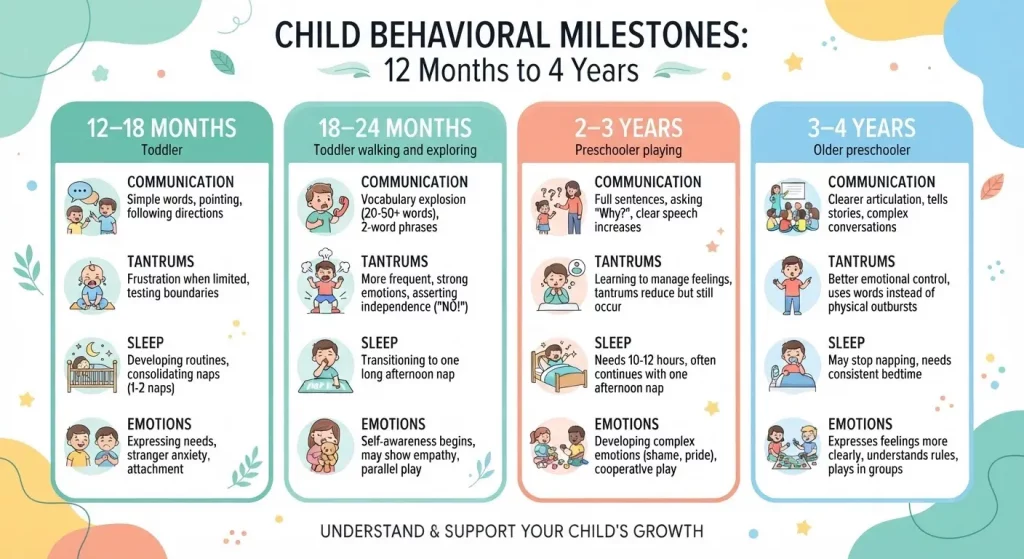
Toddler behavior problems and solutions look very different at 14 months than they do at 3.5 years, because the brain (and body) driving that behavior is at a completely different stage. This section of the toddler behavior guide breaks down toddler behavior by age, what’s typical, what’s worth flagging, and where each stage usually heads next.
12 to 18 Months: Everything Is “No” “Mine” and Pointing
At this age, your toddler understands far more than they can say, and that gap is the root of most frustration. Hitting, throwing, and dropping to the floor are common when a toddler can’t communicate a need fast enough.
Expect: short attention spans, throwing food or toys, clinginess with strangers, and big reactions to small transitions like leaving the park. This is age-appropriate toddler behavior, even on the days it doesn’t feel like it.
Worth mentioning to your pediatrician: not pointing to show you things by 18 months, no single words yet, or a total lack of interest in the people around them. According to the CDC’s “Learn the Signs. Act Early.” milestones for 18 months, most toddlers can point to show you something interesting and follow simple one-step directions by this age.
18 to 24 Months: Big Feelings, Tiny Vocabulary
This is often the peak of what people call the “terrible twos” except it usually starts before 2. Your toddler’s emotional world is expanding faster than their vocabulary, which means meltdowns become the default communication tool.
Expect: tantrums over transitions, hitting or biting when frustrated, a sudden obsession with “no” and testing what happens when they don’t listen.
For many families, the 18-24 month stretch is the loudest. What helped wasn’t more discipline, it was narrating feelings out loud (“you’re mad because we have to leave the park”) long before he could say it himself.
2 to 3 Years: Tantrums, Power Struggles, and Testing Every Limit
Two is the age where toddlers discover they’re a separate person with their own opinions and they will test that theory on every single rule you have. Tantrums, refusing to share, and “you’re not the boss of me” energy are all developmentally normal here. If every question gets a “no” right now, see why toddlers say no to everything.
According to the CDC’s positive parenting guidance for toddlers ages 2 to 3, giving attention and praise for positive behavior while limiting attention for tantrums helps toddlers learn which behaviors get a response. This is also the age when picky eating peaks, often tied to a toddler’s growing need for control rather than the food itself. Sleep can wobble at this age too. If bedtime has suddenly fallen apart, our guide to the 2 year old sleep regression explains why and what helps.
3 to 4 Years: Negotiating, “Lying,” and Selective Listening
By 3 to 4, your toddler has enough language to argue with you and they will use it. Negotiating, stalling, “forgetting” rules they followed yesterday, and elaborate made-up stories are all normal at this age, not signs of dishonesty in the adult sense.
This is also the age where sleep starts quietly driving behavior more than parents expect. According to the CDC, preschoolers ages 3 to 5 need 10 to 13 hours of sleep per 24 hours, including naps and a toddler running a deficit of even an hour often looks “defiant” when they’re actually just exhausted. As your toddler moves through these toddler development stages, the underlying pattern stays the same: behavior is communication, and the message changes as the words catch up.
Toddler Behavior Chart: What’s Normal at Each Age (Quick Reference)
Bookmark this toddler behavior chart, it’s the fastest way to check whether what you’re seeing fits normal toddler behavior for your child’s age, or whether it’s worth a mention at your next pediatrician visit.
| Age | Normal Behaviors | Common Triggers | Mention to Your Pediatrician If… |
|---|---|---|---|
| 12–18 months | Throwing, dropping to the floor, clinginess with strangers, big reactions to leaving somewhere fun | Frustration at not being understood, overstimulation, transitions | Not pointing to show interest, no single words, little interest in people by 18 months |
| 18–24 months | Tantrums over transitions, hitting/biting when frustrated, obsession with “no,” testing limits | Tiny vocabulary vs. big feelings, tiredness, hunger | Loss of skills they used to have, no interest in communicating at all |
| 2–3 years | Tantrums, refusing to share, power struggles, picky eating | Need for control and independence, overstimulation | Tantrums that are extremely intense, very frequent, or involve self-injury |
| 3–4 years | Negotiating, stalling, “forgetting” rules, elaborate made-up stories | Sleep debt, big imagination outpacing self-control | Behavior is significantly more extreme than peers, or paired with speech/social delays |
Toddler Behavior Problems and Solutions: The 5 Most Common Issues (And What’s Behind Each)
Whatever your toddler is doing right now, there’s a very good chance another parent posted about the exact same thing on a forum last night. Here’s the toddler behavior guide breakdown of the five toddler behavior problems that come up most, what’s really behind each one, a quick first step, and a link to our full guide if you want to go deeper.
1. Tantrums and Meltdowns Over “Nothing”
The wrong-shaped toast. The wrong-colored cup. Tantrums are rarely about the thing itself, they’re about a toddler who’s hit their limit and has no other way to show it. A tantrum is loud and fast and often fades once it stops getting a reaction, while a meltdown builds slowly, means your toddler is already past their limit, and needs comfort first and talking later. For age-by-age scripts, what to say in the first 10 seconds, and what to do when tantrums happen several times a day or last 20+ minutes, see our full guide to stopping toddler tantrums.
2. Hitting, Biting, or Pushing (Especially Siblings)
This one scares parents the most, and it’s also one of the most common. A toddler who hits isn’t showing you they’re “aggressive” by nature — they’re showing you their feelings are bigger than their self-control right now.
The skill that’s missing usually isn’t “knowing hitting is wrong” most toddlers who hit already know that. The missing skill is what to do instead in the second the feeling hits. Building that pause between feeling and action is the entire focus of our guide to emotional regulation in children, which breaks the skill down age by age.
Read the full guide: Emotional Regulation in Children: 7 Proven Age-Based Strategies
Full guide: toddler hitting and biting: reasons by age and what helps.
3. “Not Listening” (Ignoring Instructions)
Sometimes “not listening” really is selective hearing toddlers are remarkably good at tuning out anything that isn’t “ice cream” or “park.” But if your toddler consistently seems not to understand directions, doesn’t turn toward their name, or their speech feels noticeably behind other kids their age, it’s worth ruling out a hearing or speech gap before assuming it’s a behavior problem at all.

This matters because a toddler who can’t process what you’re asking will look exactly like a toddler who won’t and the response that helps each one is completely different. Our guide on toddler speech delay signs covers the exact milestones by age, what’s within normal toddler behavior, and what’s worth mentioning at your next check-up.
Read the full guide: Is My Toddler a Late Talker? 7 Toddler Speech Delay Signs
Full guide: toddler won’t listen: 7 real reasons and what works and why your toddler listens to everyone but you.
4. Refusing Food (Or Eating the Same Five Things on Repeat)
Food battles peak right alongside the “I’m my own person” phase, and that’s not a coincidence, the plate is one of the few places a toddler has total control.
The approach that works for many families borrows from pediatric feeding guidelines: you decide what, when, and where food is offered, your toddler decides whether and how much to eat. No short-order cooking, no “just one more bite,” no dessert as a bribe. It’s slower than it sounds, but it’s the only approach that didn’t turn every dinner into a standoff.
If dinner has become a nightly battle, our guide on what to do when your toddler won’t eat anything covers the practical, day-to-day version of this approach including what to do when it feels like your toddler is living on crackers and air.
Read the full guide: Toddler Won’t Eat Anything? 5 Tricks That Actually Work
Full guide: picky eaters: signs to worry and what helps.
5. Clinginess, Separation Anxiety, and Meltdowns in New Places
The toddler who’s confident at home but falls apart at daycare drop-off, birthday parties, or around new people isn’t being “dramatic” new environments are genuinely overwhelming for a developing brain, and clinginess is often the only tool they have to ask for safety.
What helps is practice in small doses: short, predictable separations with a consistent goodbye routine, rather than avoiding separations altogether or forcing long ones. Our guide on building confidence in shy children has age-by-age strategies for exactly this, without pushing your toddler into situations before they’re ready — which usually backfires and makes the next separation harder.
Read the full guide: Building Confidence in Shy Children: 9 Proven Strategies
Full guide: toddler only wants mom: 7 ways dad can bond.
Toddler Behavior Problems and Solutions at a Glance
Here’s the toddler behavior guide cheat sheet, save this table for the next time you’re standing in the kitchen wondering what just happened.
| Behavior | What’s Really Behind It | Try This First | Full Guide |
|---|---|---|---|
| Tantrums / meltdowns | Toddler has hit their limit and has no other way to show it | Name the feeling, get to their level | Toddler Tantrums |
| Hitting / biting / pushing | Feelings bigger than self-control | Calm removal, then name the feeling afterward | Emotional Regulation in Children |
| “Not listening” | Selective hearing, or a speech/hearing gap | One short instruction at a time, at their level | Toddler Speech Delay Signs |
| Refusing food | The plate is one of the few places they control | Offer choices within limits (“division of responsibility”) | Toddler Won’t Eat |
| Clinginess / separation anxiety | New environments overwhelm a developing brain | Short, predictable separations with a consistent goodbye | Building Confidence in Shy Children |
What Never Works (And Why)
Before we get to the approach this toddler behavior guide recommends, it’s worth being honest about the things most of us have tried because they didn’t work, and that’s not a failure on your part.
- Yelling. It feels like it works in the moment, because the shock usually stops the behavior for about thirty seconds. According to the American Academy of Pediatrics, yelling at or shaming a child is minimally effective in the short term and not effective in the long term, and it doesn’t teach the skill you actually want your toddler to learn.
- Bribery as a first move. “If you stop crying, you get a cookie” teaches your toddler that big feelings are a negotiation tactic and negotiations escalate. Bribery isn’t evil, but it works much better as an occasional tool than a default response.
- Inconsistent follow-through. If the answer is “no” on Tuesday and “fine, whatever” on Thursday because you’re too tired to fight, your toddler isn’t being manipulative by testing it again on Friday. They’re doing exactly what any of us would do when a rule is sometimes real and sometimes not.
- Long lectures. A toddler mid-tantrum cannot absorb a three-sentence explanation about why hitting is wrong. Save the talk for later, when their brain is back online.
- Comparing them to other kids. “Your cousin doesn’t act like this” doesn’t motivate a toddler. It just adds shame on top of an already overwhelmed nervous system neither of which builds the self-control you’re hoping for.
The Approach That Actually Changes Toddler Behavior
The toddler discipline strategies in this toddler behavior guide all come down to one shift: connection before correction responding to the feeling first, and the behavior second. This is what positive parenting for toddlers looks like in real life, not in theory.
In practice, that looks like:
- Name the feeling out loud, even if it seems obvious. “You’re so mad we have to leave right now.” This isn’t giving in, it’s showing your toddler that big feelings are survivable and have a name.
- Get to their level before you say anything else. Crouching down, lowering your voice, and making eye contact does more in three seconds than a string of instructions shouted from across the room.
- Offer a limited choice instead of a flat no, when you can. “We can’t stay at the park, but you can choose: walk to the car like a dinosaur, or like a bunny.” Same boundary, more cooperation.
- Hold the boundary calmly, every time. The boundary doesn’t move, your tone does. “I know you’re upset. We’re still leaving.”
- Circle back later, when everyone’s calm, for the actual teaching moment. “Earlier, you hit your brother because you were really mad. Next time, you can stomp your feet or come find me instead.”
According to the CDC’s positive parenting tips for toddlers, giving attention and praise for the behaviors you want to see, and limiting attention for behaviors you don’t helps toddlers learn over time which responses get them what they need. That’s the whole approach this toddler behavior guide is built around, repeated about four hundred times a day.
Toddler Discipline Chart: What Doesn’t Work vs. What To Do Instead
This toddler discipline chart sums up the shift at the heart of this toddler behavior guide, same boundary, different delivery.
| Instead of… | It backfires because… | Try this instead |
|---|---|---|
| Yelling | Shock stops behavior for ~30 seconds but teaches nothing | Lower your voice and name the feeling |
| Bribery as a first response | Teaches big feelings = a negotiation tool | Offer a limited choice within the boundary |
| Inconsistent rules | Toddler tests it again because the rule isn’t reliable | Hold the same boundary calmly every time |
| Long lectures mid-tantrum | Their brain can’t process logic while overwhelmed | Circle back later, when everyone’s calm |
| Comparing to other kids | Adds shame without building self-control | Acknowledge their specific feeling by name |
What Other Parents Actually Say
Talk to other parents at the playground or in a local mom group, and a few themes come up constantly. First, almost everyone is dealing with this, the parent posting at midnight about a hitting phase or a food strike is never the only one. Pediatricians agree: the AAP describes tantrums as a normal part of development, most common between ages 1 and 3. Second, the advice that gets the most agreement isn’t punishment-based; it’s almost always some version of “name the feeling,” “offer a choice,” or “this phase passed for us in a few weeks.” Third, the most common regret parents share isn’t that they were too soft. It’s wishing they’d worried less about a phase that was, in hindsight, completely normal toddler behavior that resolved on its own once their toddler had the words for it.

All Toddler Behavior Guides
Every guide in this series, grouped by problem:
Listening & cooperation
- Toddler won’t listen? 7 real reasons and what works
- Why does my toddler listen to everyone but me?
- Why does my toddler laugh when I say no?
- Toddler says no to everything? Why it happens and what helps
- 3 year old won’t listen at bedtime? What helps
Tantrums, hitting & big emotions
- How to stop toddler tantrums: 7 calm steps by age
- Toddler hitting and biting: reasons by age and what helps
- Emotional regulation in children: strategies by age
- 2 year old hitting only mom? Why it happens and what helps
Attachment, confidence & siblings
- Toddler only wants mom? 7 ways dad can bond
- Building confidence in shy children
- Siblings fighting constantly? Try the “Mom Court” method
Food & mealtimes
- 18 month old throwing food: why it happens and what to do
- Toddler won’t eat anything? 5 tricks that help
- Picky eaters: a guide for toddler parents
Communication
When to Call Your Pediatrician
Most toddler behavior is a normal, if exhausting, part of development. Talk to your pediatrician if you notice:
- loss of words or skills your child already had
- aggression that injures your child or others, or happens many times a day
- very few words, no pointing or little eye contact for their age
- tantrums that regularly last longer than 25 minutes, or include holding their breath until they faint
- behavior that disrupts sleep, eating or daycare most days
Sources & Further Reading
- HealthyChildren.org (AAP): Normal child behavior
- HealthyChildren.org (AAP): Top tips for surviving tantrums
- HealthyChildren.org (AAP): What’s the best way to discipline my child?
- CDC: Milestones by 18 months
- CDC: Positive Parenting Tips, toddlers (2–3 years)
- CDC: Positive Parenting Tips, preschoolers (3–5 years)
Frequently Asked Questions About Toddler Behavior
Why does my toddler act out?
Toddlers act out because their emotional brain is fully developed but their self-control brain isn’t, so big feelings come out as hitting, screaming, or refusing, especially when they’re tired, hungry, or overstimulated. It’s a normal stage, not a character flaw, and as this toddler behavior guide covers above, it looks different at every age from 1 to 4.
Is it normal for a 2-year-old to hit or bite?
Yes, occasional hitting or biting is common around age 2, especially when a toddler is frustrated and doesn’t have the words to express it yet. It becomes more concerning if it’s frequent, intense, or paired with other developmental concerns, which is worth a conversation with your pediatrician and worth a read through our emotional regulation guide above.
When should I worry about my toddler’s behavior?
Most “big” toddler behavior is age-typical, but it’s worth flagging to your pediatrician if behavior is extreme compared to peers, involves self-injury, comes with a loss of skills they used to have, or is paired with delayed speech or social development.
How do I discipline a toddler without yelling?
Get down to their level, name what they’re feeling, hold your boundary calmly without repeating it ten times, and save the explanation for after everyone’s calm. According to the AAP, this kind of consistent, calm response teaches more than yelling does, and it’s easier on you too.
At what age do toddler tantrums get better?
For most toddlers, tantrums peak somewhere between 18 months and 3 years and become noticeably less frequent and intense by age 4 as language catches up with emotions. Consistency in how you respond matters more than the calendar, toddlers who get the same calm response every time tend to move through this stage faster.
Bottom line: This toddler behavior guide exists because the toddler years are loud, exhausting, and most of the time completely normal. Understanding age-appropriate toddler behavior is the foundation of everything else here. Bookmark this guide and come back to it as your toddler moves through each stage, and use the links above whenever one specific behavior is the one taking up all your mental energy this week.
Medical Disclaimer: Every toddler develops at their own pace, and this toddler behavior guide is meant to support not replace guidance from your child’s pediatrician. If something about your toddler’s behavior or development feels off to you, trust that instinct and bring it up at your next visit.
Guides for your child's age, by email
New guides matched to your child's age, plus our printable sleep schedules. Free, no spam, unsubscribe in one click.