2 Year Old Sleep Regression: Causes, Signs & 9 Proven Ways to Fix It
Learn why 2 year old sleep regression happens, recognize the warning signs, and discover gentle, expert-backed strategies to help your toddler sleep through the night again.
- Quick Answer: What Is a 2 Year Old Sleep Regression?
- Signs of 2 Year Old Sleep Regression
- Why Is My 2 Year Old Not Sleeping All of a Sudden?
- What Causes 2 Year Old Sleep Regression?
- Common Triggers That Can Make Sleep Regression Worse
- My 2 Year Old Is Suddenly Waking at Night Crying : What’s Going On?
- How Long Does 2 Year Old Sleep Regression Last?
- How Do You Fix 2 Year Old Sleep Regression?
- Nightmares vs. Night Terrors at Age 2: What’s the Difference?
- What Do Parents in Online Communities Say Helps Most?
- When Should You Worry About 2 Year Old Sleep Regression?
- FAQ: 2 Year Old Sleep Regression
- Why is my 2 year old not sleeping through the night anymore?
- How long does 2 year old sleep regression usually last?
- My 2 year old is suddenly waking at night crying, is that normal?
- Should I start sleep training over during 2 year old sleep regression?
- Is 2 year old sleep regression the same as a nightmare phase?
- The Bottom Line on 2 Year Old Sleep Regression
Disclaimer: Guidelines cited from the American Academy of Pediatrics (AAP) and Sleep Foundation. This article is for informational purposes and is not a substitute for advice from your child’s pediatrician. If you’re worried about your child’s sleep, safety, or health, talk to your doctor.
Somewhere around my daughter’s second birthday, the kid who used to sleep 12 hours straight turned into a toddler who woke up screaming at 2 AM, refused her nap, and stood at the crib rail sobbing my name. Nothing had changed. No teeth, no cold, no new house. Just one. Sleep, gone.
If that sounds familiar, you’re not doing anything wrong, and you’re not alone. 2 year old sleep regression is one of the most common and least talked-about stages in toddlerhood, and it can feel like it comes out of nowhere.
This guide walks through exactly why 2 year old sleep regression happens, how long it typically lasts, and the specific steps that get most families back to sleeping through the night, without giving up the routines you worked so hard to build.
If you really care as a part of our community of parents about what’s normal toddler behavior by age, why tantrums happen, and how positive parenting strategies can reduce meltdowns, hitting, and power struggles in children ages 1–4, try to read my toddler Behavior Guide to understand how to Stop Tantrums.
2 year old sleep regression usually shows up as sudden night waking, bedtime resistance, or nap refusal around 24–30 months. It’s driven by brain development, growing independence, separation anxiety, and sometimes new fears like the dark. Most cases resolve in 2–6 weeks with a calm, consistent routine, and don’t require sleep training from scratch.
Quick Answer: What Is a 2 Year Old Sleep Regression?
A 2 year old sleep regression is a temporary stretch of disrupted sleep sudden night waking, bedtime resistance, or nap refusal — that typically starts between 24 and 30 months. It’s driven by brain development, separation anxiety, and new fears like the dark. Most cases last 2 to 6 weeks and improve fastest with a calm, consistent bedtime routine.
Once you know what it actually is, the next question is usually: how do you know that’s what you’re dealing with? Here’s what it tends to look like in real life.
Signs of 2 Year Old Sleep Regression
Not every rough night is a full-blown regression. But if several of these show up together, and they’re new, you’re very likely looking at 2 year old sleep regression rather than a one-off bad night:
- Bedtime resistance : stalling, crying, or flat-out refusing to get into bed the way they used to without a fuss
- Frequent night waking : one or more wake-ups a night from a toddler who was previously sleeping through
- Early morning waking : showing up wide awake 45–90 minutes earlier than their usual wake time
- Nap refusal : fighting or skipping a nap they’d reliably taken for months
- Taking longer to fall asleep : 20, 30, even 45 minutes of protest before they finally settle
- Increased clinginess : wanting to be held more, especially around sleep times, even if they’re usually independent
- Crying after waking : sudden or inconsolable crying at a wake-up, rather than their usual calm babbling or calling out
- More bedtime anxiety : new requests for the door to stay open, the light to stay on, or you to stay in the room longer
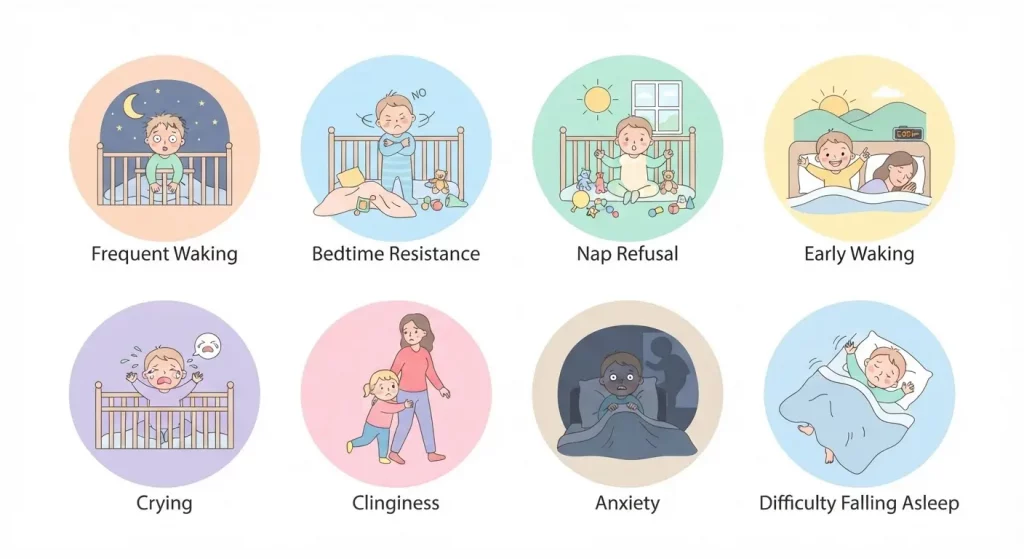
Signs of 2 year old sleep regression include bedtime resistance, frequent night waking, early morning waking, nap refusal, longer time to fall asleep, increased clinginess, crying after waking, and new bedtime anxiety, especially when several appear together in a toddler who was sleeping well before.
Recognizing the pattern is one thing. Understanding why it’s happening in the first place is what actually makes it easier to get through.
Why Is My 2 Year Old Not Sleeping All of a Sudden?
In most cases, it’s 2 year old sleep regression, a temporary disruption tied to a burst of brain development, growing independence, and emerging fears, not a sign that something is wrong with your child or your routine.
I remember frantically googling ear infections and growth spurts before I ever heard the phrase “2 year old sleep regression.” It felt too sudden to be developmental. But sudden is exactly how this regression tends to show up, often within days.
According to Sleep Foundation research, toddlers experiencing a sleep regression can suddenly wake up more in the night, resist bedtime, or begin fighting naps they previously took without issue. Nothing about your parenting broke overnight. Your toddler’s brain is just doing a lot of work right now.
2 year old sleep regression is caused by a combination of rapid brain development, separation anxiety, new nighttime fears, and nap changes, not by anything you did as a parent.
What Causes 2 Year Old Sleep Regression?
2 year old sleep regression rarely has one single cause. It’s usually a stack of developmental changes hitting at once, and understanding each one makes the bedtime battles feel a lot less personal.
- Brain development : Somewhere around this age, toddlers go through a major leap in language, memory, and independent thinking. That’s a lot of new wiring happening at once, and an active brain doesn’t power down for bedtime as easily as a quiet one does, which is a big part of why 2 year old sleep regression can hit even toddlers who were previously great sleepers.
- Separation anxiety : As toddlers become more aware of themselves as separate people from you, that awareness can resurface as a strong wave of wanting you nearby, especially the moment they wake up in a dark, quiet room and you’re not there.
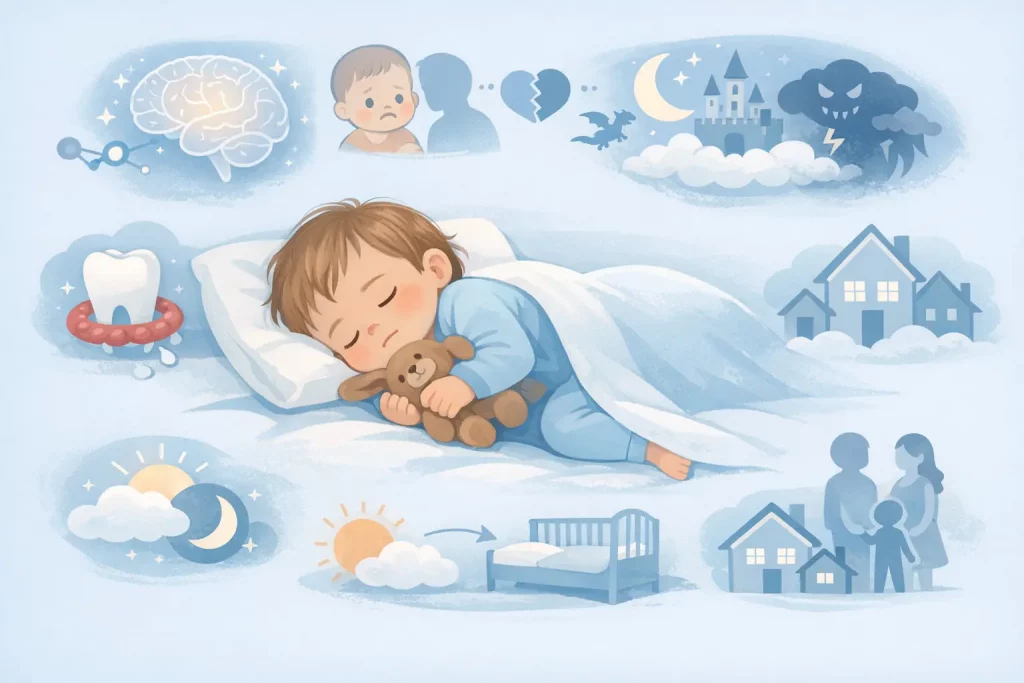
- New fears : Around age 2, imagination starts to outpace reasoning. That’s exactly the combination that produces a first real fear of the dark, of monsters, or of simply being alone, fears that weren’t there a few months ago because the imagination wasn’t there yet either.
- Imagination and nightmares : That same imaginative leap can also produce a 2-year-old’s very first real nightmares. Before this age, dreams tend to be too simple to feel frightening; now they’re vivid enough to jolt your toddler fully awake and crying.
- Nap transitions. Some toddlers start fighting or dropping the afternoon nap right around this age. Ironically, less daytime sleep usually makes nighttime sleep worse, not better, an overtired toddler’s body releases more stress hormones at bedtime, which can backfire into exactly the kind of resistance and waking you’re trying to fix.
- Major life changes. Potty training, a new sibling, moving to a big-kid bed, or starting daycare all ask a toddler’s nervous system to adjust to something new during the day and that adjustment often shows up at night, when there’s nothing left to distract from it.
Common Triggers That Can Make Sleep Regression Worse
These triggers won’t start a 2 year old sleep regression by themselves, but if your toddler is already going through one, any of these can intensify it and stretch it out longer than it needs to last:
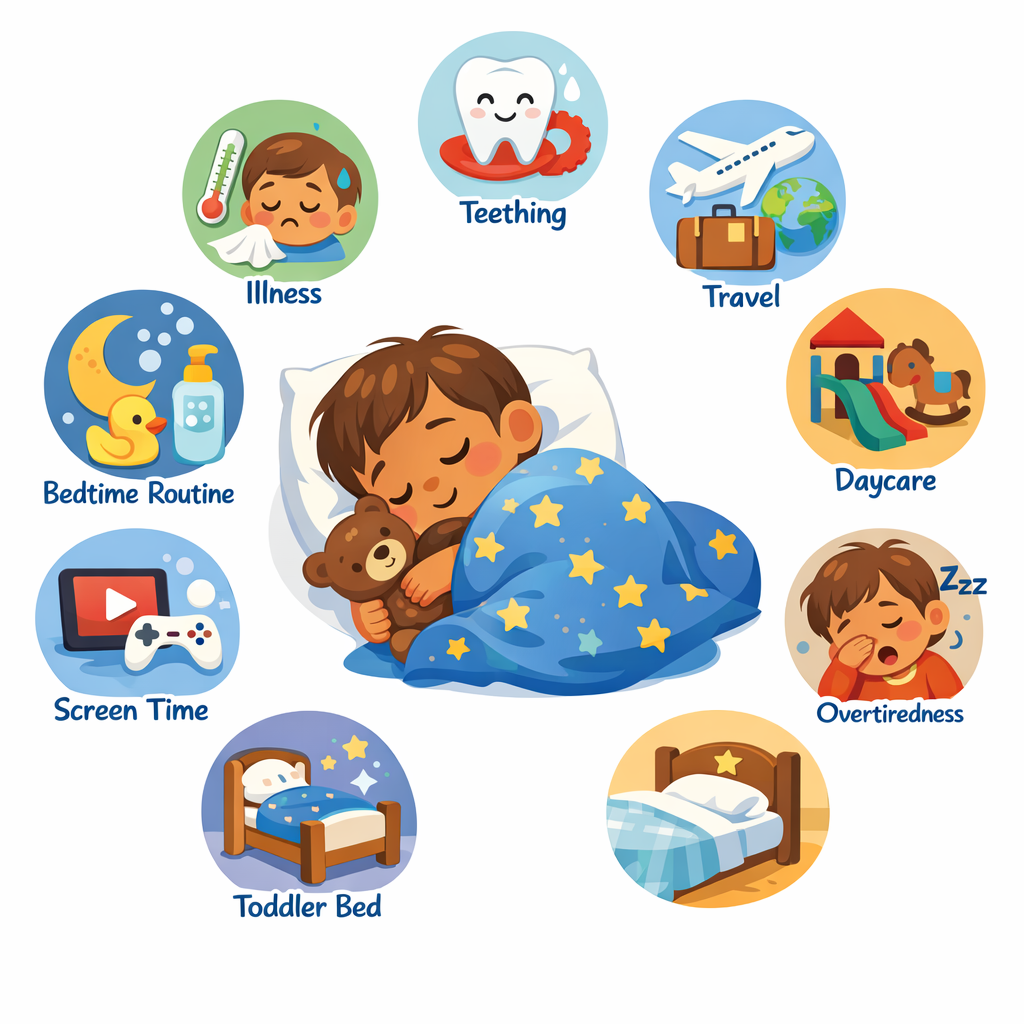
- Illness : even a mild cold disrupts sleep architecture and can make an existing regression feel like it’s getting worse, not better
- Teething : molars coming in around age 2 can add real discomfort on top of an already-disrupted sleep pattern
- Overtiredness : a missed or shortened nap compounds quickly; an overtired toddler fights sleep harder, not less
- Inconsistent bedtime : a routine that shifts by 30–60 minutes night to night makes it harder for your toddler’s body to know when sleep is coming
- Travel : new environments, time zones, and off-schedule days are a near-guaranteed short-term disruptor
- Moving to a toddler bed too early : the sudden freedom to get up can turn a manageable regression into a much bigger bedtime battle
- Daycare changes : a new room, teacher, or schedule at daycare often shows up at home before you connect the dots
- Screen time before bed : even calm shows can be stimulating enough to delay the wind-down toddlers need to fall asleep easily
None of these need to be eliminated forever. But if the regression is dragging on longer than expected, this list is usually the first place to look for what’s quietly making it worse.
My 2 Year Old Is Suddenly Waking at Night Crying : What’s Going On?
If your 2 year old suddenly waking at night crying is the exact problem keeping you up right now, here’s what’s most likely happening: your toddler is either experiencing a nightmare, waking mid-sleep-cycle and unable to resettle alone, or working through separation anxiety that peaks overnight.
A 2-year-old waking at night crying is rarely dangerous. It’s disorienting for them, and exhausting for you, but it’s a normal part of this developmental stage. The response that helps most: go in quickly, keep the room dark and your voice low, offer brief comfort, and avoid turning it into playtime or a new nightly habit that’s hard to undo later.
Featured Snippet: A 2 year old suddenly waking at night crying is usually nightmares, separation anxiety, or a mid-cycle wake-up they can’t yet resettle from alone, comfort them briefly, keep the lights low, and return them to bed calmly.
How Long Does 2 Year Old Sleep Regression Last?
| Question | Typical Answer |
|---|---|
| How long does it last? | Most cases resolve in 2–6 weeks |
| Does every toddler go through it? | No, some toddlers barely notice a change |
| Does it have a fixed start date? | No, it can appear any time between roughly 24–30 months |
| Will sleep training undo it? | No, but new sleep habits formed during the regression can stick if not addressed |
| When to call the pediatrician | If disrupted sleep continues past 4–6 weeks with no improvement |
2 year old sleep regression is frustrating precisely because it doesn’t come with a countdown. Some families see it resolve in ten days. Others are still in it a month later. Consistency during the regression is what shortens it — not waiting it out passively.
How Do You Fix 2 Year Old Sleep Regression?
Here’s the sequence that helps most families move through 2 year old sleep regression without starting sleep training over from scratch.
- Keep the bedtime routine exactly the same. Predictability is the single biggest lever you have during a regression, don’t overhaul the routine now.
- Rule out the obvious triggers first. Check for teething, illness, a too-late bedtime, or a recently dropped or shortened nap.
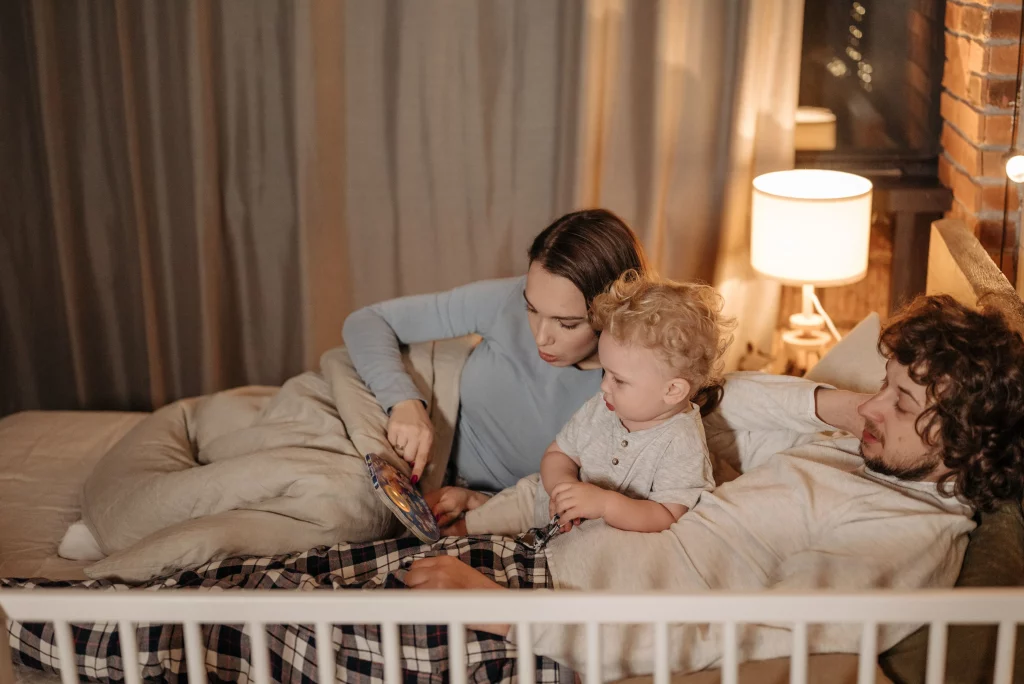
- Respond quickly but boringly. Go in, keep lights low and your voice calm, offer brief comfort, and leave before your toddler is fully asleep again.
- Add a nightlight if fear of the dark has shown up. This alone resolves a surprising number of new night wakings.
- Watch nap timing closely. An overtired 2-year-old fights bedtime harder, which can make 2 year old sleep regression look worse than it actually is.
- Avoid creating new sleep associations you’ll have to undo. Comfort in the room, not in your bed, if you want to protect the gains once the regression passes.
- Give it two to three weeks of consistency before changing course. Most 2 year old sleep regression resolves faster with patience than with a new strategy every few nights.
To fix 2 year old sleep regression, keep the existing bedtime routine intact, respond to wake-ups quickly but calmly, rule out teething or nap changes, and stay consistent for two to three weeks before trying anything new.
Nightmares vs. Night Terrors at Age 2: What’s the Difference?
Toddler sleep disruptions during 2 year old sleep regression often get lumped together, but nightmares and night terrors need different responses.
| Nightmares | Night Terrors | |
|---|---|---|
| When they happen | Second half of the night | First few hours after falling asleep |
| Is the child awake? | Yes, fully awake and scared | No, still asleep despite screaming/thrashing |
| Do they remember it? | Often, yes | No, rarely any memory |
| Best response | Comfort, reassure, stay until calm | Keep them safe, don’t try to wake them |
| How common at age 2 | Increasingly common as imagination grows | Less common before 18 months, more common toddler-to-preschool age |
The American Academy of Pediatrics notes that children may start having nightmares as young as 6 months of age, but they tend to peak between 3 and 12 years old, meaning your 2-year-old is likely just at the start of this stage. Night terrors, by contrast, tend to show up more often in toddlers and preschoolers and don’t require you to wake your child at all.
What Do Parents in Online Communities Say Helps Most?
The pattern across parenting communities around 2 year old sleep regression is consistent, and it lines up with the pediatric guidance:
- Routine, not new tricks, gets credit most often. Parents who kept bedtime exactly the same reported faster resolution than those who tried a new method every few nights.
- A nightlight is the most repeated small fix for toddlers whose 2 year old sleep regression is tied to a new fear of the dark.
- Parents consistently underestimate nap timing as a factor, several report that pulling the nap earlier in the day resolved bedtime battles that looked unrelated to napping at first.
The community consensus matches the clinical one: 2 year old sleep regression responds best to boring, predictable routines, not bigger interventions.
When Should You Worry About 2 Year Old Sleep Regression?
Most 2 year old sleep regression resolves on its own within a few weeks. A few signs mean it’s worth a conversation with your pediatrician instead of waiting it out:
- Disrupted sleep continues past 4–6 weeks with no improvement
- Loud snoring, gasping, or pauses in breathing during sleep
- Your toddler seems fearful or anxious well beyond bedtime, into the daytime
- Sleep disruption is paired with a loss of previously reached developmental milestones
- You’re noticing signs of separation anxiety spilling into daytime routines, which often overlaps with the emotional regulation challenges covered in our Toddler Tantrums guide
According to Sleep Foundation guidance, most sleep regressions do not last more than a few weeks, if sleeping problems continue for a month or more, it’s worth bringing up with your toddler’s pediatrician.
FAQ: 2 Year Old Sleep Regression
Why is my 2 year old not sleeping through the night anymore?
Most often it’s 2 year old sleep regression, driven by brain development, separation anxiety, or a new fear like the dark. It’s usually temporary and resolves within a few weeks with consistent routines.
How long does 2 year old sleep regression usually last?
Typically 2 to 6 weeks. If disrupted sleep continues well beyond that with no improvement, it’s worth a conversation with your pediatrician.
My 2 year old is suddenly waking at night crying, is that normal?
Yes. A 2 year old suddenly waking at night crying is commonly linked to nightmares, separation anxiety, or an inability to resettle mid-sleep-cycle, all of which are typical during this regression.
Should I start sleep training over during 2 year old sleep regression?
Usually not. Keeping the existing routine consistent tends to resolve the regression faster than overhauling your approach mid-stage.
Is 2 year old sleep regression the same as a nightmare phase?
Not exactly, nightmares are often one symptom of the regression, but the regression itself also includes bedtime resistance, nap changes, and separation anxiety beyond just bad dreams.
Before we wrap up, one more thing worth saying plainly: this phase is temporary, and you’re not the one causing it. Consistency matters far more than getting every single response perfect, a slightly imperfect routine you actually stick with will get your family through this faster than a flawless one you abandon after three hard nights. Most toddlers come out the other side of it back to healthy, predictable sleep, and most parents look back on it as a rough few weeks, not a lasting problem.
The Bottom Line on 2 Year Old Sleep Regression
2 year old sleep regression can feel like your toddler’s sleep broke overnight for no reason. It didn’t. It’s brain development, big feelings, and new fears, all landing at once, and it almost always passes with consistency, not a complete restart.
For more on the sleep foundations that make regressions easier to weather, our Ultimate Baby Sleep Guide covers the routines worth protecting through every regression, not just this one.