
Contents
Medical Disclaimer: This article is for informational purposes only and is not a substitute for professional medical advice, diagnosis, or treatment. Always consult your pediatrician before introducing a new sleep tool, especially regarding hearing safety.
White noise for baby sleep is probably the reason you’re up right now, phone in hand, trying to figure out if the machine you bought at 11 PM last night is actually helping or quietly making things worse. I get it. When my son was three weeks old, I ran our machine at almost full volume because I read somewhere that “louder masks more noise.” It took me an embarrassingly long time to realize I’d basically installed a small alarm clock six inches from his crib. Here’s the actual, AAP-backed answer on volume, type, and age not the vague “keep it low-ish” advice most sites give you.
White noise for baby sleep is safe when it stays at or below 50 decibels, about as loud as a gentle shower and sits at least 7 feet from the crib. This comes from American Academy of Pediatrics guidance following a 2014 study that found some infant sound machines exceeded 85 decibels at close range. Distance and volume matter far more than which “type” of white noise you pick.
What Is White Noise for Baby Sleep, Actually?
White noise for baby sleep means any steady, even sound used to mask household noise so your baby stays asleep classic static, a fan hum, or a “shhh” sound are all functionally white noise. It works by covering up the sharper, unpredictable sounds (a door, a sibling, a car alarm) that would otherwise pull your baby out of a light sleep cycle.
It’s not the same as pink or brown noise, though people use the terms loosely. True white noise for baby sleep spreads sound energy evenly across every frequency, which is why it sounds like static rather than a deep rumble. Pink noise carries more energy in the lower and middle range, so it sounds softer, and brown noise goes even deeper. For most families, the exact “color” of noise matters far less than getting the volume and placement right, which is where almost every safety concern actually comes from.
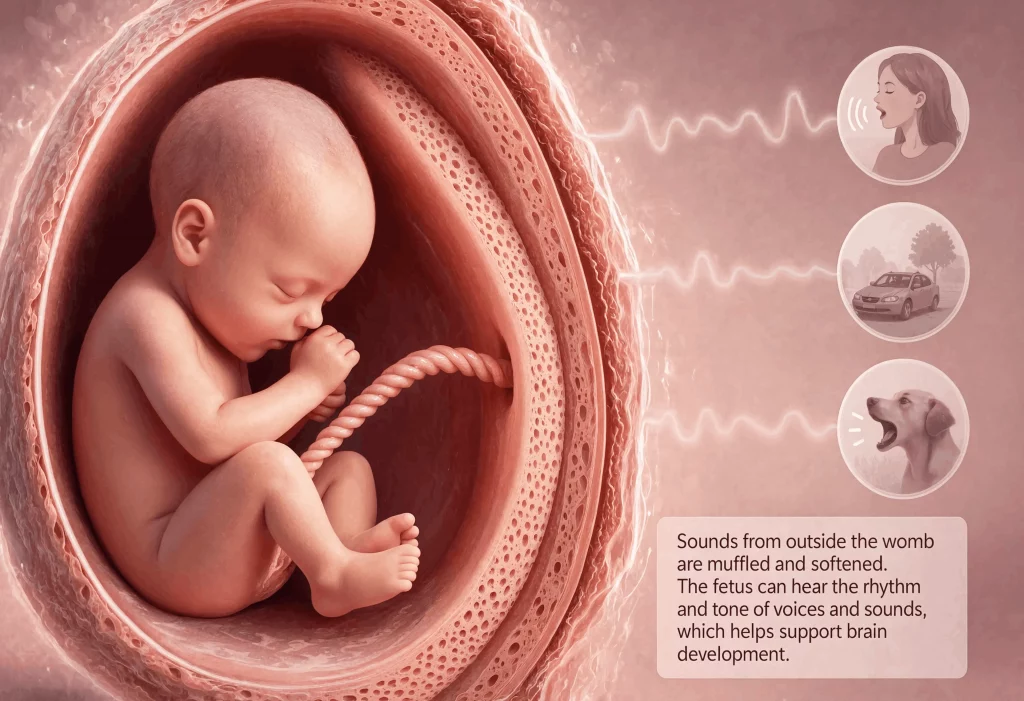
Part of why white noise works at all comes down to what your baby experienced before birth. The womb isn’t quiet, researchers who’ve measured intrauterine sound during labor put it at roughly 70 to 90 decibels, dominated by blood flow, digestion, and a mother’s heartbeat, with higher-pitched outside sounds filtered out by the abdominal wall. A newborn nursery that’s dead silent is actually the unfamiliar environment, not the noisy one.
Did You Know? Your baby spent roughly nine months hearing constant sound, an estimated 70 to 90 decibels of heartbeat, blood flow, and muffled maternal noise, with no “off” switch. That’s part of why steady sound so often calms a fussy newborn faster than silence does
With that context in mind, here’s the direct safety answer before we get into volume numbers and machine types.
Is It Safe White Noise For Baby Sleep ?
Yes, when it’s kept at or below 50 decibels and the machine sits at least 7 feet from the crib. The American Academy of Pediatrics has echoed this guidance following a 2014 study in the journal Pediatrics, which found that several infant sound machines exceeded 85 decibels when tested at maximum volume close to where a baby’s head would be. That’s loud enough that, by adult occupational noise standards, more than eight hours of exposure could pose a hearing risk over time.
The reassuring part: that study didn’t find white noise itself is harmful. It found that loud, close-range use is the risk — a combination that’s genuinely easy to avoid once you know the numbers. At the right volume and distance, white noise is considered safe for newborns and older babies alike.
Can Babies Sleep With White Noise All Night?
Yes. Running white noise for baby sleep continuously overnight is safe, within the same guidelines that apply to any use: at or below 50 decibels, at least 7 feet from the crib. AAP guidance sets no strict time limit on overnight use, volume and distance matter more than duration.
Some consultants suggest limiting use to the time it takes baby to fall asleep, then lowering the volume rather than shutting it off. In practice, most families run it all night with no issue, and there’s no evidence continuous, correctly-set white noise causes harm.
What matters more than “how long” is “how consistent.” A machine running all night at a steady, safe volume beats one perfectly calibrated for twenty minutes and then cut off, interruptions are usually what wakes a baby, not the duration itself.
The short version: white noise, pink noise, and brown noise are all built for staying asleep, while lullabies and heartbeat sounds are best for the few minutes right before sleep starts. Most families end up combining one from each category rather than picking a single “winner.”
What Volume White Noise Is Safe for Newborn Sleep?
White noise for baby sleep is considered safe when it remains at or below 50 decibels and is placed at least 7 feet from the crib. Pediatric experts recommend measuring sound at crib level rather than relying on machine settings alone.
What volume white noise for baby sleep comes down to that one number: 50 decibels or lower, measured at crib level, not at the machine itself. A machine set to 65 decibels three feet away might only read 50 decibels from seven feet away distance does real work, not just volume.
A useful fact worth knowing: every 3-decibel increase roughly doubles the sound intensity. So a machine reading 53 decibels at the crib isn’t “a little louder” than 50, it’s nearly twice as intense. That’s why a small twist of the volume dial matters more than it seems like it should.
The easiest way to check: download a free decibel meter app, place your phone where your newborn’s head will rest, and turn the machine up until it reads around 50. If you have to raise your voice to talk over it at the crib, it’s too loud, full stop.
If you’re wondering what 50 decibels actually sounds like, here’s a quick reference:
| Common Sound | Approximate Decibels |
|---|---|
| Whisper | 30 dB |
| Quiet Library | 40 dB |
| Gentle Shower | 50 dB |
| Dishwasher | 55 dB |
| Vacuum Cleaner | 70 dB |
| Hair Dryer | 80 dB |
That table is a handy gut-check: the safe target for white noise for baby sleep sits right around a gentle shower, nowhere close to a vacuum or hair dryer.
Best Type of White Noise for Baby Sleep by Age
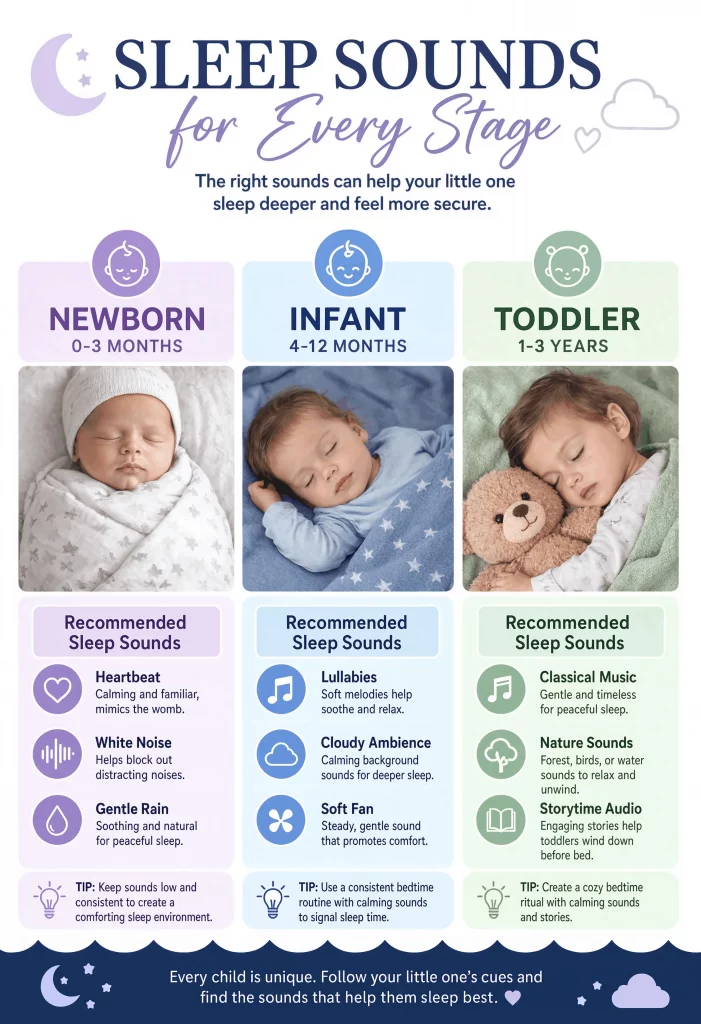
| Age | Best Sound | Why |
|---|---|---|
| Newborn (0–3 months) | Steady white noise or a heartbeat sound | Mimics the loud, constant environment of the womb |
| 3–6 months | Consistent white or brown noise, all night | Covers the frequent wake-ups of the 4-month regression |
| 6–12 months | White or pink noise, same track every night | Baby now associates a specific sound with sleep |
| Toddler (1–3 years) | White noise + a short bedtime song | Sound becomes one part of a bigger wind-down routine |
Across every age, the type of noise matters far less than consistency. A baby who’s used the same steady white noise track for months will often sleep worse on a “new and improved” sound than on the boring one they already know.
White Noise For Baby Sleep vs Brown Noise
White noise spreads sound energy evenly across every frequency, the classic static hiss, like an untuned TV channel. Brown noise concentrates far more energy in low frequencies, producing a deep, heavy rumble closer to a distant waterfall.
For newborns, brown noise often has a slight edge, since its muffled quality resembles the womb more closely. For light sleepers past the newborn stage, classic white noise sometimes masks a wider range of sharper sound better.
Parents who’ve tried both often report the same pattern: brown noise settles a newborn faster in the first few weeks, then white noise takes over once the 4-month regression hits. Neither has a dedicated infant safety study the way white noise for baby sleep does from the 2014 Pediatrics research, so the same 50-decibel, 7-foot rule applies to both. The honest conclusion: consistency matters more than which one wins on paper.
What Is the Safest Sound for Newborn Sleep?
Several options routinely come up as “safest” for newborn sleep, and most are safe when volume and placement are correct:
- White noise for baby sleep : The most studied option, with a direct 2014 safety study behind the volume and distance guidance.
- Heartbeat sounds : A close match to what your baby heard before birth, popular in the first few weeks.
- Pink noise : A softer, deeper alternative to classic white noise, good for light sleepers.
- Soft rain sounds : Pleasant and naturalistic, though cheaper apps sometimes loop with an audible click.
All four are safe at 50 decibels or below, placed at least 7 feet from the crib. White noise for baby sleep remains the most studied and practical option, since it has the clearest research trail across every age.
White Noise For Baby Sleep Machine Placement: The 7-Foot Rule
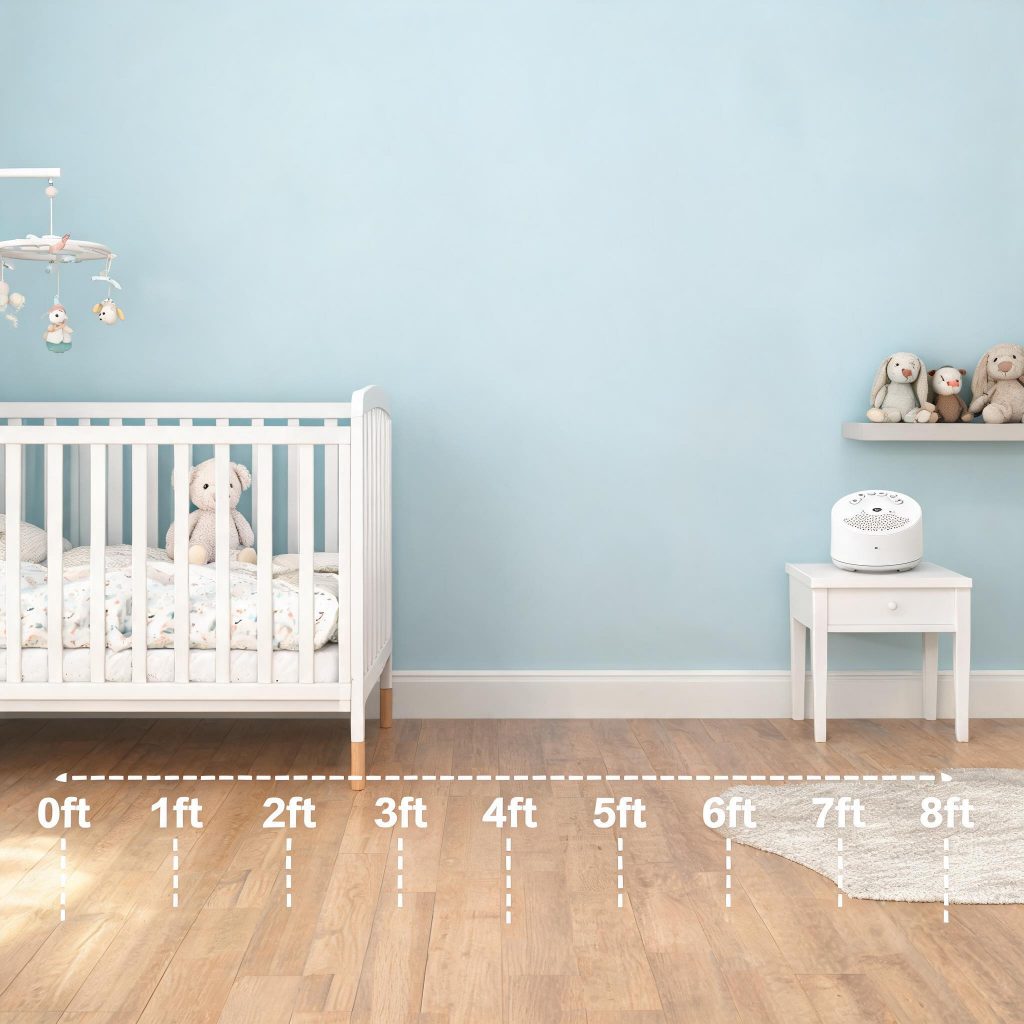
Placement is where most of the actual risk lives, not the sound itself. The American Academy of Pediatrics recommends keeping the machine at least 7 feet from your baby’s crib never clipped to the rail, never tucked inside the crib, never sitting on the same nightstand.
At 7 feet, sound intensity has dropped enough that even a machine running a bit hot on volume stays in a reasonably safe range. At 1–2 feet, the same machine can spike well past 85 decibels, which is exactly the scenario the 2014 Pediatrics study flagged as risky.
Quick placement checklist:
- At least 7 feet from the crib across the room, not the nightstand
- Not clipped to the crib rail or placed inside the crib
- Volume checked with a decibel app, not by ear
- Cords tucked away, out of reach
- Same placement used every night, including during travel
For more on setting up your baby’s whole sleep environment safely, not just the sound machine, our Newborn Environment Safety Guide covers crib setup, room temperature, and other safe sleep basics side by side
Do Babies Become Dependent on White Noise?
Not in a harmful sense. Needing white noise to fall asleep is a sleep association, the same category as a pacifier or a familiar bedtime song. Like most baby sleep associations, it only becomes frustrating if your baby wakes fully distressed every time the sound stops, rather than settling back down on their own.
Most toddlers gradually rely on it less as they get older, though there’s no strict deadline. If you’d rather wean off it, do it gradually: lower the volume slightly every few nights, or slowly increase the machine’s distance, over one to two weeks rather than stopping cold turkey.
How to Choose the Best White Noise for Baby Sleep
You don’t need the fanciest machine on the market, you need a few specific features:
- A true, unbroken loop. Cheap machines often use 20–30 second clips that repeat with an audible click, and that click becomes its own tiny wake-up trigger.
- Real low-volume options, not just “loud, louder, loudest.” Many infant machines simply don’t have a quiet-enough setting on their own, that’s part of why placement distance matters so much.
- A timer you can disable completely, so the sound can run all night instead of shutting off and waking your baby an hour later.
- Battery backup, so a power outage at 2 AM doesn’t mean starting from scratch.
- Portability, since travel is exactly when parents skip re-checking volume and distance, and exactly when it matters most.
What Sounds Are NOT Safe for Babies?
Not every “sleep sound” belongs in a nursery, even at a reasonable volume. A few sources come up again and again as ones to avoid:
- TV audio left on overnight : Volume swings between quiet dialogue and loud commercials, the opposite of the steady sound that actually helps babies sleep.
- Loud music of any kind : Even calming genres have shifting dynamics and melody, which can cause micro-arousals rather than deeper sleep.
- A phone placed beside the crib : Convenient in a pinch, but not built for continuous, close-range overnight use, and notifications can spike volume unexpectedly.
- YouTube playlists with ads : A sudden, loud ad mid-track can startle a sleeping baby awake without warning.
- A sound machine placed inside the crib : This puts the loudest possible volume right next to your baby’s head, undoing the entire point of the 7-foot rule.
- Devices clipped to the crib rail : Same issue proximity, not the sound itself, is what turns a safe machine into a risky one.
None of this means a nursery has to be silent, the source matters as much as the volume. A dedicated, steady sound machine placed correctly is always safer than a workaround within reach.
White Noise For Baby Sleep Safety Checklist
Here’s a shareable, save-for-later version of everything above, condensed into one list:
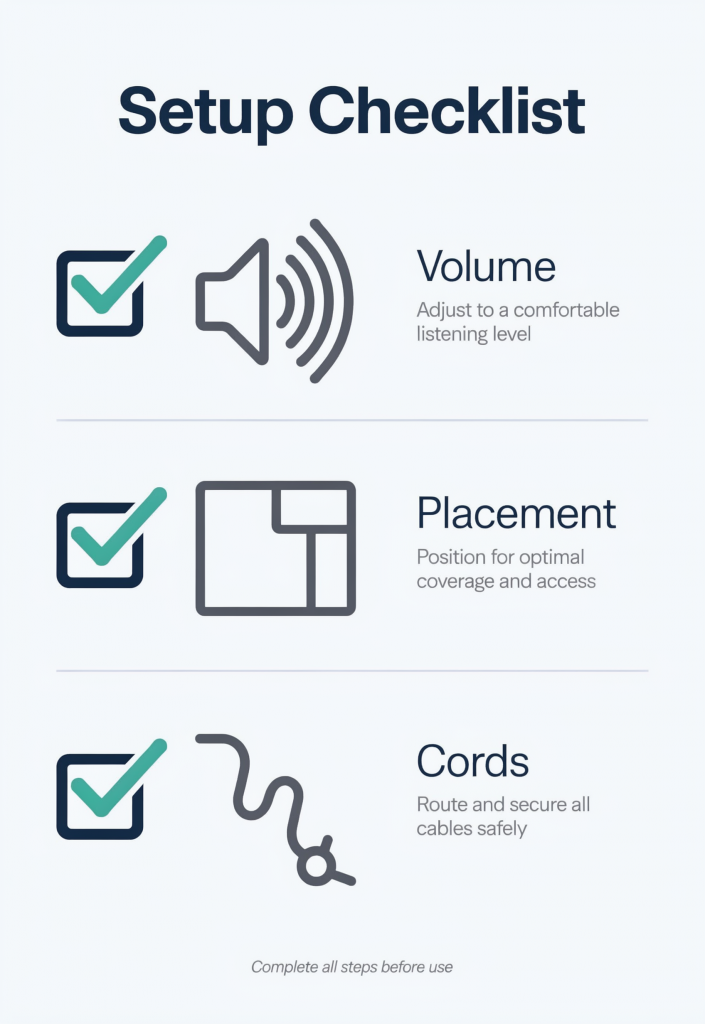
- Machine placed at least 7 feet from the crib
- Volume at or below 50 decibels, checked with a decibel app
- No cords anywhere near the crib or within baby’s reach
- The same sound used every single night
- No timer that shuts off before morning
- Volume rechecked roughly once a month, since machines can drift
- Settings rechecked after any travel or room change
Print this, screenshot it, or pin it it covers every safety point in this guide in under thirty seconds.
Why Isn’t White Noise For Baby Sleep Working?
If white noise for baby sleep doesn’t seem to be helping, the sound itself is rarely the real problem. A quick troubleshooting pass usually turns up one of these instead:
- Volume too high : An overly loud machine can be as stimulating as it is masking, especially for younger infants.
- Volume too low : If it’s not covering household noise at all, recheck with a decibel app rather than guessing by ear.
- Machine placed too close : Even a correctly-set volume can feel jarring right next to the crib instead of soothing from across the room.
- A timer cutting off mid-sleep : The sudden silence, not the earlier sound, is often what wakes your baby.
- An overtired baby : No sound machine fixes a bedtime happening too late; an earlier bedtime often solves what looks like a “sound problem.”
- A sleep regression : The 4-month, 8-month, and 18-month regressions all cause more frequent waking regardless of the sound environment.
- An inconsistent routine : Switching sounds or setups night to night undermines the very consistency that makes white noise effective.
Working through this list usually turns up the real culprit within a night or two most of the time, it’s not the white noise that failed, it’s one small variable around it.
Nothing is Wrong with you
If you’ve spent tonight worried that your white noise setup has been too loud or too close, take a breath. Almost every parent using a sound machine has made one of these mistakes at some point, the risky numbers from that 2014 study only showed up at maximum volume, inches from the crib. Move the machine across the room, turn the volume down until the app reads 50, and you’re already back in safe territory.
White noise for baby sleep works best when it’s boring, steady, and quiet enough that you could hold a normal conversation over it. Get the volume and distance right, and the rest which exact sound, which exact machine, matters far less than the marketing makes it seem.
For the full picture on sounds that help your baby sleep, our Baby Sleep Sounds Guide compares white noise against lullabies, pink noise, and brown noise side by side. And if you haven’t worked through the fundamentals yet, our Ultimate Baby Sleep Guide is the best place to start.
FAQ : Most Asked Questions
Is white noise safe for babies?
Yes, when it’s kept at or below 50 decibels and placed at least 7 feet from the crib, per AAP guidance. Risk only appears at high volume, close range, over many hours, a combination that’s easy to avoid.
What volume white noise is safe for newborn use?
50 decibels or lower, measured at crib level with a free decibel app, not by guessing from where the machine sits. Every 3 decibels above that roughly doubles the intensity.
How far should a white noise machine be from the crib?
At least 7 feet, according to the American Academy of Pediatrics. Never inside the crib or clipped to the rail, where the sound is loudest.
Does the type of white noise matter for baby sleep?
Less than volume and placement do. Steady, unchanging white or brown noise works well at any age; the biggest factor in success is using the same sound consistently, not finding a “perfect” one.