Why Won’t My Toddler Listen? 7 Hidden Reasons (By Age)
Why Won't My Toddler Listen? 7 Real Reasons (By Age)

- Why won’t my toddler listen?
- Quick Answer :
- Why Won’t My Toddler Listen? The Real Reason Their Brain Isn’t Complying
- Pediatric Perspective: What’s Actually Happening in Your Toddler’s Brain
- By-Age Quick Reference
- 18 Months: The “I Heard You, But My Body Didn’t Get the Memo” Stage
- 2 Years: The One-Instruction Rule
- 3 Years: Listening That Disappears Under Pressure
- 4 Years: Testing Limits on Purpose
- 5 Years: Reasoning Starts to Work
- How to Get a 2-Year-Old to Listen Without Yelling
- What Never Works (And Why)
- The Script That Actually Works
- The Toddler Listening Pyramid
- Common Triggers That Make Listening Even Harder
- What Parents on Reddit Actually Say
- What Changed in Our House
- When Toddler Not Listening May Need Professional Evaluation
- Useful Resources
- Frequently Asked Questions
- Why does my toddler ignore me?
- Is toddler not listening a sign of ADHD?
- Why does my toddler only listen to dad (or one parent)?
- At what age do toddlers start listening better?
- Bottom Line
Medical Disclaimer: This article is for informational and educational purposes only and is not a substitute for professional medical or behavioral advice. If you have concerns about your toddler’s development, hearing, or behavior, please consult your pediatrician.
Why won’t my toddler listen, even when I’ve asked the same thing four times in the last ten minutes? I used to think my son was ignoring me on purpose. He wasn’t. His brain simply wasn’t built yet to do what I was asking.
If you’ve said “put your shoes on” six times before breakfast and gotten nothing but a blank stare or a full meltdown, you are not doing anything wrong. You’re parenting a toddler whose brain is developing exactly on schedule, and that schedule does not include reliable listening skills yet.
It’s easy to spiral into worrying that you’re too permissive, too harsh, or somehow missing an obvious trick everyone else has figured out. Most parents land there eventually. The reassuring part is that the research on toddler brain development points somewhere much simpler than a parenting failure: this stage is hard for almost everyone, and the fixes that work are small, repeatable, and don’t require perfect execution every single time.
Why won’t my toddler listen?
A toddler who won’t listen usually isn’t defiant, their prefrontal cortex, the brain region that manages impulse control and multi-step instructions, doesn’t fully mature until well past age 4. Short, one-step requests said calmly at their eye level work far better than repeating or raising your voice.
A toddler not listening usually isn’t defiance. The part of the brain responsible for impulse control and following multi-step directions isn’t fully developed until well past age 4. Short, one-step instructions, said calmly and at their eye level, work far better than repeating yourself louder.
Quick Answer :
A toddler who ignores instructions usually isn’t being defiant. Between 18 months and 4 years, the prefrontal cortex, the part of the brain that manages impulse control and processing multi-step requests is still under construction. Shorter, single-step instructions delivered calmly get better results than repeated or louder ones.
Why Won’t My Toddler Listen? The Real Reason Their Brain Isn’t Complying
Adult “clearly” and toddler “clearly” are two very different things. In our home, I noticed the shift the moment I stopped explaining and started simplifying.
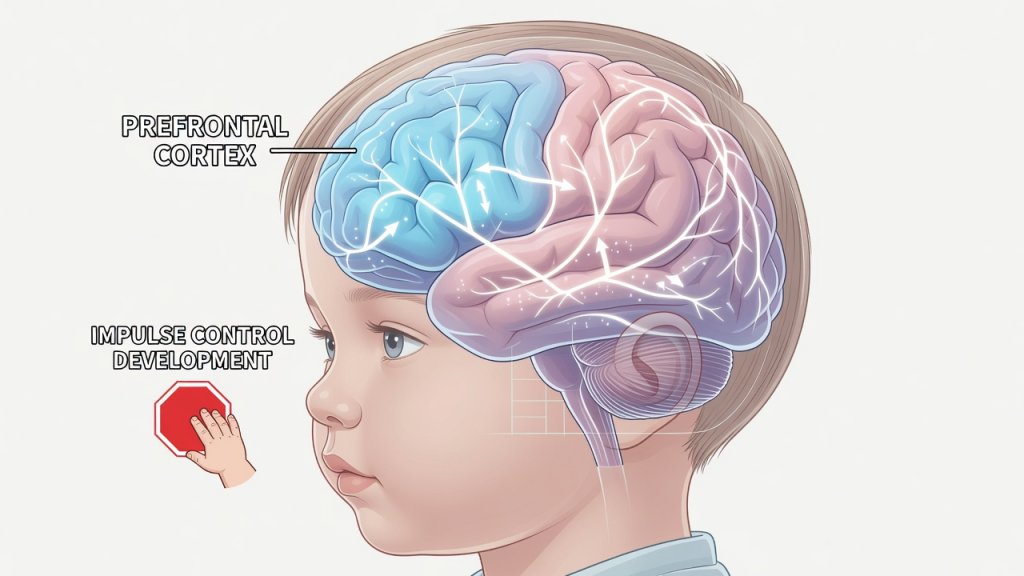
A toddler’s brain is doing an enormous amount of construction work between 18 months and age 4. The prefrontal cortex, which handles impulse control, working memory, and the ability to hold a multi-step instruction in mind, is one of the last regions of the brain to mature. According to the Centers for Disease Control and Prevention (CDC), toddlers between 1 and 3 years old are still developing basic self-control and the ability to follow simple directions, and this is a normal part of the “Learn the Signs. Act Early” developmental timeline.
That means when you say “go get your shoes, put them on, and grab your backpack,” a toddler’s brain may only register the last part of the sentence or none of it, if they were already mid-thought about something else. This isn’t a hearing problem. It’s a bandwidth problem.
Add in the fact that toddlers are wired to test boundaries as part of establishing independence, and you get the perfect storm parents call “not listening.” It’s really “not yet able to comply the way you’re asking.”
There’s also a sensory piece worth naming: a toddler mid-play, mid-tantrum, or mid-transition is often too overloaded to add “processing a new instruction” on top of everything else already happening in their nervous system.
“He’s not ignoring you. His brain just hasn’t finished building the part that lets him stop what he’s doing and switch tasks on command.”
Pediatric Perspective: What’s Actually Happening in Your Toddler’s Brain
Think of the prefrontal cortex as the brain’s control tower, the part that says “stop what you’re doing, hold this instruction in mind, and act on it.” In toddlers, that control tower is still under construction, and it stays under construction longer than most parents expect.
Typical age expectations, in plain terms:
- At 18 months, a toddler can recognize familiar words but has almost no ability to interrupt an activity on command.
- By 2, most toddlers can follow one clear instruction, but stacking two or three collapses the request entirely.
- By 3–4, two-step instructions become possible when the child is calm, well-fed, and rested but regulation, not
comprehension, is usually the limiting factor.
When it’s worth a developmental evaluation: Occasional not-listening is expected at every one of these ages. It becomes worth mentioning to your pediatrician if a toddler consistently doesn’t respond to their name by 12 months, shows no meaningful language by 18–24 months, loses previously-used words or skills, or seems unaware even when you’re directly in front of them and speaking clearly. None of these are common, everyday “not listening”, they’re a different category, and a pediatrician can screen for hearing or developmental concerns quickly and without alarm.
By-Age Quick Reference
| Age | Expected Listening Skills | Normal Behavior | Best Parenting Response |
|---|---|---|---|
| 18 Months | Recognizes familiar words; almost no impulse control | Ignoring “no,” bolting mid-instruction, needing physical guidance | Guide their body through the action instead of repeating words |
| 2 Years | Can follow one clear, single-step instruction | Multi-step requests collapse into nothing; “no” is a default answer | One instruction, said once, then wait |
| 3 Years | Can follow two connected steps when calm | Skill vanishes instantly when tired, hungry, or overstimulated | Check regulation first, instruction second |
| 4 Years | Can follow multi-step instructions | Deliberate limit-testing on top of the developmental gap | Offer two acceptable choices instead of an open command |
| 5 Years | Can generally follow instructions consistently when regulated | Occasional pushback is about autonomy, not comprehension | Involve them in the “why,” briefly, since reasoning capacity is growing |
18 Months: The “I Heard You, But My Body Didn’t Get the Memo” Stage
At 18 months, your toddler genuinely understands more words than she can act on. I remember my daughter nodding along to “let’s put your coat on” and then bolting the other direction, not because she was defying me, but because her legs and her brain weren’t yet coordinated with her comprehension. Physically guiding her through the motion worked far better than repeating the request.
2 Years: The One-Instruction Rule
Two-year-olds hit a wall the second you stack more than one direction together. Zero to Three notes that toddlers at this age are still building the working memory needed to hold multiple steps in mind, which is why long strings of instructions often result in only the first or last word being processed. Say one thing. Wait. Then say the next thing.
This is also the age where toddler not listening peaks for most families, simply because the gap between comprehension and impulse control is at its widest.
3 Years: Listening That Disappears Under Pressure
By age 3, most toddlers can follow two connected steps, but only when they’re regulated. The moment excitement, hunger, or overtiredness kicks in, that skill vanishes temporarily. This is developmental, not manipulative. A 3-year-old melting down at the exact moment you need them to listen most isn’t testing you; their nervous system is simply overloaded.
4 Years: Testing Limits on Purpose
Four-year-olds are the first age group where you’ll see genuine, intentional boundary-testing layered on top of the developmental listening gap. They understand the instruction. Sometimes they’re checking whether the rule still applies. Offering two acceptable choices (“shoes on now, or after you grab your jacket?”) gives them the control they’re seeking without losing the instruction itself.
5 Years: Reasoning Starts to Work
By 5, most children can hold a short explanation alongside an instruction without losing the instruction itself — a real shift from the toddler years. Pushback at this age is more often about wanting a say in the decision than about an inability to process what was asked.
How to Get a 2-Year-Old to Listen Without Yelling
How do you get a 2 year old to listen without yelling? Get physically close, deliver one instruction in a calm, flat tone, then wait a full five seconds before repeating anything. Toddlers respond to proximity and simplicity, not volume raising your voice adds stress, which makes listening harder, not easier.
Yelling rarely works because it activates a toddler’s stress response instead of their listening centers, and a stressed brain processes even less language than a calm one. If you’re searching for how to get a 2 year old to listen without yelling, the fix is less about tone and more about structure.
Start by lowering the number of words, not raising the volume. A calm “shoes on” lands better than an urgent three-sentence explanation of why you’re running late. Get down to their eye level first toddlers, especially 2-year-olds, need to physically orient toward you before their brain treats a sentence as something to act on rather than background noise.
Then build in a pause. Toddlers need real processing time, often several seconds longer than we instinctively allow before repeating ourselves. Jumping in with a second, louder version of the same request before the first one has landed just restarts the whole process from zero.

At the grocery store, this looks like crouching down next to the cart instead of calling out “stop touching that” from three feet away. At bedtime, it looks like walking over and saying “book or lights off first?” instead of a running list of five things they still need to do.
What Never Works (And Why)
Toddler not listening tends to get worse, not better, when parents reach for these common responses under pressure.
- Repeating the request louder each time : The brain doesn’t hear “louder” it registers “danger” and shuts down processing further.
- Long explanations of “why” : A toddler’s working memory can’t hold the reasoning and the instruction at the same time.
- Yelling from another room : No eye contact means no attention capture; toddlers need to physically orient toward you first.
- Multiple stacked instructions : Brush your teeth, get your pajamas, and pick a book” collapses into nothing.
- Bribing after every single request : This teaches negotiation as the default response to any instruction, not compliance.
- Threats you won’t follow through on : Toddlers test consistency, and an empty threat teaches them your words don’t mean anything.
The Script That Actually Works
Try replacing multi-step, distant requests with this simple four-part script, said at eye level.
- Get physically close : Walk over, get down to their eye level, and make sure you have their attention before speaking.
- Say one instruction, once :”Shoes on now.” Not a paragraph, one clear phrase.
- Wait five full seconds : Toddlers need processing time. Resist the urge to repeat immediately.
- Follow through calmly : If nothing happens, help their body do it: guide their hand to the shoe, narrate what’s happening, and stay matter-of-fact.
In our home, this script cut the daily battles over transitions down significantly within about a week. It’s not instant, and there are still hard mornings, but the pattern shifted from constant negotiation to something closer to cooperation.
The Toddler Listening Pyramid
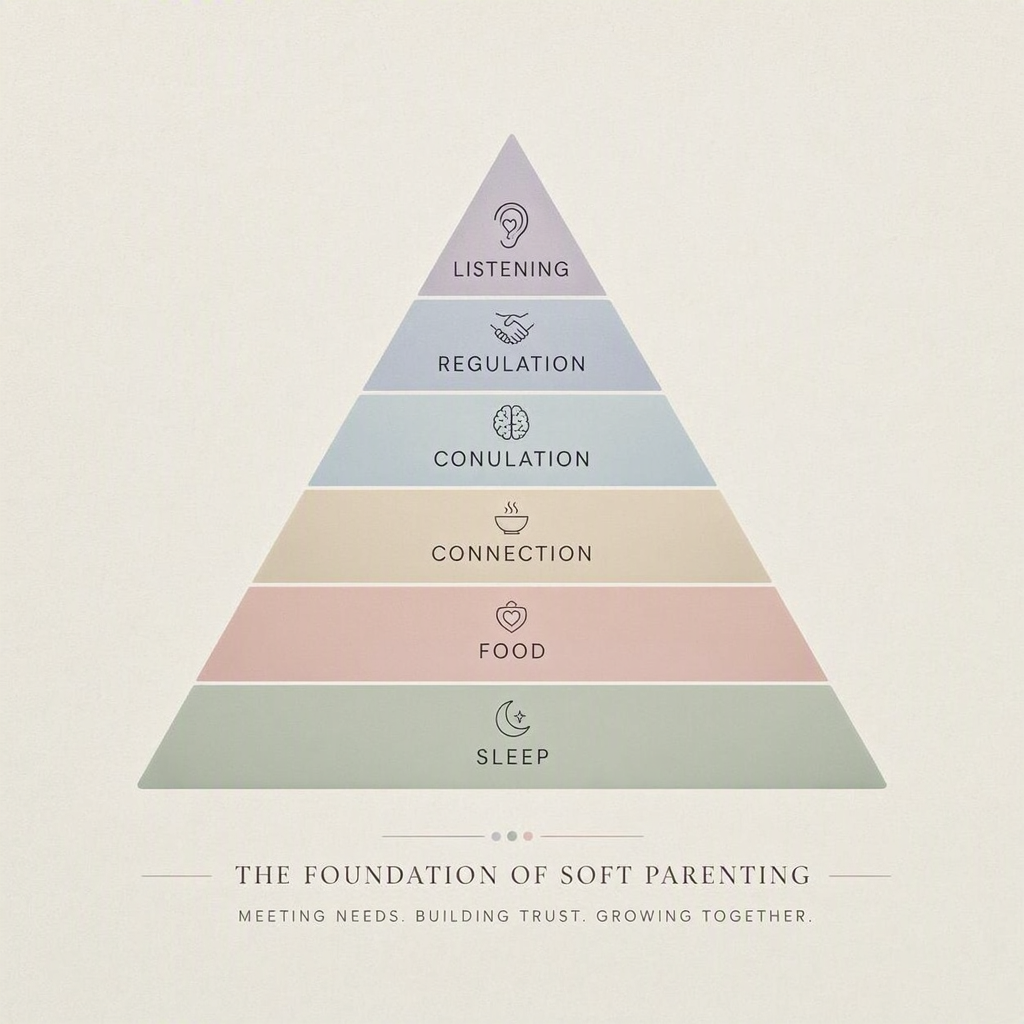
Here’s a concept I wish someone had explained to me earlier: listening sits at the top of a stack of more basic needs, not on its own.
- Level 1 – Sleep : An overtired toddler has almost nothing left for impulse control.
- Level 2 – Food : A hungry toddler’s brain prioritizes food-seeking over cooperation, every time.
- Level 3 – Connection : A toddler who hasn’t had a few minutes of real, undistracted attention from you is less likely to comply with anything.
- Level 4 – Regulation : A dysregulated nervous system from big emotions, transitions, or overstimulation, can’t access impulse control, even briefly.
- Level 5 – Listening : This is the top of the stack, and it’s the last thing available, not the first.
A toddler can’t reach Level 5, if Levels 1–4 are unmet. In practice, this means that when a request isn’t landing, the fastest fix often isn’t a better script, it’s checking whether your toddler is tired, hungry, disconnected, or overwhelmed first. Nine times out of ten in our house, the “not listening” moment traces back to one of the first four levels, not a failure of the request itself.
I think of it now almost like a checklist I run silently before I repeat myself: has he eaten in the last two hours? Did he sleep enough last night? Have we had five real minutes of undistracted attention today? Is something big happening emotionally that I haven’t named out loud yet? More often than not, the answer to one of those questions explains the moment better than any script ever could.
Common Triggers That Make Listening Even Harder
Some days the script above works like a charm. Other days, nothing lands, and it’s rarely random. A few triggers reliably make listening harder for toddlers, regardless of age:
- Hunger : A toddler running low on blood sugar has less capacity for anything beyond the immediate demand for food. Address the hunger first; the instruction can wait ninety seconds.
- Overtiredness : Missed naps and late bedtimes shrink the window for impulse control dramatically. The “witching hour” before bed is often the worst possible time to introduce a new request.
- Transitions : Moving from one activity to another screen off, out the door, into the bath is consistently the hardest moment for toddlers to comply, because it requires letting go of something they were already engaged in.
- Illness or teething : Parents in online communities consistently report a temporary dip in listening during sickness or teething, which tracks with a nervous system that’s already working overtime.
- A change in caregiver or routine. New sitters, travel, or a shifted schedule all add cognitive load that eats into the same limited bandwidth toddlers use for following instructions.
Naming the trigger out loud even just to yourself, often changes how you respond. A toddler who’s ignoring you because he’s overtired needs a different response than one who’s testing a boundary on purpose.
What Parents on Reddit Actually Say
Scrolling through threads on r/Parenting and r/toddlers, one theme comes up over and over: parents who switched from long explanations to one-word or one-phrase instructions saw the fastest change. Several parents specifically mentioned that getting down to eye level before speaking, rather than calling out from across the room made the biggest single difference.
Others pointed out that consistency mattered more than the specific method: whatever the instruction was, following through the same way every time built trust faster than any clever phrasing. A few parents also noted that their toddler’s listening got noticeably worse during illness, teething, or right before a nap, which lines up with the idea that listening is closely tied to how regulated the nervous system is at any given moment, not a fixed skill the child either has or doesn’t.
The community consensus lines up closely with what pediatric guidance already says: toddlers respond to proximity, simplicity, and consistency far more than volume or repetition.
What Changed in Our House
Before: Mornings meant six requests before anything happened. “Get your shoes” Nothing. “Get your shoes, please” Nothing. By the fourth repeat, my voice was sharp, my toddler was in tears, and neither of us knew why the morning had fallen apart over a pair of shoes.
After: I walk over. I crouch down. I say “shoes on now” once. I wait five full seconds, counting in my head if I have to. Sometimes he needs the exact same sentence repeated once, calmly. Sometimes I have to physically hand him the shoe and start the motion with him. It’s not magic, and some mornings still fall apart. But the baseline shifted from a power struggle to something closer to a routine, because the request finally matched what his brain could actually do with it.
The biggest mindset shift for me wasn’t a new phrase, it was accepting that the goal isn’t to make my toddler listen the first time, every time. The goal is to lower the number of repetitions it takes and remove the yelling from the equation, because yelling was never actually getting us there faster anyway.
When Toddler Not Listening May Need Professional Evaluation
Most listening struggles described in this article are developmentally typical and resolve with time and the strategies above. According to the American Academy of Pediatrics (HealthyChildren.org), parents should discuss a toddler’s behavior with their pediatrician if a child consistently doesn’t respond to their name, seems unaware when spoken to directly even up close, or shows a sudden regression in previously-followed instructions.
A short conversation with your pediatrician is worth having if you notice several of these together, rather than just one on an off day:
- Doesn’t respond to their name by around 12 months.
- Noticeable speech delay for their age.
- Any suspected hearing concern, even mild.
- Regression losing words, skills, or instructions they used to follow.
- Severe or escalating aggression that doesn’t respond to typical strategies.
- Little to no eye contact during everyday interactions.
- Extreme reactions to sound, texture, or light that go beyond typical sensory pickiness.
None of these on their own mean something is wrong, plenty of typically-developing toddlers show one occasionally. It’s the pattern and persistence that matters, and a pediatrician can screen for hearing and developmental concerns quickly.
Useful Resources
- If meltdowns around not listening feel extreme or constant, our guide on toddler tantrums breaks down age-specific de-escalation strategies that pair well with the script above.
- If the bigger picture of your toddler’s emotional swings feels overwhelming, emotional regulation in children covers how listening struggles and emotional meltdowns are often the same underlying issue wearing two different faces.
- If speech seems behind alongside the listening struggles, it’s worth a look at the signs of toddler speech delay as a separate, specific check.
- And if you notice your own patience wearing thin faster than it used to, nervous system regulation for parents covers the other half of this equation, because a dysregulated parent and a dysregulated toddler tend to escalate each other.
- For the full picture of toddler behavior across ages : tantrums, listening, emotional regulation, and more, see our Complete Toddler Behavior Guide
Frequently Asked Questions
Why does my toddler ignore me?
Most of the time, it’s not intentional ignoring, it’s a brain that’s still building the impulse-control skills needed to interrupt an activity and switch tasks on command, especially before age 3.
Is toddler not listening a sign of ADHD?
Not by itself. Occasional not-listening is typical toddler development. It’s worth raising with your pediatrician only alongside other signs, like extreme impulsivity across every setting, or a level of inattention well beyond same-age peers, not as a standalone concern.
Why does my toddler only listen to dad (or one parent)?
This is usually about tone, pacing, or timing differences between caregivers, not favoritism. A parent who happens to speak in shorter sentences, get to eye level more often, or catch calmer moments will often see more compliance, it’s a pattern you can adopt, not a fixed preference.
At what age do toddlers start listening better?
Most parents notice a real shift between ages 3 and 4, as two-step instructions become more reliable, with another jump around 5 as reasoning ability grows. It’s a gradual curve, not a switch that flips overnight.
Bottom Line
If you take one thing from this article, let it be this: why won’t my toddler listen has almost nothing to do with how good a parent you are, and almost everything to do with a brain that’s still under construction. The prefrontal cortex isn’t finished by 2, or 3, or sometimes even 4, and every “failed” instruction is really just evidence of a skill still being built, not a discipline problem to solve harder.
The script that works close, calm, one instruction, five seconds, follow-through, isn’t a trick. It’s just working with the brain your toddler actually has right now instead of the one you wish they had. Some mornings will still fall apart. That’s not failure; that’s toddlerhood.
You’re not raising a child who won’t listen. You’re raising a child whose brain is still learning how.