Why Your Baby Won’t Sleep Unless Held? 7 Proven Ways to Fix It (Updated 2026)
"My Baby Won't Sleep Without Being Held": Gently Breaking the Contact Nap
- You Haven’t Done Anything Wrong
- What to Do Right Now at 2AM (Quick Reset)
- Wait for deep sleep
- Lower them slowly, feet first
- Keep your hands on their chest
- If they stir, don’t panic
- Repeat 2–3 times if needed
- Why Your Baby Won’t Sleep Unless Held (Quick Answer)
- A Realistic Timeline (So You Know What to Expect)
- Why Babies Wake Up the Second You Put Them Down
- The 3-Step System to Stop Contact-Only Sleep
- Step 1: Recreate the feeling of being held
- Step 2: Master the transfer
- Step 3: Reduce dependency gradually
- The Science Behind Why Your Baby Feels Safest in Your Arms
- The Fourth Trimester: Why Your Baby Feels Like a “Biological Extension” of You
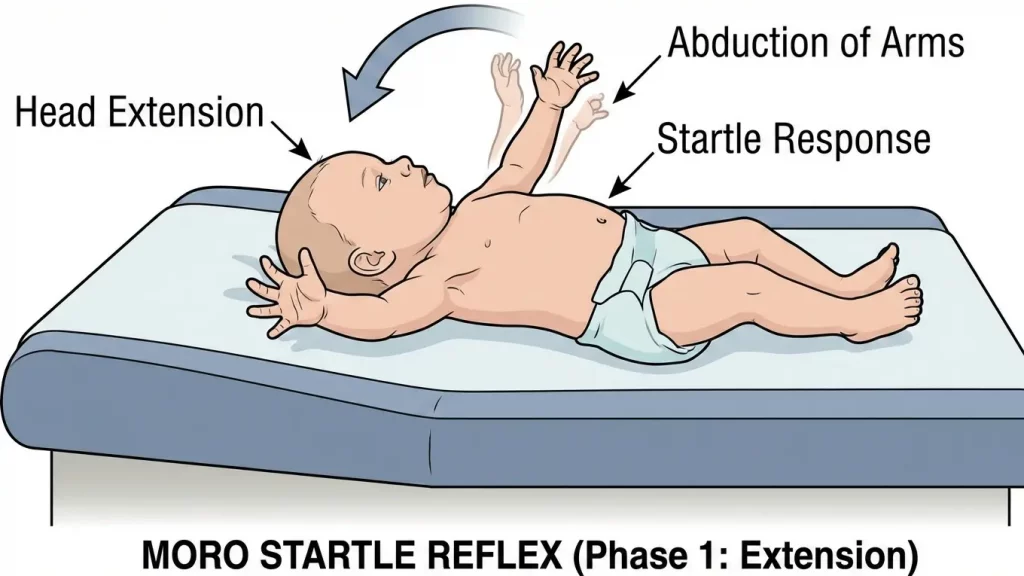
- The Moro Reflex: The “Falling” Alarm
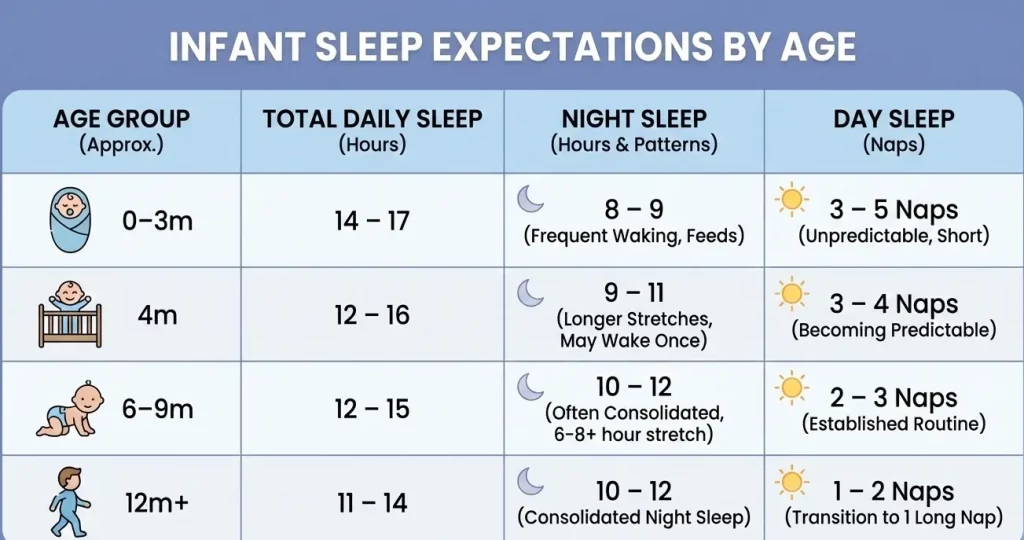
- What to Do Based on Your Baby’s Age
- Why Your Newborn or 3-Week-Old Won’t Sleep Unless Held
- The Foundation: 7 Steps to a Safe Sleep Environment
- 7 Proven Methods to Stop Contact-Only Sleep
- Method 1: The Gradual Fade (Best for Parents Who Want to Avoid Crying It Out)
- Method 2: Pick Up / Put Down (Best for 6+ Months)
- Method 3: The Contact-to-Carrier Bridge (Best for Parents Who Are Truly Exhausted)
- Method 4: The Swaddle + White Noise Combination (Best for Under 4 Months)
- Method 5: The Warmed Mattress Trick
- Method 6: Drowsy-But-Awake Practice (The Long Game)
- Method 7: The Shush-Pat (Best for Overtired Babies Who Are Already Crying)
- Why Your Baby Still Won’t Sleep Unless Held (Even After Trying Everything)
- Frequently Asked Questions About Why Your Baby Won’t Sleep Unless Held
- Is it normal that my baby won’t sleep unless held even when they are exhausted?
- At what age should I worry if my baby won’t sleep unless held?
- Can a baby won’t sleep unless held situation lead to permanent bad habits?
- What should I do if my baby won’t sleep unless held and screams the moment I lay them down?
- Is it safe to co-sleep if my baby won’t sleep unless held?
- Final Thoughts: Progress Over Perfection
You just spent 47 minutes rocking, bouncing, shushing, swaying, and your baby finally, finally drifted off. You held your breath. You made the slow-motion transfer toward the crib like you were defusing a bomb. And the second their back touched the mattress? Eyes wide open. Screaming. Baby won’t sleep unless held is a big issue nowadays.
If that’s you right now reading this at 2AM with one hand on a baby and one eye half-shut, you are not alone. Not even close.
This is called contact napping, sometimes called “velcro baby” syndrome. And it is, without a doubt, one of the most exhausting things a new parent can experience. Not because it’s dangerous. Not because you did something wrong. But because the relentlessness of it grinds you down in ways you can’t fully explain to someone who hasn’t lived it.
The need for physical closeness is a biological imperative. However, for the sake of your mental health and physical safety, transitioning to independent sleep is often necessary. This guide provides a comprehensive roadmap to help you navigate this transition while maintaining a secure attachment. To start on the right foot, make sure you have read our Environment for Your Newborn: Complete Safety Guide & Checklist (2026) to ensure the nursery itself isn’t the problem.
You Haven’t Done Anything Wrong
This is where so many parents spiral, the guilt. “Did I hold them too much? Did I create this habit? Am I spoiling them?”
No. You didn’t. Your baby isn’t manipulating you. They aren’t “bad at sleeping.” They are a tiny human being who just spent nine months in a warm, tight, constantly-moving environment, and now they’re out here in a big, cold, still world. Your arms feel like home because, biologically, they are.
The goal of this guide is to help you transition away from contact-only sleep gradually, safely, and without losing your mind, or your connection with your baby. To make sure the sleep environment itself isn’t working against you, it’s also worth checking a complete nursery safety guide before you start any method.
What to Do Right Now at 2AM (Quick Reset)
If you need help tonight, try this before reading anything else:
-
Wait for deep sleep
Don’t transfer too early. Do the floppy arm test: lift your baby’s arm gently and let it go. If it drops like a dead weight, they’re in deep sleep. If they pull it back, give it another 5–10 minutes.
-
Lower them slowly, feet first
Touch their feet to the mattress, then their bottom, then their back, then their head last. This gradual contact helps their nervous system register “I’m still safe.”
-
Keep your hands on their chest
Don’t pull away immediately. Hold gentle, firm pressure on their chest and belly for 20–30 seconds.
-
If they stir, don’t panic
Apply gentle pressure and start shushing, a low, steady “shhhh” sound right near their ear. Match the rhythm of their breathing.
-
Repeat 2–3 times if needed
Most babies will settle within a few attempts. If it takes more than three, they may not be in deep enough sleep yet. Go back to holding.
Why Your Baby Won’t Sleep Unless Held (Quick Answer)
A baby who won’t sleep unless held is seeking three specific things from you :
- Warmth : your body regulates their temperature in a way a crib simply can’t
- Safety signals : your heartbeat, scent, and movement tell their brain “no threat present”
- A known sleep association : if they always fall asleep in your arms, the crib feels wrong, not just unfamiliar
This is completely normal under 6 months. After 4–6 months, it can shift from a biological need into a learned habit, which is when more structured approaches become helpful.
A Realistic Timeline (So You Know What to Expect)
Here’s what most parents actually experience when they start working on this. Nobody tells you this part upfront, but you deserve to know:
- Day 1: Expect resistance. There may be crying. There will definitely be moments where you question everything. That’s normal.
- Days 2–3: You’ll usually see the first signs of improvement. Not perfection, just small cracks of progress.
- Week 1: A noticeable shift. Transfers get easier. Resettling gets faster.
- Week 2: Real, consistent independent sleep starts to emerge.
Medical Disclaimer: This article is for informational and educational purposes only and is not a substitute for medical advice. Every baby is different. Always consult your pediatrician before making sleep changes, especially if your baby has reflux, GERD, ear infections, or any other underlying health condition.
Why Babies Wake Up the Second You Put Them Down
This is the real problem,not falling asleep, but staying asleep during the transfer. Here’s what’s actually happening:
Temperature shock : Your chest is warm. The crib mattress is not. That sudden change in surface temperature can be enough to jolt a light sleeper awake. This is more of a factor than most parents realize.
Loss of the container : In your arms, your baby is slightly curved, held on all sides, touching something. In the crib, they’re flat and open and touching nothing. To their nervous system, that shift registers almost like falling.
The Moro reflex : Also called the startle reflex, when babies feel unsupported, their arms fling outward and their heart rate spikes. It’s a primitive survival response that wakes them immediately. This is especially strong in newborns.
Positional change : Going from slightly upright (on your chest) to flat (in the crib) changes how their airway feels and how gravity pulls on their body. Babies with even mild reflux feel this most.
Fix the transfer, and you fix the problem.
The 3-Step System to Stop Contact-Only Sleep
Step 1: Recreate the feeling of being held
- Swaddle
- White noise
- Warm environment
Step 2: Master the transfer
- Deep sleep only
- Slow lowering technique
Step 3: Reduce dependency gradually
- Hands-on soothing
- Then presence only
- Then independent sleep
The Science Behind Why Your Baby Feels Safest in Your Arms
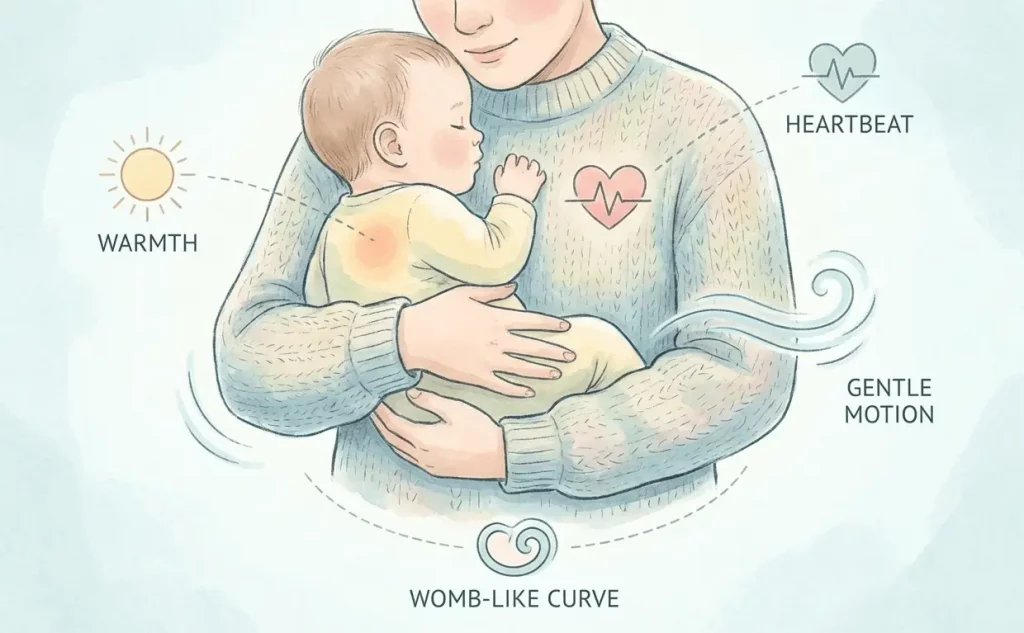
This part is worth understanding, because it changes how you feel about the situation. Once you understand the biology, you stop feeling manipulated and start feeling like the brilliant co-regulator you actually are.
The Fourth Trimester: Why Your Baby Feels Like a “Biological Extension” of You
Human babies are born uniquely underdeveloped compared to other mammals. A foal can walk within hours of birth. A baby? They can’t even hold their own head up for months.
From birth to about 4 months, babies are essentially in a “fourth trimester”, a continuation of the developmental period that would have happened in the womb if we gestated any longer. During this time, your body is their environment. When you hold your baby, three specific things happen:
- Thermoregulation: Infants cannot stabilize their own body temperature yet. Your skin does it for them. This isn’t a preference, it’s a physiological need.
- Cardiac & Respiratory Syncing: This is genuinely remarkable: when held skin-to-skin, your baby’s heart rate and breathing physically synchronize with yours. This triggers an oxytocin release and actively reduces their cortisol (stress hormone) levels. You are, in a measurable biological sense, calming their nervous system just by holding them.
- Vestibular Comfort: The slight, constant swaying motion when you breathe, walk, and move mirrors the motion of amniotic fluid. For a newborn, stillness doesn’t feel like rest, it feels like a warning.
Your baby isn’t manipulating you; they are following survival instincts that have kept human infants alive for millennia. If you find yourself feeling overwhelmed by these demands, it is vital to practice Nervous System Regulation for Parents: 5 Ways to Stop Rage to keep your cool.
The Moro Reflex: The “Falling” Alarm
The Moro Reflex is a primitive survival response. To a newborn, laying flat on a firm mattress feels like falling through space.
Without the physical “boundary” of your arms or a snug chest, their nervous system triggers a startle: their arms jerk out, their heart rate spikes, and they wake up screaming. Your body isn’t just a bed, it’s a biological container that silences this reflex, allowing their nervous system to feel secure enough to stay in deep sleep.
What to Do Based on Your Baby’s Age
Not all sleep problems are the same, and the solution really does depend on where your baby is developmentally.
| Age | What’s Going On | Best Approach |
|---|---|---|
| 0–3 months | Fourth trimester needs | Swaddle + contact + very gradual transfer |
| 4–6 months | Sleep regression + habit forming | Introduce drowsy-but-awake practice |
| 6–9 months | Separation anxiety spike | Gradual fade method works best |
| 9–12 months | Learned association + developmental leaps | Pick up/put down + consistent routine |
Why Your Newborn or 3-Week-Old Won’t Sleep Unless Held
f your newborn won’t sleep unless held, or you’re specifically struggling because your 3-week-old won’t sleep unless held, know that this is entirely normal. During the ‘fourth trimester,’ your baby is craving the womb’s environment, the heartbeat, warmth, and constant motion.
Additionally, their Moro (startle) reflex is very strong at this age, which often wakes them up the second you lay them flat in a bassinet. Safe swaddling and the ‘floppy arm test’ are your best tools right now.
Is your baby a bit older and suddenly refusing the crib? Separation anxiety might be the cause. Check out our specific 3-day reset guide on what to do when your 6-month-old won’t sleep unless held.
The Foundation: 7 Steps to a Safe Sleep Environment
Before applying any “method,” you must optimize the room. If the room is too hot, too loud, or too bright, no amount of training will work when your baby won’t sleep unless held.
Temperature: Keep it between 68–72°F (20–22°C).
Sound: Use a high-quality white noise machine to block out household sounds.
Light: Use 100% blackout curtains.
The Mattress: Must be firm and flat with a tight-fitting sheet.
Clothing: Use a sleep sack to provide a “hug” sensation without the danger of loose blankets.
Scent: Place a safe, worn shirt of yours near (but not in) the crib so they can smell you.
Routine: A consistent 15-minute routine (bath, book, song) signals to the brain that sleep is coming.
Don’t start any formal sleep training yet. Focus on optimizing the environment by reading about our full guide and checklist to set up the perfect environment for your newborn and getting the transfer right.
7 Proven Methods to Stop Contact-Only Sleep
These are not one-size-fits-all. Read through all of them and pick the one that matches your baby’s age, temperament, and your current capacity. When you’re running on two hours of sleep, realistic matters more than perfect.
Method 1: The Gradual Fade (Best for Parents Who Want to Avoid Crying It Out)
This is the gentle, slow-burn approach. It takes 2–4 weeks and requires real consistency, but it works without extended crying. The basic idea: you gradually remove yourself from the sleep process over time, rather than removing yourself all at once.
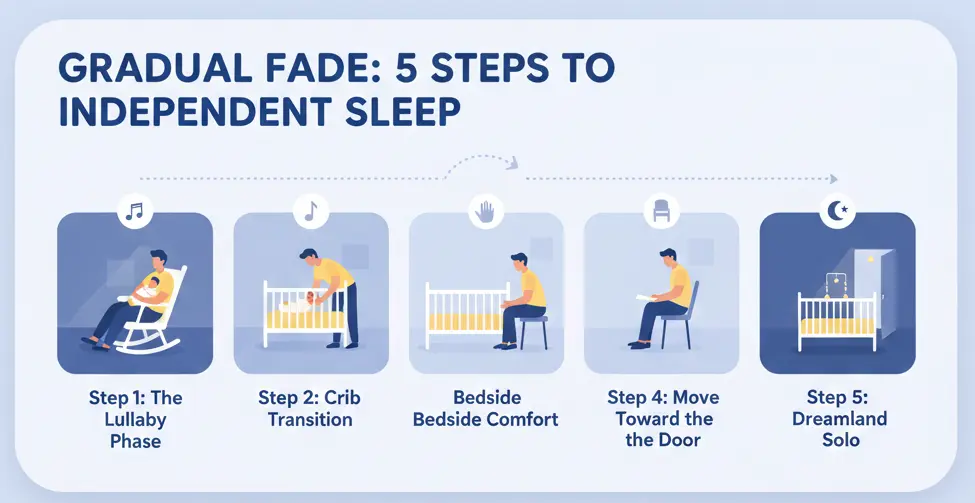
Phase 1 — The Transfer (Days 1–5):
- Hold your baby until they are in deep sleep. Use the floppy arm test.
- Lower them in slow motion: feet, then bottom, then back, then head. Keep one hand on their chest and one under their back until they’re fully settled.
- Stand still for a full 60 seconds before attempting to move away.
- If they stir, apply gentle pressure immediately and shush. Don’t pick them up unless they escalate to full crying.
Phase 2 — The Touch (Days 6–10):
- Same transfer, but now you keep only one hand resting on their chest after placing them down.
- Gradually reduce the pressure over several minutes, from firm to light to barely-there.
- You’re still in the room, still present, just reducing the physical input.
Phase 3 — The Proximity (Days 11–16):
- Transfer them, settle them, then sit in a chair next to the crib.
- Don’t touch them unless they start to cry. Your presence is the reassurance now.
- If they fuss, try verbal shushing before reaching in.
Phase 4 — The Exit (Days 17+):
- Each night, move your chair a little closer to the door.
- Eventually you’re in the doorway, then in the hallway, and then they’re falling asleep without you in the room
Method 2: Pick Up / Put Down (Best for 6+ Months)
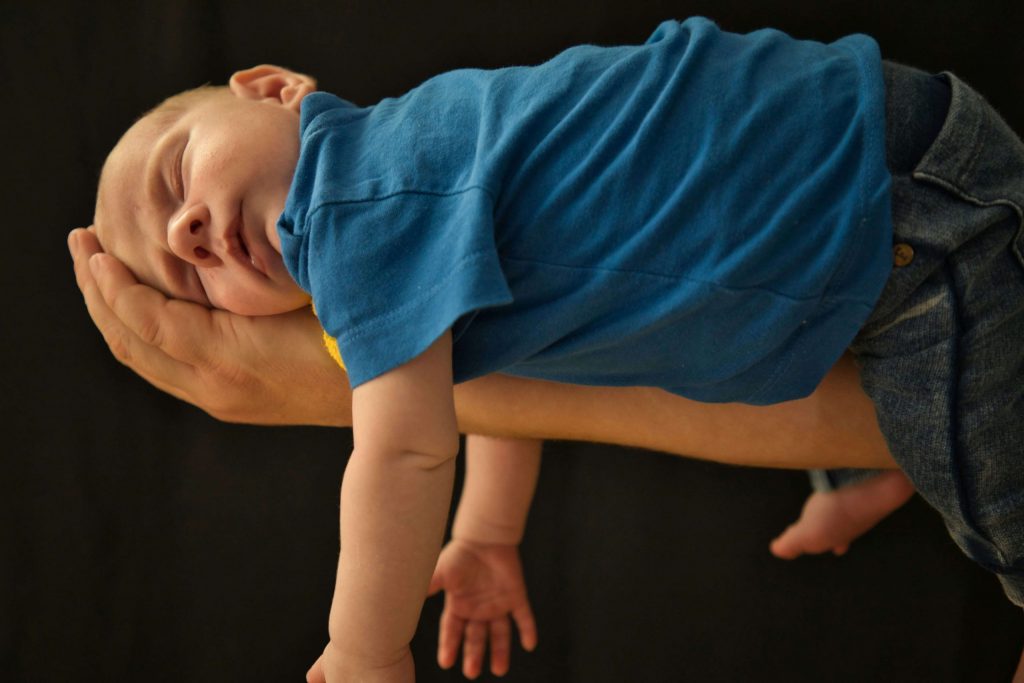
This method works well for older babies who have some capacity for self-soothing but are using contact as a habit rather than a developmental need.
The key rule here: pick up to calm, not to sleep. There’s a big difference. Here’s how it plays out in real life:
- Do your full bedtime routine. Lay your baby down while they’re drowsy, not fully asleep, but not wide awake. You’re aiming for “sleepy but aware.”
- Leave the room (or step back). If they fuss lightly, wait. Give them 2–3 minutes. Sometimes they’ll drift off on their own.
- If the fussing escalates to real crying, go back in. Pick them up. Don’t rush it, hold them until they’re fully calm and their body goes heavy.
- As soon as they’re calm (not asleep), put them back down. This is the hardest part. It feels wrong. Do it anyway.
- Repeat. The first night, this might happen 15–20 times. That’s not failure, that’s the method working. Night two will be 8–10 times. Night three, 4–5.
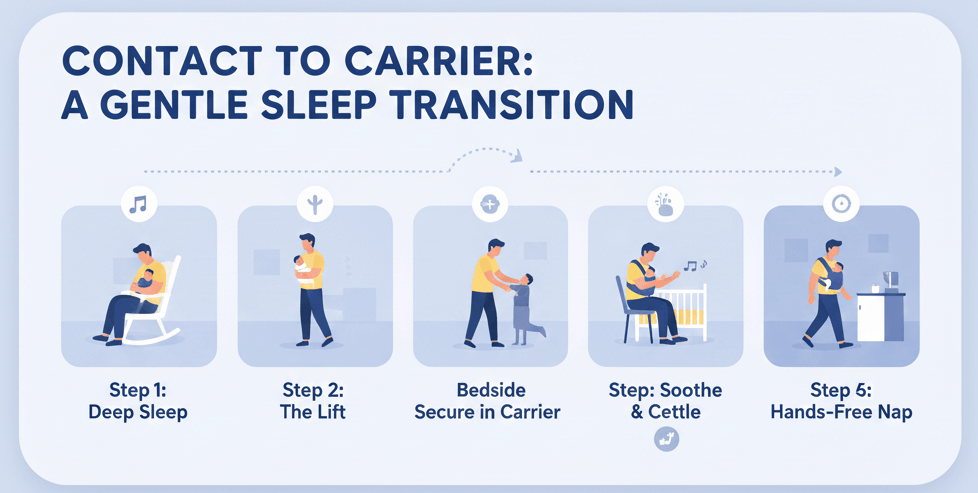
Method 3: The Contact-to-Carrier Bridge (Best for Parents Who Are Truly Exhausted)
Sometimes you cannot do a transfer right now. You’re physically depleted, you have another kid, or you’ve tried three times and your baby screams within 30 seconds every single time.
This is the bridge method, and it’s about working with the contact need before working against it.
- Put your baby in a structured baby carrier, one that keeps them upright against your chest with full support.
- Go about your day (or do a slow walk). Let them nap in the carrier.
- Once they’re in deep sleep (15–20 minutes in), try transferring them to the crib mid-nap.
- Over several days, start moving the crib transfer point earlier — at 12 minutes, then 8 minutes, then 5.
For babies who aren’t rolling yet, a snug swaddle is the closest thing to your arms. The Mayo Clinic suggests that swaddling can help keep your baby’s arms from flailing and waking them up. If your baby won’t sleep unless held, a swaddle plus a white noise machine can often “trick” the nervous system into feeling secure.
Method 4: The Swaddle + White Noise Combination (Best for Under 4 Months)
For very young babies who aren’t rolling yet, this combination is often the single most effective tool available.
The Mayo Clinic has noted that swaddling helps prevent arms from flailing during sleep, directly addressing the Moro reflex that wakes babies during transfers. How to do it effectively:
- Swaddle snugly arms in, but not so tight that breathing is restricted. You should be able to fit two fingers between the swaddle and your baby’s chest.
- Start the white noise before you begin rocking or nursing toward sleep. You want it associated with sleep onset, not just the transfer.
- Nurse or rock to drowsy, not to deep sleep. This is the practice step, you’re introducing the concept of falling asleep without being fully in a sleep cycle.
- Lower into the crib with the same slow transfer technique from Method 1.
- Leave the white noise running for the full nap or overnight.
The swaddle removes the open-air sensation that triggers the Moro reflex. The white noise masks the environmental sounds that cause partial wakings. Together, they recreate a significant portion of the “held” experience in a safe sleep space.
Method 5: The Warmed Mattress Trick
This one feels almost too simple, but the temperature shock of a cold mattress is genuinely one of the top reasons transfers fail.
- Before you start the bedtime routine, place a heating pad on the crib mattress on a low setting.
- By the time your baby is ready for transfer, the mattress surface will be warm, close to body temperature.
- Remove the heating pad completely before laying your baby down. This is critical. You’re warming the surface, not running it during sleep.
- Proceed with your normal transfer.
Method 6: Drowsy-But-Awake Practice (The Long Game)
Here’s the part no one tells you about teaching independent sleep: you can’t just do it one night. You have to practice it.
“Drowsy but awake” means laying your baby down before they’re fully asleep, while they’re still in that hazy, relaxed, half-in/half-out state. The goal isn’t for them to fall asleep independently right away. The goal is for the crib to stop feeling like a foreign, scary place and start feeling like where sleep happens.
How to introduce it:
- Once a day just once, during their most predictable nap — try putting your baby down slightly earlier in the drowsy window.
- Sit next to them. Stay present. Let them fuss a little (not cry — fuss).
- If they escalate past a fuss, pick them up. You’re not doing CIO. You’re just introducing the concept.
- Every few days, try putting them down a little less drowsy.
Method 7: The Shush-Pat (Best for Overtired Babies Who Are Already Crying)
If your baby has passed their wake window and is already overtired and crying, trying a gentle transfer right now will almost certainly fail. You need to de-escalate first.
- Hold your baby in the “hold” position, tummy against your chest, head on your shoulder.
- Begin rhythmic patting on their back not hard, not soft, but firm and steady. About the pace of a slow heartbeat.
- Add a shushing sound close to their ear, a sustained, loud “shhhh” is more effective than a soft one. It needs to be roughly as loud as their crying to register.
- Keep the rhythm completely consistent. Don’t speed up or slow down. Inconsistent rhythm keeps the nervous system alert.
- Once they’ve fully calmed and gone limp, wait another 5 minutes before attempting the transfer.
Why Your Baby Still Won’t Sleep Unless Held (Even After Trying Everything)
If nothing is working, one of these is happening:
- You’re transferring before deep sleep
- You’re being inconsistent
- The wake window is off
- The room is too stimulating
- There’s an underlying physical issue
Frequently Asked Questions About Why Your Baby Won’t Sleep Unless Held
Managing a baby won’t sleep unless held situation is one of the most common topics in parenting forums. Below are the most frequent questions parents ask when they are struggling with contact naps and crib transitions.
Is it normal that my baby won’t sleep unless held even when they are exhausted?
Yes, it is completely normal. In fact, it is a biological survival mechanism. When a baby won’t sleep unless held, it is often because their nervous system is still immature and requires your “external” regulation to stay calm. Even an overtired baby will fight sleep if they feel the physical “threat” of being separated from their primary caregiver.
At what age should I worry if my baby won’t sleep unless held?
There is no specific age where you should “worry,” but most pediatricians recommend starting to introduce independent sleep skills between 4 and 6 months. Before 4 months, a baby won’t sleep unless held due to the “fourth trimester” needs. After 6 months, it becomes more of a learned sleep association that may require a more structured approach like the “Put Down, Pick Up” method.
Can a baby won’t sleep unless held situation lead to permanent bad habits?
No. Sleep is a developmental skill, not a permanent personality trait. While it feels like a “bad habit” now, a baby won’t sleep unless held is simply in a phase of high-dependency.
What should I do if my baby won’t sleep unless held and screams the moment I lay them down?
First, check for physical discomforts like reflux or ear infections. If the baby is healthy, try the “warmed mattress” trick. Use a heating pad to warm the crib (remove it before laying the baby down) so the temperature change isn’t so drastic. Often, a baby won’t sleep unless held because the crib feels cold and clinical compared to your warm chest.
Is it safe to co-sleep if my baby won’t sleep unless held?
The American Academy of Pediatrics (AAP) recommends room-sharing but not bed-sharing, especially in the first 6 months. If your baby won’t sleep unless held, the safest alternative is a sidecar bassinet that attaches to your bed. This allows for physical proximity and easy touching without the risks associated with loose bedding and soft mattresses.
Final Thoughts: Progress Over Perfection
Transitioning away from contact naps is not a straight line. You will have nights where they sleep 6 hours in the crib, followed by nights where the baby won’t sleep unless held for a single minute. This is normal. Development is a “three steps forward, two steps back” process.
Give yourself grace. You are navigating one of the hardest parts of human existence. One day, you will put them in their bed, they will turn over and fall asleep instantly, and you will actually miss the days when they only wanted you. Until then, take it one nap at a time.