Desperate? 5 Month Old Won’t Sleep Unless Held (5-Night Proven Plan)
Why Your 5-Month-Old Only Sleeps in Your Arms : Gentle Sleep Solutions That Actually Work Without Cry-It-Out
- Why Does a 5 Month Old Only Sleep When Held?
- Quick Answer
- Is the 5-Month Sleep Regression Real?
- How to Start Transitioning a 5-Month-Old Off Holding
- The 5-Night Gradual Transition Plan
- Night 1 : Hold to Full Drowsy Transfer
- Night 2 : Reduce Rocking Before Transfer
- Night 3 : Sit With, Not Hold
- Night 4 : Hand on Chest Only
- Night 5 : Presence Without Touch
- What If My 5 Month Old Still Won’t Sleep in the Crib After 5 Nights?
- Is It Safe to Let a 5-Month-Old Cry During Sleep Training?
- How Do Wake Windows Affect Holding Sleep at 5 Months?
- What Comes Next: Preparing for the 6-Month Wake Window
- How to Get a 5 Month Old to Sleep Without Being Held: Step-by-Step
- FAQ
- Is it normal for a 5-month-old to only sleep when held?
- Will holding my baby to sleep create a permanent bad habit?
- How long does the 5-month sleep phase usually last?
- My 5 month old won’t sleep unless held but wakes immediately when transferred. What is wrong?
- Should I try the 5-Night Plan for naps and nighttime at the same time?
Medical Disclaimer: This article is for informational purposes only and does not constitute medical advice. Always consult your pediatrician before making changes to your baby’s sleep routine, especially if your baby has any health concerns.
If your 5 month old won’t sleep unless held, you are not doing anything wrong and you have not broken your baby.
I know the 3 AM panic. The stiff arm. The moment you try to lower them and those little eyes snap open like they have a built-in sensor.
There is a specific developmental reason this is happening at exactly this age. And there is a gentle, structured way out of it that does not involve hours of crying, sleep training at 5 months, or choosing between your own sleep and your baby’s.
This is the exact 5-Night Gradual Transition Plan I recommend age-specific, nervous-system-safe, and grounded in what we know about infant sleep biology.
A 5-month-old who only sleeps when held is responding normally to a developmental leap not a habit you’ve permanently created. At this age, babies are entering a pre-regression window where contact sleep feels biologically necessary. The 5-Night Gradual Transition Plan outlined below uses progressively reduced contact starting with full holding and ending with independent crib sleep, in a way that respects your baby’s nervous system and keeps cortisol levels low.
Most parents searching for why their 5 month old won’t sleep unless held find conflicting advice this article gives you the age-specific answer.
Why Does a 5 Month Old Only Sleep When Held?
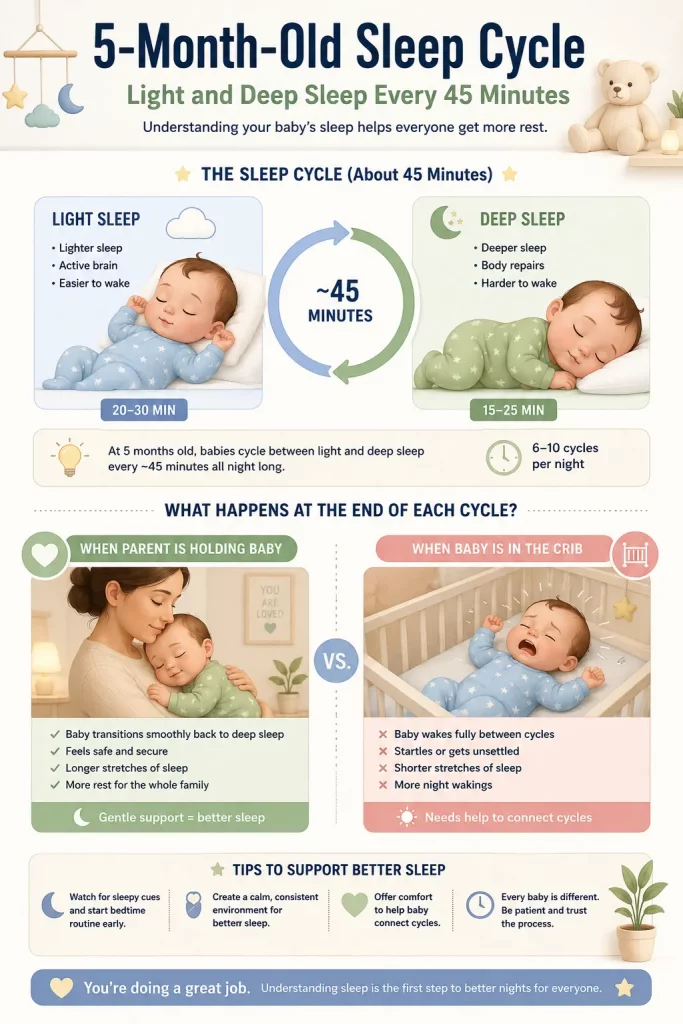
A 5 month old won’t sleep unless held because their nervous system is not yet mature enough to self-regulate between sleep cycles and your body is the only “regulator” they have ever known.
At 5 months, babies cycle between light and deep sleep roughly every 45 minutes. Each time they surface from a deep sleep cycle, they briefly check for the same conditions that existed when they fell asleep. If that condition was your arms, your warmth, and the rhythm of your breathing they will wake fully when those are gone.
This is not manipulation. According to the American Academy of Pediatrics (AAP), infant sleep architecture is fundamentally different from adult sleep through the first year of life, with more time spent in lighter REM-like states. This is protective, it is part of why SIDS risk decreases as sleep consolidates.
Three things are colliding at 5 months that make contact sleep more intense:
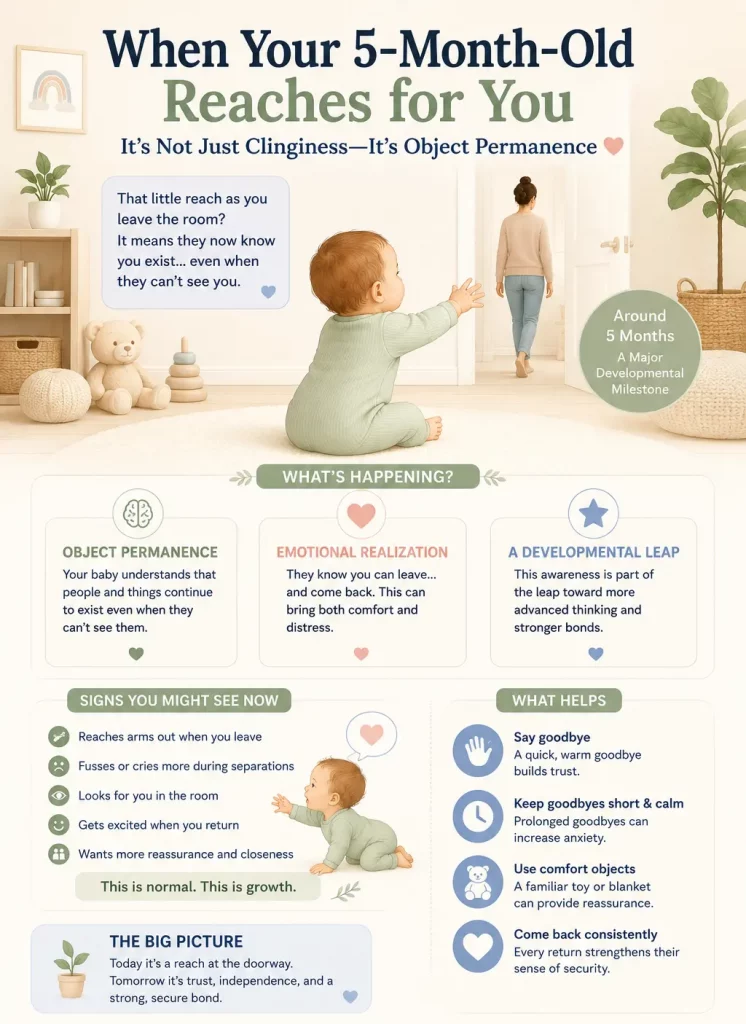
1. Object permanence is beginning
Your baby is starting to understand that things (and people) exist even when out of sight, which means your absence now registers in a new way.
2. A developmental leap is in progress
Weeks 19–22 are a known cognitive leap period. Brain reorganization disrupts sleep.
3. The 4-month regression may still be echoing
The true 4-month sleep regression when adult-style sleep architecture permanently replaces newborn sleep often lingers into month 5. If your baby regressed at 4 months and never fully bounced back, that is why.
Understanding this matters because it changes your approach. You are not breaking a spoiled habit you are transitioning a developmentally primed baby at exactly the right time.
This is the core reason a 5 month old won’t sleep unless held even after a period of better independent sleep earlier in infancy.
Quick Answer
Why won’t my 5 month old sleep unless held? A 5 month old won’t sleep unless held because their immature nervous system relies on your body to regulate between sleep cycles. Every 45 minutes, your baby surfaces from deep sleep and checks for the same conditions present at sleep onset your warmth, heartbeat, and movement. When those are gone, they wake fully. This is developmental, not behavioral, and it responds well to a gradual 5-night contact-reduction plan.
Is the 5-Month Sleep Regression Real?
The 5-month sleep regression is real, though it is better described as a continuation of the 4-month regression rather than a standalone event. Most sleep specialists refer to the window between 4 and 6 months as a single extended disruption period tied to permanent changes in how babies sleep.
According to pediatric sleep research, the 4-month regression is the only regression that is truly permanent, because it marks the point when a baby’s sleep cycles shift from newborn patterns to the lighter, multi-cycle adult pattern they will use for the rest of their lives. Babies who were sleeping longer stretches at 3 months often begin waking every 45–90 minutes at 4 to 5 months for exactly this reason.
What makes 5 months feel distinct from 4 months:
- Babies are stronger because they can resist being put down more effectively
- Babies are more aware since they notice environmental changes faster
- Babies are closer to the 6-month regression, making parents feel like it never ends
If you want to understand exactly how wake windows and sleep pressure interact to cause this pattern, I have a full breakdown in the Baby Wake Windows by Age guide (0–12 months) it explains why putting a 5-month-old down too early or too late derails every sleep attempt.
How to Start Transitioning a 5-Month-Old Off Holding
Transitioning a 5-month-old off contact sleep works best as a gradual withdrawal process, not an abrupt change. The goal is to slowly replace your body’s presence with environmental and positional substitutes over 5 nights.
This approach keeps cortisol spikes low, preserves your baby’s sense of security, and avoids the full protest response that makes abrupt transitions feel impossible.
The core principle: Each night, you reduce one layer of contact. Not all at once, one layer.
Here is how the 5 nights break down:
The 5-Month Sleep Readiness Checklist : Check all 4 before starting the 5-Night Plan
| Check | Readiness Signal | What to Look For |
|---|---|---|
| 1 | Age window | Baby is 18–22 weeks (not younger) |
| 2 | Weight + health | Gaining weight normally, no illness, no reflux flares |
| 3 | Wake windows honored | Baby shows drowsy cues, not overtired or under-tired |
| 4 | Sleep environment ready | White noise on, room fully dark, firm flat mattress |
If any box is unchecked: Fix that variable first. A 5 month old won’t sleep unless held partly because of environment gaps, the plan works faster when all 4 conditions are met.
The 5-Night Gradual Transition Plan
This plan was designed specifically for the parent whose 5 month old won’t sleep unless held whether at naps, at night, or both.
This plan works best for babies who are:
- 5 months old (18–22 weeks)
- Currently only napping or sleeping at night when held
- Otherwise healthy, gaining weight, and cleared by a pediatrician
Before you start: Optimize wake windows. At 5 months, the ideal wake window before bed is 2 to 2.5 hours. Not 3. Not 90 minutes. According to pediatric sleep research, starting the wind-down routine when sleep pressure peaks, but before overtiredness sets in is the single biggest predictor of whether a transfer attempt will succeed.
Night 1 : Hold to Full Drowsy Transfer
Everything stays the same except the moment of transfer.
Your job tonight: put your baby into the crib drowsy but awake, not fully asleep.
- Complete your normal wind-down routine (bath, feed, dark room, white noise at 65–70 dB)
- Hold and rock until your baby is heavy-limbed, eyes fluttering, but still blinking
- Lower them slowly : leading with their bottom, not their head
- Keep one hand on their chest for 60 seconds after contact with the mattress
- Stay present. Do not leave yet.
This plan was designed specifically for the parent whose 5 month old won’t sleep unless held whether at naps, at night, or both.
What to expect: Most babies will wake and protest. If that happens, pick up immediately, re-settle to drowsy, try the transfer again. Two to three attempts per night is normal on Night 1.
Success signal: Baby stays down for 20+ minutes without intervention.
Night 2 : Reduce Rocking Before Transfer
Tonight, you reduce motion before the put-down.
- Rock until drowsy, then stop rocking and hold still for 2 minutes
- Lower them in the same position as Night 1
- Keep your hand on their chest for 90 seconds
The stillness before transfer teaches the baby’s nervous system that stillness is safe, not a cue that you are leaving.
Night 3 : Sit With, Not Hold
Tonight, the hold becomes a side-lying sit.
- Place baby in the crib while still partially awake
- Sit beside the crib with your hand resting on their belly
- Hum or use a consistent verbal cue (“shhh, I’m here, you’re safe”)
- Do not pick up unless baby escalates to full crying
At this stage, many parents notice their 5 month old won’t sleep unless held less intensely, the gradual withdrawal is working.
Why this works: Your presence is still felt. The crib mattress is doing more of the support work. The transition is happening, but your baby does not experience abandonment.
Night 4 : Hand on Chest Only
Tonight, no holding at all.
- Place baby drowsy into the crib
- Stand beside the crib with one hand on their chest
- Maintain your verbal cue
- Begin slowly withdrawing hand pressure over 5-minute intervals
If baby wakes and protests: keep your hand on their chest, increase verbal soothing, but do not lift unless crying escalates beyond 2 minutes of sustained protest.
Night 5 : Presence Without Touch
Tonight, you move from touch to presence.
- Place baby in the crib at the first drowsy window
- Stand beside the crib : visible but not touching
- Use only voice for soothing
- Begin moving toward the door in small increments each time baby settles
By Night 5, 5 month old won’t sleep unless held is learning that the crib is a consistent, safe space independent of your body.
Night-by-Night Progress Tracker : What to expect each night of the plan
| Night | What You Do | Normal Baby Response | Success Signal |
|---|---|---|---|
| Night 1 | Hold → drowsy transfer | Wakes 2–3×, protests | Stays down 20+ min once |
| Night 2 | Stop rocking before lowering | Fussing at transfer, settles in 5–10 min | Shorter protest than Night 1 |
| Night 3 | Crib + hand on belly, seated | May fuss briefly, looks for you | Settles with hand present |
| Night 4 | Hand on chest only, no rocking | Light fussing, checks for hand | Sleeps 1+ hour stretch |
| Night 5 | Presence only, no touch | May fuss 2–5 min, then quiet | Falls asleep without contact |
Key insight: If Night 3 looks worse than Night 1, do not stop, this is the normal “protest peak” before the breakthrough. A 5 month old won’t sleep unless held partly out of learned expectation, and Night 3 is when that expectation is being actively unlearned.
What If My 5 Month Old Still Won’t Sleep in the Crib After 5 Nights?
If your 5 month old won’t sleep unless held after completing the full 5 nights, run through this checklist before restarting.
If your baby is still waking immediately after transfer after 5 nights, check these three things before assuming the plan is not working:
1. Is the sleep environment optimized? White noise should be on continuously, not just at bedtime. The Marpac Dohm or a simple white noise app set to 65 dB from across the room is the standard recommendation. According to the AAP, white noise may help mask environmental sounds that cause partial wakes.
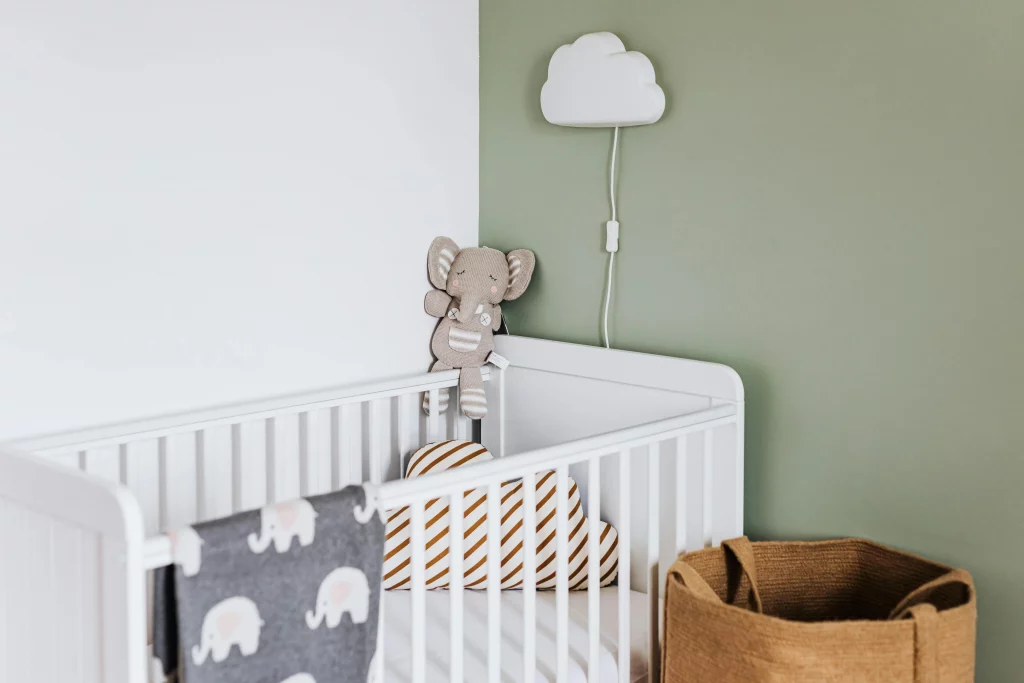
2. Is the mattress firm and the room dark enough? At 5 months, any light filtering through curtains will register during partial wake cycles. Blackout curtains (not “room darkening” full blackout) make a meaningful difference.
3. Are wake windows being honored? This is the most common reason the plan stalls. If you are starting the bedtime routine when your baby is already overtired, no transfer technique will work reliably. See the complete Baby Wake Windows by Age guide to get this calibrated.
If all three are optimized and baby is still struggling, your baby may need another week before their nervous system is ready. That is okay. Resume the plan from Night 3 and progress more slowly.
Is It Safe to Let a 5-Month-Old Cry During Sleep Training?
Graduated extinction (“Ferber method”) and formal sleep training are generally not recommended before 6 months by most pediatric sleep specialists. The AAP does not endorse any specific sleep training method but emphasizes that any approach should be consistent, responsive to the baby’s cues, and not cause prolonged distress.
The 5-Night Gradual Transition Plan above is not sleep training in the traditional sense, it is a contact-reduction protocol. It does not involve leaving the room or ignoring crying. It is designed specifically for the 4-to-6-month window where the goal is transition, not extinction.
If you are considering more structured sleep training, wait until 6 months minimum, and consult your pediatrician first.
How Do Wake Windows Affect Holding Sleep at 5 Months?
Wake windows are the single most actionable variable you can control right now, even before changing any sleep location.
At 5 months, ideal wake windows are:
- Morning wake to first nap: 1.75 to 2 hours
- Between naps: 2 hours
- Last nap to bedtime: 2 to 2.5 hours
When wake windows are too short, babies are put down without enough sleep pressure, they fight the transfer. When they are too long, babies become overtired, cortisol spikes, and the nervous system is too activated to settle.
I cover the full wake window breakdown by month in Baby Wake Windows by Age: Simple Guide (0–12 Months) including a visual chart that shows exactly when nap windows open and close at each age.
Correct wake windows are the foundation without them, even the best plan for a 5 month old won’t sleep unless held will stall.
What Comes Next: Preparing for the 6-Month Wake Window
If your 5 month old is just getting comfortable with crib sleep, be aware that the 6-month mark often brings another disruption a combination of teething onset, increased motor activity (rolling, sitting attempts), and another cognitive leap.
I have a full breakdown in Exhausted? 6-Month-Old Won’t Sleep Unless Held (The Proven 3-Day Reset), it picks up exactly where this article leaves off and covers what changes between months 5 and 6 that requires a slightly different approach.
For a broader view of how contact sleep evolves from newborn through 12 months, the 7 Effective Methods for When Your Baby Won’t Sleep Unless Held sub-hub covers every age stage with specific strategies.
Whether your 5 month old won’t sleep unless held day or night, the transition window between months 5 and 6 is the most effective time to act.
How to Get a 5 Month Old to Sleep Without Being Held: Step-by-Step
This is the condensed how-to version of the full 5-Night Plan formatted for quick reference and voice search.
Step 1 : Optimize the sleep environment
Set white noise to 65 dB, install full blackout curtains, confirm crib mattress is firm and flat. A 5 month old won’t sleep unless held in part because the crib environment does not yet replicate the sensory comfort of your arms. Close that gap first.
Step 2 : Time the wake window precisely
At 5 months, the bedtime wake window is 2 to 2.5 hours from the last nap. Start the wind-down routine dim lights, feed, swaddle or sleep sack, at the 1h45min mark. This is non-negotiable. Overtired babies cannot be transferred successfully regardless of technique.
Step 3 : Hold until deep sleep cues appear
Watch for: fully limp arms, jaw drop, no eye movement under lids, slow rhythmic breathing. Wait a full 15 minutes after these cues before attempting transfer. A 5 month old won’t sleep unless held largely because parents attempt the transfer 5 minutes too early.
Step 4 : Lead with the bottom, not the head
Lower baby bottom-first into the crib. The head, the most sensitive point makes contact last. This reduces the startle response that wakes most babies mid-transfer.
Step 5 : Keep one hand on chest for 60–90 seconds
After lowering, do not immediately remove contact. Rest one hand with gentle pressure on the chest. Your warmth is still present. The transition from held to crib is now a 60-second bridge, not an abrupt drop.
Step 6 : Use a consistent verbal cue
Whisper the same phrase every single time: “You’re safe, I’m here, go to sleep.” Repeat it at the same volume and rhythm. Within 3 to 5 nights, this phrase alone begins to trigger the sleep response because your 5-month-old won’t sleep unless held or they hear your cue. The cue becomes the anchor.
Step 7 : Exit slowly
Once baby is settled for 2 minutes without stirring, begin moving toward the door in small steps. Pause if baby stirs. Resume when settled. The goal is that your absence happens gradually, not as a single moment the baby registers.
How long does it take to get a 5 month old to sleep without being held?
Most babies who are transitioned using a gradual 7-step approach show consistent crib sleep within 5 to 7 nights. The 5 month old won’t sleep unless held today is typically capable of 2 to 3 hour independent crib stretches within 2 weeks of consistent application.
FAQ
Is it normal for a 5-month-old to only sleep when held?
Yes, it is completely normal. At 5 months, babies cycle through lighter sleep stages more frequently, and they naturally “check” for the same conditions present when they fell asleep. If those conditions involved your arms, they will wake when transferred. This is a developmental pattern, not a behavioral problem, and it typically begins responding to gradual transition approaches by 5 to 6 months.
Will holding my baby to sleep create a permanent bad habit?
No. According to the AAP, responsive caregiving, including contact sleep does not create harmful long-term sleep habits when parents begin gradual transitions at developmentally appropriate times. Most babies who are contact-sleeping at 5 months are capable of learning independent sleep skills between 5 and 7 months with a consistent, gentle approach. Most babies whose 5 month old won’t sleep unless held phase is addressed with a gradual plan show measurable improvement within 7 to 10 days.
How long does the 5-month sleep phase usually last?
For most babies, the worst of the 5-month contact sleep intensity lasts 2 to 4 weeks. Babies who go through a significant 4-month regression may experience extended disruption through months 5 and 6. Beginning a structured gradual transition plan like the 5-Night Plan above, typically shortens this window significantly. Parents who begin a structured plan while the 5 month old won’t sleep unless held pattern is active typically see the fastest results.
My 5 month old won’t sleep unless held but wakes immediately when transferred. What is wrong?
Nothing is wrong with your baby. The most common cause is that the transfer is happening during a light sleep phase rather than deep sleep. Watch for these deep sleep cues before attempting a transfer: completely limp arms, no eye movement under lids, relaxed jaw, heavy breathing. Wait at least 15 to 20 minutes after your baby falls asleep before attempting the crib transfer. The most common cause of a 5 month old won’t sleep unless held transferring immediately is that the crib attempt happens during a light sleep phase.
Should I try the 5-Night Plan for naps and nighttime at the same time?
Start with nighttime only. Nap sleep is harder to consolidate and requires more sleep pressure to achieve depth. Once your baby is transferring successfully at night typically by Night 4 or 5, begin applying the same approach to the first morning nap. Add the second nap one week later. This staged approach prevents overwhelm and makes regression less likely. Trying to solve how to get a 5 month old won’t sleep unless held at naps and night simultaneously is the most common mistake parents make.
If you found this plan helpful, the full guide to when your baby won’t sleep unless held covers every age stage from newborn to 12 months.