Baby Sleep Sounds Guide 2026: White Noise vs Lullabies (What Actually Works for Better Sleep)
Backed by AAP guidelines, real research, and a lot of 2 AM trial and error
- What Are the Best Baby Sleep Sounds?
- Types of Baby Sleep Sounds Compared
- White Noise vs Lullabies for Baby Sleep Sounds: Which One Actually Works Better?
- White Noise vs Pink Noise vs Brown Noise for Baby Sleep Sounds
- What Sounds Help Babies Sleep Best?
- Can Babies Sleep With White Noise All Night?
- Is White Noise Safe for Babies?
- How Loud Should White Noise Be for a Baby? (AAP Safety Guidelines)
- Can Babies Become Dependent on White Noise?
- How to Set Up White Noise Safely
- Common Baby Sleep Sounds Mistakes Parents Make
- Why Babies Love Noise in the First Place
- What Do Parents on Reddit and Parenting Forums Actually Say Works?
- White Noise Machine vs Phone App
- How to Choose the Right Baby Sleep Sound for Your Home
- What to Look for in a Baby Sound Machine
- Baby Sleep Sound Troubleshooting Guide
- Preventing Sleep Sound Problems Before They Start
- You Haven’t Ruined Anything
- FAQ : Baby Sleep Sounds
- Is white noise safe for babies?
- Can babies sleep with white noise all night?
- What is the safest sound for babies to sleep?
- How loud should white noise be for a baby?
Disclaimer: This article is for informational purposes only and is not a substitute for professional medical advice, diagnosis, or treatment. Always consult your pediatrician before introducing a new sleep tool, product, or routine, especially regarding hearing safety and safe sleep practices.
Baby sleep sounds saved my sanity during my youngest’s 4-month regression, right up until I realized I’d had the volume cranked way too high, way too close to the crib, for almost three weeks straight.
I’m guessing you’re here because bedtime has turned into a nightly standoff between your baby’s overtired brain and every white noise app on your phone. You’ve probably tried a box fan, a $60 machine from your registry, or a “womb sounds” playlist somebody swore changed their life. Some of it works.
Some of it’s just noise. And a little of it, if you’re not careful with volume and placement can actually work against you. Here’s what the actual research says about which sounds help babies sleep, and how to use them without a single ounce of guilt.
The best baby sleep sounds are steady, low-pitched, and played at a safe volume, think white noise, pink or brown noise, or your own voice singing a slow lullaby. The American Academy of Pediatrics recommends keeping sound machines at or below 50 decibels and at least 7 feet from the crib. White noise tends to win for staying asleep; lullabies win for falling asleep calmly. Most families end up needing both.
What Are the Best Baby Sleep Sounds?
Baby sleep sounds that actually work share three traits: they’re consistent, low in pitch, and free of sudden peaks. White noise, pink noise, brown noise, and steady rain sounds all top the list for this reason. Lullabies and gentle humming work beautifully too, especially for younger infants soothed more by a caregiver’s familiar voice than the sound itself.
The common thread pediatric sleep specialists recommend is predictability. A sound that stays the same all night masks the noise that would otherwise startle your baby awake a door closing, a sibling’s footsteps. A shuffled playlist of “nature sounds” does the opposite: it pulls a light sleeper right out of deep sleep.
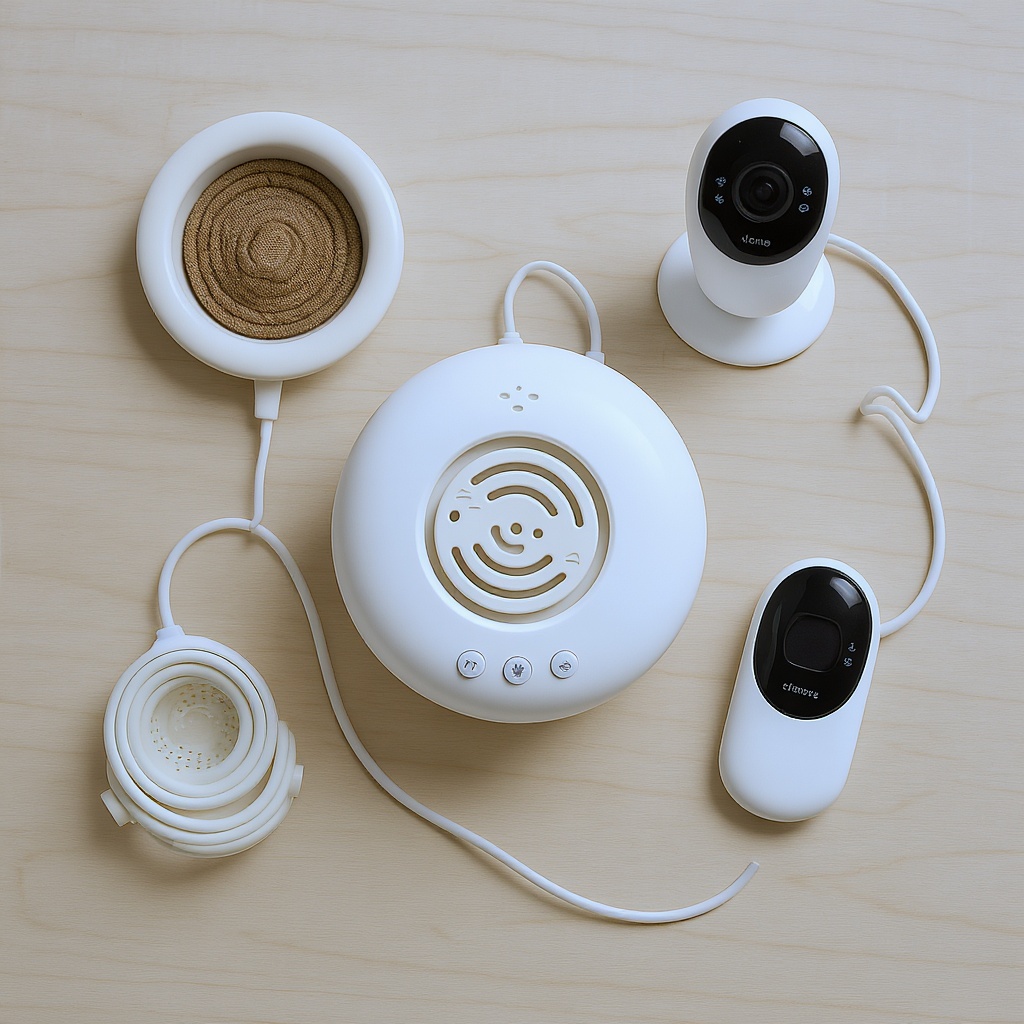
In our home, we went through three sound machines before landing on one with a true, unbroken loop instead of 20-second clips with an audible click, that click alone woke my daughter twice a night for a month.
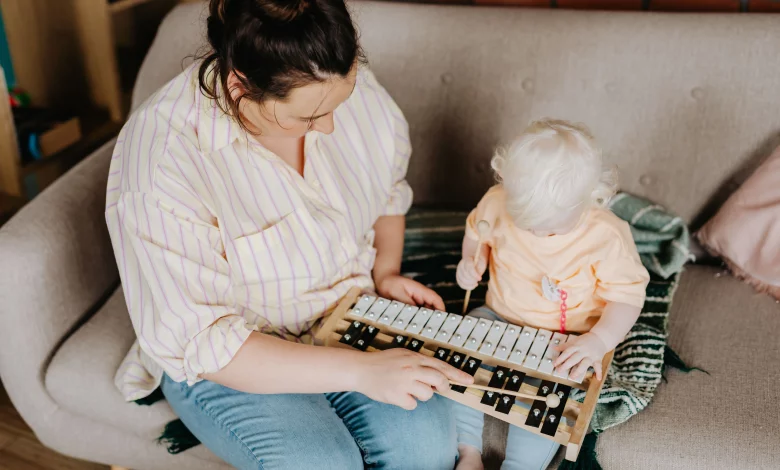
Lullabies have research behind them too. Researchers at Harvard’s Music Lab found infants relaxed measurably slower heart rate, smaller pupils, fewer signs of distress when played lullabies, even in a language they’d never heard. It’s the slow, steady rhythm your baby’s nervous system responds to, not the words.
Types of Baby Sleep Sounds Compared
Not every sound labeled “for babies” behaves the same way, and white noise for babies is only one option among several baby sleep sounds worth knowing. Here’s how the best baby sleep sounds stack up:
| Baby Sleep Sounds | Best For | Pros | Cons | Recommended Age |
|---|---|---|---|---|
| White Noise | Masking household noise | Widely studied, easy to find | Can run louder than it sounds | 0+ months |
| Pink Noise | Light sleepers | Softer, deeper than white noise | Less common as a default option | 3+ months |
| Brown Noise | Babies who like a deep rumble | Womb-like, soothing quality | Can feel like “too much” to adults | 3+ months |
| Rain Sounds | Parents who dislike static | Pleasant, naturalistic | Cheap apps loop with a click | 0+ months |
| Heartbeat Sounds | Newborns | Mimics a sound baby already knows | Less useful as baby gets mobile | 0–3 months |
| Lullabies | The wind-down moment | Builds bonding, a bedtime cue | Not built to mask noise all night | All ages |
The short version: white noise, pink noise, and brown noise are all built for staying asleep, while lullabies and heartbeat sounds are best for the few minutes right before sleep starts. Most families end up combining one from each category rather than picking a single “winner.”
White Noise vs Lullabies for Baby Sleep Sounds: Which One Actually Works Better?
White noise vs lullabies for baby sleep sounds isn’t really a fair fight, they solve different problems at different moments. White noise excels at masking, covering sudden household noise so your baby stays asleep once down. Lullabies excel at transitioning, giving an overtired baby a rhythmic cue that it’s time to power down.
Here’s how that plays out across the first few years:
| Age | Best Sound | Why |
|---|---|---|
| Newborn (0–3 mo) | Constant white noise or heartbeat sound | Mimics the loud, low-frequency womb environment |
| 3–4 months | Consistent white/brown noise, all night | Masks the frequent waking of the 4-month regression |
| 6 months | White/pink noise + short lullaby | Baby now recognizes the sound as a bedtime cue |
| 12 months | Same sound, full bedtime routine | Consistency matters more than sound choice now |
| 18 months | Sound machine + book or song | Emotional routine matters as much as the sound |
| 2–3 years | Optional sound machine + lullaby | No need to stop if it’s still working for everyone |
In practice, most families layer both, a short lullaby closes out the bedtime routine, and steady white noise takes over once the door closes.
White Noise vs Pink Noise vs Brown Noise for Baby Sleep Sounds
These three get lumped together constantly, but they’re not interchangeable:
| Noise Type | Sound Quality | Frequency Profile | Best For |
|---|---|---|---|
| White Noise | Sharp, even static, like an untuned TV channel | Equal energy across all frequencies | Masking a wide mix of household noise |
| Pink Noise | Softer, steady hiss, closer to rainfall | Weighted toward low and mid frequencies | Light sleepers sensitive to higher-pitched sound |
| Brown Noise | Deep, heavy rumble, like a distant waterfall | Heaviest concentration in low frequencies | Babies who respond best to womb-like, muffled tones |
White noise has the longest research history, since it’s what the 2014 Pediatrics study tested. There’s no dedicated safety study for pink or brown noise specifically, so the same 50-decibel, 7-foot rule is the safest default regardless of color. Newborns often respond best to brown noise or heartbeat sounds, which mimic the muffled quality of the womb, while older babies often do just as well with pink or classic white noise.
What Sounds Help Babies Sleep Best?
What baby sleep sounds help babies sleep best are steady, unchanging tones without lyrics or shifting melody, think static-like white noise, gentle rain, or a soft, breathy “shhh” close to what babies heard constantly in the womb. Sudden, high-pitched, or musical sounds with changing pitch are far more likely to stimulate a baby than settle one, which is why a shuffled “calming sounds” playlist can quietly backfire.
If you’re choosing your first sound machine, skip anything advertised as having “20 relaxing tracks.” One steady, loopable sound beats a rotating library every time.
Can Babies Sleep With White Noise All Night?
Yes, babies can safely sleep with white noise all night, as long as the volume stays at or below 50 decibels and the machine sits at least 7 feet from the crib. It only becomes a concern when it’s played too loud or too close for hours at a stretch. Most families run it continuously, every night, without any issue at all.
That said, “all night” doesn’t have to mean “at full volume the entire time.” Some families lower the volume slightly once baby is in a deeper sleep cycle, though this is a preference, not a safety requirement.
Is White Noise Safe for Babies?
White noise is safe for babies when it’s kept at a low volume and placed well away from the crib. The American Academy of Pediatrics recommends staying at or below 50 decibels, at least 7 feet from where your baby sleeps. Problems only show up at maximum volume, close range, over many hours, a combination that’s easy to avoid entirely.
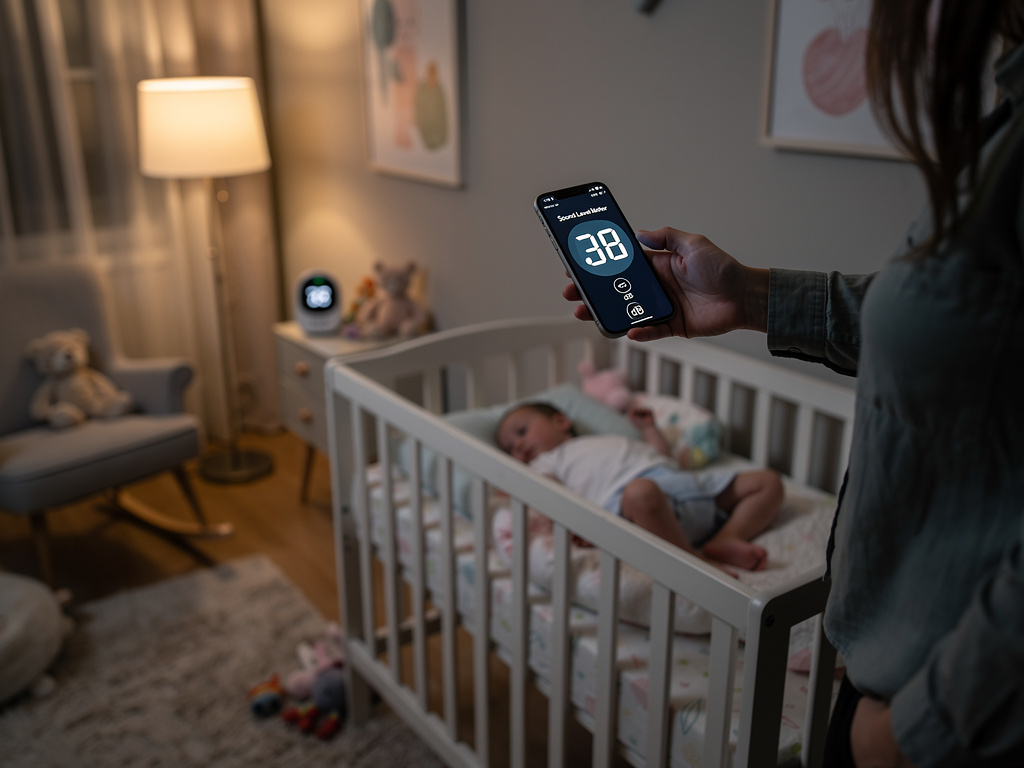
Most pediatric sleep specialists agree that consistency matters more than choosing the “perfect” sound. Pick one steady option, set the volume correctly, and leave it alone, the exact numbers behind that advice are below.
When your toddler won’t listen, hearing “no” constantly for low-stakes things makes them less responsive to it when it actually matters
How Loud Should White Noise Be for a Baby? (AAP Safety Guidelines)
This is the part most sleep-deprived parents skip, and it’s the one that matters most.
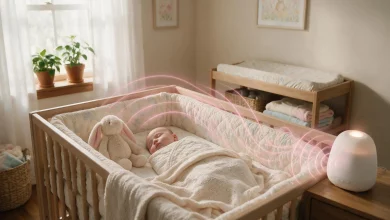
According to the American Academy of Pediatrics, sound machines used near infants should stay at or below 50 decibels roughly as loud as a running shower, and sit at least 7 feet from the crib, never clipped to the rail or placed inside it.
That guidance exists because of a 2014 study in the journal Pediatrics, which tested 14 infant sound machines at maximum volume. Three of the fourteen measured above 85 decibels near where a baby’s head would be — loud enough that, by adult occupational noise standards, more than eight hours of exposure could pose a hearing risk over time.
The fix is simple: keep the machine across the room, not on the nightstand, and turn it down until it sounds like a quiet shower, not a vacuum. A free decibel app confirms it in seconds, part of good baby sound machine safety, alongside tucked-away cords and nothing balanced on the crib rail.
Can Babies Become Dependent on White Noise?
Needing white noise to fall asleep isn’t a problem you’ve created it’s a sleep association, the same category as a pacifier or a familiar bedtime song. It only becomes frustrating if your baby wakes fully distressed every time the sound stops.
Do babies outgrow white noise? Most don’t need to for any medical reason, plenty of kids use it happily through the preschool years. To reduce it, taper gradually: lower the volume slightly every few nights, or slowly increase distance from the bed, over one to two weeks rather than stopping cold turkey.
If your toddler still needs it at two or three, nothing has gone wrong, it’s a tool that’s working, with no deadline for retiring it.
How to Set Up White Noise Safely
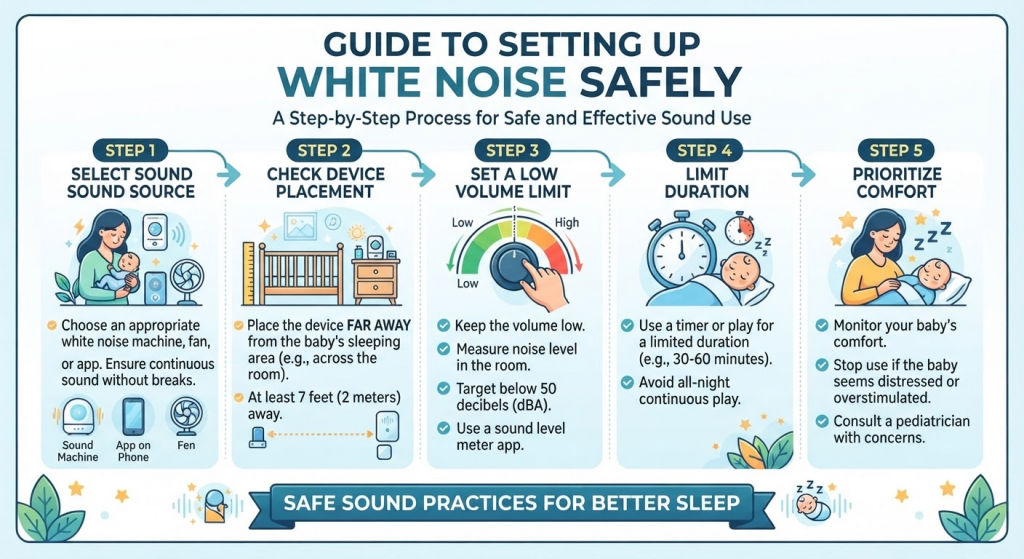
Getting the setup right the first time saves you from troubleshooting later. Here’s the actual sequence:
- Place the machine at least 7 feet away from the crib or bed across the room, not on the nightstand.
- Measure the volume once with a free decibel app, aiming for 50 dB or under at crib level.
- Turn it on a few minutes before the end of your bedtime routine, so it becomes part of the wind-down, alongside dimmed lights and a book, not a last-minute scramble.
- Keep one consistent sound every night rather than switching between options based on mood.
- Let it run the whole night instead of relying on a timer that shuts off after 20 or 30 minutes.
- Recheck your setup after travel. Hotel rooms, grandparents’ houses, and unfamiliar layouts change distance and echo, which changes the effective volume even at the same machine setting.
Common Baby Sleep Sounds Mistakes Parents Make
The same handful of baby sleep sounds mistakes come up again and again in our inbox and in parenting forums:
- Clipping the machine to the crib rail or inside the crib : the loudest volume, right at baby’s ear
- Running it at max volume “just in case” : when lower and well-placed almost always works
- Switching sounds every night : undoing the consistency babies respond to
- Playing YouTube instead of a dedicated app : a sudden loud ad can startle a sleeping baby
- Leaving a phone at full volume beside baby’s head : spiking exposure even at a “low” setting
- Using a timer that shuts off too early : causing the classic 45-minute wake-up
- Using a looping track with an audible click : where the seam itself becomes the trigger
- Leaving a smart speaker or TV on overnight : with unpredictable volume jumps and stray ads
Fixing even one of these usually shows up in your baby’s sleep within a few nights.
Why Babies Love Noise in the First Place
Silence is the unfamiliar thing here, not sound. Researchers who’ve placed microphones inside the womb during labor have measured the intrauterine environment at roughly 70 to 90 decibels, dominated by low-frequency sound: blood flow, digestion, and a mother’s heartbeat. Higher-pitched outside sounds get filtered out almost entirely by the abdominal wall and amniotic fluid, so your baby arrives already used to a loud, muffled, constant soundscape, not a quiet one.
For nine months, true silence never happened. That’s part of why a picture-perfect, silent nursery can feel unsettling to a newborn, and why steady background sound often calms a fussy baby faster than rocking alone.
What Do Parents on Reddit and Parenting Forums Actually Say Works?
Scroll through r/NewParents or r/beyondthebump on any given night and the white noise debate comes up constantly. The most repeated advice: buy a machine with adjustable volume and a built-in timer, keep it far from the crib, and stop chasing a “magic” sound, plain fan noise or static often outperforms machines with twenty nature-sound options. A number of parents also mention switching from white noise to brown noise around the 4-month mark, with noticeably better results for light sleepers going through the regression.
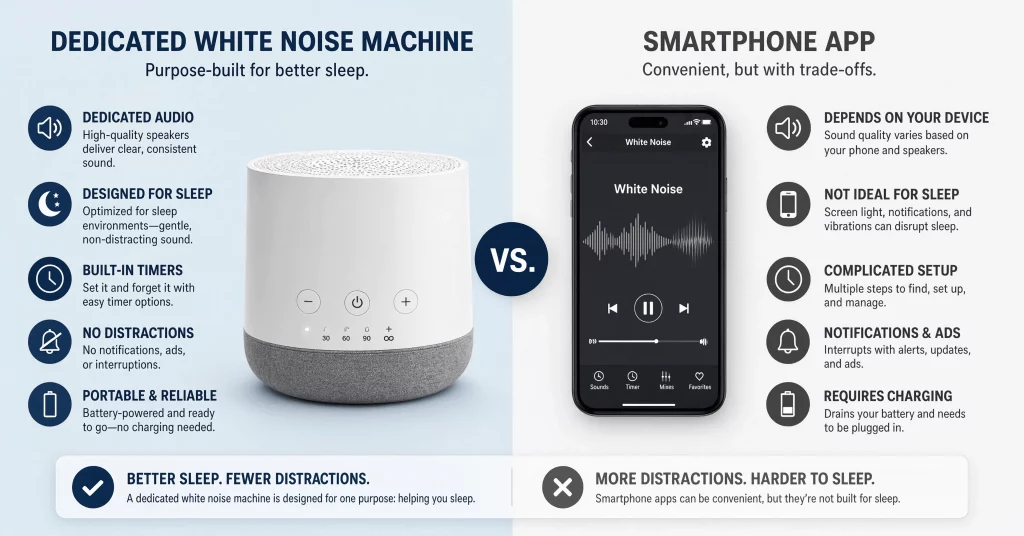
White Noise Machine vs Phone App
Deciding between a dedicated machine and a phone app for baby sleep sounds? Here’s the honest comparison:
| Factor | Dedicated Sound Machine | Phone App |
|---|---|---|
| Reliability | Plays continuously, no interruptions | Can be interrupted by calls or low battery |
| Notifications | None | Can buzz or light up and wake baby |
| Battery | Own long-life battery or plugged in | Drains your phone overnight |
| Volume Consistency | Fixed dial, set once | Can shift with app updates |
| Travel Convenience | One more item to pack | Already in your pocket |
| Safety | Built for overnight, close-range use | Not designed for that use case |
A dedicated white noise machine for baby sleep wins on consistency for everyday home use. A phone app works fine as a travel backup, switch on airplane mode so a notification doesn’t interrupt the sound or wake your baby directly.
How to Choose the Right Baby Sleep Sound for Your Home
A few practical rules make choosing baby sleep sounds easier than it feels at 2 AM:
- Pick one sound and stick with it. Consistency does more work than the “right” sound.
- Keep a battery-powered backup for travel days and power outages, losing the sound your baby associates with sleep mid-trip is rough on everyone.
- Test your volume once, properly, with a free decibel app, rather than guessing by feel.
- Place it across the room, not on the same surface as the crib or bassinet.
- Avoid streaming apps that auto-shuffle into ads or silence between tracks, a sudden gap of silence can wake a light sleeper just as easily as a loud noise would.
What to Look for in a Baby Sound Machine
You don’t need a brand recommendation to shop well, you need the right features:
- Continuous playback with no audible loop or click (a repeating seam becomes its own wake-up trigger)
- A battery backup, so a power outage doesn’t mean a 3 AM scramble
- Real low-end volume options, not just “loud, louder, loudest”
- Portability for travel, ideally without needing to stay plugged in
- A timer you can disable entirely, so it can run all night
- An easy-to-clean surface, since it’ll likely live in the nursery for years
Baby Sleep Sound Troubleshooting Guide
Quick fixes for the most common baby sleep sounds complaints we hear:
| Problem | Possible Cause | Fix |
|---|---|---|
| Wakes after about 45 minutes | Machine is set to a timer that shuts off | Turn off the timer; let the sound run all night |
| Crying at bedtime even with sound on | Sound started too late to be part of the wind-down | Turn it on a few minutes before the routine ends |
| Wakes the moment the machine turns off | Strong sleep association plus a timer cutoff | Same fix : remove the timer entirely |
| Resisting sleep despite a consistent sound | Overtiredness or a sleep regression, not the sound itself | Check wake windows and bedtime before troubleshooting the machine |
| Waking more during travel | New room changes distance and echo | Recheck placement and re-measure decibels in the new space |
| Suddenly seems to “hate” white noise | A developmental leap or new sensitivity to sound | Lower the volume slightly rather than switching to a different sound entirely |
Preventing Sleep Sound Problems Before They Start
Most trouble with baby sleep sounds isn’t about which machine parents bought, it’s how it’s used night after night. Set the volume once, in its permanent spot, and resist bumping it up during a hard night. A louder machine doesn’t solve teething, a growth spurt, or a cold; it just adds risk. The actual fix is usually more consistency, or an earlier bedtime.
It also helps to write your settings down somewhere so a partner or babysitter uses the exact same setup consistency falls apart fast when one caregiver runs a phone at full volume and another uses the correct low setting.
You Haven’t Ruined Anything
If you’ve spent the last few nights quietly panicking that you damaged your baby’s hearing with a sound machine, take a breath. Mistakes with volume and placement happen to nearly every parent who’s used one you’re the rule, not the exception. Hearing damage is genuinely unlikely in most homes, since the risky numbers from that 2014 study only showed up at maximum volume, inches from the crib, for hours on end.
A few small adjustments one notch quieter, one step farther away, no early timer cutoff — solve nearly every issue in this guide. Needing to look this up at midnight doesn’t mean you’re failing; it means you’re doing exactly what a careful parent does.
Baby sleep sounds work best when they’re boring, consistent, and quiet enough to hold a conversation over. Not the fanciest machine the safest, steadiest one, used the same way every night.
For the full framework, our Ultimate Baby Sleep Guide covers how sound fits into your baby’s broader safe sleep practices and wind-down routine. Our white noise machine guide and lullabies and baby sleep pieces go deeper on each option, and if timing feels off rather than the sound itself, our 4-month and toddler sleep regression guides cover what’s really happening developmentally.
FAQ : Baby Sleep Sounds
Is white noise safe for babies?
Yes, when kept at or below 50 decibels and placed at least 7 feet from the crib, per AAP guidance. It’s only a concern at high volume, close range, for many hours at a time.
Can babies sleep with white noise all night?
Yes. As long as volume and distance stay within AAP guidelines, running it continuously overnight is considered safe, and most families do exactly that.
What is the safest sound for babies to sleep?
Any steady, low-pitched sound white, pink, or brown noise is safe at 50 decibels or below, placed well away from the crib. The “color” of noise matters far less than volume and distance.
How loud should white noise be for a baby?
No louder than 50 decibels at the crib, about as loud as a running shower with the machine at least 7 feet away, per AAP guidance following the 2014 Pediatrics study.