Toddler Only Wants Mom? 7 Proven Ways Dad Can Bond Fast
Real scripts and a gradual handoff plan for the "only Mommy" phase

- Why Does My Toddler Only Want Mom and Reject Dad?
- A preference is usually about familiarity, comfort, or control, not a permanent love ranking
- Why toddlers choose one parent during tiredness, illness, bedtime, and transitions
- How primary caregiving routines can shape who your child requests
- Why “Mommy do it” can be a developmental choice
- How Do I Get My Toddler to Accept Dad Without Forcing It?
- Why forcing hugs, affection, or immediate handoffs can backfire
- How Dad can build a relationship through low-pressure routines
- Why Dad needs his own connection rituals instead of copying Mom
- What to say when your toddler screams for Mom
- Should I Leave the Room When My Toddler Only Wants Me?
- When a short, predictable separation may help
- Why sneaking away can make goodbyes harder
- The gradual handoff ladder
- How to leave without creating a dramatic negotiation
- How Can Mom Get a Break When My Toddler Refuses Everyone Else?
- Why the preferred parent’s exhaustion matters too
- The difference between validating feelings and surrendering every routine
- How to create protected, predictable breaks
- What to do when the child cries during a safe handoff
- How parents can avoid blaming each other
- How Long Does the “Only Mommy” Phase Last?
- Why there is no reliable universal timeline
- What gradual progress can look like
- Why preference may switch from Mom to Dad
- How illness, travel, new siblings, childcare, and sleep changes can restart the pattern
- When Should I Worry That My Toddler’s Preference for Mom Is More Than a Phase?
- Ordinary preference versus fear of a parent
- Signs of severe separation distress affecting daily life
- Developmental or communication concerns that should be discussed
- What to record before speaking with a pediatrician
- How to seek help without labeling the child or parent
- What Do Real Parents Say About Toddlers Who Only Want Mom?
- The common “Mom for comfort, Dad for play” pattern
- Why rejected parents describe feeling invisible
- Why preferred parents describe feeling trapped
- What community advice repeats, and what it leaves out
- What Should I Say When My Toddler Says “Only Mommy”?
- Acknowledge the preference without making it the family’s decision-maker
- What not to say when feelings are hurt
- How Do You Get a Toddler Who Only Wants Mom to Accept Dad? (7 Practical Solutions)
- What Is the Best Way to Rebuild a Connection With a Toddler Who Only Wants Mom?
- Start with connection, not competition
- Follow the child’s interests without demanding affection
- Create a repeatable ritual
- Let the child see both parents cooperating
- Notice connection that is not verbal or cuddly
- What Should I Remember When My Toddler Only Wants Mom?
- This is a preference, not a verdict
- Comfort can be transferred gradually
- Both parents deserve support
- The goal is flexibility, not forced equal affection
- Frequently Asked Questions
- Why does my toddler only want Mom?
- How do I get my toddler to accept Dad?
- Is it normal for a toddler to prefer one parent?
- When should I worry about my toddler rejecting Dad?
Medical Disclaimer: This article provides general parenting information, not a diagnosis. Parent preference is often part of normal development, but speak with your child’s pediatrician if your toddler appears genuinely fearful of a parent, shows developmental regression, has serious communication concerns, or cannot manage ordinary separations.
My son went through a stretch where he wouldn’t let his father buckle his car seat. Not “preferred me to do it”, wouldn’t let him. Full-body arch, screaming, hands reaching for me over my husband’s shoulder while my husband just stood there holding a car seat buckle like he’d forgotten how hands work. It happened at bedtime too, and during baths, and once, memorably, when my husband tried to hand him a snack and he swatted it onto the floor like it was contaminated. My husband started leaving the room before bedtime even started, just to avoid the meltdown. I started resenting every single “I need Mommy” because I hadn’t showered alone in four days.
If that’s roughly where you are right now, a toddler only wants mom for absolutely everything, one parent touched-out and running on fumes, the other parent quietly wondering if their toddler actually likes them, you’re not imagining how hard this is, and you’re not doing anything wrong. This toddler parent preference phase feels personal from inside it, but it usually isn’t.
When a toddler only wants Mom, it is a normal attachment phase tied to safety, familiarity, and predictability, not a reflection of who they love more. To handle this phase and help Dad build a strong bond, follow these steps:
- Gradual handoffs: Shift caregiving duties slowly without rushing the toddler.
- Low-pressure connection: Create low-stress, fun one-on-one time between Dad and the toddler.
- Predictable routines: Keep daily schedules consistent so the child knows what to expect.
- Calm boundaries: Establish gentle limits instead of forcing physical affection.
Why Does My Toddler Only Want Mom and Reject Dad?
When a toddler only wants mommy and rejects dad, it almost always comes down to familiarity, routine, and who has handled the highest number of repetitions bedtime, diaper changes, car seat buckles, not a judgment about who loves them more or does a better job. The preference is about pattern recognition, not ranking.

A preference is usually about familiarity, comfort, or control, not a permanent love ranking
Toddlers are pattern-matching machines before they’re anything else. If Mom has done bedtime 200 times and Dad has done it 12, the toddler’s brain doesn’t register “Dad is less loved”, it registers “Mom is the known sequence.” This is a comfort algorithm, not a verdict. When toddlers are overwhelmed, tired, sick, or scared, they reach for whoever their nervous system has filed under “most predictable,” and that’s frequently though not always, the parent who’s been most physically present during the highest-stakes moments.
Why toddlers choose one parent during tiredness, illness, bedtime, and transitions
This is when the preference shows up hardest, and it’s not a coincidence. A toddler’s capacity to tolerate change drops sharply when they’re overtired, sick, or moving between activities, exactly the conditions where their brain reaches for the most familiar option instead of trying something new. Dad might get accepted just fine at 10am for blocks and completely rejected at 7pm for pajamas, and that split isn’t about affection. It’s about capacity.
How primary caregiving routines can shape who your child requests
If one parent has handled the bulk of certain routines nursing, night wakings, the morning drop-off, the toddler often maps that specific task to that specific parent, even if the other parent is equally available and loving in every other context. In our home, my husband was fully hands-on with everything except bedtime, which had been mine since infancy from breastfeeding. The rejection wasn’t global. It was task-specific, and once I noticed that, it stopped feeling personal to either of us.
Why “Mommy do it” can be a developmental choice
Around the toddler years, kids are also testing something else entirely: control. Insisting on one specific parent for one specific task can be less about that parent and more about the toddler exercising the very new, very intoxicating experience of having a preference and having it matter. It’s the same instinct behind insisting on the blue cup. The parent is sometimes just the object of the moment.
How Do I Get My Toddler to Accept Dad Without Forcing It?
Dad builds acceptance fastest through short, low-pressure, repeated interactions the toddler doesn’t have to opt into emotionally, not through forced hugs, guilt, or pushing physical affection. Consistency without pressure, repeated often, works better than one big effort. Even when a toddler won’t let Dad help with basics like shoes or snacks at first, that resistance tends to soften with repetition rather than with a single big push. This is also, at its core, how do I get my toddler to accept dad when they only want mom really gets answered, not in one conversation, but in dozens of small, low-stakes ones.
Why forcing hugs, affection, or immediate handoffs can backfire
When a rejected parent pushes for a hug or insists the toddler “give Dad a chance right now,” it usually escalates the exact behavior everyone’s trying to avoid. A toddler mid-meltdown doesn’t have the regulation skills to override a strong preference on command, the same limited capacity that shows up during toddler tantrums generally, and forcing the issue teaches them that Dad’s presence equals more pressure, not more safety.
How Dad can build a relationship through low-pressure routines
The fastest path back isn’t a grand gesture, it’s picking one small, repeatable task and owning it completely, without needing the toddler to be thrilled about it. Bath time, one specific book at bedtime, the walk to the car in the morning. Repetition without demand for enthusiasm is what actually rebuilds trust. My husband picked “getting the car seat buckle” as his one job for two weeks nothing else, no pressure to also do bedtime and that narrow, boring consistency did more than any single big outing did.
Why Dad needs his own connection rituals instead of copying Mom
Trying to replicate exactly what Mom does, in the same tone, with the same songs, often reads to the toddler as an audition rather than a real relationship. Dad doing his own version a different silly voice, a different game, a different way of saying goodnight gives the child a second, distinct source of comfort instead of a lesser copy of the first one.

What to say when your toddler screams for Mom
The words matter less than the calm, but a few scripts hold up in the moment:
- “You want Mom. Dad is going to help you, and I will stay nearby”
- “Mom is resting. Dad will read the story”
- “You do not have to hug Dad. You can sit beside him or hold his hand”
- “You can be upset. Dad is still here”
None of these promise the crying will stop immediately. They just keep the boundary calm and predictable, which is what actually lowers the intensity over repeated exposures.
Should I Leave the Room When My Toddler Only Wants Me?
A brief, clearly announced separation can help a toddler build tolerance for the non-preferred parent, but the way Mom leaves matters more than whether she leaves at all, sneaking out tends to backfire, while a short, predictable goodbye followed by a reliable return tends to build trust faster.
When a short, predictable separation may help
If the toddler is safe, fed, and not in the middle of a meltdown that needs immediate soothing, a brief separation gives Dad room to be the only option for a few minutes, which is often what’s needed to interrupt the pattern of automatically reaching for Mom.
Why sneaking away can make goodbyes harder
It’s tempting to slip out while the toddler is distracted to avoid the tears altogether, but this usually backfires. If a toddler discovers Mom vanished without warning, the next goodbye, even a normal one tends to come with more panic, not less, because they’ve learned that Mom might disappear without a signal.
The gradual handoff ladder
Rather than jumping straight to “Mom leaves the house,” a stepped approach tends to hold up better:
- Both parents begin the activity together.
- Dad takes the lead while Mom remains visible.
- Mom leaves for a brief, clearly announced task.
- Dad completes one predictable routine on his own.
- The family increases flexibility gradually from there.

How fast you move through these steps depends on your specific child, which routine you’re working on, and how intense the distress is, there isn’t a universal pace that fits every toddler, and pushing faster than your child can tolerate usually sets the process back rather than forward.
How to leave without creating a dramatic negotiation
A short, warm, one-sentence goodbye said once, not repeated three times while backing slowly out of the room — tends to work better than a long explanation. Toddlers pick up on hesitation, and a parent who lingers while negotiating often extends the distress instead of shortening it.
How Can Mom Get a Break When My Toddler Refuses Everyone Else?
Mom’s exhaustion is a real, legitimate part of this problem, not a side issue and protected breaks can happen even during a strong preference phase by using predictable, announced handoffs instead of waiting for the toddler’s full cooperation or comfort.
Why the preferred parent’s exhaustion matters too
Being the only acceptable option for every nap, meal, and meltdown is genuinely depleting, and it’s not selfish to want a shower without a toddler crying at the door. Burnout in the preferred parent doesn’t help the toddler learn flexibility, it just delays the moment everyone needs a break to happen at all.
The difference between validating feelings and surrendering every routine
You can acknowledge a toddler’s distress (“you want Mommy, I know”) without reversing the plan every time they cry. Validating the feeling and changing the plan are two different things, and conflating them is one of the fastest ways to accidentally teach a toddler that crying hard enough always works.
How to create protected, predictable breaks
Announced, short, and consistent breaks tend to be tolerated better than unpredictable ones. A 20-minute shower at the same time every evening, framed the same way each time, becomes a routine the toddler eventually anticipates rather than panics over.
What to do when the child cries during a safe handoff
Crying during a handoff isn’t automatic proof that something is wrong. A toddler can be safe, well cared for, and still protest loudly, that’s a normal response to a preference being overridden, not evidence of harm. What matters more is the overall pattern: does the child recover, re-regulate, and re-engage with Dad within a reasonable window, or does the distress stay extreme and unresolving? The scripts below are for that in-between moment:
- “You want Mommy. Mommy is taking a shower. Daddy is with you”
- “I hear you. You are safe. I will come back after your snack”
- “I’m not changing the plan because you are upset. Dad can help you”
How parents can avoid blaming each other
This phase strains couples fast, especially when a toddler rejects dad consistently and one parent feels trapped while the other feels rejected. It helps to name explicitly, out loud, that neither of you caused this, it’s a developmental stage passing through your house, not a referendum on either parent’s competence. If the exhaustion is spilling into short tempers with the kids, nervous system regulation strategies for parents are worth having on hand for both of you, not just the preferred parent.
How Long Does the “Only Mommy” Phase Last?
There’s no fixed timeline for how long a mommy phase toddler stage lasts, and any article promising an exact age is guessing. According to the American Academy of Pediatrics’ HealthyChildren.org, toddler separation anxiety and strong caregiver preference are a normal developmental stage that typically begins around 6 to 12 months and gradually eases as children build independence, usually by around age 3, though the pace and intensity vary widely by child.
Why there is no reliable universal timeline
Some toddlers move through a preference phase in a few weeks. Others cycle through it on and off for over a year, especially with disruptions like illness, new siblings, or childcare changes along the way. Any promise of a specific resolution date isn’t something a general parenting article can honestly make.
What gradual progress can look like
Progress in this phase rarely looks like a clean switch, it tends to show up in small, uneven wins:
- The child accepts Dad for one activity but still wants Mom at bedtime.
- The child protests but recovers faster than before.
- The child allows both parents to participate in the same routine.
- The child asks for Mom but accepts Dad’s help after a predictable script.
- The child begins seeking Dad for play, comfort, or routines on their own.
Why preference may switch from Mom to Dad
It’s genuinely common for the pendulum to swing the other direction later, plenty of parents who were once “the rejected one” become “the only acceptable one” a few months down the line. This isn’t a reward system; it’s the same pattern-seeking behavior pointing somewhere new.
How illness, travel, new siblings, childcare, and sleep changes can restart the pattern
A resolved preference phase can reappear after a disruption. A new sibling, a move, starting daycare, or even a stretch of bad sleep can send a toddler back to the most familiar parent for comfort, even after weeks of accepting both parents equally. That’s a regression in response to stress, not a failure of anything you did.
When Should I Worry That My Toddler’s Preference for Mom Is More Than a Phase?
Ordinary parent preference and genuine fear of a parent look different up close: preference comes with protest but eventual acceptance, while fear tends to show freezing, panic, or persistent avoidance that doesn’t ease with familiar, low-pressure exposure over time.
Ordinary preference versus fear of a parent
It’s developmentally typical for a toddler to prefer one parent during stress without it meaning anything is wrong. A toddler with an ordinary preference cries at the handoff, then settles into play with Dad within a reasonable window. A toddler showing something more concerning tends to stay dysregulated, avoid eye contact, or seem physically tense around that parent even during calm, ordinary moments, not just during high-stress transitions.
Signs of severe separation distress affecting daily life
If the distress is preventing basic function, the child can’t be dropped at daycare at all, can’t sleep, can’t eat around the non-preferred parent, or the family’s routines have collapsed entirely around avoiding separations, that’s worth bringing to a pediatrician rather than waiting out.
Developmental or communication concerns that should be discussed
If the preference is showing up alongside other changes, loss of previously acquired words, a sudden change in eye contact, a broader withdrawal from either parent, or new repetitive behaviors, those are separate signals worth raising with your pediatrician, since they’re not typical features of ordinary parent preference on their own.
What to record before speaking with a pediatrician
A few specifics make that conversation far more useful than “it’s been bad”: when the pattern started, whether it followed any specific event, how long distress typically lasts, whether the child recovers, and whether it happens with both parents or only one.
How to seek help without labeling the child or parent
Bringing this up with a pediatrician doesn’t mean something is wrong with your parenting or your child, it means you’re getting an outside read on a pattern that’s hard to judge accurately from inside it. Parents should seek guidance if the child appears genuinely fearful of a parent, freezes or panics around them, can’t manage ordinary separations, or if the pattern is worsening after a major stressful event. A one-time preference episode isn’t a diagnosis, and no forum thread or blog post including this one, can tell you whether your specific child’s pattern needs a professional opinion. That’s what the appointment is for.
What Do Real Parents Say About Toddlers Who Only Want Mom?
Parent communities on BabyCenter, Reddit, and similar forums consistently describe a “Mom for comfort, Dad for play” split, along with real frustration on both sides, the rejected parent feeling invisible, and the preferred parent feeling trapped by being the only acceptable option for everything.
The common “Mom for comfort, Dad for play” pattern
A recurring thread across parent forums is that even a toddler clingy to mom during hard moments will happily roughhouse, build, or explore with the non-preferred parent during regulated, low-stakes play, then revert hard the second something goes wrong: a fall, a fright, overtiredness. Parents describe this split showing up almost exactly the same way across very different households, which suggests it’s a developmental pattern rather than something specific to any one family’s dynamic.
Why rejected parents describe feeling invisible
Forum threads from non-preferred parents repeat a similar ache: showing up every day, doing the work, and still getting turned away in favor of the other parent, especially in front of others. That feeling gets described often enough across different communities that it’s clearly a shared, common experience of this phase, not a sign that something is uniquely wrong in any one relationship.
Why preferred parents describe feeling trapped
On the other side, preferred parents describe exhaustion that goes beyond normal tiredness, not being able to shower, use the bathroom alone, or hand off a meltdown to anyone else for months at a stretch. Several describe guilt for wanting a break, layered on top of the physical exhaustion itself.
What community advice repeats, and what it leaves out
The advice that shows up most often across forums includes carving out one-on-one time for the non-preferred parent, giving that parent a signature routine the other parent doesn’t touch, staying calm during rejection instead of taking it personally, and deliberately stepping back from some tasks as the preferred parent so the other parent gets more reps. Where the advice gets inconsistent is on how to handle the actual goodbye, some parents swear by leaving the house entirely to force adjustment, while others push back hard on that and recommend a slower, staged handoff instead.
What Should I Say When My Toddler Says “Only Mommy”?
The goal of a response is to acknowledge the preference honestly without treating it as the deciding vote on what happens next, the toddler’s feelings are real, but the family’s routines don’t have to be run entirely by them.
Acknowledge the preference without making it the family’s decision-maker
Naming what the toddler wants out loud, calmly, does more to de-escalate than arguing with it or ignoring it. “You want Mommy” said flatly, without apology or negotiation, tends to land better than either overexplaining or dismissing the feeling.
Preferred-parent scripts:
- “You want Mommy. Mommy is here for a hug, and Dad will help with your shoes”
- “You may be disappointed. Dad is doing bath tonight”
- “I love you, and Dad loves you. You are safe with both of us”
Non-preferred-parent scripts:
- “You want Mom. I’m going to stay with you”
- “You don’t have to be happy about it. I can still help”
- “Mom will be back. Let’s choose your pajamas”
What not to say when feelings are hurt
It’s genuinely hard not to take this personally, but a few responses tend to make things worse for everyone, including “You don’t love me,” “Fine, go to Mom,” or “Stop being rude” Those responses put the toddler in charge of managing an adult’s feelings, which isn’t a fair weight for a two- or three-year-old to carry.
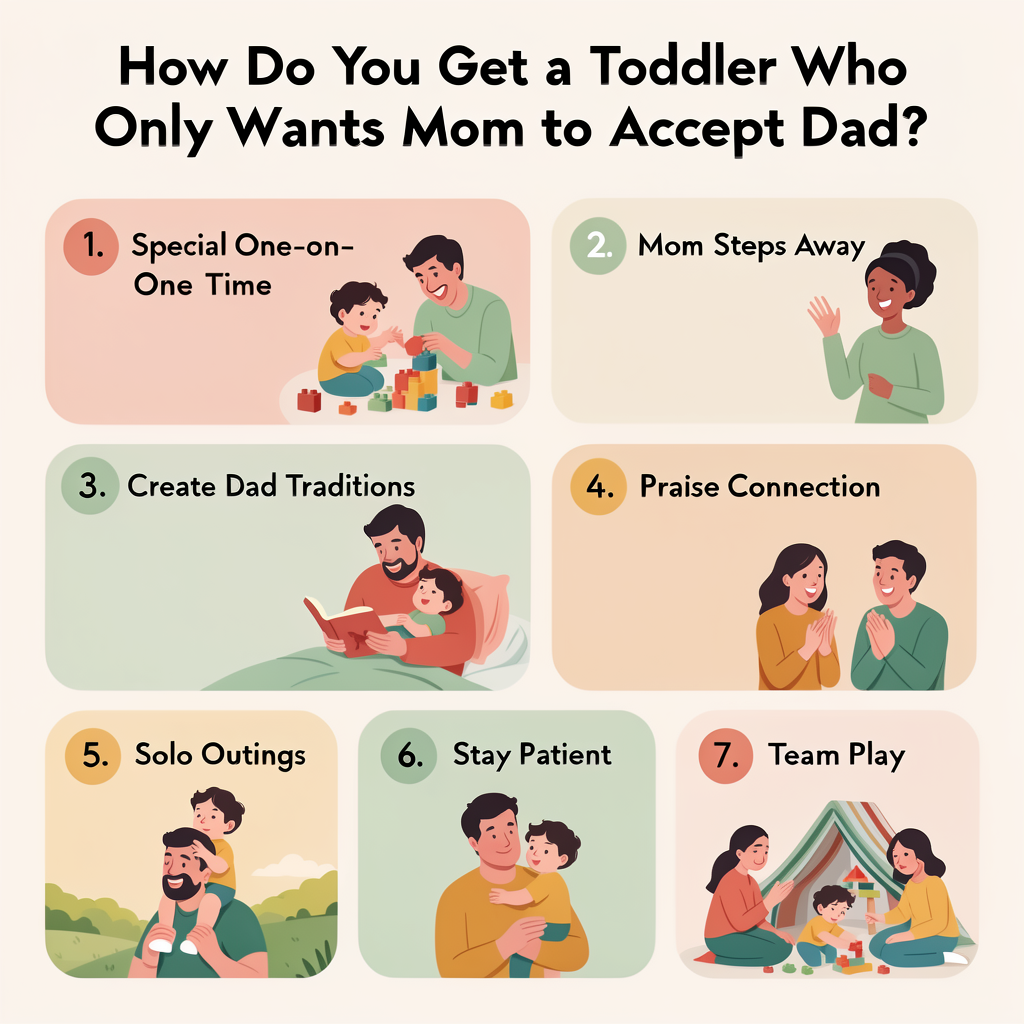
How Do You Get a Toddler Who Only Wants Mom to Accept Dad? (7 Practical Solutions)
A toddler only wants mom for reasons rooted in familiarity and repetition, not love, so the fix isn’t one big fix, it’s seven small, repeatable habits that gradually expand the child’s sense of who’s safe. Each works independently and compounds when used together.
- Give Dad one repeatable, low-pressure routine to own completely : Pick a single task shoes, bath, the car seat buckle and have Dad do only that, consistently, with no pressure to also take over bedtime.
- Use calm, predictable scripts instead of forcing affection : Lines like “You want Mom. Dad is going to help you, and I will stay nearby” keep the boundary steady without demanding a hug.
- Follow the gradual handoff ladder instead of jumping straight to separation : Move from both parents together, to Dad leading with Mom visible, to Mom briefly stepping out, to Dad completing a routine solo.
- Never sneak away, always announce goodbyes clearly : A short, one-time goodbye builds more trust over time than slipping out unnoticed, which tends to make the next separation harder.
- Build in protected, predictable breaks for the preferred parent : A 20-minute shower at the same time every evening, framed the same way each time, becomes routine instead of a fight.
- Validate the toddler’s feelings without reversing the plan : Acknowledging “you want Mommy, I know” and following through on the handoff anyway teaches the child the plan is stable, even when the feeling is real.
- Create a connection ritual that belongs only to Dad : A specific high-five, song, or bedtime-book rule that Mom doesn’t do gives the child something predictable to associate with Dad, separate from Mom’s routines.
What Is the Best Way to Rebuild a Connection With a Toddler Who Only Wants Mom?
If you’re looking into how to bond with toddler behavior like this, the fastest path is small, low-pressure, repeated moments where the non-preferred parent follows the toddler’s interests instead of demanding affection back, sitting nearby, joining play, being available after a hard moment, without needing a hug as proof it’s working.
Start with connection, not competition
Trying to “win” the toddler back with a big outing or a pile of gifts rarely works as well as showing up small and often. Connection in this age group is built through repetition, not intensity.
Follow the child’s interests without demanding affection
Sitting down next to the toddler’s blocks, narrating what they’re doing, or just being present without asking for a hug in return removes the pressure that often triggers rejection in the first place. Kids this age respond to parents who join their world rather than parents who ask to be let into it.
Create a repeatable ritual
A specific, small, repeated tradition a particular high-five, a specific song on the way to the car, a “you pick the book” rule at bedtime that’s only Dad’s, gives the toddler something predictable to associate with that parent, separate from Mom’s routines entirely.
Let the child see both parents cooperating
Toddlers pick up on tension between parents more than adults tend to assume. Seeing Mom and Dad work together calmly during a handoff, instead of one parent looking frustrated or the other looking guilty reassures the child that both relationships are safe, even during a preference phase.
Notice connection that is not verbal or cuddly
Connection doesn’t always look like a hug. Sitting nearby during a snack, bringing over a specific toy, helping with shoes without being asked, or just being the calm presence after a tantrum all count, even if the toddler never says “I love you, Dad” out loud during this stretch. The non-preferred parent should keep showing up without withdrawing after rejection, but also shouldn’t turn every small interaction into a test of whether the relationship is “working.”
What Should I Remember When My Toddler Only Wants Mom?
A toddler only wants mom during a phase like this for reasons rooted in comfort and repetition, not love, and it’s genuinely common, not a sign that anything is broken in your child, your marriage, or your parenting.
This is a preference, not a verdict
A toddler choosing one parent during a hard moment is not the same as loving the other parent less. It’s a comfort response, not a scorecard closely related to the emotional regulation skills toddlers are still building at this age.
Comfort can be transferred gradually
Through repeated, low-pressure exposure not force, not guilt, not one big gesture, a toddler’s sense of who’s safe expands to include both parents over time.
Both parents deserve support
The rejected parent’s hurt is real, and the preferred parent’s exhaustion is real. Neither cancels the other out, and both need acknowledgment, not competition over who’s struggling more.
The goal is flexibility, not forced equal affection
The point isn’t to make your toddler stop wanting Mom, and it isn’t to force identical affection toward both parents on a schedule. It’s to help your child learn, through repeated safe experiences, that Dad or another caregiver can also provide comfort, care, play, and dependable boundaries, so the family has more than one safe harbor instead of just one.
Frequently Asked Questions
Why does my toddler only want Mom?
It’s usually about familiarity and repetition, not love. Whichever parent has handled the highest number of routines bedtime, feeding, comfort during illness, often becomes the “known sequence” a toddler’s brain defaults to under stress.
How do I get my toddler to accept Dad?
Parents searching how do I get my toddler to accept dad when they only want mom usually get further with short, repeated, low-pressure interactions than with forced affection or a single big effort. Dad taking ownership of one specific routine, consistently, tends to work better than trying to do everything at once.
Is it normal for a toddler to prefer one parent?
Yes. According to the American Academy of Pediatrics, strong caregiver preference and separation anxiety are a normal developmental stage in toddlers, typically easing as children build independence.
When should I worry about my toddler rejecting Dad?
If the child seems genuinely fearful freezing, panicking, or persistently avoiding that parent even in calm moments, or if the distress is preventing ordinary daily routines, it’s worth discussing with your pediatrician.