Baby Wakes Up Every Time I Put Them Down? +5 Proven Fixes
Baby Wakes Up Every Time You Put Them Down (Why + Fix)

- Why Does My Baby Wake Up as Soon as I Put Them in the Crib?
- What Changes When a Sleeping Baby Leaves Your Arms?
- Could the Startle Reflex Wake My Baby?
- How Do I Put My Sleeping Baby Down Without Waking Them?
- What Is the Safest Transfer Technique?
- Should I Put My Baby Down Bottom-First?
- Is My Baby Waking Because They Are in Light Sleep?
- What Signs Suggest My Baby Is Deeply Relaxed?
- Why Does My Baby Wake 10 or 20 Minutes After the Transfer?
- Should I Put My Baby Down Drowsy But Awake?
- How Do I Practice Drowsy-But-Awake Settling Gently?
- What if My Baby Wakes Up Every Time I Put Them Down?
- Why Will My Baby Only Sleep When Held?
- Is Holding My Baby to Sleep Creating a Bad Habit?
- How Can I Move From Contact Sleep to Crib Sleep Gradually?
- Could Hunger, Reflux, Gas, or Illness Be Waking My Baby?
- How Can I Tell a Transfer Wake From a Discomfort Wake?
- When Should I Call the Pediatrician?
- What Safe-Sleep Rules Must I Follow When My Baby Wakes During a Transfer?
- What Should Be in the Crib or Bassinet?
- What Should Never Be Used as a Transfer Shortcut?
- What Should I Do If I Am Too Exhausted to Keep Trying the Transfer?
- How Can I Make Tonight Safer?
- What Real Parents Say
- What Should I Try First If My Baby Wakes Every Time I Put Them Down?
- What if the First Method Doesn’t Work?
- What Should I Remember When My Baby Wakes Every Time I Put Them Down?
- Frequently Asked Questions
- Why does my baby wake up as soon as I put them in the crib?
- How do I put my sleeping baby down without waking them?
- Why will my baby only sleep when held?
- When should I worry if my baby wakes every time I lay them down?
Medical Disclaimer: This article offers general information, not a diagnosis or personalized sleep plan. Always follow current safe-sleep guidance, and contact your baby’s healthcare professional if waking occurs with breathing difficulty, fever, poor feeding, persistent vomiting, unusual lethargy, signs of pain, or other concerns.
Your baby is finally asleep. Heavy in your arms, breathing slow, that perfect warm weight against your chest. You stand up carefully. You take the eleven steps to the crib like you’re defusing a bomb. You bend your knees instead of your back, because someone on Instagram told you that matters. You lower them down in slow motion, hold your breath, start to pull your hands away, and their eyes snap open.
Then you start again.
If you’ve done this cycle four, six, ten times in one evening, you’re not doing anything wrong. “Baby wakes up every time I put them down” is one of the most common searches typed into Google at 2 a.m, right alongside “newborn wakes when laid down” and “baby wakes when put down” and it’s not because you’re a bad “transferer.” It’s because a lot changes for your baby in the two seconds between your arms and the mattress.
Baby wakes up every time I put them down because the transfer triggers a sudden loss of warmth, movement, and caregiver contact, especially during light sleep phases. To successfully transfer your baby to the crib, follow these steps:
- Ensure safe sleep: Always place them back-only on a firm, flat, empty surface.
- Time the transfer: Wait 20 minutes until they enter deep sleep (limp limbs, steady breathing).
- Lower them slowly: Let their feet and bottom touch the mattress first, then their head, to avoid triggering the Moro reflex.
- Keep pressure: Leave your hand on their chest for a few moments to mimic your contact before pulling away.
Note: Consult your pediatrician if the waking is accompanied by illness, pain, feeding issues, or breathing concerns.
Why Does My Baby Wake Up as Soon as I Put Them in the Crib?
Your baby wakes up when transferred to crib because the transfer changes several sensory conditions at the exact same moment, not just one. They go from a warm, moving, familiar body to a cooler, still surface. Their position and the pressure around them shift. That sudden shift can interrupt light sleep or trigger a startle response, and none of it means your baby dislikes the crib.
It helps to picture it from their side. Your baby didn’t fall asleep in a vacuum. They fell asleep inside a whole environment. your heartbeat, your scent, your movement, the gentle pressure of being held. The crib mattress, however soft the sheet, is a completely different environment. Babies are sensitive to that difference in a way most adults have forgotten how to notice.
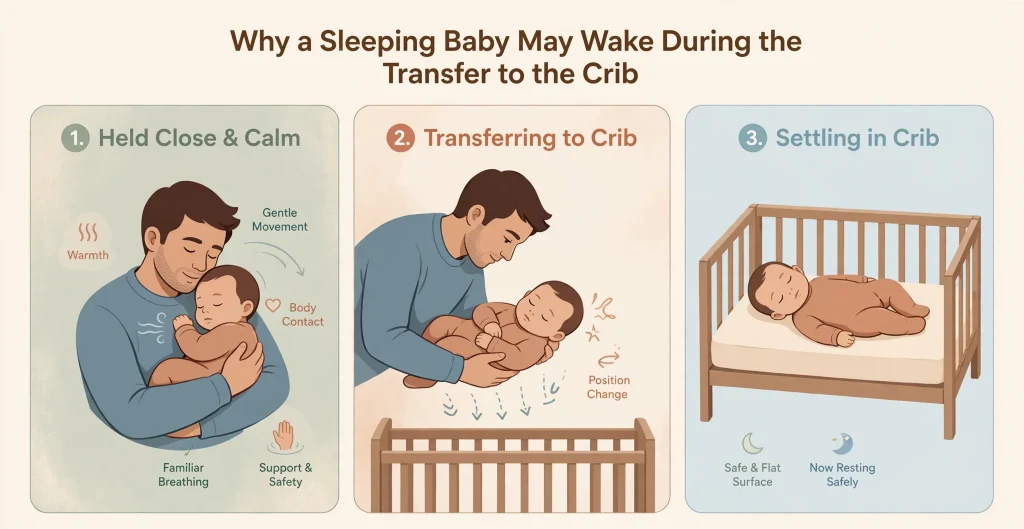
This doesn’t mean the crib is doing something wrong, and it doesn’t mean you’ve created a bad habit by holding your baby. It means the gap between “asleep in arms” and “asleep on mattress” is just wider than it feels like it should be.
What Changes When a Sleeping Baby Leaves Your Arms?
A lot happens at once, and most of it is invisible to you:
- Warmth becomes a cooler surface
- Movement becomes stillness
- A curved, supported body position becomes flatter
- Contact pressure disappears
- Familiar breathing and your voice become quieter, or go away entirely
- The head and body may shift slightly during the lowering itself
None of these changes is dangerous. But stacked together, in the space of a few seconds, they’re often enough to nudge a lightly sleeping baby back toward waking.
Could the Startle Reflex Wake My Baby?
The baby startle reflex, also called the Moro reflex can absolutely be part of what wakes your baby, though it doesn’t explain every single transfer wake. Sudden movement, a change in head position, or the sensation of being lowered can trigger it, causing your baby’s arms to fling out and often jolting them awake.
Read the section about the Moro Reflex: The “Falling” Alarm, in our article about why your baby won’t sleep unless Held?
According to the American Academy of Pediatrics, the Moro reflex is one of several newborn reflexes present from birth, and like other newborn reflexes, it fades over the first several months as your baby’s nervous system matures. I’m not going to hand you an exact week it disappears, because that varies baby to baby, but if your newborn or young infant startles hard on the way down, this reflex is a real, physical reason, not a sign you did the transfer “wrong.”
How Do I Put My Sleeping Baby Down Without Waking Them?
You can improve your odds, not guarantee a smooth transfer by prepping the sleep space first, keeping your baby’s body close to yours as you lower them, avoiding sudden position changes, placing them on their back, and keeping a calm hand nearby for a few seconds if that helps. No technique works every single time, and that’s normal, not a sign you’re doing it wrong.
I want to be honest with you here, because a lot of articles promise a “foolproof” method and then you feel like a failure when it doesn’t work at 1 a.m. There isn’t one. There’s a set of things that stack the odds in your favor.

What Is the Safest Transfer Technique?
- Check the space: make sure the sleep space is ready and completely empty before you even start rocking
- Keep the airway visible: your baby’s face and airway should stay in view the entire time
- Lower slowly: keep your body close to theirs as long as possible on the way down
- Back only: place them on their back, always
- Hold briefly: rest a calm hand on their chest or tummy for a few seconds, if that seems to help
- Release gradually: remove your hands slowly, then leave the sleep space clear
Learn how how to transfer a sleeping baby to the crib without waking them, by reading our article about transferring your sleeping baby to a crib without waking up in 3 easy steps.
Skip anything that adds softness to close the gap no pillow behind their back, no rolled towel wedged at their side, no loose blanket tucked around them, no stuffed animal “just to keep them company,” and no sleep positioner or inclined product. It’s tempting when you’re desperate for one more hour of sleep. It’s also not worth the risk, and I’ll get into exactly why further down.
Should I Put My Baby Down Bottom-First?
Bottom-first lowering is a commonly suggested technique, not a medically proven guarantee, and it works better for some babies than others. The idea is that landing the heavier part of the body first reduces the sensation of sudden falling. Some parents swear by it; other parents find head-and-shoulders-first, or a smooth diagonal lower, works better for their baby. What matters far more than the exact order is that your baby ends up flat on their back on a bare, firm surface.
Is My Baby Waking Because They Are in Light Sleep?
Babies cycle through lighter and deeper sleep stages more often than adults do, and they’re genuinely easier to disturb during the lighter stages. That’s likely part of why a transfer that works beautifully one nap fails completely the next, your baby simply wasn’t at the same depth of sleep both times. There’s no reliable number of minutes that guarantees they’ve reached deep sleep.
What Signs Suggest My Baby Is Deeply Relaxed?
You can watch for a few cautious signs, though none of them is a guarantee:
- Hands and facial muscles look relaxed, not clenched or twitchy
- Breathing is slow and even
- There’s noticeably less squirming or startling
- Their whole body feels settled rather than actively adjusting against you
These signs can shift your odds. They shouldn’t become a rule you follow instead of your baby’s actual needs, don’t delay a feed or ignore fussing just because you’re “waiting for deep sleep.”
Why Does My Baby Wake 10 or 20 Minutes After the Transfer?
A delayed wake often points to a sleep-cycle transition, hunger, discomfort, being overtired, or a mismatch between the conditions your baby fell asleep in and the conditions they find when they briefly surface. It’s sometimes called a “false start” a short first sleep cycle that ends with your baby checking whether their environment is still safe and familiar.
If your baby always seems to resurface around the same window, that’s useful information. It often means the environment they land in quiet room, no rocking, no contact, doesn’t match what they fell asleep to closely enough yet, and gradually narrowing that gap tends to help more than starting the whole bedtime routine over from scratch.
Should I Put My Baby Down Drowsy But Awake?
Drowsy but awake can be worth practicing for some babies, but it’s not a requirement, and it won’t work at every age or for every single sleep. Think of it as one settling option among several, not a test you’re failing if your baby only sleeps well when rocked all the way down. Some nights it works. Some nights it doesn’t. Both are normal.
How Do I Practice Drowsy-But-Awake Settling Gently?
If you want to try it, a gentler approach tends to go better than an all-or-nothing switch:
- Start with one relatively easy sleep period often a daytime nap, not the hardest bedtime stretch
- Use the same short, predictable routine each time
- Put your baby down when they’re calm and sleepy, not already distressed or overtired
- Stay close by, and offer your voice or a hand if that seems to settle them
- Pick them up and comfort them whenever they genuinely need it
- Try again another day, if everyone baby included is getting overwhelmed
I want to be clear that this isn’t a script for cry-it-out. Gentle settling, graduated check-ins, and more structured sleep-training methods are different approaches with different comfort levels for different families, and the right one depends on your baby’s age, health, feeding needs, and your own capacity right now. None of them is mandatory.
What if My Baby Wakes Up Every Time I Put Them Down?
When a transfer fails completely, a calm reset usually works better than repeating a frantic lowering again and again:
- Pause for a moment if they’re only stirring and stay calm yourself
- Try the least stimulating support first a hand, your voice, a pause before picking up
- Pick your baby up and soothe them if the crying escalates
- Check hunger, diaper, temperature, and general comfort
- Reset the routine rather than repeating the same frantic transfer on a loop
Why Will My Baby Only Sleep When Held?
Many young babies settle more easily with warmth, motion, contact, and feeding, because that’s the environment they’re wired to expect after nine months inside you. A baby who only sleeps when held is sleeping in the environment that feels safest to them, but it can become exhausting for you, and it carries real risk if the person holding the baby also falls asleep. Needing contact to sleep isn’t proof of a bad habit, and it isn’t a parenting failure, it’s a very common stage.
Is Holding My Baby to Sleep Creating a Bad Habit?
You can hold and comfort your baby and gradually work on crib sleep, these aren’t opposites. I’d be careful of any claim that holding your baby “always” creates a permanent sleep association, or that every baby must learn to self-settle immediately. Some babies transition to crib sleep easily around a few months old; others need longer, and that’s not a reflection of anything you did wrong.
How Can I Move From Contact Sleep to Crib Sleep Gradually?
A staged approach tends to feel less overwhelming than an abrupt switch:
- Keep some contact: hold onto contact naps or cuddles if they’re safe and manageable for you
- Pick the easy window: practice one crib sleep during the time of day your baby is most receptive
- Match the cues: use the exact same settling cues you’d use in your arms
- Taper slowly: reduce the amount of movement or holding little by little
- Stay responsive: keep responding when your baby genuinely needs comfort
- Stay flexible: adjust the whole plan if feeding, illness, or a developmental leap changes things
Could Hunger, Reflux, Gas, or Illness Be Waking My Baby?
Discomfort and unmet physical needs can absolutely wake a baby, so it’s worth pausing before assuming every single transfer wake is purely a sleep-association issue. Reflux, gas, hunger, congestion, fever, and pain all call for different responses than a sensory-transfer wake does, and anything persistent or concerning deserves a pediatrician’s opinion rather than a guess from an article.
How Can I Tell a Transfer Wake From a Discomfort Wake?
I use a rough, cautious comparison, not a diagnosis:
| What You See | Likely Cause | What To Do |
|---|---|---|
| Wakes the instant they touch the mattress | Sensory change, startle reflex, or loss of contact | Try a slower, closer transfer next time |
| Wakes repeatedly with back-arching, painful-sounding crying, or vomiting | Possible reflux or discomfort | Worth discussing with your pediatrician |
| Wakes with rooting or strong feeding cues | Hunger | Consider your baby’s age-appropriate feeding needs |
| Wakes with congestion, fever, a rash, or behavior that seems “off” | Possible illness | Get it checked by your pediatrician |
I want to say this plainly: crying alone doesn’t tell you it’s reflux. Reflux, gas, and other medical explanations need an actual evaluation, not a guess based on how upset your baby sounds during a hard transfer.
When Should I Call the Pediatrician?
Seek urgent care for breathing difficulty, blue or gray coloring, severe lethargy, signs of dehydration, or repeated forceful vomiting, or if your baby simply seems seriously unwell to you. For non-urgent but persistent concerns, contact your baby’s clinician about ongoing pain, feeding problems, poor weight gain, or sleep disruption that’s significantly affecting your baby or you.
What Safe-Sleep Rules Must I Follow When My Baby Wakes During a Transfer?
According to the AAP, babies should sleep on their backs, on a firm, flat, non-inclined surface, in their own separate sleep space, with nothing else in it no loose blankets, pillows, bumpers, stuffed toys, or other soft objects. This is the foundation everything else in this article sits on top of. No transfer trick, no settling method, and no amount of exhaustion changes it.
What Should Be in the Crib or Bassinet?
- A safety-approved crib, bassinet, or portable play yard
- A firm, flat mattress
- A fitted sheet, and nothing else
What Should Never Be Used as a Transfer Shortcut?
It’s worth naming these directly, because exhaustion makes shortcuts tempting:
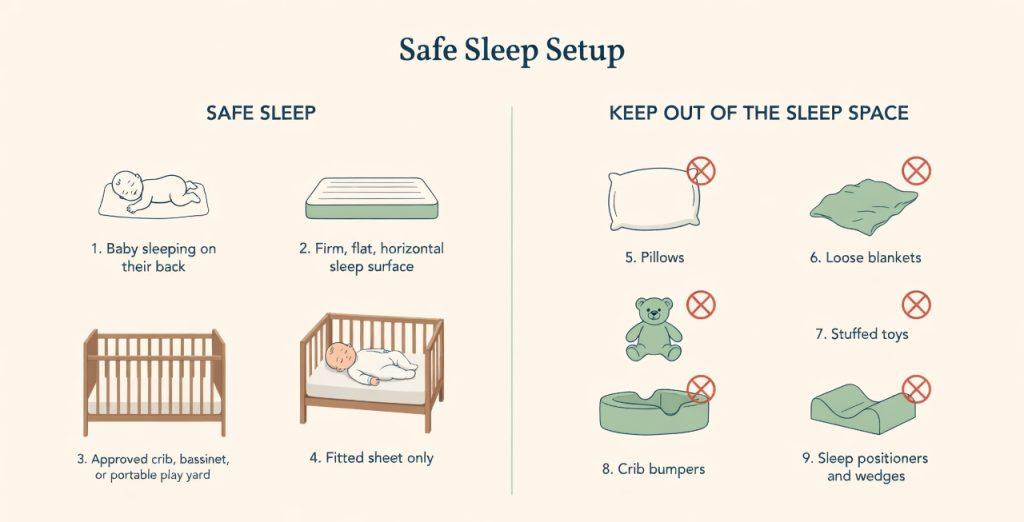
- Sleeping on a sofa, armchair, or adult bed
- Pillows, wedges, positioners, or rolled towels used to “prop” your baby
- A loose blanket or shirt left in the sleep space
- Weighted swaddles or weighted sleep products
- Letting your baby sleep in a swing, bouncer, or car seat outside of actual travel
- Continuing to swaddle once your baby shows any sign of trying to roll
According to the AAP, swaddling does not remove the need for back sleeping, and swaddling should stop once an infant shows signs of attempting to roll.
What Should I Do If I Am Too Exhausted to Keep Trying the Transfer?
Stop the experiment. Put your baby down on their back in the safe, empty crib or bassinet, and ask another adult for help if anyone is available. If you’re the one holding your baby and you can feel yourself starting to drift, that’s the moment to put them down safely rather than keep rocking on the couch or in a chair.
⚠️ Critical Safety Note: A caregiver who falls asleep while holding a baby on a couch or armchair creates one of the highest-risk sleep situations there is far riskier than a baby briefly fussing in an empty, safe crib. If you feel yourself drifting off mid-rock, put your baby down safely and ask for help. Protecting your own sleep protects theirs.
How Can I Make Tonight Safer?
- Put your baby on their back in the empty crib or bassinet
- Turn on a light if that helps you stay alert
- Ask a partner, relative, or trusted person to take a shift
- Skip driving anywhere if you’re dangerously sleep-deprived
- Don’t reach for an unsafe surface just because the transfer is hard tonight
This isn’t meant to scare you. It’s meant to protect you from the moment where exhaustion turns a frustrating sleep problem into an unsafe one, which happens to caring, careful parents more often than anyone likes to admit.
What Real Parents Say
I’ve spent a lot of time in parenting forums looking for what actually helps with this, beyond the generic “wait until they’re deeply asleep” advice every site repeats. A few themes come up again and again from real parents dealing with this same 2 a.m. cycle.
Many describe waiting for their baby’s body to feel fully limp and relaxed before even starting the lower. Others mention that laying their baby down bottom-first, or keeping a hand pressed gently on the chest for the first minute, made a noticeable difference for their particular baby. Some found that a pacifier helped bridge the gap between arms and crib. A number of parents also talk about practicing just one crib nap a day instead of trying to fix every sleep at once, and accepting that their baby simply needed more contact for a stretch of weeks or months before crib sleep clicked.
I want to be upfront that this is anecdotal, not medical evidence. What worked for one baby in a Reddit thread isn’t a guarantee for yours. But when so many exhausted parents independently land on the same handful of things go slow, minimize the sensory gap, accept that some babies need more time, it’s worth paying attention to, even without a clinical study behind it.
In our home, what finally helped wasn’t one trick. It was slowing everything down by about half, keeping my hand on my daughter’s chest for a full minute after she landed instead of pulling away right away, and accepting that some naps were just going to be contact naps for a while. That’s not a formula. It’s just what worked for us, and I share it as one data point, not a promise.
What Should I Try First If My Baby Wakes Every Time I Put Them Down?
Start with the basics before troubleshooting anything more complicated: confirm your baby is fed and comfortable and not showing signs of illness, prepare a safe and empty sleep space, use a calm and consistent pre-sleep routine, and try one gentle transfer technique. If they wake, offer low-stimulation support first rather than immediately restarting the whole routine, and change only one variable at a time so you can actually tell what helped.
- Rule out basic needs: confirm your baby is fed, comfortable, and showing no signs of illness
- Prep the space: set up a safe, empty sleep space in advance
- Keep the routine calm: use a consistent pre-sleep routine every time
- Commit to one technique: try one gentle transfer method fully before switching approaches
- Respond gently: if they wake, offer low-stimulation support before starting over completely
- Change one thing at a time: so you actually know what helped
- Know when to stop: reset if either of you is becoming overwhelmed
What if the First Method Doesn’t Work?
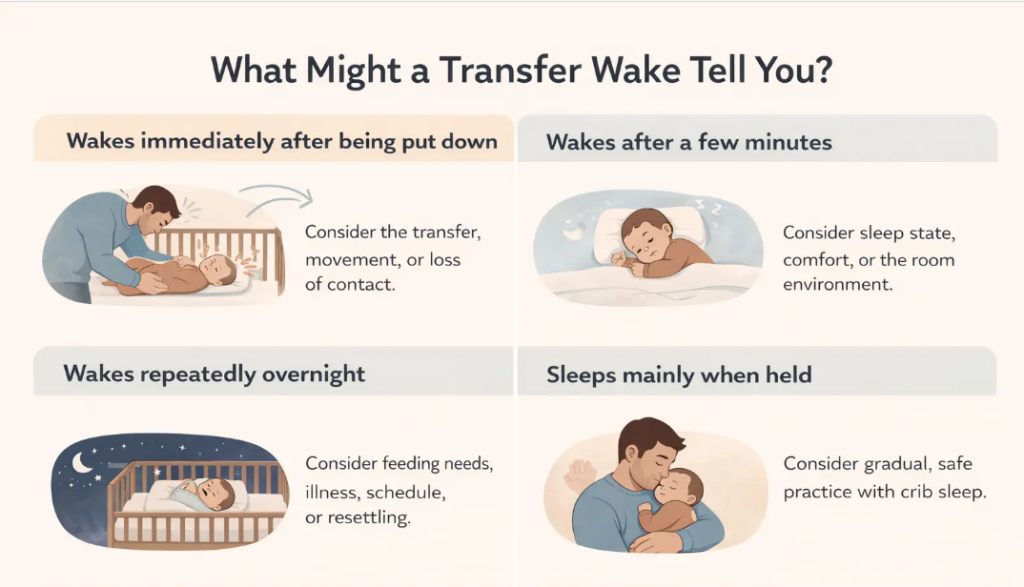
A failed transfer is information, not evidence that you’re doing something wrong. The timing of the wake usually tells you where to look next:
- Wakes instantly: focus on the movement, position, and loss-of-contact change
- Wakes after a few minutes: consider sleep state, discomfort, or the room environment
- Wakes repeatedly overnight: consider feeding, illness, schedule, and how easily they resettle
- Sleeps only while held: introduce gradual, safe practice rather than an abrupt withdrawal of contact
What Should I Remember When My Baby Wakes Every Time I Put Them Down?
This pattern usually reflects a real, temporary sensory and developmental transition, not parental failure, and not a permanent problem. You don’t have to choose between comforting your baby and slowly improving crib sleep. You can protect safe sleep, respond to their real physical needs, introduce gradual practice at a pace that works for your family, and ask for professional help the moment exhaustion or symptoms make things feel unsafe.
If your baby has breathing difficulty, fever, poor feeding, persistent vomiting, signs of pain, unusual lethargy, dehydration concerns, or you’re worried about their development or sleep safety, contact your pediatrician or local medical service. This article cannot diagnose the reason for your baby’s waking.
Frequently Asked Questions
Why does my baby wake up as soon as I put them in the crib?
The transfer changes several sensory conditions at once warmth, movement, body position, pressure, and contact all shift together, which can interrupt light sleep or trigger a startle response. It’s a common, temporary pattern, not a sign your baby dislikes the crib.
How do I put my sleeping baby down without waking them?
Prep the sleep space first, keep your baby close to your body while lowering them, avoid sudden position changes, place them on their back, and keep a calm hand nearby briefly if it helps. No technique guarantees success every time.
Why will my baby only sleep when held?
Many young babies settle more easily with warmth, motion, and contact because that’s what they’re used to. It can become exhausting and unsafe if the caregiver also falls asleep, but it isn’t proof of a bad habit or a parenting mistake.
When should I worry if my baby wakes every time I lay them down?
Worry less about the transfer itself and more about accompanying symptoms breathing difficulty, fever, persistent vomiting, poor feeding, signs of pain, or unusual lethargy are reasons to contact your pediatrician promptly.