Overwhelmed? Nervous System Regulation for Moms: 5 Quick Fixes
Overwhelmed? Nervous System Regulation for Moms (5 Resets That Actually Work)

- Why I Started Learning About Nervous System Regulation for moms
- What Nervous System Dysregulation Actually Feels Like as a Mom
- Signs Your Nervous System Is Overloaded
- Why Is Nervous System Regulation So Hard for Moms Right Now?
- What Happens in Your Brain During Mom Overwhelm?
- How to Regulate Nervous System as a Mom
- 1. The Physiological Sigh
- 2. The Cold Water Reset
- 3. Humming or Low Sound
- 4. Name It Out Loud
- 5. The 90-Second Rule
- How to Calm Nervous System When Overwhelmed as a Mom
- A Daily Nervous System Regulation Routine for Moms
- What Are Parents Actually Saying About This?
- Is Mom Rage a Nervous System Issue?
- When to Seek Help
- Frequently Asked Questions
- Is mom rage a nervous system issue?
- How to calm nervous system when overwhelmed as a mom?
- How long does it take to regulate your nervous system?
- Is it normal to feel touched-out or overstimulated as a mom?
- Nervous System Regulation for Moms: The Bottom Line
Medical Disclaimer: This article is for informational purposes only and is not a substitute for professional medical or mental health advice. If you’re experiencing persistent rage, panic, or thoughts of harming yourself or your child, please talk to a doctor or licensed therapist right away.
Your hands are shaking a little. Your jaw is tight. Your kid asked you the same question four times in ninety seconds and something in your chest just flipped a switch you didn’t choose. That’s not you “losing it.” That’s nervous system regulation for moms breaking down in real time, and it’s one of the most common, least talked-about parts of motherhood.
Calming an overloaded nervous system as a mom means settling your body’s fight-or-flight response before it hijacks your reaction to your kids. The fastest resets a long exhale, cold water on your face, humming, or naming what’s happening out loud work in under 5 minutes because they talk directly to your vagus nerve, not your willpower. You don’t need 20 minutes of meditation. You need a tool you can use standing in the kitchen with a toddler attached to your leg.
Regulating an overwhelmed mom’s nervous system means calming the body’s fight-or-flight response using techniques like breathing, cold exposure, humming, and vagus nerve stimulation.
Why I Started Learning About Nervous System Regulation for moms
I didn’t go looking for any of this. I found it after yelling at my three-year-old over a spilled cup of milk, something so small it embarrassed me even as it was happening. The guilt hit almost instantly, that specific parent-guilt that shows up after the yelling, once the adrenaline drops and you’re left staring at your kid’s face.
For months I thought it was a willpower problem more meditation, more sleep, more discipline. In our home, none of that touched it, because I was treating a body problem like a mindset problem. It wasn’t until I read about the fight-or-flight response and realized the heat, the tight jaw, and the urge to leave the room were my sympathetic nervous system, not my character, that anything changed. Learning to regulate my nervous system as a mom didn’t make me calm overnight. It gave me a way to catch the wave thirty seconds earlier, and that’s where the whole day turns.
What Nervous System Dysregulation Actually Feels Like as a Mom
Nobody warns you that it feels physical, not emotional. In our home, it usually shows up as heat first a flush up the neck, then the jaw, then the hands. I used to think I was just “short-tempered.” I wasn’t. I was dysregulated, and I didn’t have a name for it yet.
- Your chest gets tight before your brain even registers why.
- Small noises (whining, a dropped cup, a sibling squabble) feel unbearably loud.
- You snap first and feel the guilt three seconds later, like watching a rerun.
- Your body wants to either yell, cry, or leave the room, sometimes all three at once.
- You feel “fine” one second and completely flooded the next, with no obvious trigger.
That flood has a name: it’s your sympathetic nervous system, the fight-or-flight branch taking over from your parasympathetic nervous system, the “rest and digest” branch that keeps you calm, patient, and present. Once you understand it that way, it stops being a character flaw and starts being a body state you can actually work with.
Signs Your Nervous System Is Overloaded
Common signs of nervous system dysregulation in mothers include jaw tension, noise sensitivity, mom rage, exhaustion, and feeling touched out.
Before the yelling or the tears, your body is usually already sending warning signals. Most moms don’t recognize these as nervous system overload, they just think they’re “having a bad day.” Watch for:
- Jaw clenching or grinding, especially in the afternoon
- Shallow, high chest breathing instead of slow belly breaths
- Feeling touched out, an almost allergic reaction to more physical contact
- The urge to hide in the bathroom for even 60 seconds of quiet
- Noise sensitivity, a sibling squabble suddenly feels unbearable
- Sudden tears over something objectively small
- Snapping at your children faster than you meant to
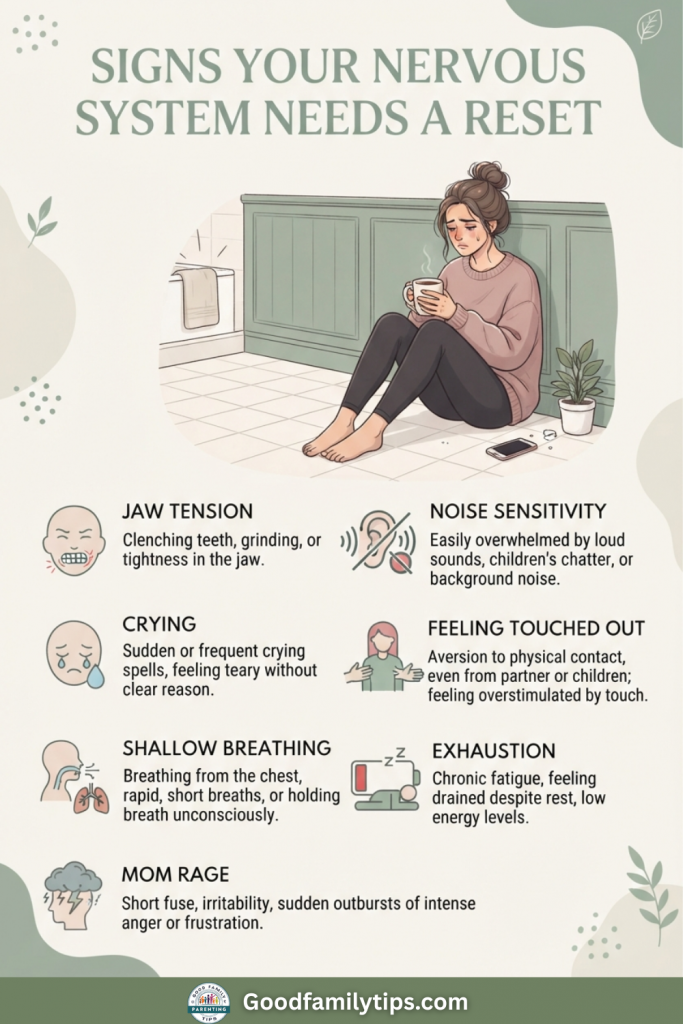
Save This, Signs Your Nervous System Needs a Reset: jaw clenched, snapping quickly, crying easily, hiding in the bathroom, feeling touched out, noise feels unbearable, exhausted after bedtime. If three or more of these show up on a regular day, your body isn’t asking for more discipline. It’s asking for a reset.
Why Is Nervous System Regulation So Hard for Moms Right Now?
This kind of body overload is harder for moms right now than it was for previous generations, and it’s not just in your head. According to the American Psychological Association’s Stress in America research, women consistently report higher average stress levels than men, and parents report a wider range of stressors than adults without kids. Motherhood adds a layer stress research doesn’t fully capture: your nervous system manages your own stress and monitors a small person’s.
A few reasons this hits moms hard: you’re never fully “off duty” (part of your brain listens for a cry even while sleeping, hypervigilance that keeps stress hormones elevated during rest); touch and noise saturation is real (constant contact and being “touched out” depletes sensory tolerance long before dinner); and decision fatigue compounds (hundreds of tiny choices by 4 PM leave your prefrontal cortex running low on fuel).
None of that means you’re doing it wrong. Your nervous system is doing exactly what it’s built to do under sustained load, it’s just built for short bursts of danger, not 14-hour shifts of low-grade chaos.
What Happens in Your Brain During Mom Overwhelm?
According to Harvard Health Publications, when your brain perceives a stressful event, your amygdala, the part that processes emotional threat, sends a distress signal that activates your stress response before you’ve consciously decided anything, triggering cortisol and adrenaline. That’s useful for a genuine emergency, less useful for a toddler refusing to put on shoes.
That same response works against your prefrontal cortex, the part responsible for patience and calm decision-making, the amygdala gets louder while the prefrontal cortex gets quieter, which is why you can know yelling won’t help and still feel the words leave your mouth anyway.
This overlaps with Polyvagal Theory, developed by neuroscientist Dr. Stephen Porges, which describes the nervous system moving between three states: calm and engaged, activated fight-or-flight, and, under extreme overwhelm, shutdown or “freeze.” Most mom-rage moments are your body swinging into that middle state, exactly why body-based tools like breath, cold, and sound work faster than thinking your way back to calm. You are not failing at parenting; your amygdala is doing its job a little too well.
How to Regulate Nervous System as a Mom
Knowing how to regulate nervous system as a mom starts with resets that work on your body directly, not your mindset first. Willpower and positive self-talk come after your body calms down not before. The five vagus nerve exercises for moms below all target the same nerve, the main highway between your brain and your body’s calm response and each one takes under five minutes.
The fastest way to regulate an overwhelmed mom’s nervous system is the physiological sigh: two short inhales followed by one long exhale.
1. The Physiological Sigh
Two inhales through your nose one long, one short then one long, slow exhale through your mouth. Repeat two or three times. The double inhale re-inflates collapsed air sacs, and the long exhale signals your vagus nerve to slow your heart rate. In our home, this is the one I use standing at the sink mid-meltdown.
2. The Cold Water Reset
Splash cool water on your face, or press a cold washcloth to your neck for 20–30 seconds. According to Cleveland Clinic, brief cold exposure triggers a reflex that can slow your heart rate and shift your body out of a stress state almost immediately. This is genuinely my emergency button.
3. Humming or Low Sound
Hum a low note for 15–20 seconds, gargle water, or sing under your breath. Your vagus nerve runs close to your throat, and low, sustained sound gently stimulates it, clinicians describe this as a low-effort, low-risk way to nudge your body toward calm.

4. Name It Out Loud
Say, quietly: “I’m dysregulated right now, not a bad mom.” Naming a state pulls activity toward the reasoning part of your brain and away from the pure reaction center.
5. The 90-Second Rule
A stress surge the wave of heat, tightness, and urge to react typically peaks and passes within about 90 seconds if you don’t feed it with more stress-thinking. Breathe. Let the wave move through instead of arguing with it or your kid.
How to Calm Nervous System When Overwhelmed as a Mom
If you’re reading this mid-meltdown, skip the theory. Here’s what it looks like in the actual moment:
- Stop talking. Even one silent breath is better than the sentence you’re about to say.
- Do the physiological sigh, two inhales through the nose, one long exhale.
- Get your hands on something cold, the fridge door, a glass of water, the faucet.
- Say the words: “I need 30 seconds” and step one arm’s length away if it’s safe to do so.
- Come back and repair, even briefly, “Mommy got too loud, I’m okay now, let’s try again.” Repair matters more than never losing your temper in the first place.
If you’re managing this pattern often, it’s worth reading our full guide on nervous system regulation for parents, which covers the deeper, daily-practice side of this, not just the emergency resets.
A Daily Nervous System Regulation Routine for Moms
Emergency resets stop a spike. A daily rhythm lowers your baseline so you have fewer spikes to stop in the first place, and most of it fits inside things you’re already doing.
| Time | Activity |
|---|---|
| Morning | Sunlight on your face within the first hour + a glass of water before coffee |
| Midday | A protein-forward lunch instead of skipping to your kids’ leftovers |
| Afternoon | 5–10 minutes of movement a walk, stretching, or pacing on a call |
| Evening | One physiological sigh before walking in the door or starting bedtime |
| Bedtime | Reduced screens for the last 30 minutes + water set out for morning |

None of this has to be perfect or daily. The goal is a nervous system that starts each day a little less depleted, so decision fatigue hits later and softer.
What Are Parents Actually Saying About This?
On parenting forums, the same threads come up again and again, moms on r/Mommit and r/beyondthebump describing the exact “heat rising” sensation before yelling, and finding relief in stepping outside for ten seconds or running cold water over their wrists. Several note that naming the state out loud (“Mommy needs a second”) visibly calms an anxious toddler too, since kids co-regulate off their parent’s nervous system, a pattern also described in family-attunement research out of places like the Yale Child Study Center. The takeaway: the tool doesn’t have to be fancy, just fast and repeatable at 6 PM with dinner burning.
This overlaps heavily with parental burnout, the slower version of the same overload. If snapping has become a daily pattern, our guide on parental burnout signs and how to recover without guilt walks through chronic depletion and how to climb out of it. Nervous system overload also shows up on the child’s side, our guides on emotional regulation in children and toddler tantrums cover the same fight-or-flight biology from your child’s perspective.
Is Mom Rage a Nervous System Issue?
Yes, mom rage is very often a nervous system issue, not a personality flaw or a sign you don’t love your kids enough. The sudden heat, the urge to yell, the feeling of being “hijacked” are classic signs of a sympathetic nervous system flood, the same fight-or-flight response your body uses for genuine danger, misfiring on a smaller trigger.
Why do moms yell when they don’t want to? Usually because the body has moved into fight-or-flight before the thinking brain gets a vote. Add overstimulation (constant touching, talking, noise) and sensory overload stacks on top of ordinary stress, so it takes less to tip over. The guilt after yelling isn’t a sign you’re a bad mom, it’s your prefrontal cortex coming back online and assessing the damage. Common overwhelmed mom symptoms the flush, tight jaw, urge to snap, flag that your body is over capacity, not that you’ve failed.
When to Seek Help
Most of this is normal, everyday nervous system overload. But reach out to a doctor or therapist if you’re experiencing:
- Intrusive thoughts that feel scary, repetitive, or out of your control
- Panic attacks, a racing heart or chest pain that comes on suddenly
- Uncontrollable rage that feels bigger than the moment or that you can’t stop
- Depression symptoms, persistent sadness, numbness, or loss of interest
- Feeling unsafe with yourself, or worried you might hurt yourself or your child
- Persistent dysregulation that doesn’t improve with rest or the tools above
None of these mean you’ve failed, they mean your nervous system needs more support than a five-minute reset can give. If you’re in the U.S. and need to talk to someone right now, call or text 988 (Suicide & Crisis Lifeline), available 24/7
Frequently Asked Questions
Is mom rage a nervous system issue?
Yes. Mom rage is typically your sympathetic nervous system (fight-or-flight) overriding your ability to respond calmly. It’s a body-state issue first, which is why breathing and cold-water resets work faster than trying to “think” your way calm.
How to calm nervous system when overwhelmed as a mom?
Stop talking, take one physiological sigh (two inhales through the nose, one long exhale through the mouth), and get your hands on something cold if you can. Those two steps alone shift most people out of a stress spike within about 30 to 90 seconds.
How long does it take to regulate your nervous system?
Fast resets like the physiological sigh or cold water shift your body within 30–90 seconds. Longer-term regulation building a higher baseline of calm, takes consistent daily practice, not one session.
Is it normal to feel touched-out or overstimulated as a mom?
Yes, it’s a very common and recognized experience tied to constant physical and sensory contact with young children. It doesn’t mean you don’t love your child, it means your sensory nervous system needs regular breaks to reset.
Nervous System Regulation for Moms: The Bottom Line
Motherhood asks your nervous system to do something it was never designed to do stay calm and patient while running on broken sleep, constant contact, and zero backup. Of course it misfires sometimes. That’s not a character flaw; that’s biology under a load it was never built to carry alone.
Nervous system regulation for moms isn’t about becoming a parent who never yells or never feels the heat rise. It’s about catching that wave a little earlier each time, having a tool ready when you can’t, and remembering that repair matters more than perfection. The moment after you snap coming back, getting down to their level, saying “I got too loud, I’m sorry, let’s try again”, teaches your child something valuable too: that people can lose their calm and still come back to each other. You are not the sum of your worst thirty seconds. You’re the mom who keeps learning how to come back.