

Contents
It is 2 a.m. and your toddler is wide awake, chatting, climbing, or calling for you, and you have to be up in five hours. If your toddler is awake for hours at night, you did not cause it, and it is common enough that parents write about it every day. Here is why it happens and the calm steps that help most.
This guide is part of our Baby & Toddler Sleep Guide: every sleep problem, by age.
TL;DR: A toddler awake for hours at night usually has not learned to get back to sleep alone, often because of long afternoon naps, an uneven bedtime routine, or needing a parent to fall asleep. The NHS advice: be as boring as possible, keep the lights off, and respond the same way every night.
We’re not doctors. This guide is general information; if your child seems unwell or you are worried, talk to your pediatrician or health visitor.
If you’re at your limit right now
- Keep the room dark and quiet. No lights, no screens, no play.
- Say one short, calm sentence (“It’s sleep time. I love you. Goodnight.”) and use the same one every time.
- If your toddler is safe and well, you do not have to go in at every sound.
- Ask your partner to take one night so you can sleep. Tomorrow’s plan works better when you are rested.
Why is my toddler awake for hours at night?
A toddler awake for hours at night is usually a toddler who woke, as all children do, and has not yet learned to fall back asleep alone. The NHS says many young children find it hard to settle and wake at night; long afternoon naps, an uneven bedtime, screens and needing a parent to fall asleep are common reasons.
Some sleep coaches call a long, happy, wide-awake stretch in the middle of the night a “split night”. Your toddler is not in distress; they are simply awake and ready to play.
The common causes, in the order to check them:
- Naps. The NHS says to avoid long naps in the afternoon. A late or very long nap leaves less sleep pressure at night.
- Total sleep. The American Academy of Sleep Medicine (AASM) says children aged 1 to 2 years need 11 to 14 hours per 24 hours including naps, and children aged 3 to 5 need 10 to 13 hours. A toddler who sleeps 12 hours at night and naps 3 hours has had 15 hours, above the range for 1 to 2 years, which is one reason to check nap length.
- Bedtime and routine. The AAP says a consistent bedtime and the same wake-up time every day help children know what to expect. The NHS suggests starting a winding-down routine about 30 minutes before the usual sleep time.
- Screens. The NHS says no laptops, tablets or phones in the 30 to 60 minutes before bed. The AAP says screens off at least 60 minutes before bed and out of the bedroom.
- Needing you to fall asleep. The AAP says children’s main goal is to get you to appear; if you come every time they call, they learn to expect it each time.
- Hunger. The NHS suggests a bowl of cereal and milk before bed (then brush teeth) if your child says they are hungry at night.
- Separation anxiety. The AAP says it can disrupt sleep for months in the second half of a child’s first year and usually fades somewhere around the second birthday.
Is it normal for a 2 year old to wake up every night and stay awake for hours?
Yes, waking at night is normal at 2, but a few hours awake every night is a signal to check the day. Look first at naps, total sleep, bedtime and your night response, then talk to your health visitor or pediatrician if it does not improve (NHS).
What should I do when my toddler wakes up and wants to play?
Be as boring as possible, leave the lights off, and take your toddler back to bed with as little fuss as you can. That is the NHS advice. The AAP adds that if your child is safe and well, you do not need to go in while they work out how to get back to sleep.
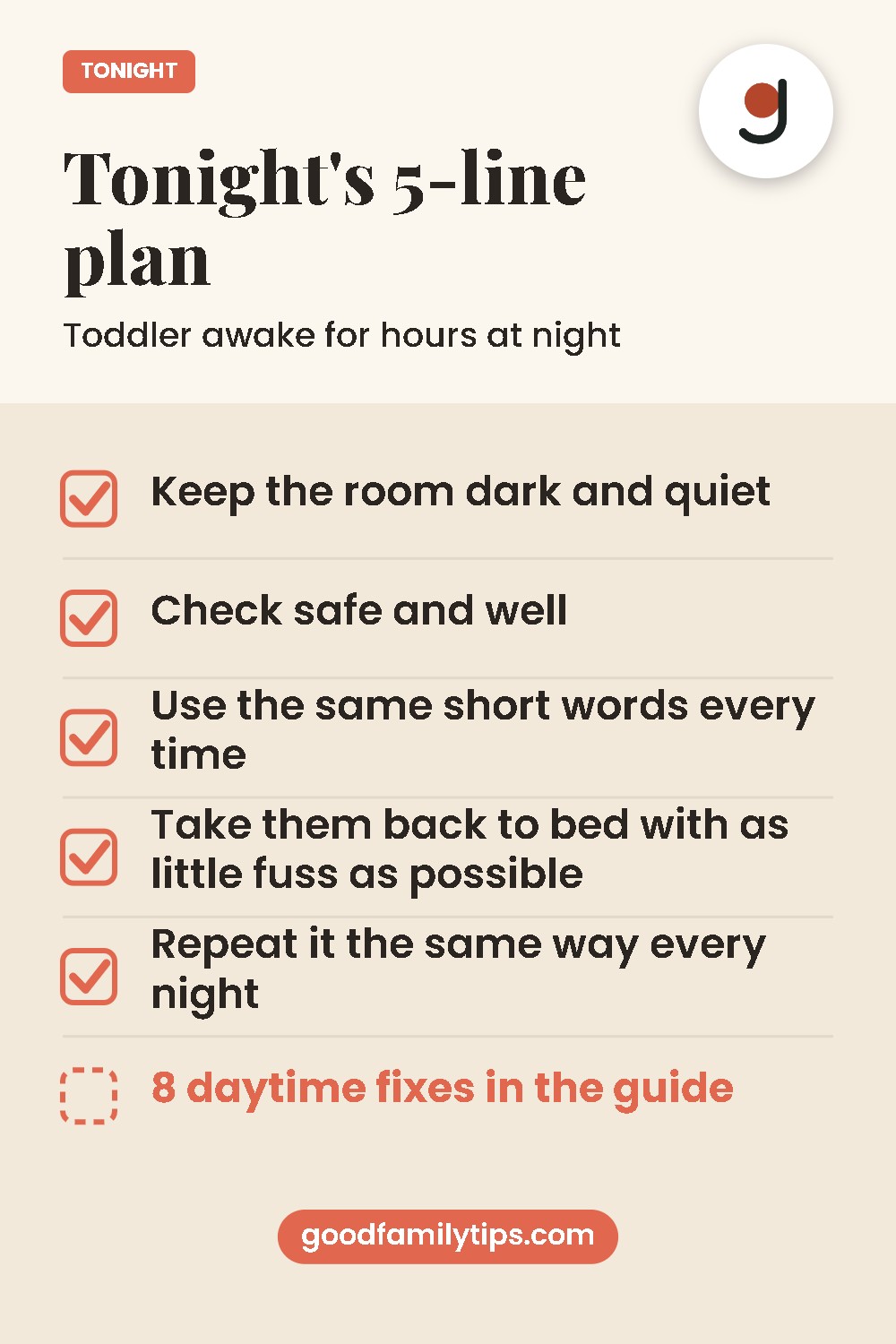
A simple night routine:
- Check safe and well. Dry, not too hot or cold, not hurt, not ill.
- Keep it dark and dull. No lights, no talking game, no toys, no screens.
- Use the same short words every time. “It’s sleep time. Goodnight.”
- If you have to go in, keep it brief. Lay them down, a pat or a word, leave. Do not sing, play or chat.
- If they get up, walk them back calmly, every time, with as little fuss as possible (NHS).
- Be consistent for several nights. The NHS says you may have to repeat the routine for several nights. Be patient: the AAP says a negative response can sometimes make a sleep problem worse.
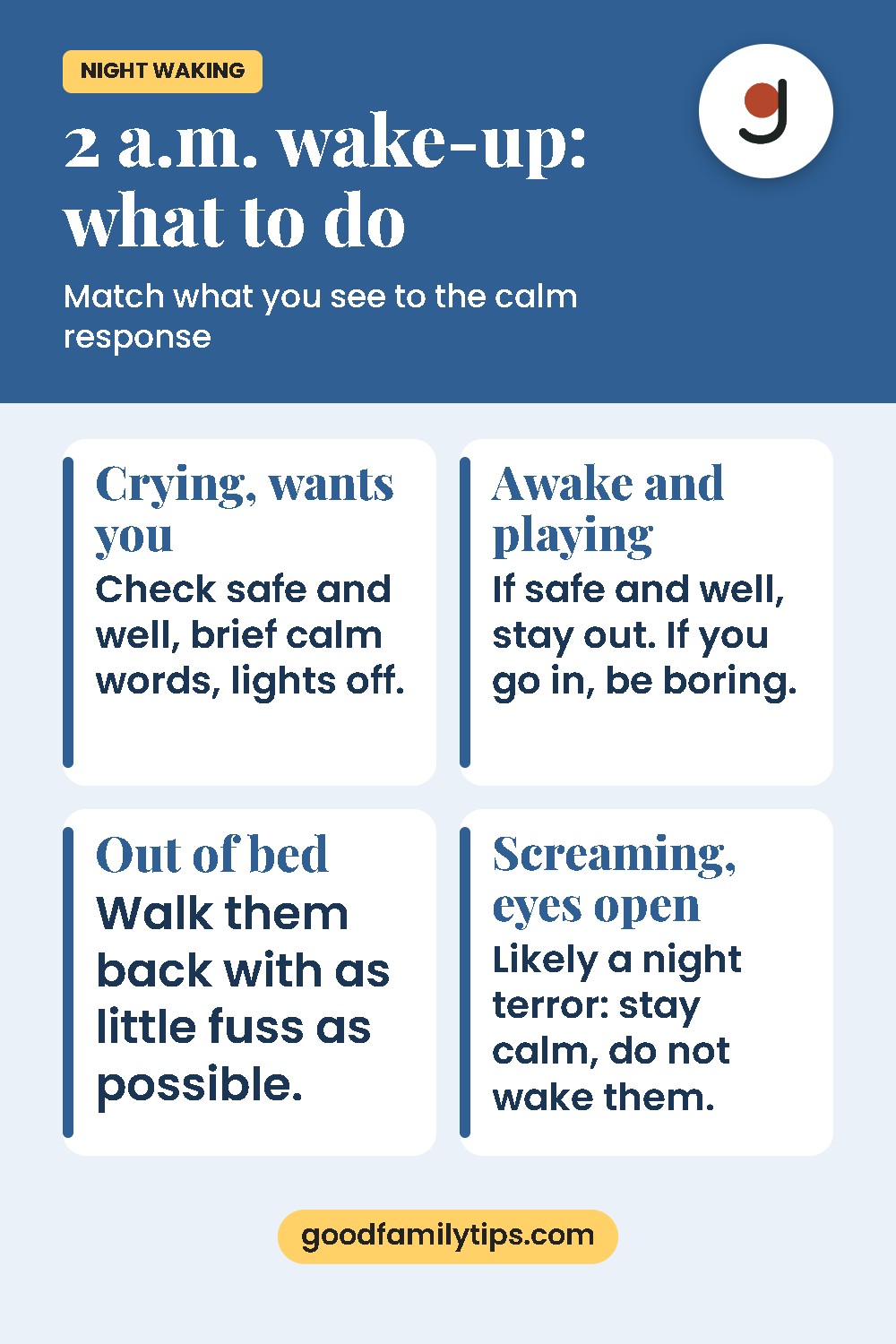
The 2 a.m. decision table
| What you see | What to do (source) |
|---|---|
| Crying, upset, wants you | Check they are safe and well, then give a brief calm reassurance with the same words and the lights off (NHS, AAP). |
| Awake and playing happily in the cot or bed | If safe and well, stay out and let them find their way back to sleep (AAP). If you go in, be boring (NHS). |
| Out of bed or at your door | Walk them back with as little fuss as possible, every time (NHS). Do not let them sleep in your bed (AAP). |
| Screaming or thrashing but eyes open and not responding, early in the night | Likely a night terror: stay calm, do not wake them, step in only for safety (NHS). |
| Wakes scared and can tell you about a bad dream | A nightmare: calm comfort, and a nightlight if they fear the dark (NHS). |
| Fever, pain, trouble breathing, or seems unwell | This is not a sleep problem: contact your pediatrician or health service. |
How do I stop the nightly wake-ups?
Fix the day first: one bedtime, a short calming routine, shorter afternoon naps, no screens before bed, and the same calm response every night. The AAP and NHS both stress routine and consistency over any trick.
- Pick one bedtime and one wake-up time and keep them every day, weekends too (AAP). To move bedtime earlier, the NHS suggests 5 to 10 minutes each week, or 15 minutes if your child is used to going to bed very late.
- Start a short, calming routine about 30 minutes before sleep (NHS): bath, pajamas, book, song, lights out, in the same order. Quiet activities only; active play can make a child too excited to sleep (AAP).
- Set a limit on how long you stay at bedtime, for example one story, then goodnight (NHS).
- Check naps. Avoid long afternoon naps (NHS). Add up naps and night sleep and compare with the AASM range for your child’s age.
- Turn screens off at least 60 minutes before bed and keep them out of the bedroom (AAP).
- Meet the needs before bed so they cannot use them as reasons to call you: a drink, a favorite safe toy or comforter, a nightlight if they fear the dark, the door slightly open (AAP, NHS).
- Do not share your bed. The AAP says sleeping in your bed can make it harder for them to fall asleep alone.
- Give it time. The AAP says children need time and opportunity to learn how to go back to sleep on their own. If you feel yourself getting upset at 3 a.m., that is normal; try to stay understanding.
Which situation sounds like your toddler?
Wakes crying and wants you
Often a mix of separation anxiety and needing you to fall asleep. The AAP says separation anxiety is a normal stage; stay matter-of-fact, tell them you are nearby, keep goodbyes short, and expect to give reassurance several times a night for a while.
Awake and playing, happy
Check naps and total sleep first (see above), then keep the room dark and the response boring. Parents also say removing toys from the bed area helps, but we did not find an AAP or NHS source for that, so treat it as a parent tip.
Comes into your bed every night
Walk them back calmly every time with as little fuss as possible (NHS), and take care of drink, light and door before bed (AAP). The AAP advises against sleeping in the same bed because it can make it harder for them to fall asleep alone.
Wakes at the same time every night
Look at what happens just before: a late nap or a late bedtime. Move the nap earlier and keep the routine and your night response identical every night.
A sudden new pattern after months of good sleep
Check for illness first, then big changes (new bed, new baby, move, daycare) and the schedule. If your toddler is around 2, our guide to the 2 year old sleep regression and the 1-minute sleep regression quiz can help you tell the difference.
Is it a nightmare, a night terror or separation anxiety?
A night terror happens early in the night while your child is asleep, even if their eyes are open; a nightmare is a bad dream they wake from and remember. The NHS says terrors are most common at ages 3 to 8 and last up to 15 minutes. Stay calm, do not wake them, and step in only for safety.
For nightmares, the NHS suggests a relaxing bedtime routine and a nightlight if they are afraid of the dark. For separation anxiety, see above: the AAP says it usually fades somewhere around the second birthday.
How much sleep does my toddler need?
Children 1 to 2 years need 11 to 14 hours per 24 hours including naps; ages 3 to 5 need 10 to 13 hours (AASM). Add up night sleep and naps. If the total is above the range, shorter or earlier naps are worth trying; if it is below and your child is cranky, ask your pediatrician.
What other parents say
We read public parent threads on Reddit’s r/toddlers and a parenting board (HelloBee) and paraphrase the patterns here. These are parents’ experiences, not medical advice, and we did not use anyone’s name.
- “Up for hours” is common. Parents describe toddlers aged 18 months to 4 years awake for one to several hours at night, some happy and chatting, some crying to get out of the cot.
- The advice they hear most: check the schedule. Replies often say the bedtime is too early or the awake time before bed is too short.
- Parent ideas that helped some families: a small nightlight or projector to look at, offering real food if they seem hungry, staying calm and boring. One parent of a 12-month-old described a wake-up that turned out to be playtime while learning to walk.
- Parents disagree about sleep training. We do not recommend a method here; it is a sensitive topic where families and doctors differ, and the AAP page we use stays with routine, consistency and giving children time.
- One post describes a short, predictable bedtime routine plus a calm, consistent response to night wake-ups as the game-changer.
Common mistakes
- Turning on the light, talking or playing “just this once”.
- Different response every night (one night a snack, one night a cartoon).
- Putting bedtime earlier and earlier hoping it fixes the wake-up, without checking naps.
- Giving up on day 2 or 3. The NHS says it can take several nights.
- Getting angry or negotiating at 3 a.m. (the AAP says a negative response can make it worse).
- Letting a screen “calm” your toddler in the night (the NHS says screens before bed can interfere with sleep).
When should I call the pediatrician?
Call your pediatrician or health visitor if your toddler seems unwell, if nights do not improve with a steady routine, or if something worries you. The NHS says a health visitor can suggest other ideas or a children’s sleep clinic.
Also tell your doctor if you see loud snoring, gasping or choking noises, or breathing that stops and starts during sleep: the NHS lists these as signs to get checked. If nightmares are frequent or follow a frightening event, the NHS says to see a GP.
Frequently asked questions
Is it normal for a toddler to be awake for hours at night?
It is common for young children to wake at night, but hours awake most nights is worth fixing. Check naps and total sleep against the AASM range, keep one bedtime and routine, and respond the same calm, boring way every time (NHS, AAP).
Should I go in when my toddler cries at night?
If your toddler is safe and well, the AAP says there is no need to go in while they sort out how to get back to sleep. If you do go in, keep it brief, dark and dull, and use the same words each time (NHS, AAP).
Why does my toddler wake up at 3 a.m. and want to play?
Usually because they have woken between sleep periods and have energy left: a late or long nap, too much total sleep, or a routine that varies. Check the day, and keep the night response boring (NHS, AASM).
How long does it take for a new routine to work?
There is no fixed time. The NHS says you may need to repeat the routine for several nights, and the AAP says to give children time to learn. If nothing changes after a steady effort, talk to your health visitor.
Can my toddler sleep in my bed just for now?
The AAP advises against sleeping in the same bed because it can make it harder for children to fall asleep alone. If it has already become a habit, walk them back calmly each time and be consistent (NHS).
Key takeaways
- A long wake-up is normal to see; the goal is helping your toddler get back to sleep alone.
- Check the day first: naps, total sleep (AASM), bedtime, routine, screens.
- At night: dark, dull, same short words, take them back to bed with as little fuss as possible.
- Stay consistent for several nights; a negative response can make it worse (AAP).
- Call your pediatrician or health visitor if your toddler seems unwell, if loud snoring or breathing pauses appear, or if nights do not improve.
Sources and further reading
- American Academy of Pediatrics (HealthyChildren.org): Toddler Bedtime Trouble: Tips for Parents
- American Academy of Pediatrics (HealthyChildren.org): Separation Anxiety and Sleeping
- American Academy of Pediatrics (HealthyChildren.org): Healthy Sleep Habits: How Many Hours Does Your Child Need?
- American Academy of Sleep Medicine: Child Sleep Duration Health Advisory
- NHS: Sleep problems in young children
- NHS: Night terrors and nightmares
- NHS: Sleep apnoea
Related reading: Baby & Toddler Sleep Guide · 2 year old sleep regression · 3 year old won’t listen at bedtime · Is it a sleep regression? (1-minute quiz) · Baby sleep schedule calculator
Updated: 20 November 2026.
Guides for your child's age, by email
New guides matched to your child's age, plus our printable sleep schedules. Free, no spam, unsubscribe in one click.