5 Month Old Not Sleeping? Pediatrician-Backed Solutions That Help
5 Month Old Not Sleeping? 12 Reasons + 7-Day Fix

- Quick Answer: Why Your 5-Month-Old Won’t Sleep (And What to Do Tonight)
- The 3 Most Common Causes at 5 Months
- One Thing You Can Try Before Bedtime Tonight
- Is This a 5 Month Sleep Regression or Something Else?
- What Is a Sleep Regression? (Simple Explanation)
- 5 Month vs. 4 Month Sleep Regression: What’s the Difference?
- How Long Does It Last? (Realistic Timelines)
- 12 Reasons Your 5 Month Old Isn’t Sleeping (And How to Fix Each One)
- 1. Lingering 4-Month Sleep Regression
- 2. Developmental Milestones (Rolling, Sitting, Babbling)
- 3. Teething Pain and Discomfort
- 4. Overtiredness (The Vicious Cycle)
- 5. Sleep Associations (Rocking, Feeding, Pacifier)
- 6. Inappropriate Wake Windows (Too Short or Too Long)
- 7. Too Many or Too Few Naps
- 8. Not Enough Physical Activity (Tummy Time, Floor Play)
- 9. Not Enough Outdoor Time and Sunlight
- 10. Sleep Environment Issues (Light, Noise, Temperature)
- 11. Hunger or Growth Spurt
- 12. Early Separation Anxiety
- How Much Sleep Does a 5 Month Old Really Need?
- Total Hours (Day + Night)
- Ideal Nap Count and Duration
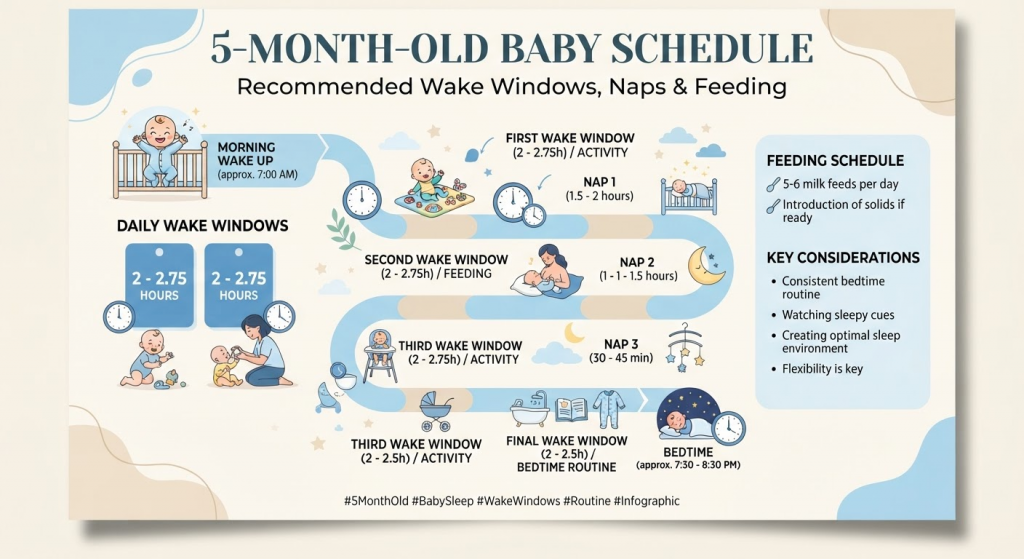
- Sample Wake Windows by Time of Day
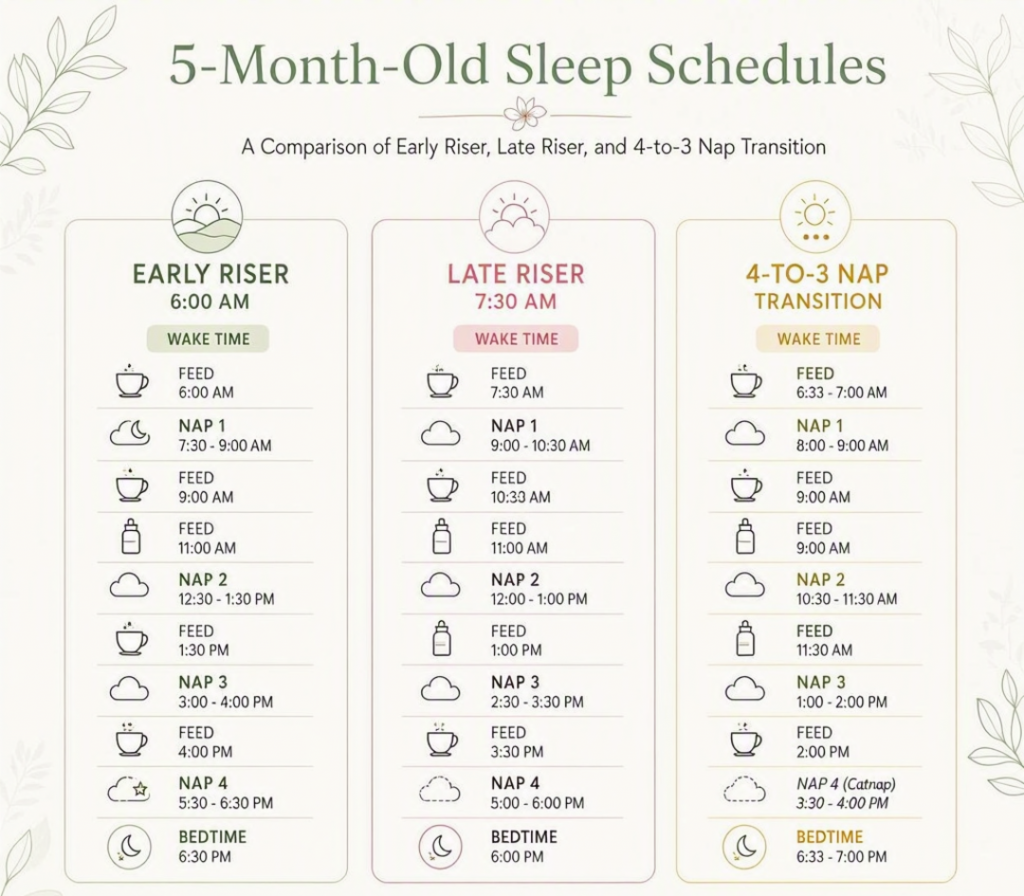
- 3 Ready-to-Use 5 Month Old Sleep Schedules
- Schedule A: Early Riser (6:00 AM Wake-Up)
- Schedule B: Late Riser (7:30 AM Wake-Up)
- Schedule C: Transitioning from 4 Naps to 3 Naps
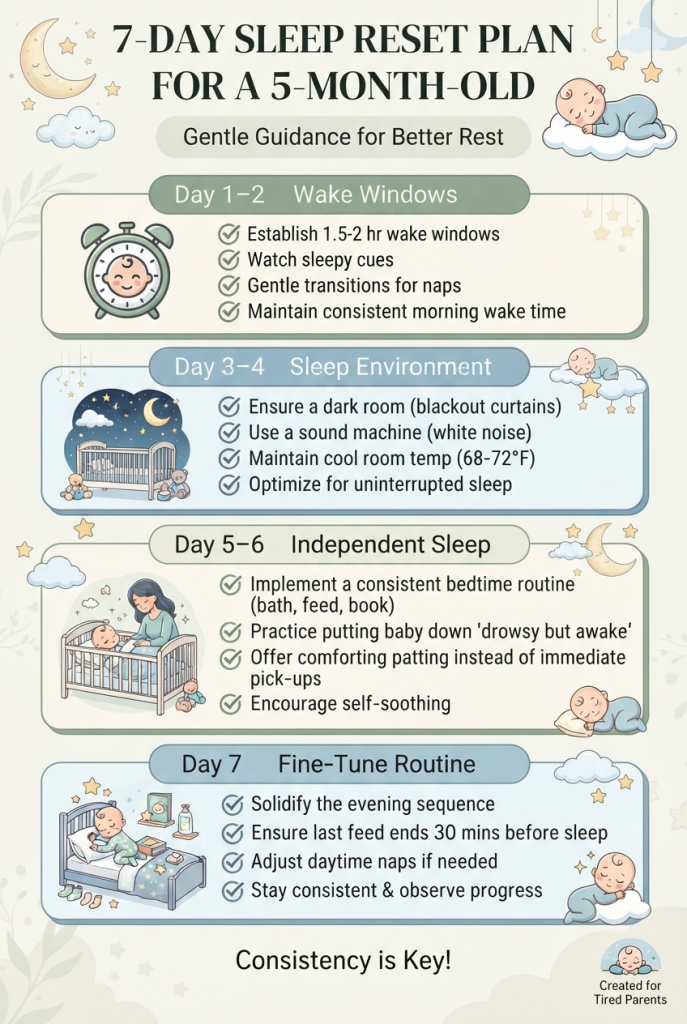
- Your 7-Day Sleep Reset Plan for 5-Month-Olds
- Day 1–2: Track and Adjust Wake Windows
- Day 3–4: Optimize Sleep Environment
- Day 5–6: Introduce Independent Sleep Practice
- Day 7: Fine-Tune Bedtime and Nap Timing
- Troubleshooting Guide: If Your Baby Is…
- Taking Only 30-Minute Naps (Cat Naps)
- Waking Every 2 Hours at Night
- Fighting Bedtime and Crying at Put-Down
- Waking Before 6:00 AM
- Only Sleeping While Being Held
- Feeding and Night Wakings: What’s Normal at 5 Months?
- How Many Night Feeds Are Typical?
- Signs Your Baby Is Ready to Drop a Night Feed
- Gentle Night Weaning Steps (Without Cry-It-Out)
- Sleep Training at 5 Months: What Works and What Doesn’t
- Gentle Methods (Pick-Up-Put-Down, Chair Method, Fading)
- Can You Sleep Train During a Regression?
- When to Wait and When to Start
- Partner Support: Dividing Night Duties Without Resentment
- Sample Night Shift Schedule for Couples
- Scripts for Asking Family or Friends for Help
- When to Call the Doctor: Red Flags Parents Shouldn’t Ignore
- Breathing Issues, Snoring, or Pauses
- Weight Loss or Poor Weight Gain
- Extreme Irritability Unsoothed by Any Method
- Sleep Problems Lasting More Than 6 Weeks
- Best Sleep Gear for 5-Month-Olds (Budget to Premium)
- Blackout Solutions (DIY, Portable, Permanent)
- White Noise Machines and Apps
- Sleep Sacks and Safe Swaddles
- Video Monitors Worth the Investment
- Parent Self-Care: Surviving the Sleep Deprivation Phase
- Lower the Bar (What Can Wait Until Baby Sleeps Better)
- When Sleep Deprivation Becomes Dangerous (Postpartum Mental Health)
- Quick Recharge Tips for Exhausted Parents
- Final Takeaway: This Phase Is Temporary (And You’re Doing Great)
- FAQ : 5 Month Old Not Sleeping ?
- Why is my 5 month old not sleeping like they used to?
- How many wake windows should a 5 month old have?
- When should I call the pediatrician about my baby’s sleep?
Medical Disclaimer: This article is for informational purposes only and is not a substitute for professional medical advice. Always consult your pediatrician about your baby’s sleep, health, or development.
You’ve tried everything. You’ve read the blogs, downloaded the app, and bought the white noise machine. But here you are again at 3 AM, rocking your wide-awake baby and wondering what you did wrong. You didn’t do anything wrong.
A 5 month old not sleeping through naps or nights is one of the most common things I hear from parents in this age bracket, and in our home it hit hard right around week 21 too. By the end of this post, you’ll know exactly why your baby is waking, what to try tonight, and roughly when things start to even out.
If your 5 month old is not sleeping, it’s almost always one of three things: a lingering sleep regression, wake windows that no longer fit their age, or a sleep association (like feeding or rocking) that’s now working against you. Fix the timing first, then work on the association gently over several nights, most families see real improvement within 7 to 10 days.
Quick Answer: Why Your 5-Month-Old Won’t Sleep (And What to Do Tonight)
A 5 month old not sleeping is usually caused by outgrown wake windows, a developmental leap, or a sleep habit that no longer works on its own. The fix isn’t one big overhaul. It’s small, boring adjustments done consistently.
The 3 Most Common Causes at 5 Months
Most cases I see boil down to these three, in this order of likelihood:
- Wake windows have shifted : What worked at 4 months is now too short, and your baby is going down overtired.
- A new skill is loading : Rolling, pushing up, or babbling nonstop keeps their brain “on” at bedtime.
- A sleep association got baked in : If your baby only falls asleep while feeding or being held, waking between sleep cycles means they need that same thing back every time.
One Thing You Can Try Before Bedtime Tonight
Try This Tonight: Move bedtime 15–20 minutes earlier than usual and dim the lights an hour before. An overtired baby fights sleep harder, not less an earlier, calmer wind-down is often the single fastest fix in this age group.
Is This a 5 Month Sleep Regression or Something Else?
The 5 month sleep regression is real for some babies, but for many it’s actually the tail end of the 4-month regression meeting a wake-window mismatch. Either way, the fixes overlap.
What Is a Sleep Regression? (Simple Explanation)
A sleep regression is a stretch of days or weeks where a baby who was sleeping reasonably well suddenly isn’t. It’s not a flaw in your parenting, it’s usually tied to a brain or body leap: a new skill, a shift in sleep cycles, or both happening at once.
5 Month vs. 4 Month Sleep Regression: What’s the Difference?
The 4-month regression is a permanent shift, your baby’s sleep cycles matured for good, and there’s no going back to the old newborn pattern. What shows up around 5 months is usually a temporary wave layered on top of that: teething, a physical milestone, or wake windows that simply haven’t been updated in a few weeks.
How Long Does It Last? (Realistic Timelines)
Real Parent Story: A mom in one of the parenting groups I follow described her son sleeping fine at 4 months, then falling apart the week he learned to roll onto his stomach at 5 months. Two weeks of rough nights later, once rolling became boring instead of thrilling, sleep came back on its own.
Most 5-month regressions run 2 to 6 weeks, shorter if you address wake windows early and longer if the underlying sleep association stays unaddressed.
12 Reasons Your 5 Month Old Isn’t Sleeping (And How to Fix Each One)
When a 5 month old is not sleeping, it almost never comes down to a single cause, it’s usually two or three of these overlapping at once.

1. Lingering 4-Month Sleep Regression
Some babies simply take longer to settle into the new, more adult-like sleep cycle.
- Fix: Stay consistent with a simple routine and give it another 1–2 weeks before troubleshooting further.
2. Developmental Milestones (Rolling, Sitting, Babbling)
New skills are exciting, and practicing them at 2 AM is common.
- Fix: Give plenty of supervised floor time during the day so the urge to practice is less intense at night.
3. Teething Pain and Discomfort
Drooling, chewing on fists, and swollen gums can start well before a tooth appears.
- Fix: A cool teething ring before bed and a check-in with your pediatrician about safe, age-appropriate pain relief if nights are especially rough.
4. Overtiredness (The Vicious Cycle)
An overtired baby produces more cortisol, which makes falling asleep and staying asleep harder, not easier.
- Fix: Watch the clock, not just the cues; sleepy signs often show up after the ideal window has already passed.
5. Sleep Associations (Rocking, Feeding, Pacifier)
If your baby needs something specific to fall asleep at bedtime, they’ll usually need that same thing to get back to sleep after every natural wake-up between sleep cycles.
- Fix: Start shifting the association gradually, put your baby down drowsy but awake for one sleep period a day and build from there.
6. Inappropriate Wake Windows (Too Short or Too Long)
- Fix: At 5 months, most babies do best with wake windows of roughly 2 to 2.75 hours. Track a few days and adjust nap timing in 15-minute increments.
We already have our full Baby Wake Windows Guide for all babies by age, between 0 and 12 months. Read it, it’s useful.
7. Too Many or Too Few Naps
Some 5-month-olds are still on 4 naps; others are ready to drop to 3.
- Fix: If the last nap of the day is consistently a fight or pushes bedtime too late, it may be time to consolidate.
8. Not Enough Physical Activity (Tummy Time, Floor Play)
A body that hasn’t moved much has less reason to be tired.
- Fix: Several short bursts of tummy time and floor play throughout the day, not just one long session.
9. Not Enough Outdoor Time and Sunlight
Morning light exposure helps anchor a baby’s circadian rhythm.
- Fix: Aim for outdoor time or at least a bright window within the first hour of waking.
10. Sleep Environment Issues (Light, Noise, Temperature)
- Fix: A fully dark room (blackout, not just dim), steady white noise, and a room temperature around 68–72°F make a measurable difference for most babies.
11. Hunger or Growth Spurt
Growth spurts around 5 months can temporarily increase night hunger.
- Fix: Offer a full feed before bed and don’t rush to cut night feeds during an active growth spurt.
12. Early Separation Anxiety
Some babies start noticing and protesting, when a parent leaves the room.
- Fix: Brief, predictable goodbyes and a consistent routine help build trust that you’ll return.
How Much Sleep Does a 5 Month Old Really Need?
Most 5-month-olds need about 12 to 16 total hours of sleep across day and night, according to the Sleep Foundation, and starting around 4 months of age, an infant’s daily sleep needs settle into the 12-to-16-hour range as sleep also begins consolidating into longer stretches.
Total Hours (Day + Night)
Expect roughly 10–12 hours overnight (with wake-ups) and 3–4 hours spread across naps.
Ideal Nap Count and Duration
Most babies this age are on 3–4 naps, ranging from 30 minutes to 2 hours each.
Sample Wake Windows by Time of Day
Wake windows typically lengthen slightly as the day goes on, shorter after the first morning nap, a bit longer heading into the final nap before bed.
3 Ready-to-Use 5 Month Old Sleep Schedules
A 5 month old not sleeping through naps is often just a timing problem, one of these three sample schedules should give you a solid starting point.
Schedule A: Early Riser (6:00 AM Wake-Up)
- 6:00 AM — Wake, feed
- 7:45 AM — Nap 1
- 9:30 AM — Wake, feed
- 11:15 AM — Nap 2
- 1:00 PM — Wake, feed
- 2:45 PM — Nap 3
- 4:15 PM — Wake, feed
- 5:45 PM — Catnap (optional)
- 7:00 PM — Bedtime routine
- 7:30 PM — Asleep
Schedule B: Late Riser (7:30 AM Wake-Up)
- 7:30 AM — Wake, feed
- 9:15 AM — Nap 1
- 11:00 AM — Wake, feed
- 12:45 PM — Nap 2
- 2:30 PM — Wake, feed
- 4:15 PM — Nap 3
- 5:45 PM — Wake, feed
- 7:15 PM — Bedtime routine
- 7:45 PM — Asleep
Schedule C: Transitioning from 4 Naps to 3 Naps
- 6:30 AM — Wake, feed
- 8:15 AM — Nap 1
- 10:00 AM — Wake, feed
- 11:45 AM — Nap 2
- 1:30 PM — Wake, feed
- 3:15 PM — Nap 3
- 4:45 PM — Wake, feed
- 6:15 PM — Short wind-down (no 4th nap)
- 7:15 PM — Bedtime routine
- 7:45 PM — Asleep
Your 7-Day Sleep Reset Plan for 5-Month-Olds
This is the exact plan I hand to parents dealing with a 5 month old not sleeping through the night small, boring changes, done in this order.
Day 1–2: Track and Adjust Wake Windows
Write down every wake-up and nap start for two days. Compare against the 2–2.75 hour range and nudge timing gradually, no more than 15 minutes a day.
Day 3–4: Optimize Sleep Environment
Add blackout coverage, steady white noise, and check the room temperature. This alone resolves a surprising number of short-nap problems.
Day 5–6: Introduce Independent Sleep Practice
Put your baby down drowsy but awake for one sleep period usually the first nap, when sleep pressure is lowest and frustration tends to be milder.
Day 7: Fine-Tune Bedtime and Nap Timing
Review what worked, keep it, and adjust anything that still feels off. This is a direction, not a deadline some babies need a second week to fully settle.
Troubleshooting Guide: If Your Baby Is…
Every 5 month old not sleeping situation looks a little different, use whichever scenario below matches your nights right now.
Taking Only 30-Minute Naps (Cat Naps)
Why does my 5 month old only take 30-minute naps? Short naps at this age are almost always a wake-window or environment issue, not a sign something is wrong. Check timing first, then darken the room further before assuming it’s a “nap transition.”
Waking Every 2 Hours at Night
If wake-ups line up with sleep-cycle length, a sleep association is the most likely driver. Start shifting how your baby falls asleep at bedtime first, that one change often ripples through the whole night.
Fighting Bedtime and Crying at Put-Down
This is frequently overtiredness in disguise. Move bedtime 15–20 minutes earlier for three nights and reassess before troubleshooting anything else.
Waking Before 6:00 AM
Check total wake-to-bed time from the last nap, an early final wake window that’s too long often pushes bedtime (and the whole next day) too early.
Only Sleeping While Being Held
This is one of the most common questions I get from parents of 5-month-olds, and it deserves its own deep div, see our full guide on gentle ways to transition a baby who only sleeps held for a step-by-step approach.
Feeding and Night Wakings: What’s Normal at 5 Months?
Hunger is one of the most overlooked reasons behind a 5 month old not sleeping through the night, so it’s worth ruling out before anything else.
How Many Night Feeds Are Typical?
Most 5-month-olds still need 1–2 night feeds, and that’s completely developmentally normal, this isn’t a habit you need to “fix” yet unless your pediatrician says otherwise.
Signs Your Baby Is Ready to Drop a Night Feed
Steady weight gain, eating well during the day, and waking at the same time each night (rather than randomly) can all be signs a feed may no longer be nutritionally necessary. Confirm with your pediatrician before changing anything.
Gentle Night Weaning Steps (Without Cry-It-Out)
- Shorten the feed by a minute or two every few nights.
- Move the feed slightly earlier in the wake-up so it’s less tied to falling back asleep.
- Offer comfort (patting, shushing) before automatically offering a feed.
Sleep Training at 5 Months: What Works and What Doesn’t
If a 5 month old not sleeping without help is the main issue, sleep training is a reasonable next step, but timing matters more than method.
Gentle Methods (Pick-Up-Put-Down, Chair Method, Fading)
These methods work gradually, with you staying present and slowly reducing hands-on help over several nights. They tend to suit parents who want change without extended crying.
Can You Sleep Train During a Regression?
Generally, no : wait until wake windows and environment are already dialed in. Starting formal sleep training mid-regression usually means more tears for less payoff.
When to Wait and When to Start
Wait if your baby is sick, teething hard, or mid-milestone. Start once the household is stable and you can commit to at least a week of consistency.
Partner Support: Dividing Night Duties Without Resentment
Sample Night Shift Schedule for Couples
One simple split that works for a lot of families: one parent covers wake-ups before 1 AM, the other covers everything after. Swap weekly so no one is permanently on the harder shift.
Scripts for Asking Family or Friends for Help
Try: “Could you take the baby for two hours on Saturday so I can nap? It would genuinely help me function this week.” Specific, time-boxed asks are easier for people to say yes to than a vague “let me know if you can help.”
When to Call the Doctor: Red Flags Parents Shouldn’t Ignore
Most sleep struggles at this age are developmental, not medical, but a 5 month old not sleeping paired with any of the following warrants a call to your pediatrician.
Breathing Issues, Snoring, or Pauses
Loud snoring, gasping, or pauses in breathing during sleep should always be checked by your pediatrician.
Weight Loss or Poor Weight Gain
If sleep struggles are paired with feeding difficulty or a slowing growth curve, bring it up at your next visit.
Extreme Irritability Unsoothed by Any Method
A baby who cannot be comforted by any method for an extended period may be signaling pain or illness rather than a typical sleep issue.
Sleep Problems Lasting More Than 6 Weeks
If nothing has shifted after six-plus weeks of consistent effort, it’s worth a conversation with your pediatrician to rule out other causes.
For general safe sleep guidance, the CDC recommends creating a safe sleep environment as one of the most effective ways to reduce the risk of sleep-related infant death, and HealthyChildren.org notes there is no single guaranteed way to prevent every risk, but a safe sleep environment meaningfully lowers it.
Best Sleep Gear for 5-Month-Olds (Budget to Premium)
The right gear won’t fix a 5 month old not sleeping on its own, but it removes easy obstacles like light and noise.
Blackout Solutions (DIY, Portable, Permanent)
- Budget: Black-out cardboard or foil cut to fit the window
- Mid-range: Portable blackout blinds with suction cups (great for travel too)
- Premium: Custom-fitted blackout curtains or panels
White Noise Machines and Apps
- Budget: A free white noise app on an old phone (kept well away from the crib)
- Mid-range: A dedicated plug-in sound machine
- Premium: A combined sound-and-light machine with adjustable volume and timers
Sleep Sacks and Safe Swaddles
Once your baby is showing any signs of rolling, it’s time to transition out of a swaddle and into a wearable sleep sack, per standard safe sleep guidance.
Video Monitors Worth the Investment
A monitor with night vision and two-way audio helps you check in without fully waking your baby, useful during regressions when you’re listening more closely than usual.
Parent Self-Care: Surviving the Sleep Deprivation Phase
Living with a 5 month old not sleeping well is genuinely exhausting, and your own well-being matters just as much as fixing the schedule.
Lower the Bar (What Can Wait Until Baby Sleeps Better)
Dishes, laundry, “keeping up” on social media, all of it can wait. Sleep, food, and basic hygiene are the only non-negotiables during a regression.
When Sleep Deprivation Becomes Dangerous (Postpartum Mental Health)
Occasional exhaustion is normal. But if you’re experiencing persistent hopelessness, intrusive thoughts, or feel unable to function, please reach out to your doctor or a postpartum support line, you deserve support, and it’s available.
Quick Recharge Tips for Exhausted Parents
- Nap when the baby naps at least once a day, even 20 minutes.
- Trade off “off duty” hours with your partner or a trusted helper.
- Say the hard thing out loud to someone, exhaustion shrinks when it’s shared.
Final Takeaway: This Phase Is Temporary (And You’re Doing Great)
In our home, the 5-month stretch was one of the hardes, and one of the shortest. Wake windows, a little patience with milestones, and one consistent bedtime routine were what finally turned things around. If your 5 month old not sleeping yet after trying these steps, that’s not a sign of failure. It just means it’s time to look a little closer, or loop in your pediatrician.
Which of these 12 reasons resonates most with your situation? Share your baby’s sleep story in the comments, you are not alone in this.
If you found this helpful, check out our guides on the 4-month sleep regression and gentle sleep training methods for more support.
FAQ : 5 Month Old Not Sleeping ?
Why is my 5 month old not sleeping like they used to?
Yes. A sudden shift at this age is extremely common and usually ties back to wake windows, a developmental leap, or a sleep association, not something you did wrong.
How many wake windows should a 5 month old have?
Most 5-month-olds do well with wake windows of roughly 2 to 2.75 hours between sleep periods.
When should I call the pediatrician about my baby’s sleep?
Reach out if you notice breathing issues during sleep, poor weight gain, inconsolable irritability, or no improvement after six-plus weeks of consistent effort.