Why Does My Toddler Laugh When I Say No? (The 1% Brain Secret)
Why Does My Toddler Laugh When I Say No? (5 Real Reasons)
- Why does my toddler laugh when I say no?
- How can I tell what the laugh may mean?
- Does my 2-year-old understand what “no” means yet?
- Why does understanding a rule not guarantee cooperation?
- How do I get my toddler to stop dangerous behavior without yelling?
- What is the calm safety sequence?
- What should I say instead of “no” to make my toddler listen?
- What should I say when my 2-year-old laughs during discipline?
- What can I say when my toddler laughs after hitting?
- What can I say when my toddler laughs after touching something unsafe?
- What can I say when my toddler laughs because I look angry?
- How can I stop the laughter from turning discipline into a game?
- What does calm follow-through look like?
- Should I ignore the laughter?
- Why does my toddler laugh when I scold him or her?
- When should I worry about my toddler laughing at serious situations?
- Should my toddler have a hearing test?
- What do real parents say about toddlers laughing when told no?
- What should I remember the next time my toddler laughs when I say no?
- What are the most common questions parents ask about this behavior?
- Why does my 1-year-old laugh when I say no?
- Is it normal for a toddler to laugh for no reason?
- What is a red flag behavior for a 2-year-old?
- Why does my toddler laugh when I scold him?
Medical Disclaimer: This article provides general parenting information, not a diagnosis. A laugh during discipline is usually not concerning by itself, but contact your child’s pediatrician if you notice broader communication, hearing, developmental, behavioral, or regression concerns.
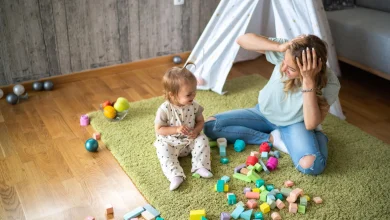
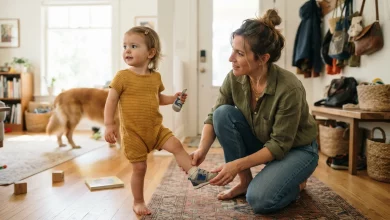
He reaches for the outlet cover, I say “no” in my most serious voice, and he grins at me like I just told the funniest joke of the year. Then he does it again. Maybe your toddler hits, throws food, climbs the bookshelf, or bites, and the second you use your firm voice, the giggling starts. It can feel like they’re mocking you on purpose.
That laugh isn’t usually mockery. It can come from excitement, nervousness, social experimentation, or a nervous system that hasn’t caught up with self-control yet. Why does my toddler laugh when I say no is one of the most common 3 AM Google searches for a reason, it feels personal, even when it isn’t.
So Why does my toddler laugh when I say no? It comes down to nervous system overload: they often laugh because the situation feels exciting, surprising, or uncomfortable, not out of disrespect. To handle this behavior effectively, parents should follow these steps:
- Stay calm to avoid reinforcing the tension.
- Stop unsafe behavior immediately and physically if needed.
- Use short limits such as “Hands are gentle.”
- Redirect your child toward an approved activity.
Note: Seek professional advice if this behavior occurs alongside wider communication, hearing, or developmental concerns.
Why does my toddler laugh when I say no?
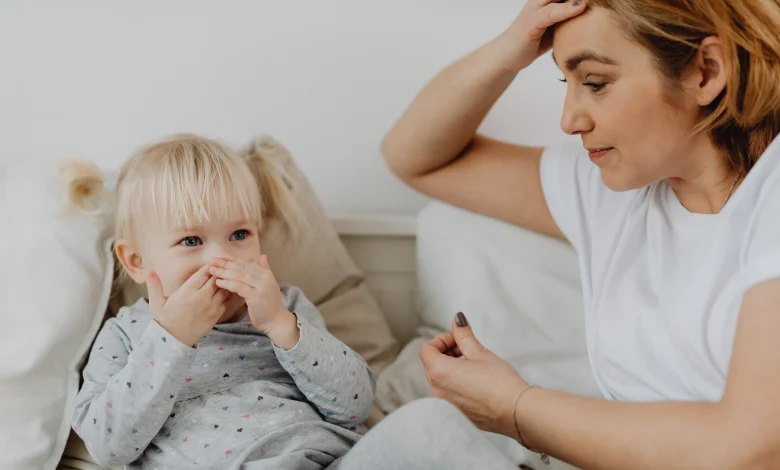
Your toddler’s laugh doesn’t come from one single motive, it’s usually a mix of things happening at once. It might be excitement about your sudden change in tone and face. It might be a tiny science experiment: “When I do this, Mom’s voice gets loud.” Sometimes it’s pure playfulness, an attempt to keep you engaged a little longer. And sometimes it’s nervousness, laughter that shows up when a moment feels tense, not fun at all.
I used to think my son’s laugh meant he thought the rule was a joke. It took me a while to realize the laugh and the rule-breaking are two separate problems. The behavior still needs a boundary, the laugh is just information about how his body is processing the moment, not proof that he doesn’t respect you.
How can I tell what the laugh may mean?
Watch what happens around the laugh, not just the laugh itself, a toddler with excited eyes who repeats the behavior and glances at you for a reaction is often testing and playing. A toddler who freezes, hides, cries, or laughs in a frantic, unsettled way may be overwhelmed rather than amused.
Context matters more than the sound of the laugh. Tired, hungry, overstimulated, or mid-transition toddlers laugh and ignore limits more than well-rested ones, that’s not a character flaw, it’s a nervous system running low on fuel. None of this changes what you do if the behavior is dangerous. A toddler heading toward the stairs or reaching for a hot stove needs your hands, not your analysis, first.
Does my 2-year-old understand what “no” means yet?
Understanding a word, understanding a rule, and having the self-control to follow it are three different skills, and a 2-year-old may have the first two without fully having the third. That gap is normal, not defiance.
According to the CDC, by 1 year, many children understand “no” well enough to pause briefly or stop. According to the CDC, by 18 months, a child may follow a one-step direction without gestures, like handing you a toy when you ask for it. According to the CDC, by 30 months, a child may follow simple routines when told, such as helping to pick up toys at clean-up time.
This is also the age range where tantrums tend to spike as language and self-control race to catch up with big feelings, the laughing and the meltdowns often come from the same immature system.
Those milestones describe skills your child may show, they don’t describe perfect obedience. A toddler can genuinely know a rule exists and still break it the moment excitement, hunger, or big emotion takes over. That’s not your child ignoring you. That’s your child’s brain still under construction.
Why does understanding a rule not guarantee cooperation?
Knowing a rule and following it require different brain systems, and the second one develops slowly through childhood. Attention, working memory, flexible thinking, and impulse control are still forming in the toddler years.
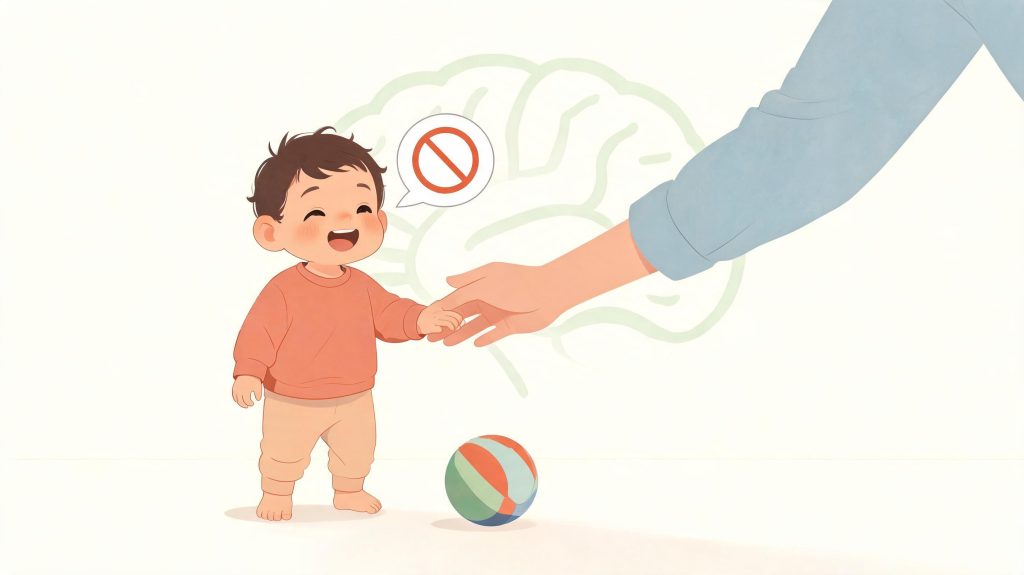
The Center on the Developing Child at Harvard University describes these abilities as executive function and self-regulation skills, and notes that children aren’t born with them, but are born with the potential to build them gradually through everyday interactions and practice. That’s the honest version of “it depends”: your toddler isn’t choosing chaos over cooperation. He’s running on a system that’s still being built, the same system covered in more depth in our guide to emotional regulation in young children.
How do I get my toddler to stop dangerous behavior without yelling?
Safety comes before conversation. If your child is doing something dangerous, act with your body first block the movement, move your child away, or remove the object, then give the short explanation after they’re safe.
I don’t wait to finish a sentence when my daughter is halfway up the bookshelf. I move her, set her down somewhere safe, and then I talk. The words matter less than the physical boundary in that first second.
What is the calm safety sequence?
A sequence that works in the moment, no matter what the laugh is doing:
- Stop or block the unsafe action.
- State the limit in a few words.
- Name the acceptable behavior.
- Help your child do it.
- Praise the cooperation the moment it shows up, even briefly.
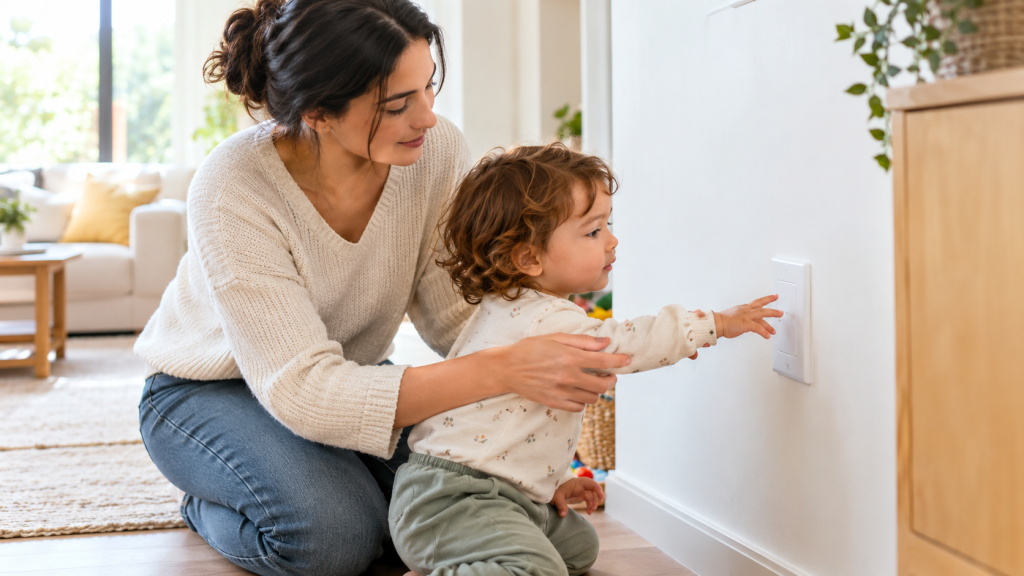
A few scripts I actually use:
- “Hot. I won’t let you touch it. Hands here”
- “I won’t let you hit. Hands are gentle”
- “The street is dangerous. I’m holding your hand”
- “Feet stay on the floor. You can jump on the cushion”
- “The cup stays on the table. You can drink here”
The laugh doesn’t get a pass, and it also doesn’t get a lecture. It gets a calm, physical boundary and a next step.
What should I say instead of “no” to make my toddler listen?
Telling your toddler what to do works better than only telling them what not to do, because it gives their still-developing brain a clear action instead of just a stop sign. This won’t guarantee instant obedience, but it gives them something to actually follow.
- Instead of “No climbing”, try “Feet on the floor”
- Instead of “No throwing”, try “Balls are for throwing, blocks stay on the floor”
- Instead of “No touching”, try “Hands in your lap”
- Instead of “No screaming”, try “Use a quiet voice”
What should I say when my 2-year-old laughs during discipline?
You don’t need your toddler to feel remorse or stop laughing before you respond to the behavior. Most 2-year-olds aren’t yet capable of understanding “being in trouble” the way an older child or adult does, so chasing that reaction wastes energy you need for the actual limit.
What can I say when my toddler laughs after hitting?
Something like: “I won’t let you hit. Hitting hurts. I’m moving your hand. You can say, ‘My turn” If someone got hurt, I check on them first, then help my toddler regulate and practice the replacement phrase. The laugh doesn’t change either step.
What can I say when my toddler laughs after touching something unsafe?
Try: “I won’t let you touch that. It’s dangerous. You can touch this instead”. Removing the object or moving your child away works faster than repeating “no” from across the room ever will.
What can I say when my toddler laughs because I look angry?
A simple line does the job: “You see that I’m serious. The limit stays the same” Then stop explaining and follow through. The moment doesn’t need to become a performance or a debate, it needs a boundary and a return to normal life.
How can I stop the laughter from turning discipline into a game?
Repeated warnings, rising volume, chasing, and big dramatic reactions can accidentally make the whole interaction more exciting , which is the opposite of what you want. Toddlers are drawn to intensity, even negative intensity, so a shorter, flatter response often works better than a bigger one.
What does calm follow-through look like?
- Move close before giving the direction, don’t shout it from across the room.
- Give one clear instruction.
- Wait a beat.
- Help your child comply if they don’t on their own.
- Apply a related, immediate consequence when it fits the moment.
- Return to normal interaction once the boundary is handled, don’t keep circling back to it.
There’s no fixed timeline where this suddenly clicks and the laughing stops for good. Consistency helps toddlers build the pattern over time, but don’t be surprised if the same behavior shows up again tomorrow in a different mood.
Should I ignore the laughter?
Ignore the laugh, not the behavior. Dangerous or harmful actions always need a response, regardless of whether your child looks amused, blank, or upset while doing them. For laughter that’s clearly harmless attention-seeking, like giggling while handing you a toy after being asked twice, a low-key response followed by redirection is usually enough.
Why does my toddler laugh when I scold him or her?
Scolding creates a sudden emotional mismatch, you’re serious, and your toddler’s nervous system may respond with excitement, confusion, nervousness, or play instead of matching your tone. That mismatch is common and doesn’t automatically mean anything is wrong. It’s part of the same emotional wiring we cover in our complete toddler behavior guide, worth a look if this is one of several behavior questions on your mind right now, alongside things like building confidence in a sensitive or easily-overwhelmed toddler.
There’s a real difference between a quick laugh during an unusual moment, laughter used to stretch out a game, laughter that shows up during an overwhelming or scary exchange, and a wider pattern of trouble with emotional expression or social communication. Laughing during discipline, by itself, does not diagnose autism, oppositional behavior, hearing loss, or any other condition, it’s one data point, not the whole picture.
When should I worry about my toddler laughing at serious situations?
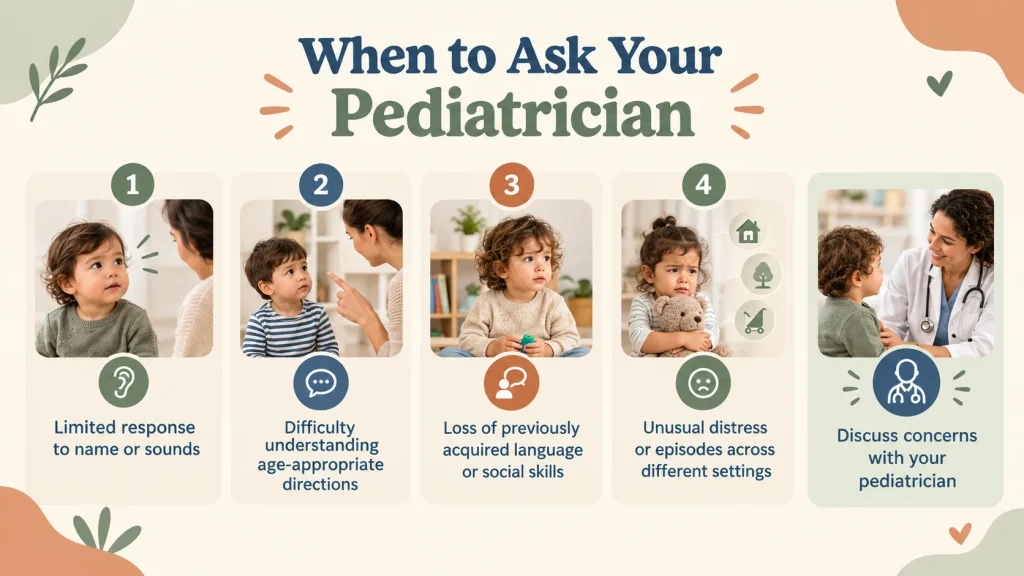
A single laugh during discipline is rarely something to worry about on its own, the broader pattern matters far more than one moment. Contact your pediatrician if you also notice limited response to your child’s name or to sounds, difficulty understanding age-appropriate directions, loss of language or social skills your child once had, persistent communication difficulties, frequent unsafe behavior despite close supervision, or extreme distress and unusual episodes that show up across different settings and caregivers.
Should my toddler have a hearing test?
A hearing evaluation may be worth asking about if your child doesn’t consistently respond to speech, sounds, or their name, or if their understanding of language seems behind. A laugh during discipline alone doesn’t point to hearing loss, but if it’s paired with those other signs, it’s worth raising at your next pediatrician visit.
Before that appointment, it helps to jot down: your child’s age, what happened right before the laugh, whether your child seemed to understand the instruction, whether the behavior was dangerous, how your child responds in other everyday situations, and whether the same pattern shows up with other caregivers too. That short list gives your pediatrician something concrete to work with instead of “he laughs when I discipline him,” which on its own is hard to act on.
What do real parents say about toddlers laughing when told no?
Parent forums and communities are full of the exact same story, a toddler laughs the moment a caregiver gets serious, and it leaves the parent second-guessing everything. On BabyCenter, Reddit, and other parenting communities, this comes up constantly, and a few patterns repeat across thousands of posts.
Parents frequently describe babies and toddlers laughing the instant a caregiver’s voice turns serious. Many describe their child pausing briefly at the “no” and then going right back to the behavior seconds later. A lot of parents say the laugh feels like mockery in the moment, even when they suspect logically that it probably isn’t. Other caregivers in these threads tend to suggest the same things over and over: keep your reaction low-key, redirect instead of repeat, and stay consistent even when it’s not working yet. And there’s a recurring thread of genuine confusion, is this humor, nervousness, or my toddler testing the limit on purpose?
None of that is medical evidence. It’s a community of tired parents comparing notes, and it’s useful for exactly that, it tells you that your toddler isn’t doing something unusual, and that the question you’re asking is one nearly every parent of a 2-year-old has typed into a search bar at some point.
In our home, my son went through a stretch around 27 months where every single “no” turned into a full-body giggle, followed by him doing the exact thing again while watching my face. I remember standing in the kitchen thinking he was doing it at me. What actually helped wasn’t a bigger reaction, it was getting quieter and more boring. I’d say the limit once, move him or the object, and go back to whatever we were doing. The laughing didn’t disappear overnight, but it stopped feeling like a standoff, because I stopped treating it like one.
What should I remember the next time my toddler laughs when I say no?
A short list I keep coming back to on hard days:
- The laugh is information, not proof of disrespect.
- The unsafe or unwanted behavior still needs a firm limit.
- Say what your child should do, not just what to stop.
- Act immediately when safety requires it, words come second.
- Keep your response brief and predictable, even when you’re frustrated.
- Look for the first moment of cooperation and acknowledge it out loud.
The goal was never to make a 2-year-old look ashamed of himself. It’s to teach safety, boundaries, and self-regulation one repetition at a time, a skill that’s still under construction, laugh and all.
What are the most common questions parents ask about this behavior?
Why does my 1-year-old laugh when I say no?
A 1-year-old may be reacting to your tone, facial expression, or the novelty of the interaction rather than fully grasping the rule. According to the CDC, by 1 year, many children may pause briefly or stop when told “no,” but this doesn’t mean they’ll consistently comply every time.
Is it normal for a toddler to laugh for no reason?
Is it normal for a toddler to laugh for no reason? Occasional laughter without an obvious adult explanation can be completely normal, especially during play, excitement, tiredness, or social interaction. Talk with your pediatrician if the laughter feels unusual or distressing, happens alongside episodes of altered awareness, or appears with communication, developmental, or regression concerns.
What is a red flag behavior for a 2-year-old?
Laughter alone isn’t a red flag. Broader concerns, like losing skills your child once had, not responding to sounds or their name, ongoing trouble understanding simple directions, or significant communication and social differences, are the ones worth discussing with your pediatrician.
Why does my toddler laugh when I scold him?
The laugh may reflect excitement, discomfort, nervousness, confusion, or social experimentation rather than defiance. Keep the limit calm and short, stop unsafe behavior right away, and avoid assuming the laugh means your child is mocking you on purpose.
If you are worried about your child’s hearing, language, development, emotional responses, or safety, speak with your pediatrician. This article cannot diagnose the cause of a child’s laughter or replace an individualized medical evaluation.