
Building Confidence in Shy Children: 9 Proven Strategies
Help your shy child thrive with proven strategies from experts
- The Science Behind Shyness: Is It Nature or Nurture?
- What You’ll Learn:
- Understanding Your Shy Child
- Why Building Confidence in Shy Children Takes Time
- 9 Proven Strategies for Building Confidence in Shy Children
- Strategy 1: Stop Saying “Don’t Be Shy”
- Strategy 2: Arrive Early to Everything
- Strategy 3: Practice Social Situations at Home
- Strategy 4: Create a Warm-Up Routine
- Strategy 5: Build Confidence Through Mastery
- Strategy 6: Teach Social Skills Explicitly
- Strategy 7: Host Structured Playdates
- Strategy 8: Use “Brave Challenges” Not Pressure
- Strategy 9: Address Perfectionism Directly
- Building Confidence by Age
- Ages 3-5: Foundational Years
- Ages 6-10: Skill-Building Years
- Ages 11+: Identity Years
- Social Media and Shy Children in 2025
- Common Mistakes When Building Confidence
- Mistake 1: Forcing Social Interaction
- Mistake 2: Comparing to Siblings or Peers
- Mistake 3: Always Speaking for Them
- Mistake 4: Showing Anxiety About Their Shyness
- Mistake 5: Over-Protecting Them
- When to Seek Professional Help
- Frequently Asked Questions
- Is shyness genetic or learned?
- Will my shy child have friends?
- Did I cause my child’s shyness?
- Should I push them to be more social?
- When does shyness become a problem?
- Can shy children be leaders?
- Self-Care for Parents of Shy Children
- How long does building confidence in shy children take?
- Can I build confidence if I am shy myself?
- Take Action This Week
- Conclusion
- 💬 Share Your Experience
Building confidence in shy children became my mission the day of my daughter’s fifth birthday party. Twelve kids played games in our living room while she refused to leave the kitchen. Furthermore, she begged me to open her own presents for her. I watched other parents’ children confidently leading games while mine whispered every request in my ear. That’s when I knew this had to become my priority.
Watching your child hide behind your legs at every social event? You’re not alone. Additionally, you’re probably wondering if you caused this or if they’ll ever have friends. Most importantly, your shy child can develop real confidence without changing who they are.
The Science Behind Shyness: Is It Nature or Nurture?
Before trying to fix it, understand it. Shyness is often misunderstood. According to the American Psychological Association, shyness is the tendency to feel awkward, worried, or tense during social encounters.
-
It is not a flaw: Research from Harvard University indicates that some children are born with a more sensitive amygdala (the brain’s alarm system), making them naturally cautious.
-
The Goal: Building confidence in shy children isn’t about changing their personality; it is about teaching them how to manage that sensitivity.
What You’ll Learn:
- Why your child is shy: Temperament, anxiety, or just slow-to-warm
- 9 strategies that work: Building confidence without pushing too hard
- What to say and do: Specific scripts for different situations
- By age strategies: What works for toddlers vs teens
- Social media’s impact: How digital life affects shy kids in 2025
- When to get help: Signs that shyness needs professional support
Understanding Your Shy Child
Building confidence in shy children begins with understanding what you’re dealing with. Shyness isn’t a flaw. Rather, it’s often a temperament trait present from birth.
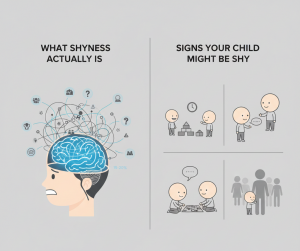
What shyness actually is:
About 15-20% of children are born highly reactive. According to Harvard research, these children process stimulation more intensely. Therefore, new situations feel genuinely overwhelming to them.
Signs your child might be shy:
- Takes time to warm up to new people
- Watches before joining activities
- Speaks quietly in groups
- Prefers one-on-one play
- Clings to you in social situations
Here’s what matters most:
Shyness isn’t something wrong with your child. Furthermore, many shy children become successful, happy adults. Moreover, the goal isn’t changing their personality, it’s giving them tools to manage discomfort.
The difference between shy and anxious:
A shy child eventually joins in after warming up. An anxious child may refuse to participate even after extended time. Additionally, anxiety often includes physical symptoms like stomach aches before social events.
Why Building Confidence in Shy Children Takes Time
Your shy child’s brain works differently. Understanding this helps you stay patient. Moreover, it helps you stop blaming yourself.
The biology of shyness:
Research shows shy children have more active amygdalas. This brain region processes fear and threat. Therefore, what seems harmless to you genuinely feels scary to them.
Your child isn’t being difficult:
They’re not trying to embarrass you or ruin family events. Their nervous system is simply more sensitive. Additionally, they need more time to assess safety before engaging.
The good news:
With support, shy children develop coping strategies. Furthermore, they keep their thoughtful, empathetic nature while gaining confidence. Moreover, many parents report their shy children are their most emotionally intelligent.
9 Proven Strategies for Building Confidence in Shy Children
Strategy 1: Stop Saying “Don’t Be Shy”
Building confidence in shy children starts with your words. Labels become identity. Therefore, remove “shy” from your vocabulary around your child.
What NOT to say:
- “Don’t be shy!”
- “Why are you being so shy?”
- “She’s our shy one”
- “He’s shy, sorry”
What TO say instead:
- “Take your time. Join when you’re ready.”
- “New situations take time to feel comfortable.”
- “You like to watch first. That’s smart.”

Why this matters:
When you label them shy, they believe that’s who they are. However, describing their behavior leaves room for growth. Moreover, it removes shame from their natural process.
Strategy 2: Arrive Early to Everything
One powerful strategy for building confidence in shy children is arriving early. This simple change dramatically reduces anxiety.
Why early arrival works:
Walking into a room full of people feels overwhelming. However, arriving first lets your child:
- See the space before it’s crowded
- Watch others arrive instead of being watched
- Choose a comfortable spot
- Build familiarity before chaos starts
How early to arrive:
- Birthday parties: 10-15 minutes early
- School events: 15-20 minutes early
- Classes or activities: 20 minutes early
- Playdates: Right on time or slightly early
What to do when you’re early:
Help your child explore. Find the bathroom together. Locate the snacks. Identify a quiet corner they can retreat to if needed.
Real-Life Scenario: The “Birthday Party” Warm-Up
-
The Challenge: Arriving at a loud party is terrifying for a shy child.
-
The Old Way: Pushing them forward and saying, “Go play! Look, there is a bouncy castle!” (This spikes their anxiety).
-
The Confidence Way: Use the “Anchor Method.”
-
Arrive 10 minutes early before the crowd.
-
Say: “I am going to sit on this bench. You can sit with me or stand right here until you are ready.”
-
Result: Building confidence in shy children requires a safe base. Once they feel safe, they will venture out on their own.
-
Strategy 3: Practice Social Situations at Home
Building confidence in shy children includes rehearsing before the real event. Role-playing removes the fear of unknown situations.
What to practice:
Introducing yourself:
- Child: “Hi, I’m [name]”
- You play the other child: “Hi! Want to see my toy?”
- Practice 3-4 times in different scenarios
Asking to join a game:
- “Can I play?”
- “That looks fun. How do you play?”
- “Is it okay if I join?”
Handling rejection:
- “Maybe later”
- “Okay, I’ll find someone else to play with”
- Practice staying calm when hearing “no”
When to practice:
2-3 days before the event works best. Earlier creates anticipation anxiety. Later doesn’t give enough time to absorb the practice.
Strategy 4: Create a Warm-Up Routine
Predictable routines are essential when building confidence in shy children. They give your child a sense of control.
The warm-up sequence:
- Arrive early (10-15 minutes)
- Observe (5 minutes of watching)
- Stay close (Parent nearby but not hovering)
- Parallel play (Playing near others, not with them)
- Join in (When child signals readiness)
Respect their timeline:
| Age | Typical Warm-Up Time |
|---|---|
| 3-5 years | 15-30 minutes |
| 6-8 years | 10-20 minutes |
| 9-12 years | 5-15 minutes |
Never compare your child’s pace to others. Every child warms up differently. Moreover, pushing speeds nothing up, it usually backfires.
Strategy 5: Build Confidence Through Mastery
Building confidence in shy children happens when they get good at something. Mastery in one area creates general confidence.
How to choose activities:
Let them choose: Their genuine interest matters most
Start small: Private lessons before group classes
Give time: 6-12 months minimum in one activity
Avoid pressure: No competitions or performances initially
Best activities for shy children:
- Swimming (individual, builds competence)
- Martial arts (structured, confidence-building)
- Music lessons (private initially)
- Art classes (often quiet, focused work)
- Coding or robotics (interest-based, less social pressure)
Why mastery works:
When your child is good at something, they have:
- Something to talk about with peers
- Confidence that transfers to other areas
- Identity beyond “the shy kid”
- Proof they can overcome challenges
Strategy 6: Teach Social Skills Explicitly
Building confidence in shy children requires teaching specific social skills. Don’t assume they know what to do. Rather, teach step-by-step.
Social scripts that work:
Starting a conversation:
- Find common ground: “I like your backpack. Is that from [show]?”
- Ask open questions: “What’s your favorite game?”
- Share something: “I like that show too!”
Joining a game:
- Watch for 1-2 minutes first
- Move closer to the group
- Say: “Can I play?” or “How do you play that?”
- Accept their answer calmly
When someone says no:
- Say: “Okay, maybe later”
- Walk away calmly
- Find another person or activity
- Remember: It’s not personal
Practice these scripts:
Use TV shows or books to discuss social moments. Ask your child: “What could that character say?” or “How would you handle that?”
Strategy 7: Host Structured Playdates
Controlled practice is crucial for building confidence in shy children. Structured playdates create success opportunities.
The winning playdate formula:
Start small:
- One child only (never two)
- 90 minutes maximum
- At your house (familiar territory)
- With a planned activity
Good activities for shy children:
- Board games (structured interaction)
- Baking or cooking together
- Craft projects
- Building with Legos
- Outdoor exploration
Progression over weeks:
Week 1-2: One friend, your home, 90 minutes, structured activity
Week 3-4: One friend, their home, 2 hours
Week 5-6: One friend, neutral place (park), 2 hours
Week 7+: Two friends when child requests
Strategy 8: Use “Brave Challenges” Not Pressure
Building confidence in shy children works better with agency than force. Let them choose challenges instead of demanding participation.
Create a brave challenge list together:
- Wave to one new person
- Answer one question in class
- Order own food at restaurant
- Call a friend on the phone
- Join one activity
How to implement:
Your child picks from the list. No forced timeline. Celebrate every attempt, whether successful or not. Additionally, never punish “failures.”
Why choice matters:
When children control their challenges, anxiety decreases. Furthermore, success feels like their achievement, building genuine confidence.
Strategy 9: Address Perfectionism Directly
Many shy children struggle with perfectionism. Therefore, building confidence in shy children includes addressing fear of judgment.
Normalize mistakes:
- Share your mistakes openly
- Laugh about minor errors
- Say: “Mistakes help us learn”
- Never criticize them harshly
Celebrate effort over results:
- “You tried talking to that new kid. That took courage.”
- “You participated even though it felt uncomfortable.”
- Not: “See? That wasn’t so bad!” (This invalidates their feeling)
Reframe failure:
When something doesn’t go well, ask: “What did you learn?” not “Why didn’t it work?”
Building Confidence by Age
Ages 3-5: Foundational Years
What they need: Physical closeness, validation, routine
Key strategies:
- Stay very close during social situations
- Narrate their experience: “You’re watching first. That’s smart.”
- Don’t force interactions with adults or kids
- Keep expectations very low
Ages 6-10: Skill-Building Years
What they need: Social coaching, practice opportunities, mastery experiences
Key strategies:
- Teach conversation starters explicitly
- Host regular one-on-one playdates
- Find their “thing” (activity they love)
- Practice social scenarios at home
Ages 11+: Identity Years
What they need: Respect for preferences, authentic friendships, independence
Key strategies:
- Accept they may prefer small friend groups
- Don’t push large social events
- Help them find their people through interests
- Address social media pressure
Social Media and Shy Children in 2025
Building confidence in shy children faces new challenges in 2025. Social media creates unique pressure and opportunities.
How digital life affects shy kids:
The challenges:
- Seeing others’ social lives creates comparison
- Pressure to appear outgoing online
- Less practice with real-world interaction
- Increased vulnerability to cyberbullying
The opportunities:
- Connect with like-minded peers globally
- Express themselves through creative content
- Practice social skills with lower stakes
- Find communities based on interests
Healthy boundaries for shy children:
Elementary age (6-10):
- Delay social media as long as possible
- Focus on real-world friendships
- Use technology for creation, not comparison
- Monitor all interactions closely
Teens (11+):
- Discuss online vs reality openly
- Private accounts with trusted friends only
- Follow interest-based accounts, not just peers
- Regular social media breaks
If your shy teen is retreating into screens to avoid people, read our guide on Phone-Free Teens: 7 Steps to Break the Addiction to help them reconnect socially.
Common Mistakes When Building Confidence
Mistake 1: Forcing Social Interaction
Why it hurts: Forcing participation creates shame. Moreover, it increases anxiety long-term.
Do this instead: Offer choices. “Would you like to wave or say hi?” Respect “no” as an answer.
Mistake 2: Comparing to Siblings or Peers
Why it hurts: “Why can’t you be like your sister?” destroys confidence and breeds resentment.
Do this instead: Celebrate their unique strengths. “You’re thoughtful and observant. Those are gifts.”
Mistake 3: Always Speaking for Them
Why it hurts: Ordering for them or answering questions prevents practice.
Do this instead: Give them time to respond. Say: “She needs a minute to think.”
Mistake 4: Showing Anxiety About Their Shyness
Why it hurts: Your worry signals something’s wrong with them.
Do this instead: Project calm confidence in their ability to grow at their pace.
Sometimes shyness turns into explosive behavior at home. This is a sign of dysregulation. Learn how to manage it in our Nervous System Regulation Guide.
Mistake 5: Over-Protecting Them
Why it hurts: Never facing discomfort prevents growth.
Do this instead: Create safe challenges. Support them through discomfort, don’t eliminate it entirely.
When to Seek Professional Help
Most shyness is normal temperament. However, some situations need professional support.
Call your pediatrician or child psychologist if you notice:
Functional impairment:
- Refusing school regularly
- No friends after 6+ months in same school
- Avoiding necessary activities completely
- Declining academic performance due to fear of asking questions
Severe distress:
- Panic attacks before social situations
- Physical symptoms (stomach aches, headaches) multiple times weekly
- Excessive worry lasting hours or days
- Frequent tears or meltdowns about social situations
Behavioral concerns:
- Selective mutism (speaks at home, silent elsewhere)
- Self-harm or aggressive outbursts
- Regression in previously mastered skills
- Complete social isolation even from family
Treatment that works:
Cognitive Behavioral Therapy (CBT) helps children develop coping strategies. Additionally, social skills groups provide safe practice. Moreover, early intervention makes significant difference.
Frequently Asked Questions
Is shyness genetic or learned?
Shyness is 40-60% genetic according to research. However, your response to it influences how it develops. Additionally, accepting their temperament while teaching skills creates the best outcome.
Will my shy child have friends?
Yes. Shy children often develop fewer but deeper friendships. Moreover, quality matters more than quantity. Furthermore, many shy children maintain close friendships throughout life.
Did I cause my child’s shyness?
No. Temperament is largely inborn. However, modeling anxiety or overprotecting can worsen it. Therefore, work on your own social confidence and give them appropriate challenges.
Should I push them to be more social?
Gentle encouragement with support works. Forcing participation backfires. Therefore, create opportunities, teach skills, then let them proceed at their pace.
When does shyness become a problem?
When it significantly impairs daily functioning, prevents relationships, or causes severe distress, seek professional help. Otherwise, support their temperament while building confidence.
Can shy children be leaders?
Absolutely. Many leaders are introverted or were shy children. Additionally, thoughtful, empathetic leadership is valuable and effective.
Self-Care for Parents of Shy Children
Building confidence in shy children taxes parents emotionally. Therefore, take care of yourself too.
How long does building confidence in shy children take?
It is a marathon, not a sprint. You might see small changes in weeks, but true building confidence in shy children is a developmental process that happens over months. Be patient.
Can I build confidence if I am shy myself?
Absolutely. Modeling bravery is powerful. Narrate your own feelings: “I feel a bit shy talking to that new mom, but I am going to say hi anyway.” This shows them that building confidence in shy children is about action, not just feelings.
Manage your own feelings:
- Your anxiety affects them: Work on your social confidence
- Your frustration shows: Find support from other parents
- Your expectations matter: Adjust them to your child’s reality
- Your patience helps: Remember this is a marathon, not sprint
Find your support:
- Join online groups for parents of shy children
- Talk to your pediatrician about your concerns
- Consider therapy if you’re overwhelmed
- Connect with parents who understand
Celebrate small wins:
- They waved at someone new
- They answered a question in class
- They initiated a playdate
- They tried something scary
Take Action This Week
Building confidence in shy children happens gradually. Therefore, start with one small step this week.
Your action plan:
- Stop using the label “shy” around your child
- Arrive early to one social event this week
- Set up one structured playdate
- Practice one social script at home
- Identify one activity for mastery building
Remember:
- Progress takes 3-6 months minimum
- Their temperament is a strength, not a flaw
- Small steps lead to real confidence
- You’re doing better than you think
- Your support makes all the difference
Conclusion
Building confidence in shy children feels slow and frustrating. However, with patience and the right strategies, your child will develop genuine confidence. Moreover, they’ll learn to honor their temperament while engaging with the world. Furthermore, many successful adults were shy children who learned to manage their sensitivity.
Your shy child is thoughtful, observant, empathetic, and capable of deep relationships. These are incredible strengths. Building confidence doesn’t mean changing who they are—it means giving them tools to be their authentic selves in a loud world.
💬 Share Your Experience
Tell us in the comments:
- How old is your shy child?
- Which strategy will you try first?
- What social situation is hardest for your family?
- What’s helped so far?
Your story helps other parents feel less alone. Additionally, this community offers incredible support. Therefore, share below.
Other parents of shy children are reading this right now, feeling exactly like you do. Your words might be exactly what they need. ⬇️