How to Stop a Toddler Tantrum: 7 Calm Steps That Work
7 Calm Steps That Actually Work
- Why Do Toddlers Have Tantrums?
- Developing independence
- Limited language and communication skills
- Hunger, tiredness, illness, and overstimulation
- Frustration, denied requests, and difficult transitions
- The difference between a tantrum and a possible meltdown
- What to Do During a Toddler Tantrum
- 1. Check immediate safety
- 2. Stay physically and emotionally calm
- 3. Use fewer words
- 4. Validate the feeling without giving in
- 5. Hold the boundary clearly
- 6. Choose proximity or safe space
- 7. Wait until the child is calm before teaching
- What to Say During a Toddler Tantrum
- What Not to Do During a Tantrum
- How to stop a toddler tantrum before They Start
- Protect sleep and meal routines
- Offer two acceptable choices
- Give transition warnings
- Use positive instructions
- Prepare for shopping and public outings
- Praise cooperation specifically
- Teach emotion words during calm moments
- Create predictable screen boundaries
- How to Handle Toddler Tantrums in Public
- What to Do After the Tantrum
- Reconnect first
- Name the feeling and restate the limit
- Practice an alternative behavior
- Repair harm
- Praise recovery
- How to Identify Toddler Tantrum Triggers
- When Are Toddler Tantrums a Reason to Seek Help?
- Practical Calm-Down Tools for Parents
- Toddler Tantrum Scripts for French/English Families
- Frequently Asked Questions
- How do I stop a toddler tantrum quickly?
- Should I ignore my toddler during a tantrum?
- What should I do if my toddler hits during a tantrum ?
- How long do toddler tantrums normally last?
- Bring It All Together
Medical Disclaimer: This article is for informational purposes only and is not a substitute for professional medical or developmental advice. Always talk to your child’s pediatrician or a qualified child-development professional about your specific child.
It’s 5:47 PM, you’re still in your coat, and your toddler is on the floor of the cereal aisle screaming like you’ve asked them to give up their soul instead of a box of cookies. People are staring. Your hands are shaking a little. And somewhere in the back of your mind is the thought: am I doing this wrong?
You’re not. How to stop a toddler tantrum isn’t really about making the screaming stop on command, it’s about helping your child move from “out of control” back to “safe and calm,” while you stay the steady one in the room.
This guide walks through what to actually do in the moment, what to say (with real scripts you can borrow), how to prevent tantrums before they start, what to do afterward, and the signs that mean it’s time to loop in your pediatrician. For the bigger picture on this stage of parenting, our toddler tantrums hub guide rounds up every strategy we recommend. I won’t promise you’ll never see another meltdown — no honest guide can. But you’ll have a plan for the next one.
To stop a toddler tantrum, keep your child safe first, then stay calm and use very few words. Validate the feeling (“You’re mad”) without changing your answer, and wait until your child is calm before you teach or discuss anything. According to the American Academy of Pediatrics, tantrums are a normal part of toddler development, not a sign your child is spoiled or that you’re failing as a parent.
Why Do Toddlers Have Tantrums?
My oldest had a phase around 20 months where putting on socks could end in tears hers, sometimes mine. It felt personal. It wasn’t. It was development doing exactly what it’s supposed to do.
Developing independence
Somewhere between 12 and 36 months, your toddler discovers they have opinions strong ones about shoes, snacks, and who gets to press the elevator button. That drive toward independence is healthy. It’s also completely mismatched with a brain that can’t yet regulate the disappointment when the answer is no.
Limited language and communication skills
Your toddler often knows exactly what they want and has zero reliable way to say it. Imagine being furious and handed only ten words to explain why. Tantrums fill that gap.
Hunger, tiredness, illness, and overstimulation
A missed nap or a skipped snack can turn a manageable afternoon into a minefield. Before you troubleshoot anything else, rule out the basics: is my child hungry, tired, sick, or simply overwhelmed by noise and stimulation?
Frustration, denied requests, and difficult transitions
Being told “no” or “time to go” asks a toddler to give something up with almost no warning and no coping tools yet. That’s the perfect storm for a meltdown, not defiance for its own sake.

The difference between a tantrum and a possible meltdown
Not every intense episode is a toddler testing limits on purpose. Some children are wired to feel things more intensely, and some are dealing with sensory overload or communication difficulties that make ordinary moments genuinely overwhelming. I’m not going to diagnose your child in a blog post, and neither should you, but if meltdowns look different from what’s described here (longer, more physical, harder to interrupt no matter what you try), that’s worth mentioning to your pediatrician, which we’ll cover later in this article. If your child seems to struggle with big feelings well beyond tantrum age, our guide to emotional regulation in children walks through age-based strategies in more depth.
What to Do During a Toddler Tantrum
How do you calm a toddler tantrum in the moment? Follow this seven-step sequence, in order, every time the repetition is what makes it work.
1. Check immediate safety
Before anything else, scan for danger. Move breakable objects, block access to stairs or streets, and calmly separate siblings if the tantrum has turned physical. Safety comes before soothing, always.
2. Stay physically and emotionally calm
Your nervous system is contagious. Lower your voice instead of raising it, slow your movements, and skip the shouting, threats, or sarcasm, even when you’re at the end of your rope. This is the hardest step and the most important one.
3. Use fewer words
A tantrum is not a debate. Long explanations, “why did you…” questions, and lectures land on deaf ears at the emotional peak, because your child’s thinking brain is temporarily offline. Say less than you think you need to.
4. Validate the feeling without giving in
You can hold the limit and still let your child know you see them. Try: “You’re angry because we are leaving the park. I won’t let you hit.” Two short sentences. Feeling acknowledged, boundary intact.
5. Hold the boundary clearly
State the limit once. Resist the urge to repeat it five different ways, and never flip a “no” into a “yes” purely to end the noise, that teaches escalation works, which makes the next tantrum longer, not shorter. If holding boundaries calmly is a struggle outside of tantrums too, our article on what to do when your toddler won’t listen covers the same skill for everyday moments.
6. Choose proximity or safe space
Some toddlers calm faster with you close and quiet nearby; others need a little physical space to come down. Either is fine, the goal is staying available without rewarding unsafe behavior with attention it wasn’t asking for.

7. Wait until the child is calm before teaching
Save the apology talk, the problem-solving, and the “next time” conversation for after the storm passes. A dysregulated brain can’t absorb a lesson. A calm one can.
What to Say During a Toddler Tantrum
Real scripts help more than theory when you’re standing in the moment with no time to think. Use these as starting points, not scripts to recite word for word.
When the child is told “no”: “You really wanted that. The answer is still no.”
When leaving the playground: “You want more time. The playground is finished. You may walk to the car or hold my hand.”
When the child hits, bites, or kicks: “I won’t let you hit. I’m moving your hands. You can say, ‘I’m angry.'”

During a supermarket tantrum: Skip the audience-management and speak as if no one else is there. One short sentence, then follow through, if things aren’t improving, it’s okay to calmly leave the cart and go.
During a screen-related tantrum: “You want one more episode. Screen time is finished. You can choose blocks or a book.”
During dressing, bathing, or bedtime: Offer a real choice inside the non-negotiable: “Pajamas first or teeth first , you pick.”
| Situation | What to say | What to avoid |
|---|---|---|
| Told “no” | “The answer is still no.” | Repeating “no” ten different ways |
| Leaving the park | “You may walk or hold my hand.” | Threatening to never come back |
| Hitting/biting | “I won’t let you hit.” | Hitting or biting back |
| Supermarket meltdown | One short sentence, then follow through | Buying the item to end the scene |
| Screen time ends | “Screen time is finished. Blocks or a book?” | Negotiating “just five more minutes” repeatedly |
| Bedtime resistance | “Pajamas first or teeth first?” | Long bedtime lectures |
What Not to Do During a Tantrum
- Don’t shout, threaten, insult, or shame your child.
- Don’t hit, bite, or physically punish, modeling the exact behavior you’re trying to stop rarely stops it.
- Don’t hand over the requested item purely to make the tantrum end.
- Don’t deliver a long lecture at the emotional peak; save it for later.
- Don’t force an apology before your child is actually calm.
- Don’t compare your child to a sibling or another child.
- Don’t use physical restraint except when it’s genuinely necessary to prevent immediate harm and even then, keep it as brief and gentle as the situation allows.
How to stop a toddler tantrum before They Start
Prevention won’t get you to zero, but it will get you to fewer and shorter.
Protect sleep and meal routines
An overtired or hungry toddler has less capacity to cope with disappointment, full stop. Predictable naps, meals, and snacks aren’t a luxury, they’re tantrum prevention.
Offer two acceptable choices
“Red shirt or blue shirt?” gives your toddler a real sense of control inside boundaries you’ve already set. Cleveland Clinic pediatricians recommend offering toddlers two simple, acceptable choices to reduce power struggles.

Give transition warnings
Five-minute and one-minute warnings, a visual timer, or a consistent “one more time down the slide” ritual all soften the shock of a sudden stop.
Use positive instructions
“Walk beside me” lands better than “Stop running,” because it tells your toddler what to do instead of just what to stop.
Prepare for shopping and public outings
Bring a snack, bring water, keep the trip short, give your toddler a small job (“hold the list”), and know your exit plan before you walk in.
Praise cooperation specifically
Skip the generic “good job.” Try: “You stopped when I asked and used gentle hands.” Specific praise teaches exactly which behavior to repeat.
Teach emotion words during calm moments
Teach “angry,” “sad,” “disappointed,” “worried,” and “frustrated” when things are quiet, not in the middle of a meltdown, when nothing new can be learned.
Create predictable screen boundaries
Give advance warning before screen time ends, use a visual timer, keep limits consistent day to day, and have a clear next activity ready. The American Academy of Pediatrics notes that tantrums and pushback often spike right after new screen-time limits are introduced, and that consistency not giving in, is what settles it over time.
How to Handle Toddler Tantrums in Public
How do you stop a toddler tantrum in public without losing your mind? Walk in with a plan: explain it before you enter, give your child a small task, know where your quiet exit is, and use one short sentence if things start to unravel.
- Explain the plan out loud before you go inside.
- Give your toddler a simple job to feel involved.
- Identify a quiet corner or exit route in advance.
- Use one calm sentence, not a negotiation, during the tantrum.
- Protect physical safety first; skip negotiating for an audience.
- Leave calmly if the situation isn’t improving.
- Don’t buy the requested item just because people are watching.
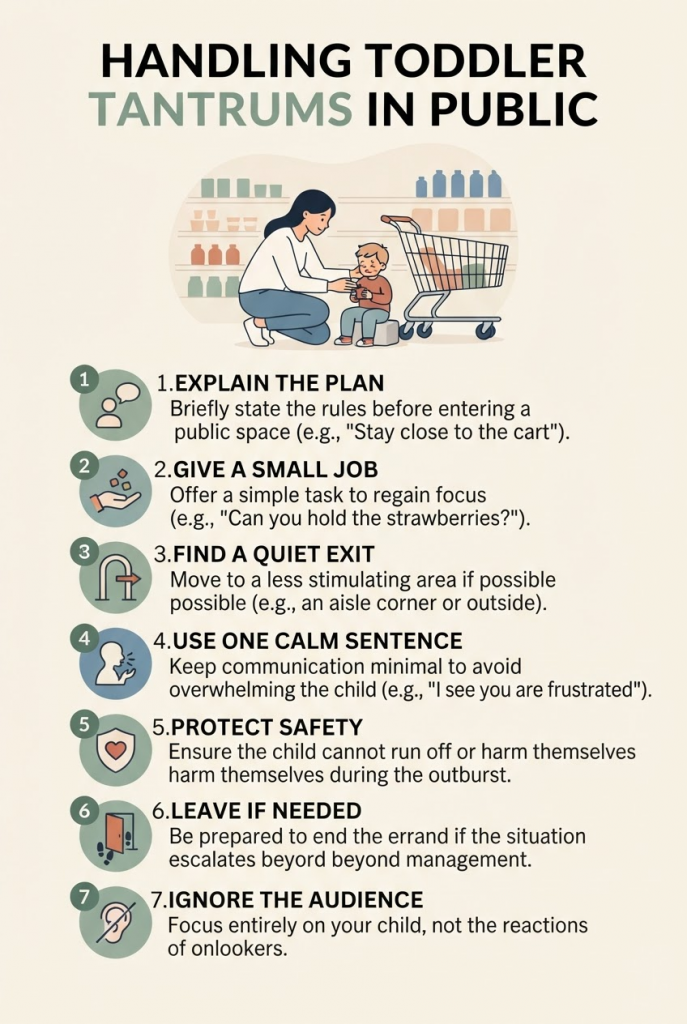
Here is the link, if you want to save this inforgraphic or explore more about parenting tips. And about the stares, most of the people watching have either been exactly where you are or will be soon. Your job is your child’s safety and regulation, not a stranger’s opinion of your parenting.
What to Do After the Tantrum
Reconnect first
A hug, a hand on the back, or simply sitting nearby says “we’re okay” before a single word about behavior is needed.
Name the feeling and restate the limit
“You were angry when the tablet was turned off. It is okay to be angry. It is not okay to hit.” This is the moment the actual lesson lands, not during the storm.
Practice an alternative behavior
Give your child words to reach for next time: “help,” “more time, please,” “I’m angry,” or “can I have a turn?”
Repair harm
If a sibling was hit or a toy was broken, guide (don’t force) your child to check on the person or help tidy up. This lands better than a performative “sorry” said through gritted teeth.
Praise recovery
Notice out loud when your child calms down, uses words, or accepts help. That’s the behavior you want to see grow.
How to Identify Toddler Tantrum Triggers
A simple seven-day tracker can reveal patterns you’d otherwise miss. For each tantrum, jot down:
- How much sleep your child got the night before.
- Timing of the last meal or snack.
- Where it happened.
- What happened right before it started.
- Any early warning signs you noticed.
- How you responded.
- Roughly how long it lasted, and what helped your child recover.
After a week, patterns tend to jump out often hunger, missed naps, or a specific transition (like leaving somewhere fun) that you can plan around next time.
When Are Toddler Tantrums a Reason to Seek Help?
Most tantrums are simply toddlerhood. Talk with your pediatrician or a qualified child-development professional if tantrums:
- Last unusually long or happen many times every single day.
- Frequently involve serious aggression toward others.
- Cause injury to your child or to someone else.
- Include destruction that you can’t interrupt or control.
- Come with signs of developmental regression or lost communication skills.
- Stay unusually severe well past the toddler years.
- Involve fainting, breath-holding, or anything that looks medically concerning.
- Make it genuinely difficult to keep your child or others safe.
According to the CDC, if you’re ever concerned about your toddler’s development or behavior, the right move is to talk with your child’s doctor and ask about a developmental screening an online article, including this one, can’t replace an individual assessment of your child.
Practical Calm-Down Tools for Parents
Your own regulation matters as much as your child’s.
- Take a slow breath while keeping your child safe, even three seconds helps.
- Step a few feet away for a brief pause if another trusted adult can watch your child.
- Trade off with a partner when your patience is running out.
- Lower your expectations during illness, travel, or big routine changes, this isn’t the season for perfect parenting.
- If you shout or lose your temper, repair it afterward: “I got too loud. That wasn’t fair to you. I love you.” Modeling repair teaches your child that mistakes are fixable.
- Reach out for support a partner, a friend, or your doctor, if tantrums are leaving you feeling overwhelmed more days than not.
Toddler Tantrum Scripts for French/English Families
Family gatherings, souk trips, and long car rides through Casablanca traffic all bring their own tantrum triggers, and their own vocabulary. Here are natural scripts for common Moroccan family moments, in English and French.
Supermarket trip:
- English: “You want the chocolate. Not today. You can help me push the cart.”
- French: “Tu veux le chocolat. Pas aujourd’hui. Tu peux m’aider à pousser le chariot.”
Crowded family gathering:
- English: “It’s loud in here. Let’s find a quiet corner for a minute.”
- French: “Il y a beaucoup de bruit ici. On va trouver un coin calme.”
Leaving a playground or restaurant:
- English: “You want to stay. It’s time to go. You can walk or I’ll carry you.”
- French: “Tu veux rester. Il faut partir maintenant. Tu marches ou je te porte.”
A relative offering sweets after you said no:
- English (gently, to the relative): “Thank you, not right now — maybe after lunch.”
- French: “Merci beaucoup, pas maintenant. C’est possible après le déjeuner.”
Greeting or hugging relatives:
- English: “You don’t have to hug. A wave is okay too.”
- French: “C’est pas nécessaire de donner un câlin, juste pas main c’est suffisant”
Long car journeys:
- English: “The road is long. Let’s play I-spy while we drive.”
- French: “La route est longue. Jouons quelque chose durant la route”
Frequently Asked Questions
How do I stop a toddler tantrum quickly?
Check for safety, lower your voice, and use as few words as possible: name the feeling, hold the limit, and stay close. There’s no instant off-switch, but this combination shortens most tantrums faster than arguing or bargaining does.
Should I ignore my toddler during a tantrum?
You can ignore the behavior the screaming or the demands, while staying nearby and available. Never ignore your child’s safety, and step in immediately for hitting, biting, or danger.
What should I do if my toddler hits during a tantrum ?
Calmly and firmly stop the hand: “I won’t let you hit.” Move the child’s hands gently, keep others safe, and offer the word “angry” as an alternative once things settle.
How long do toddler tantrums normally last?
Most last somewhere between two and fifteen minutes. Longer or more frequent episodes are still often normal, but if they’re not easing with consistency over time, it’s worth mentioning to your pediatrician.
Bring It All Together
Tantrums are not proof you’re failing, they’re proof your toddler is growing a brain that still needs your help to catch up with their big feelings. The core method doesn’t change from one tantrum to the next: keep everyone safe, stay the calm one in the room, name the feeling without changing the answer, and save the teaching for after the storm passes.
You won’t get it perfect every time. Nobody does. Tonight, at bedtime, that’s still enough.