7 Effective Methods for When Your Baby Won’t Sleep Unless Held
"My Baby Won't Sleep Without Being Held": Gently Breaking the Contact Nap
- ⚠️ Medical Disclaimer
- Why Won’t My Baby Sleep Unless Held? The Science Explained
- The Fourth Trimester Theory
- The Moro Reflex (Startle Reflex)
- Age-Specific Factors: Why the Struggle Changes
- Sleep Associations: The Science of Habit
- Why Contact Naps Become Unsustainable for Your Family
- The Foundation: 7 Steps to a Safe Sleep Environment
- Method 1: How Do I Use the Gradual Fade Method for Contact Napping?
- Method 2: The “Put Down, Pick Up” Approach (6+ Months)
- Method 3: The Contact-to-Carrier Bridge
- Troubleshooting: What to Do When Your Baby Won’t Sleep Unless Held Despite Trying Everything
- Protecting Your Mental Health
- The Truth About “Bad Habits” and Spoiling
- Frequently Asked Questions About Why Your Baby Won’t Sleep Unless Held
- Is it normal that my baby won’t sleep unless held even when they are exhausted?
- At what age should I worry if my baby won’t sleep unless held?
- Can a baby won’t sleep unless held situation lead to permanent bad habits?
- What should I do if my baby won’t sleep unless held and screams the moment I lay them down?
- Is it safe to co-sleep if my baby won’t sleep unless held?
- Final Thoughts: Progress Over Perfection
If your baby won’t sleep unless held, you know the exhausting cycle of rocking, bouncing, and shushing for nearly an hour, only for their eyes to fly open the second their back touches the mattress. This phenomenon, often called “contact napping” or “velcro baby” syndrome, is one of the most draining challenges a new parent can face. You are likely reading this through a fog of sleep deprivation, wondering where you went wrong. Before we dive into the science and the solutions, let’s get one thing straight: you haven’t done anything wrong. Your baby isn’t “spoiled,” and you aren’t a “bad parent” for holding them.
The need for physical closeness is a biological imperative. However, for the sake of your mental health and physical safety, transitioning to independent sleep is often necessary. This guide provides a comprehensive roadmap to help you navigate this transition while maintaining a secure attachment. To start on the right foot, make sure you have read our Environment for Your Newborn: Complete Safety Guide & Checklist (2026) to ensure the nursery itself isn’t the problem.
⚠️ Medical Disclaimer
This article is for informational and educational purposes only and does not constitute medical advice. The information provided should not replace consultation with a qualified pediatrician or healthcare professional. Every baby is different, and what works for one family may not be appropriate for another. Always consult your child’s doctor before making changes to sleep routines, especially if your baby has underlying health conditions. If you suspect your baby has reflux, GERD, ear infections, or sensory processing issues, seek professional medical evaluation.
Why Won’t My Baby Sleep Unless Held? The Science Explained
To solve the problem, we must understand the “why.” Human infants are the most “under-developed” mammals at birth. While a foal can walk within hours, a human baby requires constant coregulation for survival.
The Fourth Trimester Theory
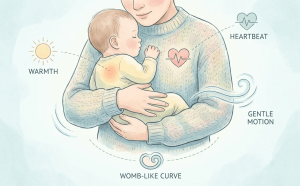
From birth to approximately 4 months, babies are technically in their “fourth trimester.” After spending nine months in a warm, cramped, loud, and constantly moving womb, the outside world is a sensory shock. When your baby won’t sleep unless held, they are simply trying to replicate the only environment they have ever known. In your arms, they experience:
-
Thermoregulation: Your skin helps keep their body temperature stable.
-
Cardiac Syncing: Their heart rate actually synchronizes with yours, lowering their stress.
-
Movement: The slight swaying of your body mimics the constant motion of the womb.
Your baby isn’t manipulating you; they are following survival instincts that have kept human infants alive for millennia. If you find yourself feeling overwhelmed by these demands, it is vital to practice Nervous System Regulation for Parents: 5 Ways to Stop Rage to keep your cool.
The Moro Reflex (Startle Reflex)
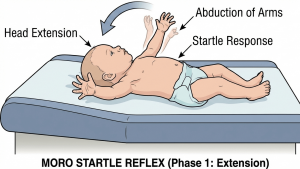
The Moro reflex is a primitive response where the baby feels like they are falling. When you try to lay them down, the change in gravity triggers this reflex, causing their arms to jerk out and wake them up. This is a primary reason why a baby won’t sleep unless held; your arms provide the physical “boundary” that prevents this reflex from fully waking them.
Age-Specific Factors: Why the Struggle Changes
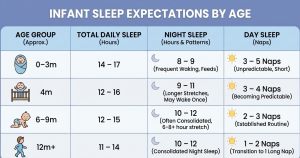
The reasons a baby won’t sleep unless held will evolve as they grow. Understanding these stages prevents you from using the wrong strategy at the wrong time.
-
Newborns (0-3 Months): Focus is entirely on sensory comfort. They lack the neurological ability to “self-soothe.”
-
The 4-Month Regression: This is a permanent change in sleep architecture. If your baby won’t sleep unless held during this time, it’s likely because they are now waking up fully between sleep cycles and don’t know how to fall back asleep without your help.
-
6-9 Months: Object permanence kicks in. They now realize that when you put them down and leave the room, you are “gone.” This causes separation anxiety.
-
12 Months+: Developmental leaps like walking or talking can disrupt sleep. Even a toddler who used to be a great sleeper might suddenly become a baby won’t sleep unless held situation.
Sleep Associations: The Science of Habit
Every human has sleep associations. You might need a specific pillow or a dark room. For a baby won’t sleep unless held, their primary association is “parental contact + motion.” Their brain has literally wired the sensation of your chest and the smell of your skin to the “off switch” for their brain.
The goal of this transition is not to remove comfort, but to expand their “toolbox” of associations. If your baby is also struggling with intense crying during these times, check out Baby Crying for No Reason? 6 Proven Reasons & Solutions to rule out other factors like colic or overstimulation.
Why Contact Naps Become Unsustainable for Your Family
While contact naps are beautiful, they can become a safety risk if the parent falls asleep in an unsafe position (like a sofa or armchair). According to the American Academy of Pediatrics (AAP), the safest place for a baby is on a firm, flat surface.
Furthermore, if you are a Single Parent After Divorce: 7 Steps to Survive & Thrive, you may not have the luxury of “shifts,” making independent sleep a necessity for your own survival. Sleep deprivation can lead to poor decision-making and increased risks of postpartum depression.
The Foundation: 7 Steps to a Safe Sleep Environment
Before applying any “method,” you must optimize the room. If the room is too hot, too loud, or too bright, no
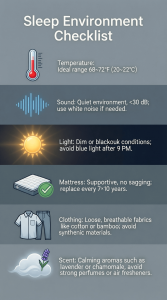
amount of training will work when your baby won’t sleep unless held.
-
Temperature: Keep it between 68–72°F (20–22°C).
-
Sound: Use a high-quality white noise machine to block out household sounds.
-
Light: Use 100% blackout curtains.
-
The Mattress: Must be firm and flat with a tight-fitting sheet.
-
Clothing: Use a sleep sack to provide a “hug” sensation without the danger of loose blankets.
-
Scent: Place a safe, worn shirt of yours near (but not in) the crib so they can smell you.
-
Routine: A consistent 15-minute routine (bath, book, song) signals to the brain that sleep is coming.
Method 1: How Do I Use the Gradual Fade Method for Contact Napping?
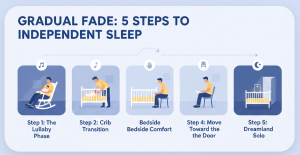
This is the best approach for parents who want to avoid “crying it out.” It takes 2-4 weeks and requires immense patience.
-
Phase 1 (The Transfer): Hold them until they are in a “deep” sleep (limp limbs). Practice the transfer very slowly—feet first, then bottom, then head.
-
Phase 2 (The Touch): Once they are in the crib, don’t walk away. Keep your hands on their chest and belly.
-
Phase 3 (The Proximity): Sit by the crib, but don’t touch them. Your presence provides the security they need even if the baby won’t sleep unless held normally.
-
Phase 4 (The Exit): Gradually move your chair toward the door over several nights.
Method 2: The “Put Down, Pick Up” Approach (6+ Months)
This method is perfect for older babies who are developing Building Confidence in Shy Children.
-
Place them in the crib while drowsy but awake.
-
If they start to fuss, use your voice to soothe them first.
-
If they escalate to a full cry, pick them up until they are calm (not until they are asleep!).
-
As soon as they are calm, put them back down.
-
Repeat this as many times as necessary. The first night might involve 20 “pick-ups,” but the second night will be 10, and so on.
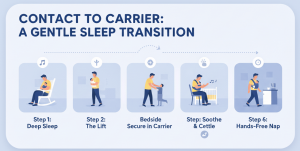
Method 3: The Contact-to-Carrier Bridge
If you are physically exhausted, use a structured baby carrier. This allows the baby to get the contact they crave while you remain upright and mobile. Over time, try to transition from the carrier to the crib mid-nap. This is a great strategy for parents who are also managing other kids.
For babies who aren’t rolling yet, a snug swaddle is the closest thing to your arms. The Mayo Clinic suggests that swaddling can help keep your baby’s arms from flailing and waking them up. If your baby won’t sleep unless held, a swaddle plus a white noise machine can often “trick” the nervous system into feeling secure.
Troubleshooting: What to Do When Your Baby Won’t Sleep Unless Held Despite Trying Everything
If you have tried everything for two weeks with no progress, there may be a physical cause.
-
Reflux/GERD: Lying flat causes stomach acid to rise, which is painful.
-
Ear Infections: Pressure in the ears increases when lying down.
-
Sensory Processing: Some babies have a higher need for tactile input. If your child is also showing other odd behaviors, like being a Toddler Won’t Eat Anything later on, it might be worth discussing sensory needs with a pediatrician.
Protecting Your Mental Health
The “velcro baby” phase is a high-risk time for parental burnout. If you find yourself resenting your child or feeling trapped, you must seek help. Whether it’s a sleep consultant or a family member, don’t do this alone. In the future, you’ll worry about different things like baby crying at night, but right now, your only job is to survive and help your baby sleep.
The Truth About “Bad Habits” and Spoiling
There is a common myth that holding your baby creates a “bad habit.” Research in attachment theory shows the opposite. Meeting a baby’s needs for closeness actually leads to more independent children. By responding when your baby won’t sleep unless held, you are telling their nervous system that they are safe. This safety eventually gives them the confidence to sleep alone.
Frequently Asked Questions About Why Your Baby Won’t Sleep Unless Held
Managing a baby won’t sleep unless held situation is one of the most common topics in parenting forums. Below are the most frequent questions parents ask when they are struggling with contact naps and crib transitions.
Is it normal that my baby won’t sleep unless held even when they are exhausted?
Yes, it is completely normal. In fact, it is a biological survival mechanism. When a baby won’t sleep unless held, it is often because their nervous system is still immature and requires your “external” regulation to stay calm. Even an overtired baby will fight sleep if they feel the physical “threat” of being separated from their primary caregiver.
At what age should I worry if my baby won’t sleep unless held?
There is no specific age where you should “worry,” but most pediatricians recommend starting to introduce independent sleep skills between 4 and 6 months. Before 4 months, a baby won’t sleep unless held due to the “fourth trimester” needs. After 6 months, it becomes more of a learned sleep association that may require a more structured approach like the “Put Down, Pick Up” method.
Can a baby won’t sleep unless held situation lead to permanent bad habits?
No. Sleep is a developmental skill, not a permanent personality trait. While it feels like a “bad habit” now, a baby won’t sleep unless held is simply in a phase of high-dependency.
What should I do if my baby won’t sleep unless held and screams the moment I lay them down?
First, check for physical discomforts like reflux or ear infections. If the baby is healthy, try the “warmed mattress” trick. Use a heating pad to warm the crib (remove it before laying the baby down) so the temperature change isn’t so drastic. Often, a baby won’t sleep unless held because the crib feels cold and clinical compared to your warm chest.
Is it safe to co-sleep if my baby won’t sleep unless held?
The American Academy of Pediatrics (AAP) recommends room-sharing but not bed-sharing, especially in the first 6 months. If your baby won’t sleep unless held, the safest alternative is a sidecar bassinet that attaches to your bed. This allows for physical proximity and easy touching without the risks associated with loose bedding and soft mattresses.
Final Thoughts: Progress Over Perfection
Transitioning away from contact naps is not a straight line. You will have nights where they sleep 6 hours in the crib, followed by nights where the baby won’t sleep unless held for a single minute. This is normal. Development is a “three steps forward, two steps back” process.
Give yourself grace. You are navigating one of the hardest parts of human existence. One day, you will put them in their bed, they will turn over and fall asleep instantly, and you will actually miss the days when they only wanted you. Until then, take it one nap at a time.