Toddler Won’t Listen? 7 Proven Reasons and What Actually Works
Discover why toddlers ignore instructions and learn CDC- and AAP-backed parenting strategies that improve listening, reduce power struggles, and build better cooperation without yelling or bribing

- Why Won’t My Toddler Listen to Me?
- What Are the Real Reasons a Toddler Won’t Listen?
- Why Does My 2 Year Old Ignore Me Completely?
- Did My Toddler Actually Ignore Me, or Were They Too Focused?
- What’s Really Happening in a Toddler’s Brain When They Don’t Listen?
- Does a Toddler Not Listening Change by Age?
- What Actually Works When a Toddler Won’t Listen?
- 1. Get Close and Down to Their Level
- 2. Use One Short Instruction at a Time
- 3. Say What to Do, Not Just What to Stop
- 4. Wait 5–10 Seconds Before Repeating Yourself
- 5. Follow Through Every Single Time
- 6. Praise the Listening, Specifically
- 7. Cut Back on Unnecessary “No”
- Common Mistakes That Make a Toddler Less Likely to Listen
- 1. Expecting Instant Compliance
- 2. Repeating Instructions Too Many Times
- 3. Yelling From Another Room
- 4. Giving Several Instructions at Once
- 5. Asking Questions Instead of Directing
- 6. Threatening Consequences That Never Happen
- What to Say Instead
- What Your Toddler Actually Hears When You Say…
- Toddler Won’t Listen or Is It a Tantrum Waiting to Happen?
- When Should You Worry About a Toddler Who Won’t Listen?
- How to Raise a Toddler Who Listens More Often
- 1. Establish Consistent Routines
- 2. Prioritize Connection Before Correction
- 3. Give One Instruction at a Time
- 4. Prioritize Age-Appropriate Sleep
- 5. Use Predictable Transitions
- 6. Offer Limited Choices
- 7. Use Positive Reinforcement
- 8. Maintain Calm, Consistent Follow-Through
- FAQ: Toddler Won’t Listen
- Why won’t my toddler listen to me specifically, but they listen to daycare or grandma?
- Why does my 2 year old ignore me completely when I call their name?
- Is it ADHD if my toddler won’t listen?
- When do toddlers usually start listening better?
- The Bottom Line on a Toddler Who Won’t Listen
Disclaimer: Guidelines cited from the CDC and American Academy of Pediatrics (AAP). This article is for informational purposes and is not a substitute for advice from your child’s pediatrician. If you’re worried about your child’s behavior or development, talk to your doctor.
I have said “please put your shoes on” to my toddler so many times in a single morning that I started counting. Six. Six times, standing right in front of her, before she even looked up. I remember standing there thinking: does she actually not hear me, or is she just choosing not to?
If you’re googling this at 7 AM with one shoe in your hand, I want to save you some time: toddler won’t listen is one of the most common searches in all of parenting, and it’s rarely about defiance the way it feels in the moment. It’s usually a mix of brain development, how the request was given, and what’s competing for your toddler’s attention.
This guide covers the real reasons behind a toddler who won’t listen, and the specific, CDC-backed adjustments that get most toddlers actually following directions again, without yelling, bribing, or repeating yourself five more times.
A toddler won’t listen for a handful of very normal reasons: they’re developmentally wired to test limits, their attention is genuinely elsewhere, or the instruction itself was too long, too vague, or delivered from across the room. The fix isn’t a bigger consequence it’s shorter, clearer directions, delivered up close, followed through every time.
Why Won’t My Toddler Listen to Me?
In most cases, a toddler won’t listen because they either didn’t fully register the instruction, are testing the limits of their new independence, or simply don’t yet have the self-control to stop what they’re doing on command.
I used to take it personally. It felt like she was ignoring me on purpose. But a toddler won’t listen the same way an adult chooses to ignore someone, their brain is still building the skills required to stop, switch tasks, and comply, especially mid-play.

According to the CDC, it is completely normal for children not to follow directions some of the time, and it takes practice and repetition before a toddler reliably learns that a parent means what they say.
What Are the Real Reasons a Toddler Won’t Listen?
A toddler won’t listen for reasons that have almost nothing to do with respect or manipulation. Here are the seven that come up again and again.
| Number | Real Reason | What It Looks Like |
|---|---|---|
| 1 | Genuine distraction | Fully absorbed in play, doesn’t register the instruction was even said |
| 2 | Testing independence | Hears you clearly, pauses, then deliberately does the opposite |
| 3 | Too many words | Long, multi-step instructions get lost before the toddler acts |
| 4 | Doesn’t know how to start | Understands the goal (“get dressed”) but not the first physical step |
| 5 | Seeking a reaction | Has learned that not listening gets a bigger, more interesting response than listening does |
| 6 | Emotional disconnect | Feels rushed, unseen, or disconnected, and stops complying as a result |
| 7 | Repeated warnings without follow-through | Has learned the first four requests are just noise, and only the fifth one counts |
Reason #2 on that list, testing independence deserves a closer look, because it’s the one parents tend to take the most personally.
Why Does My 2 Year Old Ignore Me Completely?
If why does my 2 year old ignore me completely is the exact phrase you typed into Google at your wits’ end, here’s the honest answer: complete ignoring at this age is almost always one of two things, genuine sensory/attention overload, or a toddler who has learned that ignoring the first several requests carries no real consequence.
A 2-year-old’s brain simply isn’t built to multitask the way an adult’s is. When your toddler is deep in a puzzle or a pretend game, an instruction from across the room may not register as something requiring their attention at all, not because they’re choosing to tune you out, but because their focus genuinely can’t split that easily yet.
A 2 year old ignores you completely most often because they’re fully absorbed in another activity, or because repeated past requests were never followed through, teaching them that ignoring you carries no real consequence.
That “fully absorbed” idea is worth slowing down on, because it’s the difference between a toddler who’s genuinely ignoring you and one who genuinely can’t hear you yet.
Did My Toddler Actually Ignore Me, or Were They Too Focused?
It can feel identical from the outside you say something, and nothing happens. But there’s a real difference between a toddler who registered your voice and chose not to respond, and one who was so deep in play that your words never actually landed.
Deep play at this age is genuinely absorbing. When a toddler is stacking blocks or narrating a pretend tea party, they’re using a huge amount of their limited attention capacity just to stay in that activity. Shifting attention away from it toward a new instruction what researchers call attention switching, takes a skill toddlers are only beginning to build.
This is where executive function comes in: the mental toolkit responsible for noticing a new demand, pausing the current activity, and redirecting focus. It’s still under heavy construction at toddler age, which is exactly why a toddler can look like they’re ignoring you when they’re actually just not equipped yet to switch gears on command.
What’s Really Happening in a Toddler’s Brain When They Don’t Listen?
None of this is an excuse, it’s context and context makes the whole thing easier to respond to calmly.
A toddler’s impulse control is still forming, which is why stopping an enjoyable activity the instant they’re asked is genuinely hard, not just inconvenient. Their working memory, the ability to hold an instruction in mind while doing something else is still short, so a multi-step direction can fall out of their head before they’ve finished step one. And all of this sits under the umbrella of executive function, the set of brain skills responsible for planning, switching tasks, and controlling impulses, which doesn’t fully mature until well into the school-age years.
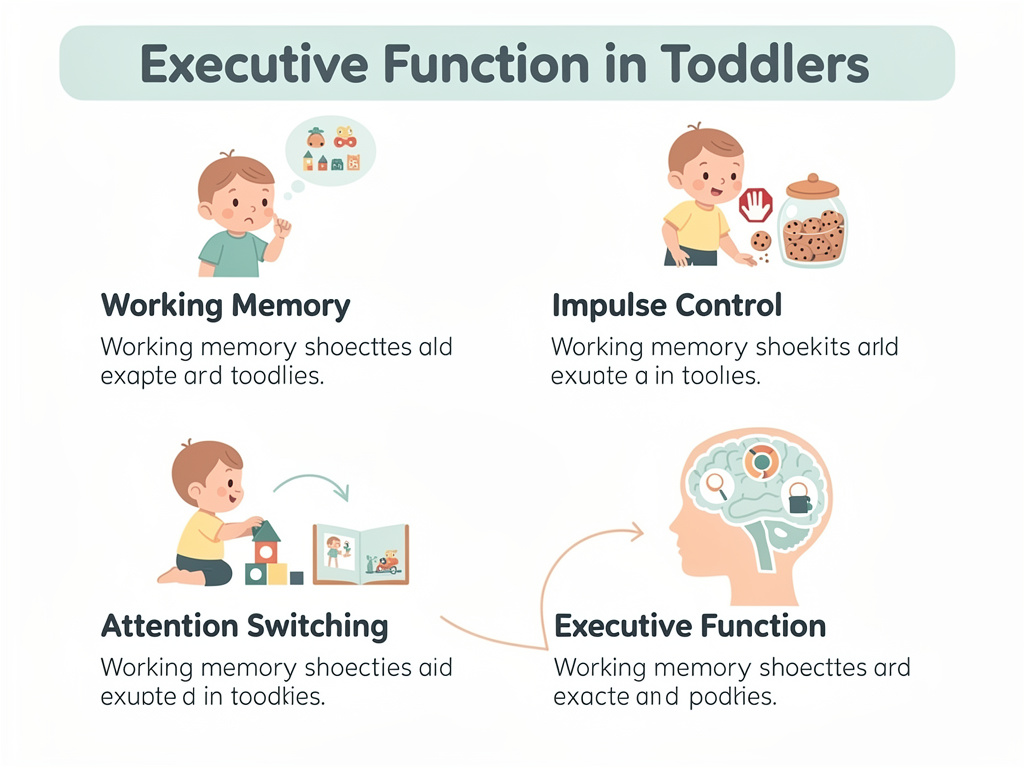
None of that means you wait it out and hope for the best. It just means the goal isn’t a toddler who never struggles to listen, it’s a toddler who’s supported with instructions their current brain can actually handle.
Does a Toddler Not Listening Change by Age?
Yes, a toddler won’t listen for different reasons, and to different degrees, depending on where they are developmentally. Attention span, impulse control, language, and independence all shift fast between 18 months and 4 years, and each shift changes what “listening” realistically looks like.
| Age | What’s Developing | What “Not Listening” Usually Looks Like |
|---|---|---|
| 18–24 months | Very limited impulse control, minimal language for negotiating | Ignoring simple requests, no real understanding of “wait” |
| 2 years | Growing independence, short working memory | Hearing the instruction, then testing what happens if they don’t comply |
| 3 years | Longer attention span, more language to express “no” | Negotiating, stalling, or offering an alternative instead of complying |
| 4 years | Stronger impulse control, better multi-step following | More reasoning and back-and-forth, less flat-out ignoring |
Note : A toddler won’t listen the same way at 18 months as they will at 4 years old younger toddlers are mostly limited by brain capacity, while older toddlers are more often negotiating on purpose. Matching your expectations to your child’s actual age makes the whole stage far less frustrating.
What Actually Works When a Toddler Won’t Listen?
Here’s the sequence that actually moves the needle when a toddler won’t listen, based on CDC and pediatric guidance rather than bigger threats or louder voices.
1. Get Close and Down to Their Level
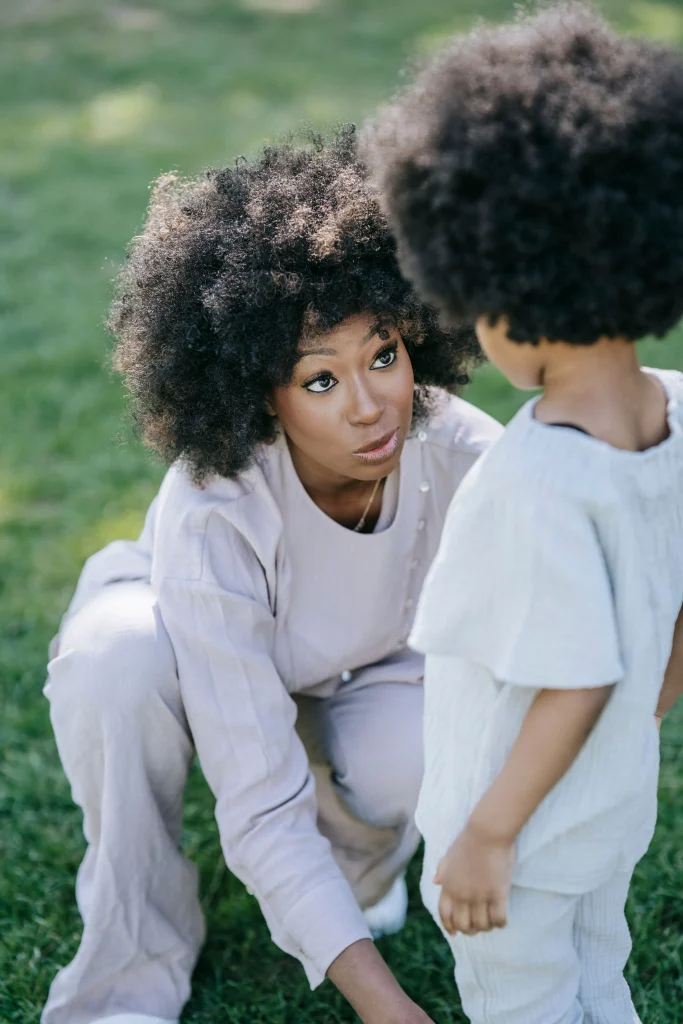
Directions given from across the room are far easier to miss or ignore than ones given face-to-face when a toddler won’t listen.
- In practice: Walk over, crouch or kneel to their eye level.
- Physical cue: Lightly touch their arm or shoulder before you speak to ensure you have their full attention.
2. Use One Short Instruction at a Time
“Shoes on” lands better than “Can you please stop what you’re doing and go put your shoes on so we can leave”
- In practice: Strip every instruction down to two or three words whenever you can.
- Examples: “Shoes on,” “Blocks away,” “Hands down.”
3. Say What to Do, Not Just What to Stop
“Walk feet” works better than “Stop running,” which only tells your child what not to do.
- In practice: Swap every “stop” instinct for a positive direction.
- Examples: “Walking feet,” “Gentle hands,” “Inside voice”
4. Wait 5–10 Seconds Before Repeating Yourself
Toddlers need a beat to process and respond. Jumping in immediately with a second request resets their processing instead of speeding it up.
- In practice: Count silently to eight in your head after every instruction before you say anything else.
5. Follow Through Every Single Time
If you give a direction, see it through to completion. This is the single biggest factor in whether a toddler won’t listen or learns to listen the first time or the fifth.
- In practice: If you said “Shoes on,” physically guide them to the shoes if they haven’t moved after your wait, rather than repeating the request a third time.
6. Praise the Listening, Specifically
“Thank you for putting your shoes on” reinforces the exact behavior you want repeated more effectively than a generic “good job.”
- In practice: Name the exact action every time.
- Example: “You put your shoes on the first time I asked, thank you”, instead of a vague “good boy/girl.”
7. Cut Back on Unnecessary “No”
When your toddler won’t listen, hearing “no” constantly for low-stakes things makes them less responsive to it when it actually matters. Save the sharp tone for real safety issues.
- In practice: For anything that isn’t a safety issue, offer a limited choice instead of a flat “no”
- Example: “We’re not doing that right now, but you can pick the red cup or the blue one.”
Knowing what works is half the picture. The other half is recognizing the small habits that quietly undo it.
Common Mistakes That Make a Toddler Less Likely to Listen
A few everyday habits make a toddler won’t listen problem worse without anyone realizing it’s happening. Avoiding these common parenting traps will drastically improve your child’s cooperation.
1. Expecting Instant Compliance
Toddlers genuinely need a few seconds to process language and switch between tasks.
- The issue: Expecting an immediate response sets both of you up for intense frustration.
- The reality: A slight delay in action is usually a processing lag, not intentional defiance.
2. Repeating Instructions Too Many Times
When a toddler won’t listen, repeating yourself over and over completely backfires.
- The issue: Every repeat without a real consequence teaches your child a bad lesson.
- The reality: They learn that the first few requests are optional, and only the final warning matters.
3. Yelling From Another Room
Proximity is everything when communicating with a young child.
- The issue: A raised voice from a distance is incredibly easy for a busy child to tune out.
- The reality: It skips the eye contact and close proximity that actually help a toddler won’t listen mistake turn into an understood request.
4. Giving Several Instructions at Once
“Put your shoes on, grab your bag, and get in the car” asks too much of a young brain.
- The issue: This multi-step command asks a still-developing working memory to hold three distinct tasks at once.
- The reality: Most toddlers lose the very first instruction before you even finish speaking the third.
5. Asking Questions Instead of Directing
Framing commands as questions creates a major loophole when a toddler won’t listen.
- The issue: Asking “Do you want to put your shoes on?” invites a flat “no” that you don’t actually want to hear.
- The reality: If the task is not optional, phrase it as a clear direction rather than a question.
6. Threatening Consequences That Never Happen
Consistency is the foundational backbone of effective pediatric guidance.
- The issue: Issuing empty threats teaches your toddler that your words do not match your real-world actions.
- The reality: This lack of follow-through erodes the exact parental authority that makes listening improve.
What to Say Instead
Small wording changes make a bigger difference than they seem like they should. Here’s what to try instead of the phrases that tend not to land.
| Instead of Saying | Try Saying |
|---|---|
| “Can you PLEASE put your shoes on?” | “Shoes on” |
| “How many times do I have to tell you?” | “I’m here to help you do it” |
| “Stop running!” | “Walking feet” |
| “Don’t hit your brother!” | “Gentle hands” |
| “Why won’t you ever listen to me?” | “Let’s do this together” |
| “Hurry up, we’re late!” | “Two more minutes, then shoes on” |
| “Stop climbing on that!” | “Feet on the floor” |
| “Do you want to clean up now?” | “Time to clean up. Blue bin or red bin first?” |
| “I already told you five times!” | “Shoes on now, please” |
| “Why can’t you just behave?” | “I can see this is hard. Let’s try again.” |
What Your Toddler Actually Hears When You Say…
The exact wording of an instruction changes how a toddler processes it, sometimes dramatically. Here’s how a few common phrasings tend to land.
| Parent Says | Toddler Hears |
|---|---|
| “Can you maybe clean up?” | This is optional. |
| “Put the blocks in the basket.” | Clear instruction. |
| “Stop that!” | Unsure what to do instead. |
| “Hands stay on your body.” | Specific action. |
| “Please try to be careful.” | Vague, no clear action. |
| “Walk next to me.” | Specific action. |
| “Don’t make me count to three!” | A threat, not an instruction. |
| “Shoes on, then we go outside.” | Clear instruction and reward. |
Toddler Won’t Listen or Is It a Tantrum Waiting to Happen?
A toddler who won’t listen and a toddler mid-meltdown often look similar from across the room, but they’re not the same problem. Ignoring a direction is usually about attention, independence, or unclear communication. A full tantrum is a much bigger emotional overload, and often, an ignored direction is actually the first domino that tips into one. For some toddlers, that same overload shows up physically rather than vocally, which is the territory our Toddler Hitting and Biting guide covers in more depth.
If tantrums are the bigger daily struggle in your house, Toddler Tantrums: 5 Ways to Stop Them Without Losing Your Mind walks through the meltdown side of this in more depth. And if the not-listening seems tied to your toddler’s bigger emotions rather than simple distraction, Emotional Regulation in Children: 7 Age-Based Strategies is a natural next read after this one.
When Should You Worry About a Toddler Who Won’t Listen?
Most toddlers who won’t listen are going through a completely typical developmental stage. A few signs are worth mentioning to your pediatrician instead of waiting it out:
- Your toddler doesn’t respond to their name being called, even up close and without distractions
- Not listening is paired with a significant speech or language delay (our Toddler Speech Delay Signs guide covers when that overlap is worth a closer look)
- The behavior is getting significantly worse rather than better with consistent, calm follow-through
- You notice a broader pattern of not responding to sounds, names, or requests across multiple settings, not just at home
- It’s paired with a loss of previously reached developmental milestones
According to the American Academy of Pediatrics, occasional difficulty following directions is a normal part of toddler discipline and development, but persistent, across-the-board unresponsiveness is worth raising at your child’s next well-check.
Most of the time, though, the goal isn’t fixing something that’s broken, it’s building habits that make the whole stage a little smoother.
How to Raise a Toddler Who Listens More Often
No toddler listens perfectly, and that’s not the goal here. A certain amount of defiance is a normal, healthy part of early childhood development. However, when your toddler won’t listen, a handful of everyday habits can genuinely increase cooperation over time.
1. Establish Consistent Routines
A predictable day gives fewer moments where a child is caught off guard by sudden instructions. If your toddler won’t listen, establishing a solid daily rhythm provides comfort and clear expectations.
2. Prioritize Connection Before Correction
A few seconds of eye contact and warmth before a request lands better than a cold instruction shouted mid-stride.
- In practice: Get down physically to their eye level.
- Why it works: It ensures your message is actually received.
3. Give One Instruction at a Time
Matching requests to your child’s working memory dramatically cuts down on ignored directions.
- The trap: Stacking several steps together (e.g., “Get your shoes, grab your bag, and wait by the door”).
- The fix: Use single, punchy commands that a developing brain can easily process.
4. Prioritize Age-Appropriate Sleep
An overtired child has far less capacity for impulse control. If bedtime battles or frequent night waking are part of your daily routine, our 2 Year Old Sleep Regression guide covers the sleep side of this directly. Fixing sleep schedules is critical when a toddler won’t listen.
5. Use Predictable Transitions
A warning before a change gives a child’s brain time to shift gears instead of being asked to switch tasks instantly.
- Example phrase: “Two more minutes of play, then we clean up the blocks.”
6. Offer Limited Choices
Offering two acceptable options keeps a child engaged in cooperating rather than resisting. This is a highly effective tool to try when your toddler won’t listen to direct commands.
- Example: “We are leaving now. Do you want to wear the red shoes or the blue shoes?”
7. Use Positive Reinforcement
Specific praise for listening reinforces the exact behavior you want to see again. Avoid generic phrases and name the exact helpful action they completed.
8. Maintain Calm, Consistent Follow-Through
This is the single habit that compounds every other item on this list. A request that is always followed through builds lasting trust, teaching them that your instructions always mean something.
FAQ: Toddler Won’t Listen
Why won’t my toddler listen to me specifically, but they listen to daycare or grandma?
This is extremely common and usually reflects how comfortable and safe your toddler feels with you, plus how consistently different caregivers follow through. It’s not a sign that your toddler dislikes you or respects someone else more.
Why does my 2 year old ignore me completely when I call their name?
Most often it’s genuine absorption in an activity, not intentional ignoring. If it happens across many settings, including quiet ones with no distractions, mention it to your pediatrician.
Is it ADHD if my toddler won’t listen?
Occasional not-listening alone is not a reliable sign of ADHD at toddler age, it’s typical development. If it’s paired with major impulsivity, inability to sit for any activity, or other developmental concerns, bring it up with your pediatrician.
When do toddlers usually start listening better?
Most children show a noticeable improvement in following directions between ages 3 and 4, as language and impulse control catch up with their understanding.
The Bottom Line on a Toddler Who Won’t Listen
A toddler who won’t listen isn’t rejecting you, and it isn’t a sign you’re doing something wrong. It’s a brain that’s still learning to filter distractions, switch tasks on command, and connect a request to a consequence, all skills that take years, not days, to build.
Shorter instructions, closer proximity, and real follow-through move this faster than volume or bigger threats ever will.