Toddler Hitting and Biting? 7 Proven Age-Based Reasons (It’s Not Bad Parenting)
Understand why toddler hitting and biting happens at every age, learn positive discipline strategies that actually work, and know when behavior is completely normal, or when it's time to seek professional advice.

- Why Does My Toddler Hit and Bite?
- What Causes Toddler Hitting and Biting at Each Age?
- Is Toddler Hitting and Biting Normal Toddler Behavior?
- How to Stop Toddler From Hitting Without Punishing
- Get down to their level immediately
- Name the feeling, then the rule
- Keep your own reaction flat
- Comfort the child who was hurt first
- Offer the replacement immediately
- Repeat the same short script every time
- Praise the moments they use words instead
- Toddler Hitting and Biting: What Works vs. What Backfires
- Toddler Tantrums vs. Toddler Hitting and Biting: What’s the Difference?
- What Do Parents in Online Communities Say About Toddler Hitting and Biting?
- When Should You Worry About Toddler Hitting and Biting?
- FAQ: Toddler Hitting and Biting
- Why does my toddler hit and bite me specifically?
- Is toddler hitting and biting a sign of autism?
- How to stop toddler from hitting without punishing them?
- Should I bite or hit my toddler back to teach them a lesson?
- When does toddler hitting and biting usually stop?
- The Bottom Line on Toddler Hitting and Biting
Medical Disclaimer: Medically reviewed guidelines cited from the American Academy of Pediatrics (AAP) and CDC. This article is for informational purposes and is not a substitute for advice from your child’s pediatrician. If you’re worried about your child’s behavior or safety, talk to your doctor.
The first time my son bit another kid at the park, I wanted to disappear into the mulch. He was 19 months old, he’d just had his favorite shovel taken away, and instead of using words he didn’t have yet, he used his teeth. I remember the other mom’s face. I remember mine, too.
If you’re here because your toddler just hit their sibling, bit a friend at daycare, or smacked you across the face mid-tantrum, take a breath. Toddler hitting and biting is one of the most common, and most misunderstood stages of early childhood. It’s not a parenting failure. It’s a communication gap.
This guide breaks down toddler hitting and biting by exact age, why it happens, and exactly what to do instead of punishing, so you can stop it without shame, for either of you.
If you want to understand what’s normal toddler behavior by age, why tantrums happen, and how positive parenting strategies can reduce meltdowns, hitting, and power struggles in children ages 1–4. Read our Complete Toddler Behavior Guide
Toddler hitting and biting usually peaks between 15 and 30 months and happens because toddlers feel big emotions before they have the words to express them. The fix isn’t punishment, it’s teaching your child what to do instead, staying calm and consistent, and matching your response to their age. Most toddlers stop hitting and biting on their own by age 3 to 4 with the right response.
Why Does My Toddler Hit and Bite?
Toddlers hit and bite because their emotional brain develops years before their language and impulse-control skills do. When a toddler feels frustrated, overstimulated, jealous, or scared, hitting or biting is often the fastest tool available to them, faster than finding the right words.
I know how counter-intuitive that sounds when you’re the one who just got bitten on the arm. But toddler hitting and biting is rarely about aggression the way we understand it in adults. It’s about a nervous system that’s still under construction.
According to the American Academy of Pediatrics, toddlers and preschoolers frequently lack the self-control to express anger peacefully, and may naturally lash out by hitting or biting when frustrated. That’s not an excuse to let it slide, it’s the reason your response has to teach the skill your child is missing, not just punish the absence of it..
What Causes Toddler Hitting and Biting at Each Age?
Toddler hitting and biting doesn’t look the same at 13 months as it does at 3 years old, and the response shouldn’t either. Here’s how the pattern usually shifts as your child grows.
| Age Range | Most Likely Cause of Hitting/Biting | What Actually Helps |
|---|---|---|
| 12–17 months | Teething, sensory exploration, cause-and-effect testing | Redirect to a teething toy; stay neutral, don’t overreact |
| 18–24 months | Peak biting window, frustration, limited words, big transitions | Name the feeling for them; short, calm “no biting” script |
| 2–3 years | Testing limits, jealousy, overstimulation, sibling conflict | Teach replacement words/actions; consistent, calm limits |
| 3–4 years | Should be tapering off; may signal unmet emotional needs | 1:1 connection time; problem-solve triggers together |
| 4+ years, ongoing | Possible underlying stressor (change at home, speech delay, anxiety) | Talk to your pediatrician for evaluation |
If your toddler is squarely in the 18-to-24-month window, you’re in the most common phase for this behavior. This is the age where toddler hitting and biting is most frequent, and most survivable.
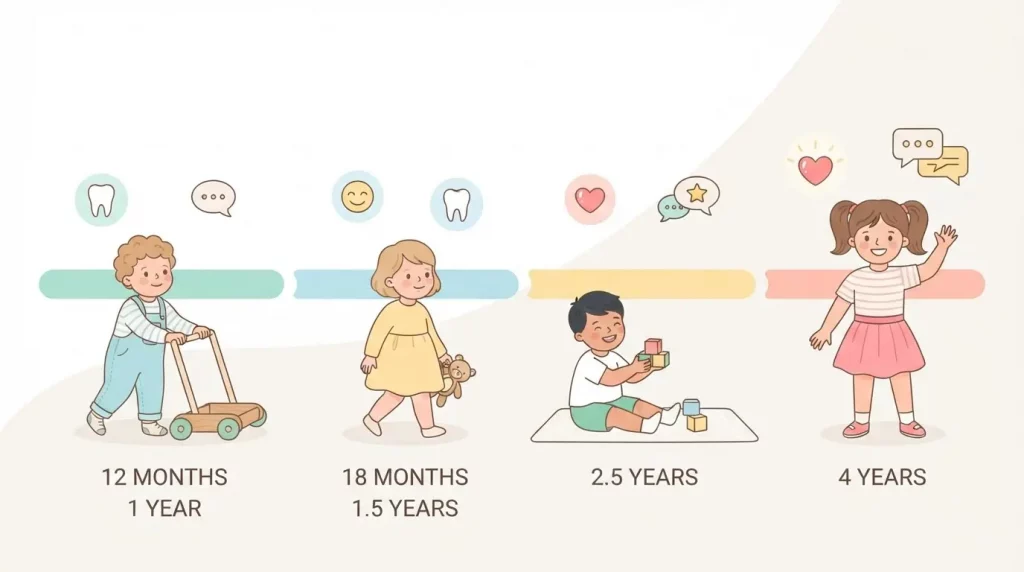
Toddler hitting and biting at 18–24 months is caused mainly by a language gap: your toddler feels the emotion before they have the word for it. This is the peak age for biting specifically, and it typically fades by age 3 as speech and self-control catch up.
Is Toddler Hitting and Biting Normal Toddler Behavior?
Yes, occasional hitting or biting between ages 1 and 3 is developmentally typical, not a red flag. Many children go through a phase of aggressive biting between one and three years of age as they test cause and effect, seek attention, or work through frustration.
In our house, the phase lasted about five months. It felt endless in the moment. It wasn’t. Toddler hitting and biting is common enough that most daycare and preschool programs have a standard protocol for it, which should tell you something about how expected this stage really is.
That said, “normal” doesn’t mean “ignore it”. Toddler hitting and biting still needs a consistent response every single time, or your toddler won’t learn where the line is.
How to Stop Toddler From Hitting Without Punishing
If you’ve searched how to stop toddler from hitting without punishing, you already know that time-outs and consequences alone don’t seem to be working. That’s because toddler hitting and biting is a skills gap, not a discipline gap. Here’s the sequence I use, and the one most pediatric sources recommend.
Get down to their level immediately
Physically block another hit or bite if needed, calmly and without force.
Name the feeling, then the rule
Try: “You’re really mad he took your toy. I won’t let you hit.” This teaches empathy while holding the boundary.
Keep your own reaction flat
A big reaction (yelling, shocked faces, dramatic gasps) can accidentally reward the behavior with attention.
Comfort the child who was hurt first

In front of your toddler. This shows the natural consequence of hitting or biting without you delivering a punishment.
Offer the replacement immediately
“Use your words: ‘my turn’ or ‘stop.'” Toddlers can’t do what they haven’t been shown.
Repeat the same short script every time
Consistency, not severity, is what actually stops toddler hitting and biting.
Praise the moments they use words instead
Catching the good behavior does more long-term work than any consequence for the bad.
The AAP is direct about what not to do here: spanking or hitting a child in response often increases aggression rather than correcting it. Biting a child back to “show them how it feels” carries the same risk, it models the exact behavior you’re trying to stop.
How to stop toddler from hitting without punishing comes down to three moves: stay calm, name the feeling, and immediately teach the replacement behavior every time, the same way, without exception.
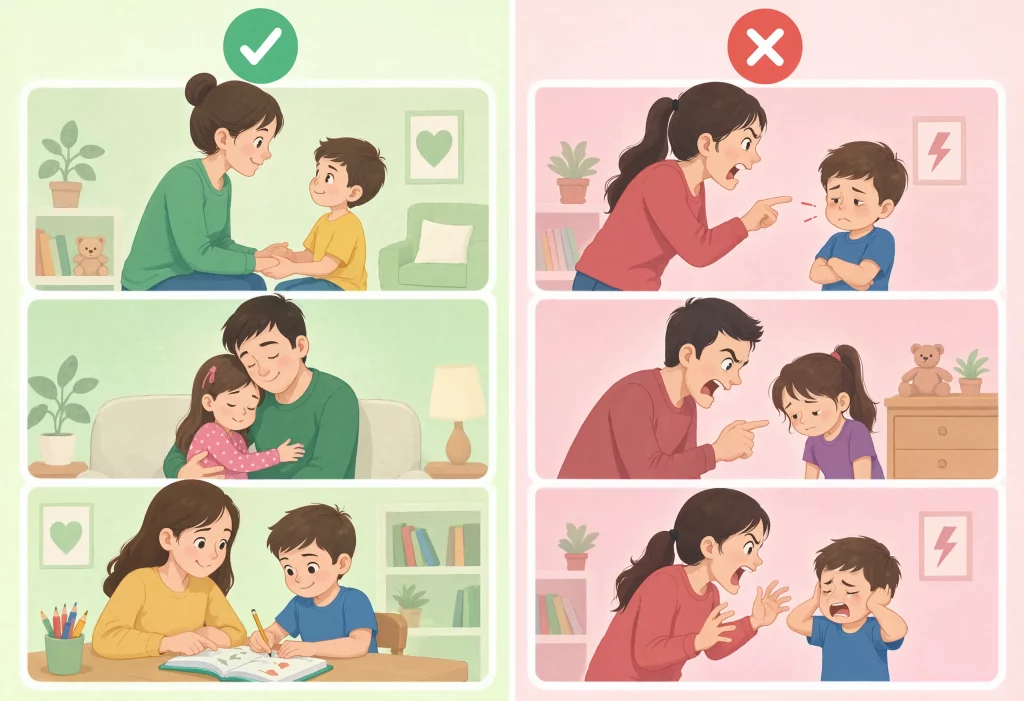
Toddler Hitting and Biting: What Works vs. What Backfires
| ✅ What Actually Works | ❌ What Backfires |
|---|---|
| Calm, consistent one-line script (“No biting. Biting hurts.”) | Long lectures a toddler can’t process |
| Redirecting to words or a physical outlet (pillow, stomping) | Biting or hitting the child back |
| Comforting the injured child first | Public shaming or labeling (“You’re a biter”) |
| Praising word-use in the moment it happens | Only reacting when things go wrong |
| Watching for and heading off known triggers (hunger, overstimulation) | Waiting until the child is mid-meltdown to teach the skill |
Toddler Tantrums vs. Toddler Hitting and Biting: What’s the Difference?
Not every meltdown involves hitting, and not every instance of toddler hitting and biting happens during a full tantrum, the two overlap, but they’re not identical. A tantrum is a total emotional overload; hitting and biting are often one specific behavior inside that overload, or a stand-alone reaction to a smaller trigger like a shared toy.
If tantrums are your bigger struggle right now, our full breakdown in Toddler Tantrums: 5 Ways to Stop Them Without Losing Your Mind walks through the meltdown side of this in more depth. And if the hitting seems tied to bigger emotions your toddler can’t name yet, Emotional Regulation in Children: 7 Age-Based Strategies is the natural next read after this one.
What Do Parents in Online Communities Say About Toddler Hitting and Biting?
Scroll through any parenting forum and the pattern around toddler hitting and biting is remarkably consistent. Parents in communities like r/Parenting, r/beyondthebump, and r/toddlers tend to report the same three things:
- The behavior almost always clusters around transitions : leaving the park, a sibling arriving, daycare drop-off.
- Consistency beats intensity. Parents who used the same calm script every time saw faster improvement than parents who escalated consequences.
- Most parents say the phase peaked hard around 18–22 months and was mostly gone by 3, matching what pediatric guidance describes.
The community consensus lines up with the clinical one: toddler hitting and biting responds better to a boring, predictable adult reaction than to a bigger one.
When Should You Worry About Toddler Hitting and Biting?
Most toddler hitting and biting resolves on its own with a consistent response and time. But a few signs mean it’s worth a conversation with your pediatrician rather than waiting it out:
- Hitting or biting is getting more frequent or more severe past age 3–4, not less
- Your child seems to target the same person repeatedly with intent to hurt
- It’s paired with a loss of previously reached milestones, or a significant speech delay (our Toddler Speech Delay Signs guide covers when that overlap needs a closer look)
- The behavior is getting your toddler removed from daycare or preschool
- You notice self-injury alongside the aggression toward others
According to the CDC, toddlers between 1 and 3 years old are expected to show more independence and can display defiant behavior as a normal part of development, but persistent, escalating aggression is one of the signs worth flagging to your child’s doctor during a well-child visit.
FAQ: Toddler Hitting and Biting
Why does my toddler hit and bite me specifically?
Toddlers often direct hitting and biting at the person they feel safest with, usually a parent. It’s not personal — it means your child trusts you enough to fall apart in front of you, even if that “falling apart” looks like aggression.
Is toddler hitting and biting a sign of autism?
Occasional hitting and biting alone is not a reliable sign of autism — it’s typical toddler behavior. If aggression is paired with lost skills, no eye contact, or significant speech delays, mention it at your next pediatric visit for a broader developmental check.
How to stop toddler from hitting without punishing them?
Stay calm, name the feeling, hold the boundary with a short consistent phrase, and immediately teach the replacement word or action. Repetition, not punishment severity, is what changes toddler hitting and biting over time.
Should I bite or hit my toddler back to teach them a lesson?
No. Pediatric guidance is consistent on this: modeling the same aggressive behavior you’re trying to stop tends to reinforce it rather than correct it.
When does toddler hitting and biting usually stop?
For most children, hitting and biting peaks between 18 and 24 months and fades significantly by age 3, as language and self-control catch up. If it’s still frequent or escalating past age 4, talk to your pediatrician.
The Bottom Line on Toddler Hitting and Biting
Toddler hitting and biting feels like a crisis in the moment, especially the first time it happens in public. But it’s one of the most predictable, most temporary stages of early childhood, and it responds well to a calm, consistent adult who teaches the skill instead of just punishing the behavior’s absence.
You’re not raising an aggressive kid. You’re raising a toddler whose feelings are bigger than their vocabulary, for now.
Medical Disclaimer: This article is intended for general informational purposes only and does not constitute medical advice. Always consult your child’s pediatrician with questions about your child’s behavior, development, or health.