Newborn Sleep Schedule: A Week-by-Week Guide for New Parents
What no one tells you about newborn sleep, and a realistic schedule that actually works.

- Quick Answer: What Is a Normal Newborn Sleep Schedule?
- Why Newborn Sleep Is So Unpredictable (And When It Gets Better)
- Introduction
- Week 1-2: Survival Mode
- Week 3-4: First Patterns Appear
- Month 2: Longer Stretches Begin
- Month 3: A Routine Is Finally Possible
- What “Drowsy But Awake” Actually Means
- Sample Newborn Sleep Schedule – Month 3
- How Long Should Each Nap Be?
- Safe Sleep Rules That Apply to Every Newborn Sleep Schedule
- 5 Sleep Cues That Should Drive Your Newborn Sleep Schedule
- 5 Mistakes That Disrupt Any Newborn Sleep Schedule
- What to Do When Nothing Works
- When to Call Your Doctor
- Related Guides on GoodFamilyTips
- One Tool That Helped Our Routine More Than Any Book
- Newborn Sleep Schedule FAQ
- The Honest Truth About Any Newborn Sleep Schedule
- Honest Words
Quick Answer: What Is a Normal Newborn Sleep Schedule?
According to the American Academy of Pediatrics (AAP) and Stanford Children’s Health, newborns sleep 14 to 17 hours per day, but rarely more than 1 to 2 hours at a time. Regular sleep cycles do not develop until around 6 months of age. Before that, the newborn sleep schedule is driven entirely by hunger and biology.
| Age | Total Sleep/Day | Night Sleep | Naps/Day |
| Week 1-2 | 16-17 hours | 8-9 hrs (fragmented) | 4-5 short naps |
| Week 3-4 | 15-17 hours | 8-9 hrs | 4-5 naps |
| Month 2 | 14-16 hours | 9-10 hrs | 3-4 naps |
| Month 3 | 14-16 hours | 10-11 hrs | 3 naps |
Source: American Academy of Pediatrics (AAP) & Children’s Hospital of Philadelphia (CHOP)
Why Newborn Sleep Is So Unpredictable (And When It Gets Better)
Most parents expect a newborn to sleep like a tired adult, long, deep, and predictable. The reality is the opposite, and understanding why makes the whole experience less frightening.

Newborns spend about 50% of their sleep in REM, the light, active sleep stage. Adults spend only 20%. This means your baby wakes more easily, moves more during sleep, and cycles between light and deep sleep every 45-50 minutes. When they surface between cycles, they do not yet know how to connect back into the next one without help.
Understanding wake windows is key to this schedule. Check out our Baby Wake Windows by Age guide for more details
This is not a problem to fix. It is developmental.
Here is when it genuinely gets easier:
- 6 weeks: First social smiles, slightly longer night stretches
- 8-10 weeks: One 4-5 hour stretch most nights
- 3 months: Predictable nap windows, earlier bedtime possible
- 4-6 months: Sleep cycles mature – this is when real consolidation happens
Knowing this timeline does not make the 2 AM wake-ups easier. But it makes them make sense.
Introduction
I remember sitting in the dark at 3 AM, my newborn finally asleep on my chest, terrified to move.
I had read every book. I had the newborn sleep schedule printed and taped to the wall. And none of it matched what was actually happening in front of me.
Here is what I wish someone had told me: newborns do not follow a newborn sleep schedule. They follow biology. Their stomachs are tiny, their nervous systems are brand new, and their circadian rhythm does not exist yet. Once I stopped fighting that and started working with it, the first three months became manageable.
This guide gives you a realistic newborn sleep schedule week by week, built around how newborn biology actually works.
Week 1-2: Survival Mode
Your newborn has zero concept of day or night. Their only biological job is to eat, sleep, and grow, on their own timeline, not yours.
A realistic newborn sleep schedule at this stage does not really exist yet, and that is completely normal.
What is normal in week 1-2:
- Sleeping 16-17 hours total, never more than 2-3 hours at a stretch
- Waking every 2-3 hours to feed, this is biological necessity, not a sleep problem
- No meaningful difference between day sleep and night sleep
- Falling asleep mid-feed, normal and expected
Your only job right now: keep baby fed, warm, and safe. Do not try to force any newborn sleep schedule before week 6. It will not work, and it will exhaust you faster.
Week 3-4: First Patterns Appear
Around week 3, something starts to shift. Melatonin begins developing, and most babies show a slight preference for longer sleep at night. This is your first real opening to start shaping a newborn sleep schedule.
What helps at this stage:
- Natural light during the day : morning sunlight is the strongest signal for setting the circadian rhythm
- Dark and calm nighttime feeds : no bright lights, no talking, no stimulation
- Simple wind-down : feed, short calm hold, put down drowsy but awake
- White noise : consistent sound at every sleep becomes a reliable sleep cue

Expert note: Pediatric sleep specialist Dr. Harvey Karp recommends the “5 S’s” — Swaddle, Side/Stomach position (for calming only, never for sleep), Shush, Swing, Suck — to trigger the calming reflex and support whatever newborn sleep schedule you begin to build.
Month 2: Longer Stretches Begin
Month 2 is when most parents start to feel human again. The newborn sleep schedule at this stage becomes more visible. Most babies stretch their longest sleep to 4-5 hours typically in the first part of the night.
What changes at 2 months:
- Naps become slightly more predictable : 3-4 per day
- Baby is more socially alert during wake windows : smiling, tracking faces
- An eat-play-sleep rhythm starts to naturally support the newborn sleep schedule
- Wake windows extend to 60-90 minutes : watch for tired cues and act before overtired
Important: An overtired baby at 2 months is significantly harder to settle. The newborn sleep schedule at this age works best when you catch the sleep window early at the first yawn, not the first meltdown.
Month 3: A Routine Is Finally Possible
By month 3, most babies can handle 5-6 hour stretches at night. The newborn sleep schedule becomes more consistent and more predictable. This is the earliest realistic point to introduce gentle structure.
A realistic newborn sleep schedule at 3 months:
- 3 naps during the day — morning, midday, late afternoon
- Wake windows of 1.5 to 2 hours between naps
- Bedtime between 7 and 8 PM
- 1-2 night feeds still completely normal and expected
Do not measure success at month 3 by whether your baby sleeps through the night. Measure it by whether you have a consistent rhythm that works for your family.
What “Drowsy But Awake” Actually Means
Every newborn sleep guide mentions it. Almost none explain it clearly.
Drowsy but awake means baby is fed, calm, eyes heavy but not fully asleep yet. You put them down at this exact moment so they learn to cross the final threshold into sleep on their own.
It will not work every time in the first weeks. That is normal. Keep trying by month 3, it becomes the foundation of your entire routine.
Sample Newborn Sleep Schedule – Month 3
This is a loose guide, not a rigid plan. Your baby will adjust it.
| Time | Activity | Note |
|---|---|---|
| 7:00 AM | Wake + feed | Bright light — signals start of day |
| 8:30 AM | Nap 1 | 45-90 min — watch cues |
| 10:00 AM | Wake + feed + play | Tummy time, talk, engage |
| 11:30 AM | Nap 2 | Longest nap of the day |
| 1:30 PM | Wake + feed + activity | Outdoor light if possible |
| 3:00 PM | Nap 3 | 30-45 min max — keep short |
| 4:00 PM | Wake + feed | Last nap ends by 5 PM |
| 6:30 PM | Bedtime routine | Bath, feed, white noise, dark room |
| 7:00-7:30 PM | Bedtime | Drowsy but awake |
| Night | 1-2 feeds | Dark, quiet, minimal stimulation |
How Long Should Each Nap Be?
Nap length changes fast in the first three months:
- Week 1-4: Naps vary wildly — 20 minutes to 2 hours. Do not try to control this yet.
- Month 2: Aim for at least one longer nap of 1-1.5 hours per day. Morning nap is usually the easiest.
- Month 3: Two longer naps (1-1.5 hours) and one short catnap (30-45 min) in the late afternoon.
If every nap is under 30 minutes, baby is likely overtired going in — adjust wake windows shorter.
Safe Sleep Rules That Apply to Every Newborn Sleep Schedule
No newborn sleep schedule is safe without a safe sleep environment. The AAP reports around 3,500 infant sleep-related deaths occur in the US each year, most preventable. These rules apply to every nap and every night, no exceptions:
- Alone — baby sleeps alone in their own safe space, every time
- Back — always on their back, from day one
- Crib — firm flat surface, no soft bedding, no bumpers, no toys
Room-sharing — not bed-sharing — reduces SIDS risk by up to 50% according to the AAP. Keep baby’s crib or bassinet in your room for the first 6 months of your newborn sleep schedule.
2025 AAP update: Weighted swaddles and weighted sleep sacks are now strongly discouraged. They can restrict breathing and should be removed from any newborn sleep schedule toolkit.
5 Sleep Cues That Should Drive Your Newborn Sleep Schedule
The most effective newborn sleep schedule is cue-based, not clock-based. These signals mean put baby down now:
- Rubbing eyes or face : earliest and most reliable cue
- Staring blankly : zoned out, not tracking your face or movement
- Yawning : obvious, but easy to miss mid-activity
- Fussing without clear cause : if fed, changed, and comfortable, this is sleep
- Turning head away or arching back : baby is pulling away from stimulation
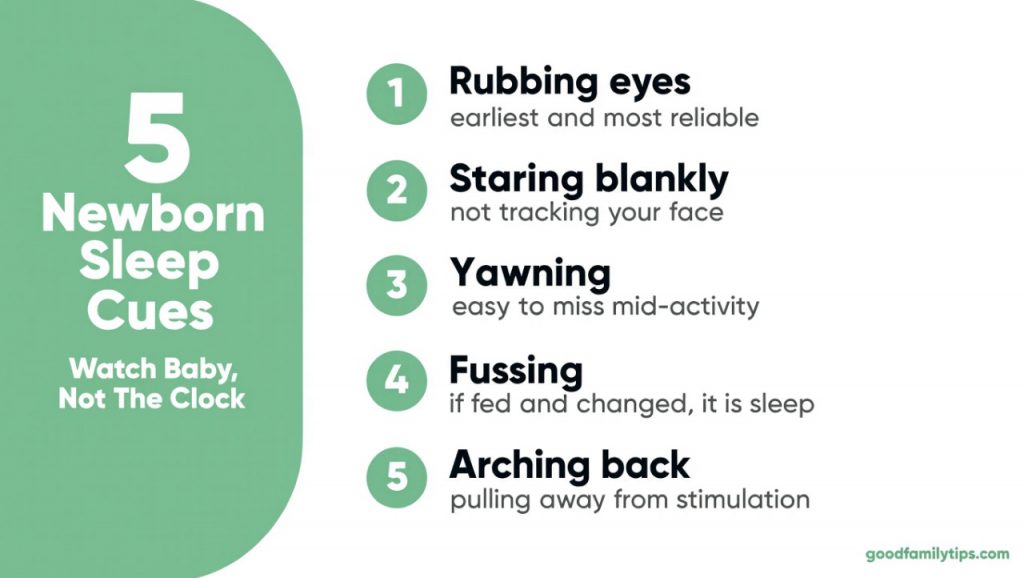
Missing these cues leads to overtired babies who fight sleep harder. Your newborn sleep schedule works best when you respond to the first cue, not the fourth.
5 Mistakes That Disrupt Any Newborn Sleep Schedule
- Starting structure too early. Before 6-8 weeks, biology overrides any newborn sleep schedule you try to set.
- Keeping wake windows too long. At month 1, 45-60 minutes maximum. Overtired = harder to settle.
- Not separating day from night. Bright, active days and dark, quiet nights teach baby the difference faster.
- Skipping white noise. Consistent sound is one of the most reliable sleep cues you can build into a newborn sleep schedule.
- Comparing to other babies. Every newborn sleep schedule looks different. What works for one baby may not work for yours.
What to Do When Nothing Works
Some nights, no routine holds. Baby is fed, changed, rocked — and still crying.
This is not a schedule failure. This is a newborn.
On those nights, do one thing: survival mode. Hold baby, stay calm, and lower your expectations for the next 24 hours. One bad night does not break a routine you spent weeks building.
If bad nights happen more than they do not, check wake windows first — that is the most common hidden cause.
When to Call Your Doctor
Most newborn sleep schedule variation is completely normal. Call your pediatrician if you notice:
- Baby sleeping more than 19 hours and difficult to wake for feeds
- Not regaining birth weight by day 10-14
- Fewer than 6 wet diapers per day after day 5
- Noisy or labored breathing during sleep
- Inconsolable crying for 30+ minutes consistently
Related Guides on GoodFamilyTips
- 👉 Baby Wake Windows by Age: Simple Guide (0-12 Months)
- 👉 7 Methods for When Your Baby Won’t Sleep Unless Held
- 👉 The Ultimate Baby Sleep Guide: 5 Proven Steps for Regressions
- 👉 Newborn Environment: Complete Safety Guide & Checklist
- 👉 How to Generate Custom Baby Sleep Sounds with Suno AI
One Tool That Helped Our Routine More Than Any Book
Consistent white noise same sound, every sleep, every nap.
We started generating custom sounds using Suno AI white noise, heartbeat rhythms, gentle rain, tailored to exactly what our baby responded to. No ads, no shuffle surprises at 2 AM.
👉 How to Generate Custom Baby Sleep Sounds with Suno AI
Newborn Sleep Schedule FAQ
How many hours should a newborn sleep?
A healthy newborn sleep schedule includes 14-17 hours per day. As long as they wake to feed every 2-3 hours and gain weight steadily, this is normal.
When do newborns start sleeping longer at night?
Most newborn sleep schedules shift around 6-8 weeks, when babies begin stretching to 4-5 hour stretches. By 3 months, many reach 5-6 hours. Night feeds at 3 months are still completely normal.
Should I wake my newborn to feed?
In the first 4-6 weeks, yes. The AAP recommends not letting newborns go longer than 4-5 hours without feeding regardless of your newborn sleep schedule, until steady weight gain is confirmed by your pediatrician.
Is white noise safe in a newborn sleep schedule?
Yes, when used correctly. Keep volume at or below 50 decibels and place the machine at least 7 feet from baby. Never put it directly in the crib.
When should I start a real newborn sleep schedule?
A loose routine can start around 6-8 weeks. A predictable, consistent newborn sleep schedule is more realistic from 4-6 months, when sleep cycles begin to mature.
The Honest Truth About Any Newborn Sleep Schedule
No plan works perfectly. And that is not a failure.
The goal in the first three months is not to perfect a newborn sleep schedule. It is to understand your baby’s biology, meet their needs consistently, and build small patterns that slowly become a rhythm.
The schedule in this guide is a starting point. Your baby will teach you the rest.
Honest Words
The first three months are the hardest part of any routine, not because you are doing it wrong, but because you are doing it with a brand new human who has never slept outside a womb.
Every family I have spoken to who came out the other side says the same thing: the routine did not click because they found the perfect schedule. It clicked because they stayed consistent long enough for their baby to feel safe.
Give yourself that time. Track wake windows. Watch the cues. Adjust when something stops working. And remember — a good enough routine followed consistently beats a perfect routine followed inconsistently every single time.