How to Put a Baby to Sleep in 40 Seconds (Safe, Proven Methods That Actually Work)
The Step-by-Step System That Works at 3 AM — Even When Nothing Else Does

- Quick Answer:
- Why Parents Search “How to Put a Baby to Sleep in 40 Seconds”
- The Real Problem Behind the Search
- Why Most “Quick Sleep Tips” Fail
- Can You Really Put a Baby to Sleep in 40 Seconds?
- What “40 Seconds” Actually Means
- When Fast Sleep Techniques Work Best
- The 40-Second Baby Sleep System (Step-by-Step)
- Step 1 – Set the Sleep Environment (10 Seconds)
- Step 2 – Choose the Right Technique (Based on Baby State)
- Step 3 – Lock the Sleep (Floppy Arm Test)
- Why These Techniques Work (Science Simplified)
- Nervous System Regulation
- Womb Simulation
- Sleep Cycle Triggering
- When This 40-Second Method Will NOT Work
- Overtired Baby
- Hunger or Discomfort
- Sleep Regression Phases
- Common Questions Parents Ask
- Why does my baby wake up multiple times at night?
- How do I get my newborn to sleep longer at night?
- What are the best tricks to settle an overtired baby quickly?
- How long should it take for a baby to fall asleep?
- Is my baby getting too much or too little daytime sleep?
- Safe Sleep Rules You MUST Follow (AAP Guidelines)
- Final System Recap (Quick Reference)
Quick Answer:
To put a baby to sleep in 40 seconds, place them on their back in a safe crib with white noise, then stroke gently from forehead to nose every 3 seconds (tissue stroke method). Works best when baby is drowsy but not overtired. Full step-by-step system below.
Medical Disclaimer: This article is for informational purposes only and does not replace professional medical advice. Always consult your pediatrician with concerns about your baby’s sleep or development.
Learning how to put a baby to sleep in 40 seconds starts with one thing most parents skip the environment.
If you are searching how to put a baby to sleep in 40 seconds at 3 AM, you are in the right place.
Here is what to do right now: Place your baby on their back in a safe crib, turn on white noise, and try the tissue stroke method described in Step 2 below.
That is the short version. Keep reading for exactly how to do it.
Why Parents Search “How to Put a Baby to Sleep in 40 Seconds”
The Real Problem Behind the Search
You are not looking for magic. You just need something that works — fast.
Sleep deprivation does something real to your brain. It creates anxiety, irritability, and a kind of desperation that is hard to explain to anyone who has not lived it.
And the cruel part? The more stressed you are, the harder it is for your baby to settle. They feel your tension. You feel their crying. The cycle keeps going.
You are not failing. You are exhausted. There is a difference.
Why Most “Quick Sleep Tips” Fail
Most tips you find online are too vague.
“Rock your baby.” “Feed them.” “Try skin-to-skin.”
These are not bad suggestions. But they fail because they ignore three critical things:
- Whether your baby is overtired or undertired
- Whether the sleep environment is actually set up correctly
- Whether you have a consistent, repeatable system — not just a list of tricks
One tip applied randomly will not work. A system applied consistently will.
Can You Really Put a Baby to Sleep in 40 Seconds?
What “40 Seconds” Actually Means
Honest answer: not for every baby, every time.
But knowing how to put a baby to sleep in 40 seconds gives you a real starting point, especially when you need it most.
The 40-second techniques work best when your baby is drowsy but not yet in full meltdown. Think of it as a trigger — you are helping their body cross the line from “almost asleep” to “actually asleep.”
You are not forcing sleep. You are creating the right conditions for sleep to happen.
When the environment is right, the timing is right, and you apply the technique correctly — it can happen very fast. Sometimes in under a minute.
When Fast Sleep Techniques Work Best
These methods work best when:
- Your baby is showing early tired signs (yawning, glazed eyes, slowing down)
- They have been awake for an age-appropriate amount of time
- The sleep environment is already set up before you start
- You have used the same bedtime cues consistently
If your baby is already screaming and arching their back — they may be overtired. We will cover that too.
The 40-Second Baby Sleep System (Step-by-Step)
Here is the complete system for how to put a baby to sleep in 40 seconds : Three steps, in order, every time.
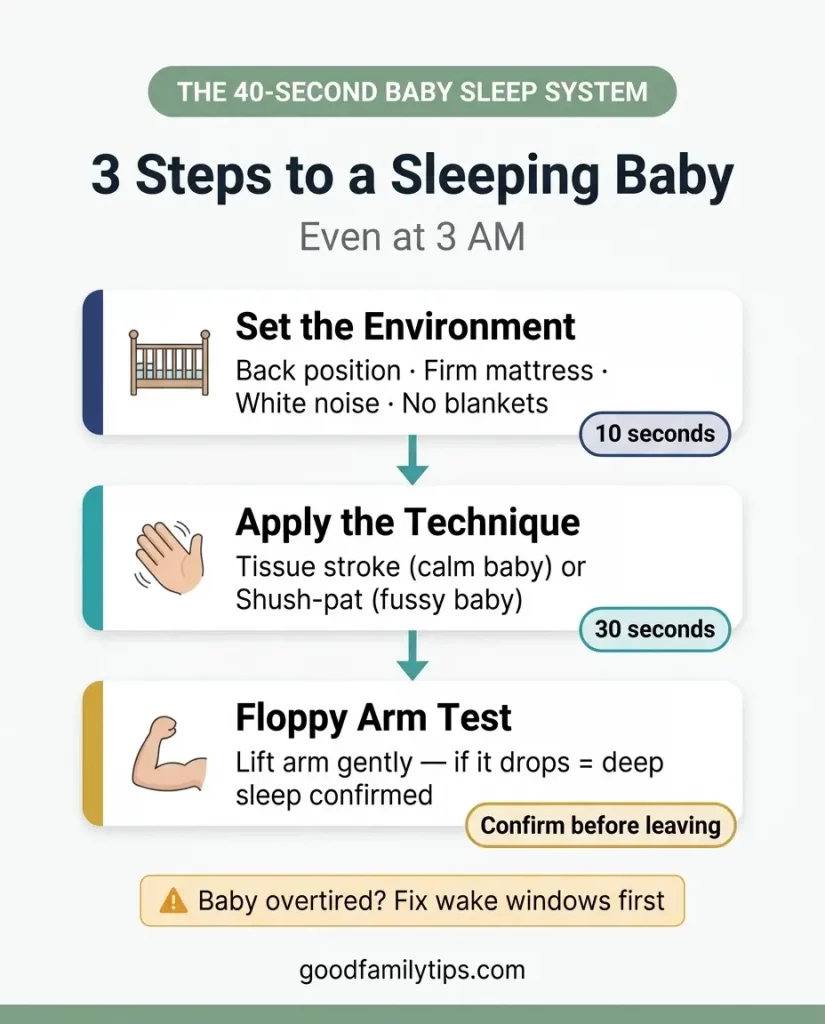
Step 1 – Set the Sleep Environment (10 Seconds)
Before anything else — get the environment right. This takes ten seconds and it matters enormously.
Place your baby on their back. Always. This is the AAP safe sleep recommendation and it is non-negotiable.
The crib should have:
- A firm, flat mattress
- A fitted sheet — nothing else
- No pillows, blankets, positioners, or toys
Turn on white noise. The whooshing sound mimics the womb environment your baby lived in for nine months. It signals safety to their nervous system.
If your baby is a newborn and you are using a swaddle — make sure arms are secure but hips can move. Stop swaddling as soon as your baby shows any signs of rolling.
Step 2 – Choose the Right Technique (Based on Baby State)
This is the core of how to put a baby to sleep in 40 seconds, the right technique for your baby’s current state. Now choose your technique based on how your baby is right now.
Technique 1 – The 40-Second Tissue Stroke Method
This is the one that surprises most parents. It works by stimulating the facial nerves, which encourages the eye-closing reflex.
The tissue stroke is the fastest answer to how to put a baby to sleep in 40 seconds for calm or drowsy babies.
Here is exactly how to do it:
- Lay your baby on their back in the crib
- Use a soft tissue or the back of your hand
- Stroke gently from forehead → down over the eyes → to the tip of the nose
- Repeat every 3 seconds in a slow, rhythmic motion
- Keep going — even if their eyes open again
Most babies cannot resist keeping their eyes closed when something is stroking them in that rhythm. You will feel the moment it starts working — the breathing slows, the eyelids get heavier, the body relaxes.
Stop when:
- Eyelids are drooping consistently
- Baby has transitioned to sleep
Technique 2 – Shush-Pat Method (For Fussier Babies)
If your baby is more worked up, the tissue stroke may not be enough. This is where the shush-pat comes in.
- Position your baby slightly on their side, facing away from you
- Pat rhythmically on the shoulder, hip, or back — not too hard, not too soft
- At the same time, make a loud “shhhhh” sound close to their ear
- Start fast — then gradually slow down every 100 counts
Fast shush-pat → medium → slow → stop.
Once your baby is asleep, gently roll them onto their back. This is the AAP safe sleep position. Do not leave them on their side.
Step 3 – Lock the Sleep (Floppy Arm Test)
This is the step most parents skip — and then accidentally wake their baby.
Before you move, put your baby down, or leave the room — check that they are actually in deep sleep.
Gently lift your baby’s arm a few centimeters and let it go.
- If it drops loosely and heavily — deep sleep confirmed
- If it resists or baby stirs — wait another two minutes
Only when the arm drops floppy do you stop all stimulation and leave.
Once your baby is in deep sleep and you need to transfer them to the crib, the technique matters as much as the transfer itself — read our guide on how to transfer a sleeping baby to the crib without waking them.
Why These Techniques Work (Science Simplified)
Nervous System Regulation
Your baby’s nervous system is immature. It gets overwhelmed easily — by noise, by activity, by stimulation.
Understanding how to put a baby to sleep in 40 seconds means understanding what is actually happening in your baby’s nervous system.
Repetitive, predictable motion tells the nervous system: nothing threatening is happening. It is safe to relax.
This is why rocking works. Why patting works. Why rhythm in general works. It is not a trick — it is biology.
A 2022 study published in Current Biology found that rhythmic motion—specifically maternal carrying while walking—rapidly reduced crying and promoted sleep in infants under 8 months. The combination of motion activated the transport response, boosting parasympathetic nervous system activity via increased vagal tone (Source: Current Biology, 2022)
Womb Simulation
Your baby spent nine months in a loud, warm, constantly moving environment.
The outside world is silent, still, and cold by comparison.
White noise and shushing recreate the womb environment. Studies show they reduce cortisol — the stress hormone — in infants. Your baby is not being manipulated. They are being reminded of a place where they always felt safe.
A 1990 randomized trial found white noise induced sleep within 5 minutes in 80% of newborns (vs. 25% in silence). This suggests white noise effectively accelerates sleep onset in neonates aged 2–7 days. (Source: Spencer JA et al., Archives of Disease in Childhood, 1990)
Sleep Cycle Triggering
Babies cycle through light and deep sleep phases roughly every 30-50 minutes.
The techniques above help your baby cross from light sleep into a deeper phase — the phase where they stop stirring and actually rest.
That crossing point is when most babies wake up. Your job is to help them get through it.
When This 40-Second Method Will NOT Work
Overtired Baby
If your baby has been awake too long, cortisol has flooded their system. They look wired, not tired. They may be arching their back, crying intensely, or rubbing their eyes aggressively.
Signs your baby is overtired:
- Arching back while crying
- Inconsolable for more than 10 minutes
- Rubbing eyes but refusing to close them
- Fell asleep the moment you picked them up
The fix is not a better technique. The fix is adjusting wake windows.
If your baby consistently fights sleep, the wake window is almost always the first thing to fix — see our complete guide on why do babies fight sleep for the age-by-age breakdown.
Hunger or Discomfort
No sleep technique works if your baby has a physical need that is not met.
Before you try anything — ask:
- When did they last eat?
- Do they need a diaper change?
- Could they be gassy or uncomfortable?
Feed first. Change first. Then try the technique.
Sleep Regression Phases
The 4-month sleep regression is real — and it is permanent, not a phase.
At 4 months, your baby’s sleep architecture changes to become more adult-like. They cycle through lighter sleep more frequently. They wake more.
During regressions, expect inconsistency. The techniques still help — but you may need to apply them more often and with more patience.
If your baby has also started rolling during sleep, this adds another layer — our guide on baby rolls onto stomach and can’t roll back covers exactly what to do.
Common Questions Parents Ask
Why does my baby wake up multiple times at night?
This is normal. Babies cycle through sleep stages every 30-50 minutes. If they have not learned to connect cycles independently, they wake up and need help settling again.
The most common causes: sleep associations (they need you to fall back asleep) and overtiredness going into the night.
How do I get my newborn to sleep longer at night?
Newborns under 8 weeks have no circadian rhythm. Day and night mean nothing to them yet.
Two things that help:
- Expose them to natural daylight during awake periods
- Use the same bedtime cues consistently, even if results vary
What are the best tricks to settle an overtired baby quickly?
- White noise at high volume
- Swaddle (if age-appropriate)
- Rhythmic motion — rocking, bouncing, patting
- Reduce light and stimulation immediately
Avoid: talking, eye contact, activity. The goal is zero stimulation.
How long should it take for a baby to fall asleep?
Typically 5 to 20 minutes. If it is consistently taking longer than 20 minutes, the wake window is probably off — either too long or too short.
When you apply how to put a baby to sleep in 40 seconds correctly with the right timing and environment, you can often land at the shorter end of that range.
Healthy sleep onset for infants typically takes 5-20 minutes. Routines longer than 20 minutes may indicate mismatched wake windows or reliance on sleep associations like rocking or feeding. (Source: National Sleep Foundation)
Wake windows vary significantly by age — a 2-month-old needs very different timing than a 6-month-old. Our baby wake windows by age guide has the exact numbers for every stage, with a free chart included.
Is my baby getting too much or too little daytime sleep?
Too much daytime sleep usually means more night waking. Too little means overtiredness — which also causes more night waking.
Safe Sleep Rules You MUST Follow (AAP Guidelines)
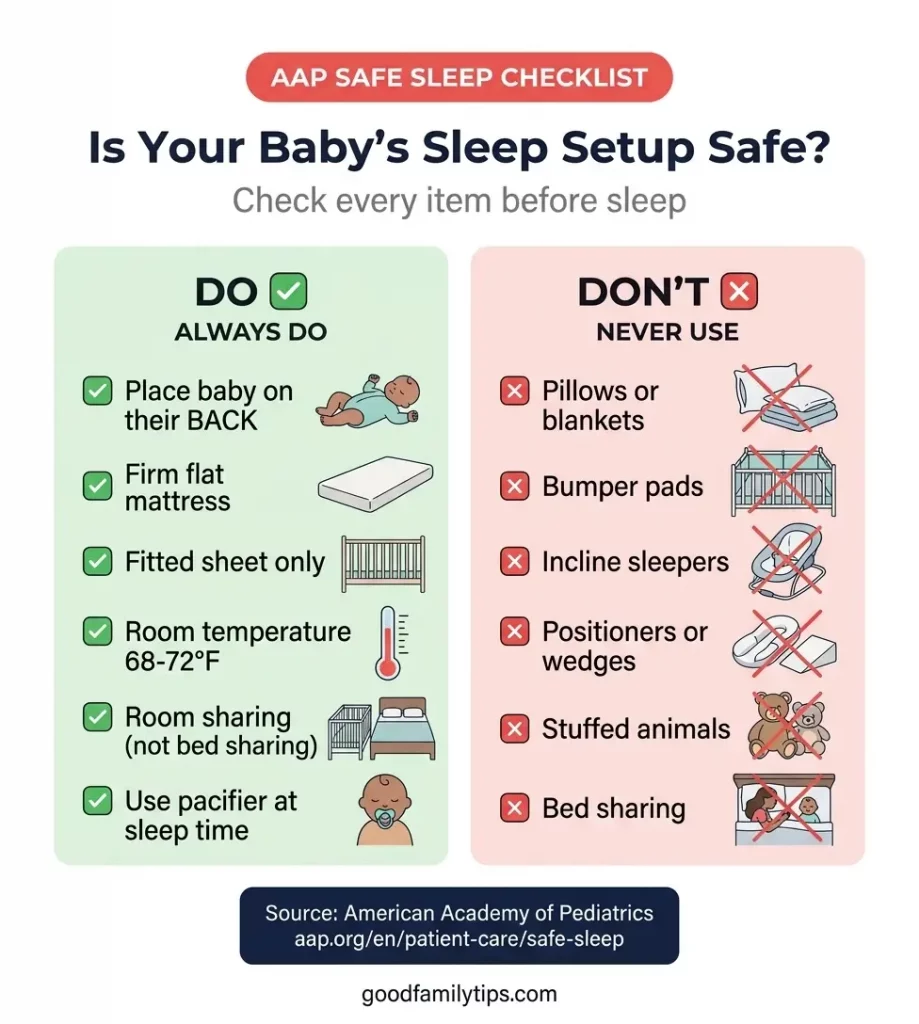
These are not optional. Every technique in this article is designed to be used within these guidelines.
Every technique for how to put a baby to sleep in 40 seconds must be applied within these AAP safe sleep guidelines.
- Always place your baby on their back to sleep
- Use a firm, flat mattress — no exceptions
- Fitted sheet only — no pillows, blankets, bumpers, or toys
- No incline sleepers, positioners, or wedges
- Room-sharing is recommended for at least the first 6 months — but not bed-sharing
Sleep-related deaths account for approximately 3,500 infant deaths annually in the United States, according to the AAP. The vast majority are preventable with a proper safe sleep environment
Final System Recap (Quick Reference)
This is the complete answer to how to put a baby to sleep in 40 seconds, not a single trick, but a repeatable system. Too tired to re-read everything? Here is the whole system in ten seconds:
- Step 1: Back in crib, firm mattress, white noise on
- Step 2: Try tissue stroke (calm baby) or shush-pat (fussier baby)
- Step 3: Floppy arm test before you move or leave
That is it.
You can do this. Tonight is hard. But you are not doing anything wrong, you are learning a new system, and systems take a few nights to work consistently.