Newborn Won’t Sleep Unless Held? 5 Proven Fixes (0–4 Weeks)
Why Your Newborn Only Sleeps When Held. And the Safe 5-Step Transfer That Finally Works
- Quick Answer
- Why Does My Newborn Only Sleep When Held?
- Is It Safe for a Newborn to Sleep in Your Arms?
- Why Won’t My Newborn Sleep Unless Held at Night Specifically?
- How Do I Transition My Newborn from Arms to Bassinet?
- Step 1 : Wait for Deep Sleep (15–20 Minutes)
- Step 2 : Warm the Sleep Surface First
- Step 3 : Swaddle Before Transfer (Not After)
- Step 4 : Transfer Slowly, Feet First
- Step 5 : Leave Your Scent
- What If My Newborn Wakes the Moment I Put Them Down?
- How Long Does the “Only Sleeps When Held” Phase Last?
- At a Glance: Why Your Newborn Won’t Sleep Unless Held by Week
- The 5-Minute Rule for Exhausted Parents
- FAQ : Newborn Won’t Sleep Unless Held
- 1. Is it OK to hold my newborn all night so we can both sleep?
- 2. Will holding my newborn to sleep create bad habits?
- 3. Why does my newborn wake up as soon as I put them down?
- 4. Can I use a swing or bouncer for my newborn to sleep in?
- 5. Is it safe when my newborn won’t sleep unless held on my chest is skin-to-skin ?
- ⚠️ MEDICAL DISCLAIMER
- Related Resources
This article is for informational purposes only and does not constitute medical advice. Always consult your pediatrician before changing your newborn’s sleep environment or routine. For safe sleep guidelines, refer to the American Academy of Pediatrics (AAP).
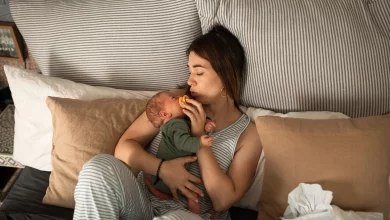
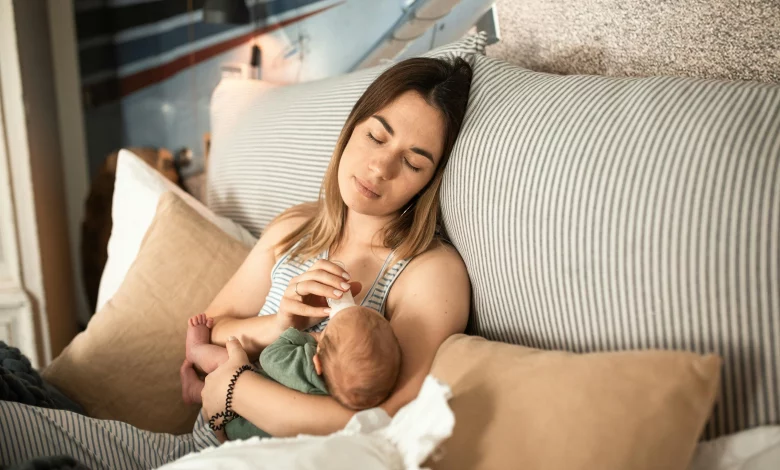
It is 2 AM. The moment you lower your newborn into the bassinet, the eyes fly open and the crying starts again. Your newborn only sleeps when held and you are starting to wonder if this is ever going to change.
You are not doing anything wrong. The reason your newborn won’t sleep unless held is one of the most common challenges in the first four weeks of life, and there is a very specific reason it happens.
Here is exactly why your newborn won’t sleep unless held and the safe, practical steps that actually move you toward longer stretches in the bassinet. Every tip below is specific to weeks 0–4, because a newborn won’t sleep unless held for reasons that are completely different from a 3-month-old or a 6-month-old.
Quick Answer
A newborn won’t sleep unless held because the fourth trimester instinct drives them to seek warmth, heartbeat, and scent all of which stop the moment they are placed down. In weeks 0–4, this is completely normal. The fix is a layered approach: warm the sleep surface before transfer, use tight swaddling, and time the transfer for deep sleep (usually 15–20 minutes after feeding). Unsafe co-sleeping is never the solution, see AAP guidelines below.
Why Does My Newborn Only Sleep When Held?
Newborns only sleep when held because they are hardwired to associate your body with survival. In the womb, your newborn had constant warmth, your heartbeat at 24/7, and the rhythmic motion of your breathing. The bassinet delivers none of these so the nervous system triggers a wake-and-cry alarm.
According to the AAP, newborns in weeks 0–4 spend up to 70% of sleep time in light (REM) sleep, which means they rouse easily the moment environmental cues change. That cold, flat, motionless bassinet feels like a threat not a bed.
This phase is called the fourth trimester, and it is developmentally expected. It does not mean your newborn is “spoiled” or that you have created a bad habit. At 0–4 weeks, that is not physiologically possible. A newborn won’t sleep unless held at this age because their nervous system is still calibrating to life outside the womb not because anything is wrong with your baby or your parenting.
Three specific triggers fire when you set your newborn down:
- Temperature drop : your body is 98.6°F; the mattress is room temperature
- Scent loss : your smell is a powerful calming signal for a newborn
- Pressure change : the weight of being held activates calming proprioceptors
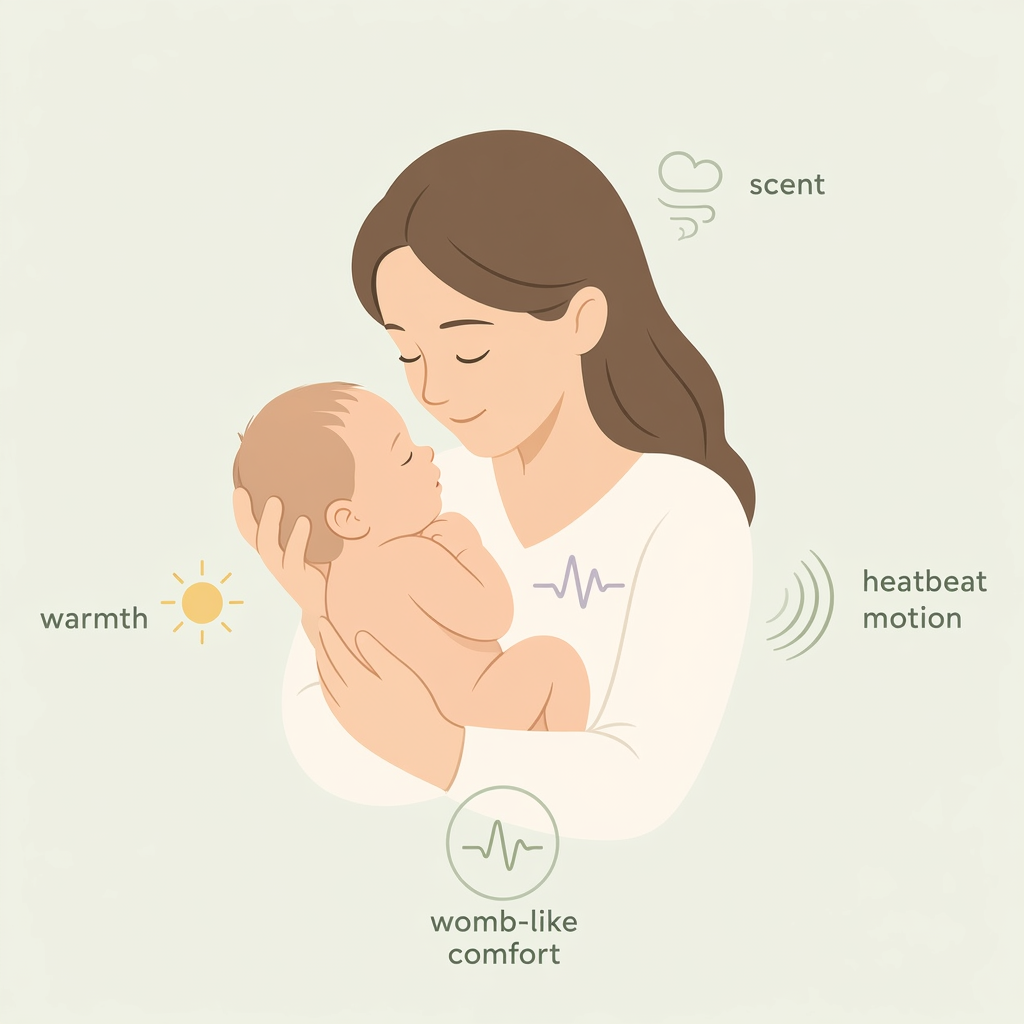
Understanding these three triggers is the key to solving them.
Is It Safe for a Newborn to Sleep in Your Arms?
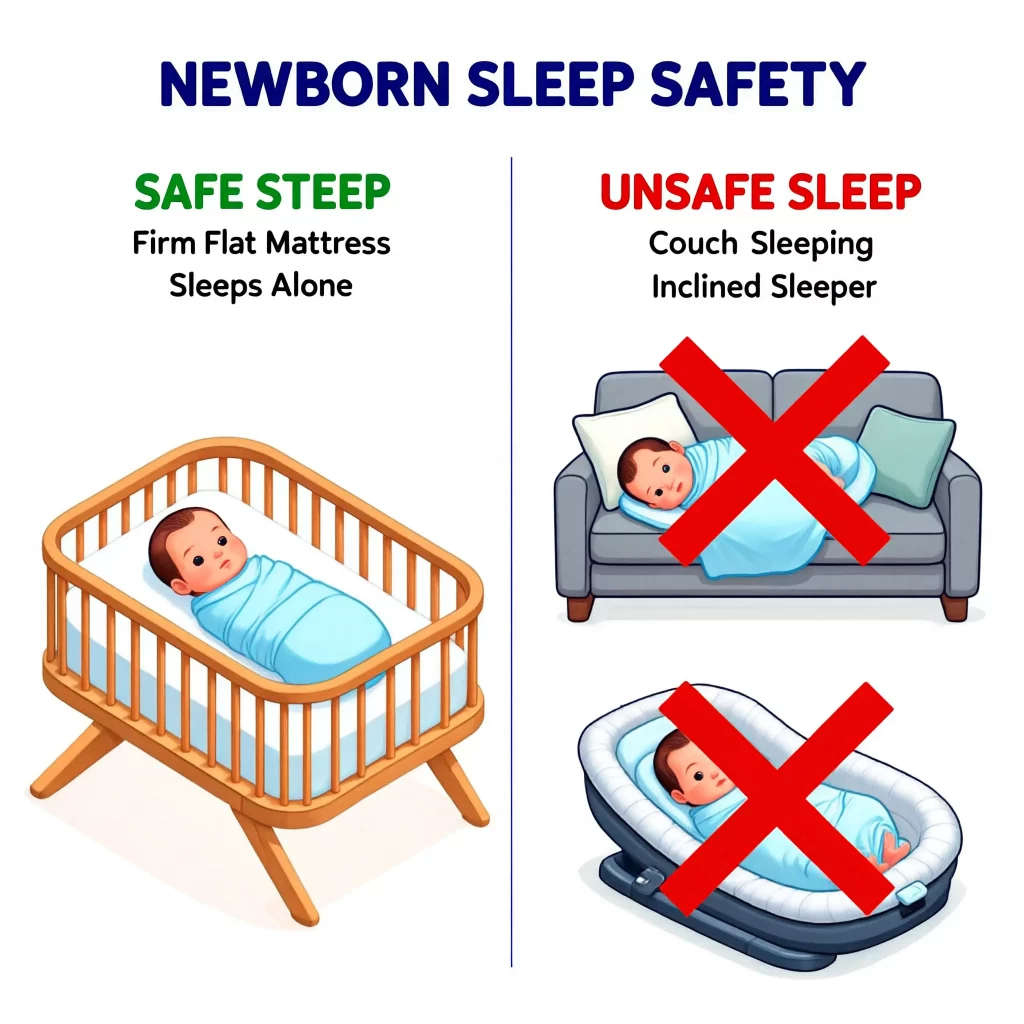
Holding your awake or drowsy newborn is safe; falling asleep yourself while holding them is not. The AAP safe sleep guidelines are clear: every sleep, including naps, should happen on a firm, flat surface, on their back, with no soft objects, loose bedding, or inclined surfaces.
This matters because of the risk of positional asphyxia when a sleeping adult unknowingly shifts and blocks the baby’s airway. Exhausted parents are especially vulnerable to this.
What is safe in weeks 0–4:
- Holding your newborn for comfort and contact during the day
- Skin-to-skin while you are awake and alert
- Rocking, feeding, and soothing in arms before transferring to a safe sleep surface
What is never safe regardless of exhaustion level:
- Falling asleep with your newborn on a sofa or armchair
- Bed-sharing without following safe bedsharing protocols (still not AAP-recommended)
- Using any inclined sleeper, swing, or bouncer as a primary sleep surface
If you need to rest, place your newborn in their safe sleep space first, even if they cry briefly while you lie down nearby. The single most important safety rule when your newborn won’t sleep unless held: never let exhaustion push you into an unsafe sleep surface.
Why Won’t My Newborn Sleep Unless Held at Night Specifically?
Newborns are developmentally night-blind to the concept of “nighttime.” At 0–4 weeks, the circadian rhythm has not formed. Melatonin production is minimal, and your newborn has no internal clock distinguishing day from night only the difference between being held and not being held.
According to a 2020 review published in Sleep Medicine Reviews, circadian rhythm consolidation in newborns begins around weeks 6–8, driven largely by light exposure and feeding patterns. Before that window, nighttime holding is not a habit, it is biology.
This is also why the “just let them fuss” approach fails at this age. At 0–4 weeks, your newborn cannot self-soothe. The neural pathways for self-regulation are not yet developed. Responding quickly to cries in this stage builds secure attachment, it does not create dependency.
The practical implication: night stretches in the bassinet get longer on their own as the circadian rhythm develops. Your job at this stage is to make the bassinet tolerablenot to train the newborn out of a need they cannot yet control. If your newborn won’t sleep unless held at night specifically, this is the biological reason and it resolves on its own by weeks 6–8.
How Do I Transition My Newborn from Arms to Bassinet?
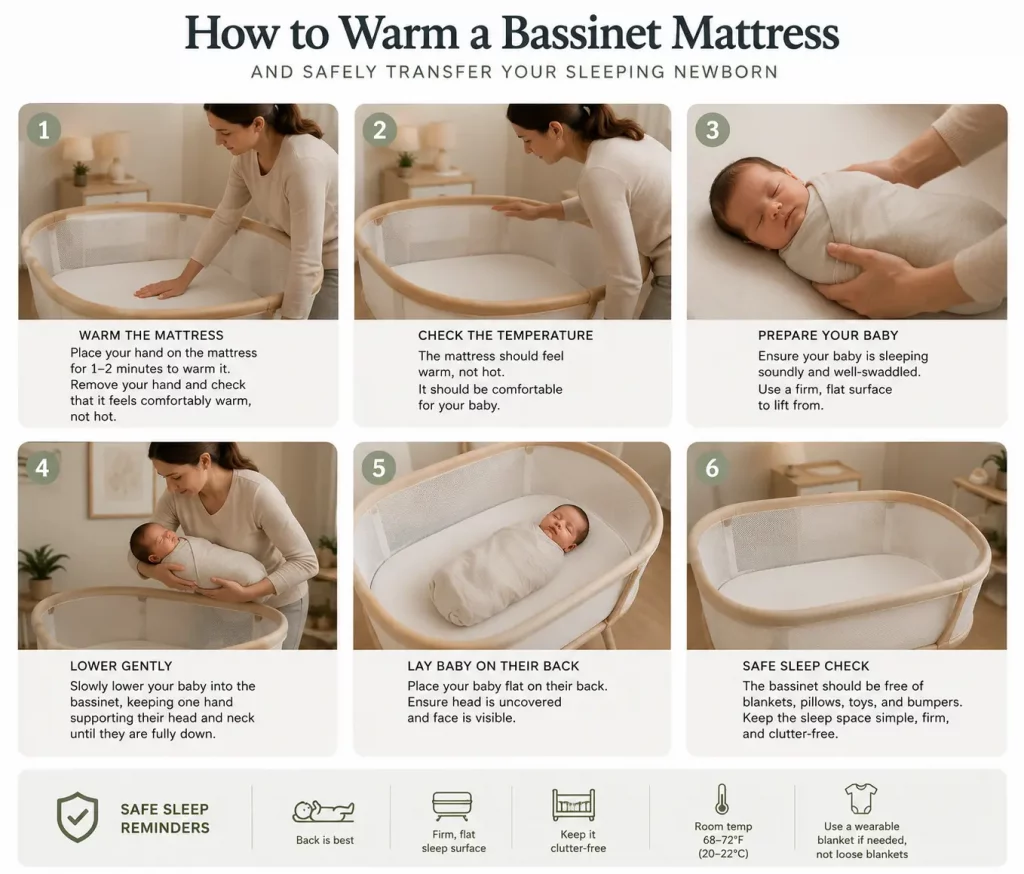
The newborn-to-bassinet transfer works best when you address all three wake triggers : temperature, scent, and pressure simultaneously. Most parents address zero of the three and wonder why every transfer fails. This is the core reason a newborn won’t sleep unless held even when you are sure they are deeply asleep.
Here is the exact sequence to follow:
Step 1 : Wait for Deep Sleep (15–20 Minutes)
Do not attempt the transfer at the first sign of drowsiness. The #1 reason a newborn won’t sleep unless held is that parents transfer too early in light REM sleep rather than deep sleep. Wait until your newborn shows deep sleep signals: limp limbs, no eye movement under lids, slow and even breathing, jaw slightly slack. This typically happens 15–20 minutes after falling asleep in arms during a feeding or hold.
Step 2 : Warm the Sleep Surface First
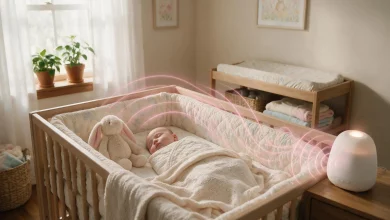
Use a heating pad on the bassinet mattress for 5–10 minutes before transfer, then remove it completely before placing your newborn down. You are matching the temperature your baby felt against your body. A cold mattress is the #1 cause of immediate wake-on-transfer.
Never use electric blankets, loose heating pads, or anything that stays in the sleep space. The mattress must be bare and firm by the time your newborn touches it.
Step 3 : Swaddle Before Transfer (Not After)
Swaddle your newborn while still in your arms not after placing them down. The swaddle pressure mimics the sensation of being held and suppresses the Moro reflex (the startle reflex that jolts newborns awake during transfers). According to the AAP, swaddling done correctly snug at the chest, loose at the hips is safe for newborns up to 2 months or until they show signs of rolling.
Step 4 : Transfer Slowly, Feet First
Lower feet and bottom first, then the back, then the head last. Keep your hands under the baby for an extra 20–30 seconds after they touch the mattress. This slow pressure release prevents the abrupt proprioceptive change that triggers waking.
Step 5 : Leave Your Scent
Place a worn (not washed) T-shirt or muslin cloth near not in the sleep space. Your scent activates calming responses in newborns. Do not place fabric inside the bassinet; tuck it just under the fitted mattress sheet where your baby cannot access it.
If the transfer fails on the first attempt, do not skip steps start again from Step 1. Multiple same-session attempts typically work by the second or third try once the technique is consistent.
What If My Newborn Wakes the Moment I Put Them Down?
Immediate wake-on-transfer is almost always caused by transferring too early (light sleep stage) or skipping the surface-warming step. Both are fixable.
The most common mistakes parents make:
- Transferring at drowsy but not yet in deep sleep
- Cold mattress surface
- Skipping swaddle or swaddling after placement
- Moving too fast during the lowering motion
- Immediately removing all hand contact
If you have ruled those out and wake-on-transfer is still happening every single time, check your newborn’s feeding status. According to La Leche League, cluster feeding peaks in weeks 2–3 and can cause a newborn to rouse immediately when separated from the food source, regardless of sleep depth. In that case, the solution is completing the cluster feeding cycle before attempting bassinet transfer. Cluster feeding is one of the most overlooked reasons a newborn won’t sleep unless held during the second and third week specifically.
How Long Does the “Only Sleeps When Held” Phase Last?
In most newborns, the held-only sleep phase begins to shift naturally between weeks 4–6, when the first sleep consolidation window opens. If your newborn won’t sleep unless held right now, the first independent bassinet stretch typically 2–3 hours, usually appears in this window without any formal sleep training.
Formal sleep training is not appropriate at 0–4 weeks and is not needed to solve this. The AAP does not recommend any form of sleep training before 4–6 months.
What you can do right now in weeks 0–4 to accelerate the shift:
- Expose your newborn to natural light during daytime feeds (helps circadian development)
- Keep nighttime feeds calm, dim, and quiet, no stimulation.
- Distinguish day naps from night sleep with environmental cues (light vs. dark, activity vs. silence)
- Follow our full Newborn Sleep Schedule: Week-by-Week Guide (0–3 Months) for age-specific wake windows that reduce overtiredness
The goal at this stage is not to eliminate holding, it is to create one or two safe bassinet stretches per night while keeping everything else as responsive as your newborn needs.
At a Glance: Why Your Newborn Won’t Sleep Unless Held by Week
| Week | Primary Reason Newborn Won’t Sleep Unless Held | What Helps Most |
|---|---|---|
| Week 1 | Womb transition shock all sensory cues gone | Skin-to-skin, tight swaddle, warm surface |
| Week 2 | Cluster feeding peak separation = hunger signal | Complete full feed before every transfer attempt |
| Week 3 | Cluster feeding continues + growth spurt | Feed on demand, don’t fight the holding |
| Week 4 | First circadian signals emerging | Start day/night light distinction; first bassinet stretches possible |
The 5-Minute Rule for Exhausted Parents
When you are functioning on 90-minute stretches, perspective matters. Here is the reality:
The “newborn only sleeps when held” phase is one of the shortest phases of your child’s entire life. It peaks at weeks 2–3 and begins resolving by week 6 for most babies. You are not setting a permanent pattern. You are surviving a biological window.
Use every safe tool available:
- Take shifts : one parent holds for a stretch while the other sleeps
- Babywearing during the day : a structured baby carrier during daytime naps reduces the nighttime holding load
- Ask for help : a single 4-hour covered sleep block from a family member once a week changes everything
For the full picture of what to expect across the first year, including when to start working on independent sleep. Read our Ultimate Baby Sleep Guide and the complete Baby Won’t Sleep Unless Held guide (all ages).
FAQ : Newborn Won’t Sleep Unless Held
1. Is it OK to hold my newborn all night so we can both sleep?
Holding your newborn while you are awake is safe. However, the AAP strongly advises against falling asleep while holding your newborn on a sofa, armchair, or bed without following specific safe-surface protocols. If you need to sleep, place your newborn in a firm, flat bassinet on their back, even if they fuss and sleep nearby.
2. Will holding my newborn to sleep create bad habits?
No. At 0–4 weeks, newborns are neurologically incapable of forming learned sleep associations. When your newborn won’t sleep unless held at this stage, responding to that need builds secure attachment and does not create long-term sleep problems. Sleep habits become trainable around 4–6 months.
3. Why does my newborn wake up as soon as I put them down?
When your newborn won’t sleep unless held and wakes instantly on transfer, the cause is almost always one of three instinctive triggers: temperature drop, loss of your scent, and the pressure change from being held to lying flat. Warming the bassinet surface, swaddling before transfer, and waiting for deep sleep (15–20 minutes after falling asleep) address all three.
4. Can I use a swing or bouncer for my newborn to sleep in?
No. The AAP advises against using swings, bouncers, car seats, or inclined surfaces as a regular sleep environment. These surfaces can cause positional asphyxia, especially in newborns who lack the muscle control to reposition their airway. They are safe for awake, supervised time only.
5. Is it safe when my newborn won’t sleep unless held on my chest is skin-to-skin ?
Skin-to-skin contact while you are alert and awake is safe and beneficial research published in Pediatrics shows it stabilizes heart rate, temperature, and reduces cortisol in newborns. The risk arises when you fall asleep during skin-to-skin, particularly on a sofa or soft surface. Keep skin-to-skin sessions to times when you are fully awake.
⚠️ MEDICAL DISCLAIMER
This article is for informational purposes only. It does not replace professional medical advice, diagnosis, or treatment. Consult your pediatrician with any concerns about your newborn’s sleep, health, or development. Safe sleep guidelines referenced throughout this article are sourced from the American Academy of Pediatrics (AAP).
Related Resources
- Exhausted? 6-Month-Old Won’t Sleep Unless Held (The Proven 3-Day Reset)
- Baby Wake Windows by Age: Simple Guide (0-12 Months)
- Why Your Baby Won’t Sleep Unless Held? 7 Proven Ways to Fix It (Updated 2026)