
- Quick Answer: What Is Parental Burnout?
- What Is Parental Burnout (And Why It’s So Common Now)
- 9 Warning Signs of Parental Burnout
- Parental Burnout vs Stress vs Depression
- How to Recover From Parental Burnout (Without Guilt)
- Step 1: Stop Trying to Do It All
- Step 2: Reduce Decision Fatigue
- Step 3: Address Your Nervous System Directly
- Step 4: Get Real Help (Not Just “Me Time”)
- Step 5: Rebuild Connection in Small Moments
- Step 6: Set Age-Appropriate Boundaries
- Common Mistakes Parents Make When Burned Out
- Mistake #1: Pushing Through
- Mistake #2: Blaming Yourself
- Mistake #3: Consuming More Parenting Advice
- Mistake #4: Trying to “Fix” Your Kids
- Mistake #5: Isolating Yourself
- Trust, Safety & Disclaimer
- Frequently Asked Questions
- What is parental burnout?
- Is parental burnout normal?
- Can parental burnout affect children?
- Can parental burnout cause rage?
- How do I know if I need therapy for parental burnout?
- You’re Not Failing : You’re Burned Out
You’re standing in the kitchen at 6:47 PM. Dinner’s burning. Your toddler is screaming about the wrong plate. Your seven-year-old just announced they have a project due tomorrow that requires poster board you don’t have. And you? You feel absolutely nothing. This is parental burnout.
Not frustration. Not anger. Just… empty.
I remember the night the emptiness first scared me. My oldest was crying over homework, the toddler had dumped milk on the dog, and chaos reigned. But as I watched the mess spread, I felt… nothing. When my child’s crying escalated, my voice came out flat and robotic: “Please just… stop. I can’t.” I wasn’t angry. I wasn’t even upset. I was just… gone, while standing in my own kitchen.
If this sounds familiar, you’re not a bad parent. You’re not weak. You’re not failing. You’re experiencing parental burnout one of the most misunderstood, under-discussed realities of modern parenting.
Parental burnout isn’t just “being tired.” It’s a deeper exhaustion that sleep doesn’t fix, and an emotional numbness that can make you question whether you even like your kids anymore (you do your nervous system just can’t feel it right now). In this guide, we’ll unpack what it actually is, how to spot it early, why it’s so common right now, and most importantly, practical, guilt-free ways to start recovering, without adding seventeen new “self-care” tasks to your already overloaded to-do list.
Quick Answer: What Is Parental Burnout?
Parental burnout is a state of physical, emotional, and mental exhaustion caused by prolonged parenting stress without adequate recovery or support. It’s not just being tired, it’s chronic depletion.
Key characteristics:
- Overwhelming exhaustion that sleep doesn’t fix
- Emotional distance from your children (feeling numb or detached)
- Loss of parental joy (everything feels like a burden)
- Feeling ineffective as a parent, no matter what you try
Why it happens:
- Chronic sleep deprivation
- Invisible mental load (remembering everything, planning everything)
- Lack of community support (the “village” disappeared)
- Constant sensory overload
- Unrealistic parenting standards from social media
What helps most:
- Reducing decision fatigue (fewer choices, more routines)
- Nervous system regulation (calming your body’s stress response)
- Lowering expectations (imperfect parenting is good parenting)
- Getting real support (not just “me time,” but actual help)
What Is Parental Burnout (And Why It’s So Common Now)
Parental burnout isn’t the same as having a hard day or even a hard month. It’s a chronic state where your body and mind have been running on stress hormones for so long that your system starts shutting down to protect itself as research from the American Psychological Association confirms.
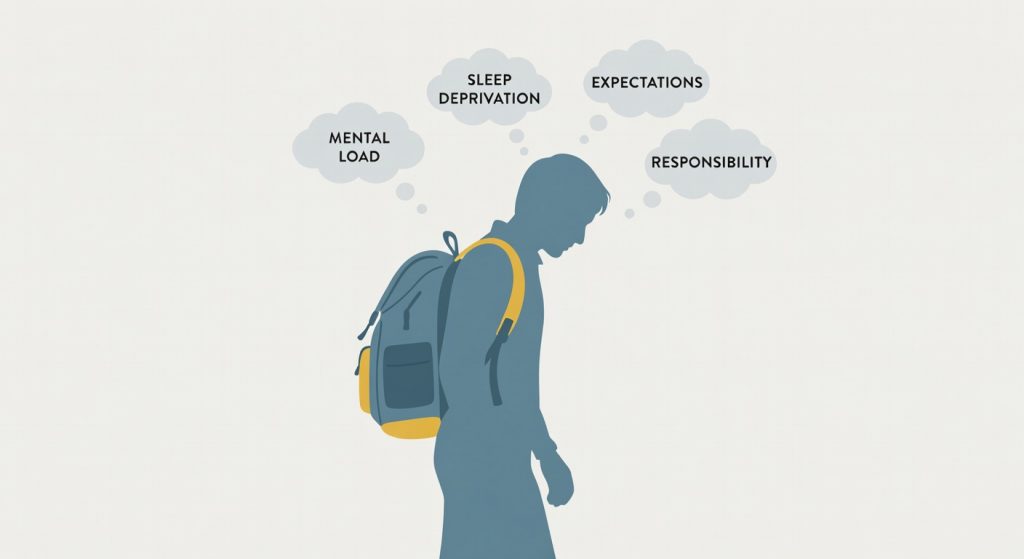
Think of it like this: Your body has an allostatic load, the cumulative burden of stress on your system. When you’re constantly dealing with crying babies, tantrums, and endless demands without recovery time, that load gets heavier until something breaks.
Here’s why it’s epidemic right now:
The village disappeared, leaving parents more vulnerable to parental burnout than ever before. Humans didn’t evolve to raise children in isolation, we evolved in communities where childcare was shared, where multiple adults helped with the mental and physical load. Now? Most parents face parental burnout alone, with maybe one partner (if they have one) and zero extended family nearby.
The mental load driving parental burnout is invisible but crushing. You’re not just feeding kids, you’re tracking doctor appointments, remembering permission slips, monitoring developmental milestones, planning meals around allergies, coordinating schedules, researching schools, and making approximately 847 decisions before breakfast. Decision fatigue is real, and it accumulates.
Sleep deprivation isn’t temporary anymore. It used to be that once kids slept through the night, parents recovered. But now we’re dealing with screen-disrupted sleep, anxiety-driven wake-ups, and parents lying awake worrying about everything from school shootings to whether their kid has enough friends. If you’re in the thick of night waking and regressions, our guide The Ultimate Baby Sleep Guide: 5 Proven Steps for Regressions walks you through practical ways to support your baby’s sleep and protect your own.
9 Warning Signs of Parental Burnout
These signs often creep up slowly. You might not recognize them until you’re already deep in it. Here’s what to watch for:
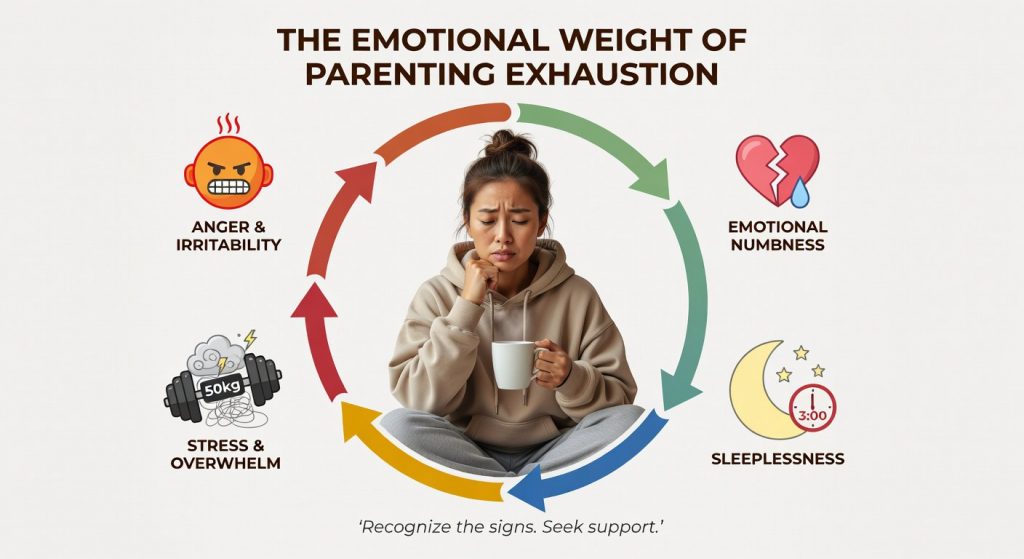
1. You feel emotionally numb toward your children
Not anger. Not frustration. Just… nothing. You go through the motions feeding them, bathing them, getting them to bed, but you feel disconnected. Like you’re watching your life happen to someone else.
2. You fantasize about running away
And we’re not talking about a nice vacation fantasy. We’re talking about genuine, detailed thoughts about disappearing. Walking out the door and just… not coming back. This isn’t about not loving your kids. It’s about your nervous system being so overwhelmed it’s desperately seeking an escape route.
3. You can’t remember the last time you laughed with your kids
When parental burnout takes hold, everything feels like a chore. Their jokes annoy you. Their excitement exhausts you. Their stories and needs feel like sandpaper on raw nerves.
I realized I was deep in parental burnout one Saturday afternoon. My youngest cracked an egg that missed the bowl completely, and while he giggled, I felt my jaw clench. “I don’t have energy for this” was my only thought. My older child tried making faces to get me to smile, but I could only fake it.
That’s what parental burnout does, it puts up a glass wall between you and joy. While my kids were still light and silly on one side, I was trapped on the other, unable to genuinely laugh with them anymore.
4. Small things trigger disproportionate rage
Spilled milk shouldn’t make you want to scream. But when you’re burned out, your nervous system has no buffer left. Every small frustration triggers disproportionate anger because your body has no emotional reserves. If you recognize yourself in those reactions, our article Nervous System Regulation for Parents: 5 Ways to Stop Rage walks you through simple, science-backed ways to calm your body before it boils over.
5. You’re either sleeping too much or can’t sleep at all
Burnout messes with your sleep regulation. Some parents crash hard, sleeping whenever possible but never feeling rested. Others lie awake at 2 AM with a racing mind, too wired to sleep even though they’re exhausted.
6. You avoid your own children
Scrolling your phone in the bathroom for twenty minutes. “Running errands” that take twice as long as necessary. Volunteering for late shifts at work. Finding reasons not to engage. When parental self-efficacy your belief in your ability to parent well—tanks, avoidance becomes a coping mechanism.
7. You feel like a terrible parent, no matter what you do
Even when you’re trying hard, it doesn’t feel like enough. Other parents seem to have it together. Your kids would be better off with someone else. You’re ruining them. (None of this is true, by the way it’s the burnout talking.)
8. Physical symptoms you can’t explain
Headaches. Stomach issues. Muscle tension. Getting sick constantly. Burnout isn’t just mental, it’s deeply physical. Your body is literally breaking down under chronic stress.
9. You don’t recognize yourself anymore
You used to be patient. Creative. Fun. Now you’re short-tempered, resentful, and joyless. You look in the mirror and think, “Who is this person?” That disconnect is one of the most painful parts of burnout.
If you recognized yourself in more than a few of these, keep reading. Help is coming.
Parental Burnout vs Stress vs Depression
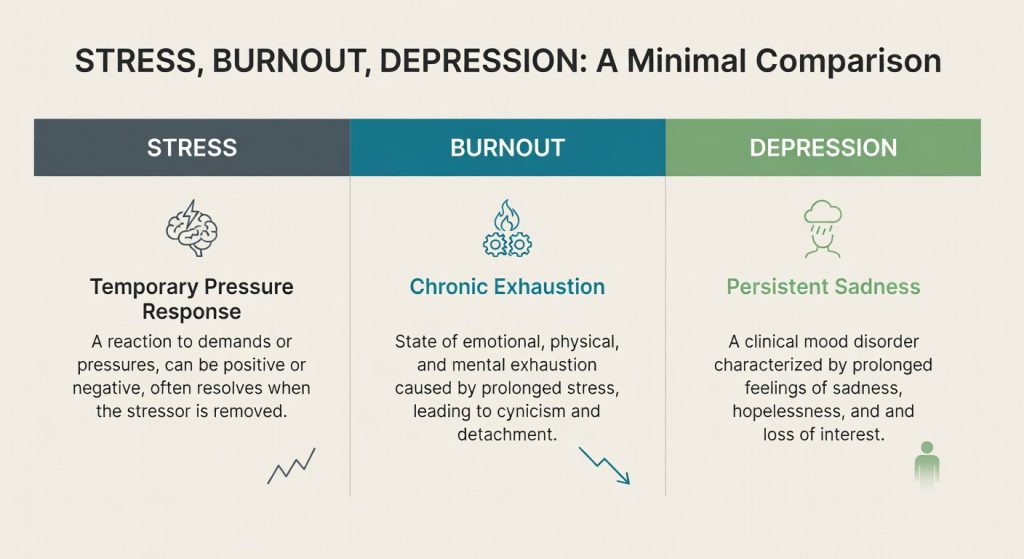
A lot of parents wonder: Is this just normal parenting stress? Am I depressed? Or is it burnout?
Here’s a simple comparison:
| Symptom | Stress | Burnout | Depression |
|---|---|---|---|
| Duration | Temporary (days to weeks) | Chronic (months+) | Persistent (weeks to months+) |
| Cause | Specific situation or event | Prolonged demands without recovery | May not have clear external cause |
| Feeling | Overwhelmed but engaged | Emotionally numb, detached | Pervasive sadness, hopelessness |
| Relief Strategy | Rest, addressing the stressor | Systematic capacity-building | Professional treatment often needed |
As medical organizations like the Mayo Clinic explain in their guidance on mental health, there are important differences between burnout and depression, even though they can look and feel similar.
Here’s the key difference:
With stress, you still feel things. You’re overwhelmed, yes, but there’s emotion there frustration, worry, even occasional joy when things go well.
With burnout, you feel empty. Detached. Like you’re performing the role of “parent” but you’re not really there.
With depression, the emptiness extends beyond parenting. You feel hopeless about everything, not just your ability to parent. You might have thoughts of self-harm or severe worthlessness.
When to seek professional help:
- If you have thoughts of harming yourself or your children
- If symptoms persist despite rest and support
- If you can’t function in daily tasks
- If you experience severe anxiety or panic attacks
- If you feel hopeless most days
Therapy isn’t admitting defeat. It’s getting the support your nervous system needs to recover. Many parents benefit from working with a therapist who understands parental burnout specifically.
How to Recover From Parental Burnout (Without Guilt)
Let’s be honest: Most parental burnout recovery advice is useless.
“Take a bubble bath!” “Practice self-care!” “Just ask for help!”
Cool. With what time? What energy? And help from whom, exactly?
Real recovery isn’t about adding more tasks. It’s about reducing your nervous system’s load and rebuilding your capacity slowly. Here’s how.
Step 1: Stop Trying to Do It All
Your expectations need to drop. Dramatically.
The house doesn’t need to be clean. Dinner can be cereal. Your kids don’t need enriching activities every weekend, they need a parent who’s not running on fumes.
Practical actions:
- Rotate which meals you actually cook (Monday and Thursday only, everything else is simple)
- Lower your standards for cleanliness (clean enough is good enough)
- Cancel optional commitments (soccer can wait, playdates can wait)
- Let go of “should” statements (“I should be more patient,” “I should enjoy this”)
This isn’t giving up. It’s strategic capacity management.
Step 2: Reduce Decision Fatigue
Every decision drains your already depleted resources. The solution? Make fewer decisions.
Practical actions:
- Same breakfast every day (yes, really)
- Capsule wardrobe for kids (fewer clothing battles)
- Meal rotation (same meals, same nights, every week)
- Standard bedtime routine (no variations, no negotiations)
- Auto-pay everything possible
Your brain will fight this. “But variety! But spontaneity!” Your nervous system needs predictability right now more than it needs novelty.
Step 3: Address Your Nervous System Directly
Burnout is partly a nervous system issue. Your body has been stuck in fight-or-flight (or freeze) for so long it doesn’t remember what safety feels like.
You can’t think your way out of nervous system dysregulation. You have to help your body find safety again.
Practical actions:
- Physical regulation: Long exhales (literally breathe out longer than you breathe in)
- Bilateral stimulation: Walking, gentle swaying, tapping alternating knees
- Sensory soothing: Cold water on your face, weighted blanket, specific music
- Movement: Even five minutes helps (stretch, walk, shake your body)
This isn’t the same as rage management, that’s about acute moments of overwhelm. This is about chronic nervous system exhaustion. If rage is a frequent symptom for you (and it often is with burnout), nervous system regulation work becomes even more important.
Step 4: Get Real Help (Not Just “Me Time”)
Burnout doesn’t recover with occasional breaks. It recovers with sustained reduction in load.
You don’t need a spa day (though those are nice). You need someone to consistently take tasks off your plate.
Practical actions:
- Ask for specific help (“Can you handle bedtime Tuesday and Thursday?”)
- Hire help if possible (cleaning service, grocery delivery, meal kit)
- Trade childcare with another parent (not a playdate actual solo time)
- Lower mental load by delegating fully (your partner plans the birthday party, not just “helps”)
If you don’t have help available, that’s real and it’s hard. Focus even more intensely on the “reduce expectations” strategy. You cannot do everything, and that’s okay.
Step 5: Rebuild Connection in Small Moments
When you’re burned out, forcing “quality time” feels fake and exhausting. Don’t do that.
Instead, look for tiny moments of genuine connection that don’t require performing.
Practical actions:
- Sit next to your kid while they play (you don’t have to engage just be present)
- Make one genuine eye contact moment per day
- Physical touch without pressure (hand on their back, quick hug, hair ruffle)
- Share one real feeling (“I’m tired today, but I’m glad you’re here”)
These micro-moments rebuild the bond without demanding energy you don’t have. And here’s what happens: As your nervous system calms, you’ll naturally start feeling more connection. You can’t force it, but you can create space for it.

Step 6: Set Age-Appropriate Boundaries
Part of burnout is feeling like your kids’ needs are infinite and your capacity is zero. The truth? Some of those “needs” are actually wants, and it’s okay to say no.
For toddlers and preschoolers:
- “I’m sitting down right now. You can play near me.”
- “Mommy needs quiet time. You can watch a show or play independently.”
If daily meltdowns are wearing you down, our article Toddler Tantrums: What are the 5 Ways to Stop Them Without Losing Your Mind? walks you through five concrete strategies to handle tantrums calmly while still holding firm boundaries.
For elementary age:
- “I’m too tired to play right now. You can choose a quiet activity.”
- “I need space. We’ll connect after I’ve had some rest.”
For older kids:
- “I’m overwhelmed. I need us to lower the noise level.”
- “I can’t handle this right now. Let’s talk about it tomorrow.”
Your kids can handle you having limits. Actually, modeling healthy boundaries teaches them something valuable about their own future capacity, a concept we explore deeply in Emotional Regulation in Children: 7 Proven Age-Based Strategies, where we show how parent-modeled boundaries help children develop their own emotional skills.
Common Mistakes Parents Make When Burned Out
Mistake #1: Pushing Through
The “just power through” mentality makes burnout worse. Your body isn’t lazy, it’s protecting you. Ignoring the signals leads to complete shutdown.
What to do instead: Listen to the exhaustion. It’s information, not weakness.
Mistake #2: Blaming Yourself
“If I were stronger…” “If I were more organized…” “If I were a better parent…”
Stop. Burnout isn’t a character flaw. It’s what happens when unsustainable demands meet insufficient support.
What to do instead: Recognize this as a systemic issue, not a personal failing.
Mistake #3: Consuming More Parenting Advice
When you’re burned out, reading another parenting article (yes, even this one) can feel like homework. More information doesn’t help when your capacity is already maxed out.
What to do instead: Stop researching. Pick one or two strategies from this article and ignore the rest for now.
Mistake #4: Trying to “Fix” Your Kids
Burned-out parents often hyperfocus on children’s behavior, if only the kids would listen better, sleep better, fight less, then everything would be fine.
But the real issue isn’t your kids. It’s your depleted capacity.
What to do instead: Work on your own nervous system and capacity first. Interestingly, when you regulate, kids often improve too because you’re no longer adding your dysregulation to the family system.
Mistake #5: Isolating Yourself
Shame makes you hide. You stop reaching out because you’re embarrassed about how you’re struggling. You decline invitations because you can’t perform “okay.”
What to do instead: Tell one safe person the truth. “I’m really struggling. I think I’m burned out.” You’d be surprised how many parents respond with, “Me too.”
Trust, Safety & Disclaimer
What this article can help with:
- Recognizing parental burnout early
- Understanding why you’re struggling (it’s not your fault)
- Implementing practical recovery strategies
- Reducing shame and self-blame
What this article cannot do:
- Replace professional mental health care
- Diagnose clinical depression or anxiety disorders
- Guarantee immediate relief
- Solve systemic issues like lack of support or financial stress
Important disclaimers:
I’m a parent and writer sharing research-based strategies and lived experience. I’m not a therapist, psychologist, or medical professional. This content is educational, not medical advice.
If you’re experiencing severe symptoms thoughts of self-harm, inability to care for yourself or your children, persistent suicidal thoughts, or complete inability to function, please contact a mental health professional immediately or call the 988 Suicide & Crisis Lifeline.
If you’re experiencing thoughts of self-harm or feeling unable to keep yourself or your children safe, the National Institute of Mental Health provides immediate support and resources, please reach out for help right away.
Parental burnout is serious, and recovery sometimes requires more than self-help strategies. Therapy, medication, or intensive support might be necessary, and that’s completely okay. Getting help is strength, not failure.
Trust your gut. If something feels more serious than typical burnout, seek professional evaluation.
Frequently Asked Questions
What is parental burnout?
Parental burnout is a state of chronic physical, emotional, and mental exhaustion resulting from prolonged parenting stress without adequate recovery. Unlike temporary tiredness, burnout involves emotional detachment from your children, loss of parental joy, feeling ineffective as a parent, and exhaustion that doesn’t improve with rest. It’s a real condition affecting millions of parents.
Recent studies on parental burnout suggest that up to 20% of parents experience severe burnout symptoms, with rates climbing significantly since the pandemic began.
Is parental burnout normal?
Yes. Research shows that parental burnout affects a significant percentage of parents, with some studies suggesting up to 1 in 3 parents experience it at some point. It’s especially common among parents with young children, those without adequate support systems, and those managing multiple demands (work, caregiving, household). Normal doesn’t mean okay, it means you’re not alone and this is a legitimate response to unsustainable conditions.
Can parental burnout affect children?
Does parental burnout affect my kids? Yes, but not permanently. While children notice when we’re emotionally distant or less patient, they’re remarkably resilient. Your work to recover from parental burnout actually teaches them valuable lessons about self-care and boundaries. The fact that you’re worried shows you care and that awareness helps prevent any lasting impact.
Can parental burnout cause rage?
Absolutely. Rage is often a symptom of parental burnout. When your nervous system is chronically depleted, your emotional regulation capacity disappears. Small frustrations that you’d normally handle calmly trigger disproportionate anger because your body has no buffer left. This isn’t about being an angry person, it’s about a dysregulated nervous system running on empty. Addressing the underlying burnout (not just managing individual rage moments) is essential for lasting change.
How do I know if I need therapy for parental burnout?
Consider therapy if: your symptoms persist despite rest and self-care efforts, you feel hopeless most days, you’re having thoughts of harming yourself or your children, your relationships are seriously suffering, or you can’t complete basic daily tasks. Therapy is also helpful if you want professional support even without severe symptoms. Many parents benefit from working with someone who understands the specific challenges of parenting burnout.
You’re Not Failing : You’re Burned Out
The Truth About Parental Burnout: You’re Not Broken
That emptiness and numbness you’re feeling? That’s not who you are. That’s what parental burnout does to your system, it shuts down to protect you. Your love for your children isn’t gone; your nervous system just needs a reset.
The guilt and constant “I should be better” thoughts are normal responses to parental burnout. We weren’t meant to parent in isolation while juggling endless modern demands.
Recovery from parental burnout starts small:
- Take three deep breaths
- Say no to one commitment
- Set firm boundaries about shared duties
Your kids don’t need perfection, they need presence. And presence requires protecting your energy.
Have you experienced parental burnout? What helped you start recovering? Share your story in the comments, your experience might be exactly what another exhausted parent needs to hear today.




I don’t even know the way I ended up here, however I
thought this put up used to be good. I don’t realize who you’re but certainly
you are going to a famous blogger in case you are not already.
Cheers!
Thank you so much for your feedback, it’s a pleasure. I will always keep writing about my experiences to make them a real source of knowledge