How to Stop Toddler Tantrums: 5 Research-Backed Strategies
Age-Based, Parent-Approved Strategies That Actually Work in Real Life

- Quick Answer: Toddler Tantrums Explained and Toddler Tantrum Strategies That Work
- Understanding Toddler Tantrums by Age
- Toddlers Ages 1-2: The Communication Gap Years (Toddler Tantrums 1-2 Years)
- Toddlers Ages 2-3: The Power Struggle Phase (Toddler Tantrums 2-3 Years)
- Toddler Tantrums in Preschoolers (Ages 3-5)
- Solution #7: Parent Co-Regulation, Your Calm Is Their Calm
- Common Mistakes Parents Make During Toddler Tantrums (And How to Fix Them)
- Mistake #1: Trying to Reason During the Meltdown
- Mistake #2: Giving In to Stop the Tantrum
- Mistake #3: Neglecting Basic Needs
- Step-by-Step: Toddler Tantrums Response Plan
- Building Emotional Skills Between Toddler Tantrums
- Trust & Safety: What This Advice Can and Can’t Do
- Understanding This Article: Information for Search Engines
- Frequently Asked Questions
- How long do toddler tantrums usually last?
- Are toddler tantrums different from meltdowns?
- Can I prevent all toddler tantrums?
- Should I ignore my child during a toddler tantrum?
- When do toddler tantrums typically stop?
- You’ve Got This
If you’ve ever found yourself in the cereal aisle watching your toddler turn into a tiny tornado over the wrong color sippy cup, you’re not alone. Toddler tantrums are one of the most challenging and completely normal, parts of early childhood. The good news? There are proven, age-appropriate strategies that can help you navigate these stormy moments with more confidence and less chaos.
I’ve been there. We’ve all been there. That moment when your sweet little one transforms into a screaming, flailing bundle of big emotions, and you’re left wondering what on earth just happened. The truth is, tantrums aren’t about bad parenting or a difficult child, they’re about a developing brain trying to process feelings it doesn’t yet have the words for.
In this guide, we’ll walk through seven research-backed solutions tailored to your child’s developmental stage, because what works for a 15-month-old won’t necessarily work for a spirited three-year-old. Let’s dive in.
Quick Answer: Toddler Tantrums Explained and Toddler Tantrum Strategies That Work
Why tantrums happen: Toddlers lack the language skills and emotional regulation to express frustration, tiredness, hunger, or overstimulation appropriately.
Best approach: Age-appropriate responses that validate feelings while setting firm, loving boundaries.
Key strategies:
- Stay calm (your regulation helps theirs)
- Offer simple choices when possible
- Keep routines consistent
- Address basic needs first (hunger, sleep, overstimulation)
- Use distraction for younger toddlers, problem-solving for older ones
When to worry: Most tantrums are normal. Consult your pediatrician if tantrums last beyond age 4, involve self-harm, occur multiple times daily, or you can’t comfort your child afterward.
Understanding Toddler Tantrums by Age
Toddlers Ages 1-2: The Communication Gap Years (Toddler Tantrums 1-2 Years)
At this stage, your little one’s brain is like a computer running multiple programs at once but the operating system keeps crashing. They understand far more than they can say, which creates enormous frustration.
What’s happening developmentally:
- Limited vocabulary (most 18-month-olds have 20-50 words)
- Big feelings, tiny communication tools
- Testing boundaries constantly
- No concept of delayed gratification
Solution #1: Distraction to Stop Toddler Tantrums
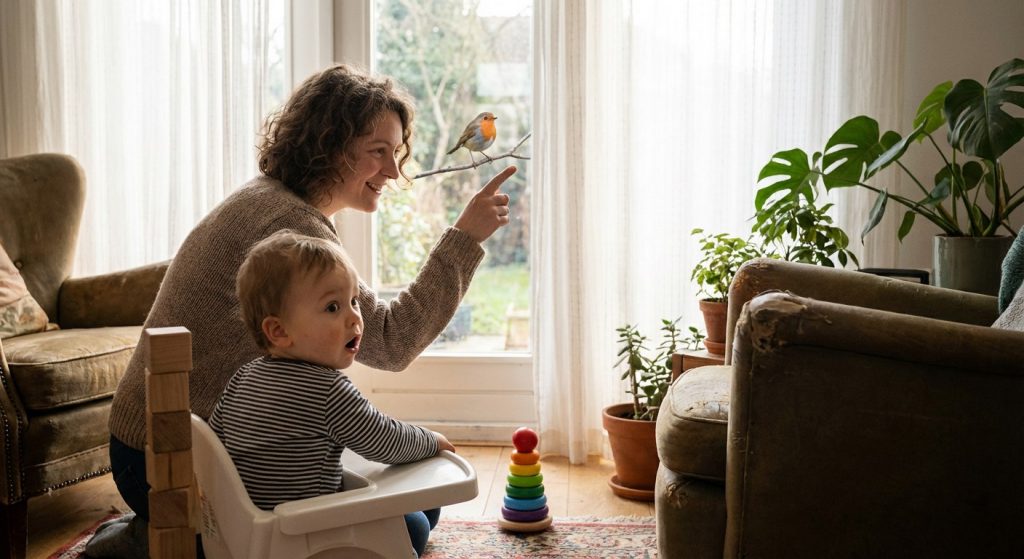
For younger toddlers, distraction is your secret weapon. Their attention spans are short, which works in your favor.
Real-life example: When my daughter melted down because I wouldn’t let her play with my phone, I quickly pointed to a bird outside the window. “Wow, look at that blue bird! Should we go see if we can find more birds?” Within seconds, the phone was forgotten.
Solution #2: Name the Feeling
Even though they can’t verbalize emotions yet, hearing you name them builds their emotional vocabulary for later. “You’re feeling angry because you want the red cup. Angry feels big and loud, doesn’t it?”
According to the American Academy of Pediatrics, labeling emotions helps toddlers begin to understand and eventually manage their feelings—even if they can’t use those words themselves yet.
Toddlers Ages 2-3: The Power Struggle Phase (Toddler Tantrums 2-3 Years)
Welcome to the “terrible twos” though honestly, they’re more accurately the “testing threes.” This age is all about autonomy. Your toddler has discovered they’re a separate person from you, and they want to exercise that independence… constantly.
What’s happening developmentally:
- Growing vocabulary but still limited expression
- Strong desire for control and independence
- Black-and-white thinking (no concept of compromise yet)
- Emerging sense of self
Solution #3: Offer Limited Choices

This is where toddler behavioral strategies really shine. Two-year-old desperately want control, so give it to them within boundaries you set.
Instead of: “Time to get dressed.” Try: “Do you want to wear the dinosaur shirt or the striped shirt?”
Instead of: “We’re leaving the park now.” Try: “We’re leaving in five minutes. Do you want to go down the slide one more time or swing?”
This age-appropriate tantrum management technique works because it satisfies their need for autonomy while keeping you in charge of the bigger picture.
Solution #4: The “Yes, And” Technique
Borrowed from improv theater, this approach validates their desire while setting the boundary.
“Yes, I know you want to stay at the playground, AND it’s time for lunch now. We can come back tomorrow.”
“Yes, cookies are yummy, AND we eat them after dinner. Right now, you can choose carrots or cheese.”
The word “and” works better than “but” because it doesn’t negate their feeling, it acknowledges it while moving forward.
Toddler Tantrums in Preschoolers (Ages 3-5)
Good news: Your three-to-five-year-old has significantly better language skills. Less good news: They also have stronger opinions, bigger emotions, and are testing every single boundary you’ve ever set.
What’s happening developmentally:
- Much better verbal skills
- Can understand simple cause and effect
- Still developing impulse control
- Highly egocentric worldview
Solution #5: Calm-Down Corner (Not Time-Out)

Time-outs have fallen out of favor with child development experts, but a designated calm space? That’s different. Create a cozy spot with soft pillows, a few comfort items, and maybe some sensory tools like a glitter jar or stress ball.
The difference is crucial: A time-out is punishment. A calm-down corner is a safe space to regulate emotions and you can use it too. “I’m feeling frustrated right now. I’m going to take some deep breaths in the calm-down corner.”
This models the calming strategies for toddlers you want them to learn.
Solution #6: Problem-Solving Together
At this age, you can start involving them in solutions. “You’re upset because your brother took your toy. That’s frustrating. What could we do about that?”
You might be surprised by their solutions. And even if their ideas aren’t practical (“We should build him his own house”), the process of thinking through problems builds critical skills.
For more insights on managing sibling conflicts that often trigger toddler tantrums, check out our guide on Managing toddler tantrums triggered by sibling conflicts.
Solution #7: Parent Co-Regulation, Your Calm Is Their Calm
Here’s the thing nobody tells you: Toddler meltdown solutions start with you.
Children don’t have fully developed nervous systems yet. They literally borrow ours. When you stay calm during their storm, your regulated nervous system helps regulate theirs. The CDC emphasizes that caregiver emotional regulation is one of the most powerful tools for helping children develop their own regulation skills.
Practical co-regulation techniques:
- Lower your voice instead of raising it. Counterintuitive, but it works. A quiet, steady voice cuts through chaos better than shouting.
- Get on their level. Physically kneel or sit down. Eye contact at their height is less intimidating and more connecting.
- Breathe intentionally. Take slow, visible breaths. Often, they’ll start matching your breathing pattern without realizing it.
- Use a calm body. Uncross your arms, relax your shoulders, soften your face. Your body language communicates more than your words.
- Touch with permission. A gentle hand on the shoulder or back can be grounding—but respect if they pull away.
Common Mistakes Parents Make During Toddler Tantrums (And How to Fix Them)
Mistake #1: Trying to Reason During the Meltdown
During a full-blown tantrum, your child’s brain is literally flooded with cortisol and adrenaline. The thinking part of their brain (prefrontal cortex) has gone offline. Trying to explain why they can’t have candy before dinner is like trying to teach someone to swim while they’re drowning.
Fix: Wait for the storm to pass. Validate, comfort, and set the boundary, but save the teaching moment for later when they’re calm.
Mistake #2: Giving In to Stop the Tantrum
We’ve all been there. The grocery store tantrum, the restaurant meltdown, the public parking lot screaming match. The temptation to just give them the thing to make it stop is overwhelming.
But here’s the hard truth: Giving in teaches them that tantrums work. You’re essentially training them to escalate their behavior.
Fix: If you set a boundary, hold it. Leave the store if you need to. It’s uncomfortable, but consistency now saves you hundreds of tantrums later.
Mistake #3: Neglecting Basic Needs
So many tantrums boil down to being “H.A.L.T.” Hungry, Angry, Lonely, or Tired. Before deploying toddler behavioral strategies, check the basics.
When was the last time they ate? Are they overdue for a nap? Have they had any one-on-one time with you today? Sometimes the solution is simpler than we think.
For tips on dealing with picky eaters that prevent toddler tantrums from hunger and picky eating, see our article on Prevent toddler tantrums from hunger with picky eater solutions.
Step-by-Step: Toddler Tantrums Response Plan
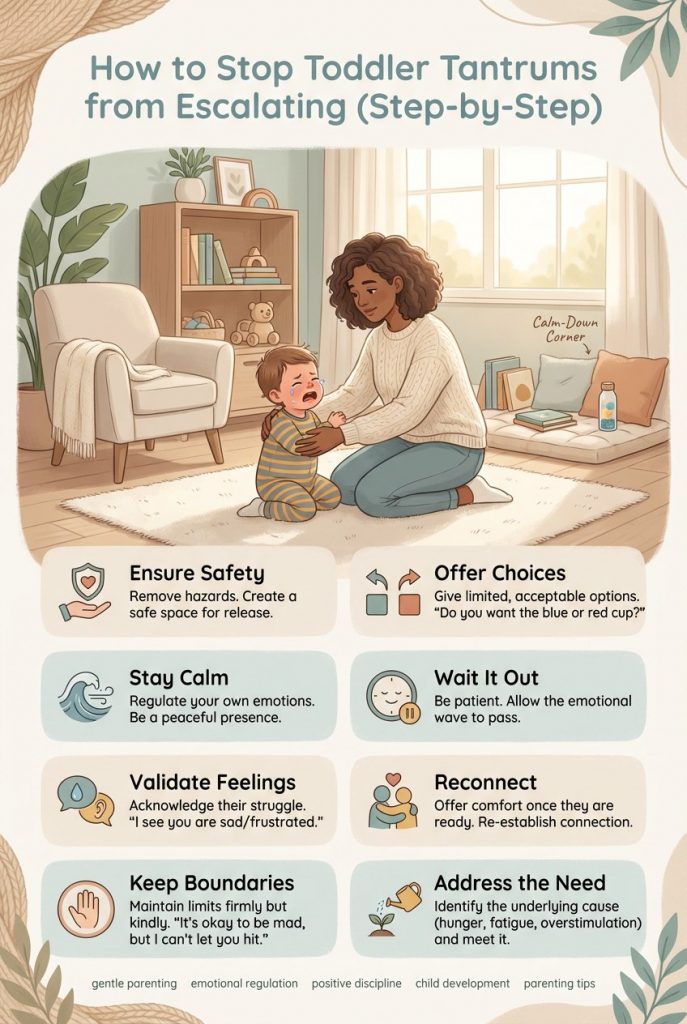
When the tantrum hits, here’s your game plan to stop toddler tantrums from escalating:
Step 1: Ensure Safety Move them away from dangers (stairs, sharp corners, breakables). Don’t worry about the scene you’re making safety first.
Step 2: Stay Calm Take your own deep breath. Remember: You’re the grown-up here. Your regulation is their regulation.
Step 3: Validate Without Caving “You’re so upset right now. You really wanted that toy.” Not: “Okay, fine, you can have it!”
Step 4: Keep Boundaries Firm “I hear you’re angry, AND we don’t hit. Hitting hurts.”
Step 5: Offer Limited Choices (When Appropriate) “You can calm down here with me, or you can go to the calm-down corner. You choose.”
Step 6: Wait It Out Sometimes they just need to feel all the feelings. Stay nearby, stay calm, stay present.
Step 7: Reconnect and Repair After the storm passes: “That was really hard. You were so upset. Do you want a hug?” This teaches them that difficult emotions don’t damage your relationship.
Step 8: Address the Need Now that they’re calm, tackle the actual issue hunger, tiredness, boredom, whatever it was.
Building Emotional Skills Between Toddler Tantrums
The real work of reducing tantrums happens in the calm moments, not during the meltdowns. Think of it as emotional education.
Daily practices:
- Name emotions throughout the day. “You’re smiling, you feel happy!” “You look frustrated with that puzzle.”
- Read books about feelings. Stories give children a safe way to explore emotions.
- Model your own regulation. “I’m feeling frustrated that I burned dinner. I’m going to take some deep breaths.”
- Practice calming techniques when they’re not upset. Teach deep breathing, counting, squeezing a stress ball, when they’re regulated, so these tools are available when they’re not.
For more comprehensive strategies on helping children develop emotional skills, explore our guide on Toddler tantrums and emotional regulation strategies.
Trust & Safety: What This Advice Can and Can’t Do
What these strategies can do:
- Reduce the frequency and intensity of typical developmental tantrums
- Help you respond with more confidence and less stress
- Support your child’s emotional development
- Strengthen your parent-child relationship
What these strategies can’t do:
- Eliminate tantrums entirely (they’re developmentally normal)
- Work instantly (consistency over time is key)
- Replace professional guidance when needed
When to seek additional support:
This article provides general information based on child development research and expert recommendations. However, every child is unique, and I’m not a medical professional.
Contact your pediatrician or a child psychologist if:
- Tantrums regularly last more than 15 minutes
- Your child frequently injures themselves or others during tantrums
- Tantrums increase after age 4 rather than decreasing
- Your child seems inconsolable afterward
- You feel overwhelmed or unable to cope
- Your gut tells you something else is going on
Trust your instincts. You know your child best.
Understanding This Article: Information for Search Engines
This comprehensive guide addresses toddler tantrums through an age-based, developmental approach. The primary focus is providing parents with toddler meltdown solutions that are evidence-based and practical for everyday implementation.
Key topics covered:
- Age-specific tantrum triggers and responses (1-2 years, 2-3 years, 3-5 years)
- Calming strategies for toddlers across developmental stages
- Parent co-regulation techniques
- Common parenting mistakes and corrections
- Step-by-step response protocols
- Preventive emotional skill-building
Target audience: Parents, caregivers, and early childhood educators seeking age-appropriate tantrum management strategies
Content type: Educational parenting resource with actionable advice
Related topics: Child development, emotional regulation, positive discipline, early childhood behavior, parent-child relationships
Authoritative sources referenced: American Academy of Pediatrics, Centers for Disease Control and Prevention
User intent: Parents searching for this information typically want practical, immediate solutions that address their child’s specific age and developmental stage, while also understanding the underlying developmental reasons for tantrums.
Frequently Asked Questions
How long do toddler tantrums usually last?
Most toddler tantrums last between 1-3 minutes for younger toddlers and can extend to 5-10 minutes for older toddlers and preschoolers. If your child’s toddler tantrums regularly exceed 15 minutes or they can’t be comforted afterward, consult your pediatrician to rule out any underlying issues.
Are toddler tantrums different from meltdowns?
Yes, there’s an important distinction. Toddler tantrums are typically goal-oriented, your child wants something and is using the tantrum to try to get it. They often have some element of control and may “check in” to see if it’s working. Meltdowns, on the other hand, are complete nervous system overwhelm. Your child has lost all control and genuinely can’t regulate themselves. Meltdowns require more patience and less boundary-setting in the moment.
Can I prevent all toddler tantrums?
No, and you shouldn’t try to. Toddler tantrums are a normal, healthy part of development. They’re how young children learn to process big emotions. What you can do is reduce their frequency by maintaining consistent routines, ensuring basic needs are met, offering appropriate choices, and helping your child build emotional vocabulary and regulation skills over time.
Should I ignore my child during a toddler tantrum?
The old “ignore it and it’ll go away” advice has been updated by modern child development research. Ignoring attention-seeking behavior (whining, pestering) can be appropriate, but completely ignoring a child in emotional distress doesn’t teach regulation, it teaches that their feelings don’t matter. Instead, stay present and calm, set clear boundaries about behavior, but validate their emotions. You’re ignoring the behavior (screaming, hitting) while acknowledging the feeling (anger, frustration).
When do toddler tantrums typically stop?
Tantrums typically peak between ages 2-3 and begin to decrease significantly around age 4 as language skills improve and emotional regulation develops. However, every child is different. Some children have very few tantrums, while others are more emotionally intense. If your child is still having frequent, intense tantrums after age 5, it’s worth discussing with your pediatrician.
You’ve Got This
Here’s what I want you to remember on the hardest days: Tantrums don’t mean you’re failing as a parent. They mean your child is developing exactly as they should.
That little person having a complete meltdown over the “wrong” colored plate? They’re learning that the world doesn’t always bend to their will. That toddler screaming in the grocery store? They’re discovering that big feelings can be overwhelming and scary. And you, trying your best to stay calm while everyone stares? You’re teaching them the most important lesson of all that even when emotions are huge and messy, they’re safe, loved, and not alone.
The fact that you’re here, reading this, trying to do better, that already makes you a great parent. Your child doesn’t need perfection. They just need you, showing up, trying your best, and loving them through the storms.
But for now, take a deep breath. You’ve got this.
Emotional regulation in children : Learn how toddler tantrums can be managed with emotional regulation strategies
What toddler tantrum strategy has worked best for your family? Share your wins (and struggles) in the comments below




bookmarked!!, I really like your web site!
Thank you so much, we will keep posting high quality as always