Toddler Won’t Eat Anything? 5 Tricks That Actually Work
What to Do When Your Toddler Won't Eat Anything (And Why It's Completely Normal)

- Why Your Toddler Won’t Eat Anything (The Science Behind It)
- Understanding Why Your Toddler Won’t Eat Anything By Age
- The One-Year-Old Who Suddenly Stopped Eating Everything
- The Two-Year-Old and Food Neophobia
- The Three-Year-Old Who Negotiates Everything
- When Your Toddler Won’t Eat Anything: Red Flags to Watch
- 5 Proven Strategies When Your Toddler Won’t Eat Anything
- Strategy 1: Create a Structured Eating Schedule
- Strategy 2: Always Include One “Safe” Food
- Strategy 3: Model Adventurous Eating Without Pressure
- Strategy 4: Make Mealtime About More Than Food
- Strategy 5: Repeated Exposure Without Pressure (The 10-15 Rule)
- Strategy 6: The “Food Chaining” Trick
- Frequently Asked Questions: When Your Toddler Won’t Eat Anything
- How long can a toddler go without eating before I worry?
- Should I give vitamins if my toddler won’t eat anything healthy?
- Is it normal for eating to vary day-to-day?
- What if my toddler won’t eat anything except snacks?
- A Word for the Exhausted Parent
- Conclusion: What to Remember When Your Toddler Won’t Eat Anything
- 3 “Picky-Proof” Sample Menu Plans
- Menu A: The “Texture Sensitive” Eater (Crunchy Focus)
- Menu B: The “Beige Food” Lover
- Menu C: The “Deconstructed” Taco Night
It’s 6 PM on Tuesday. You’ve spent an hour preparing a nutritious dinner with colorful vegetables and perfectly cooked chicken. Your toddler won’t eat anything on the plate. They glance at it for two seconds before declaring “YUCK!” and launching broccoli across the kitchen.
If your toddler won’t eat anything you prepare, take a breath. You’re not failing as a parent. Additionally, your child isn’t broken. What you’re experiencing affects up to 50% of American families with young children, according to pediatric feeding specialists.
The real problem? Most parents fight their toddler’s biology instead of working with it. Furthermore, understanding why your toddler won’t eat anything helps you stop the mealtime battles.
Why Your Toddler Won’t Eat Anything (The Science Behind It)

When your toddler won’t eat anything, there’s actual science explaining this frustrating behavior. Understanding the biological reasons helps you respond effectively. Moreover, it stops you from blaming yourself or your child.
The growth slowdown factor:
Between ages 1 and 5, children’s growth rate dramatically slows. In their first year, babies triple their birth weight. After their first birthday, they might only gain 4-5 pounds all year. Check CDC growth charts about normal toddler growth patterns.
Their appetite drops because their body needs fewer calories per pound. Therefore, what looks like food refusal is actually normal appetite regulation.
The independence drive:
Your toddler just discovered the word “No.” Refusing food is one of the first ways toddlers test their newfound autonomy. When your toddler won’t eat anything, they’re often practicing independence, not rejecting your cooking.
Evolutionary survival instincts:
Around age two, children develop “food neophobia”—a biological fear of unfamiliar foods. This is a well-documented developmental phase where toddlers instinctively reject new foods as a survival mechanism. You can read about food neophobia in early childhood development in National Institutes of Health Research
From an evolutionary perspective, this kept mobile toddlers safe from poisonous plants. In modern kitchens, this means your toddler won’t eat anything except their five safe foods.
Understanding Why Your Toddler Won’t Eat Anything By Age
The reasons your toddler won’t eat anything change as they grow. Each age brings different challenges. Therefore, your strategies need to adapt too.
The One-Year-Old Who Suddenly Stopped Eating Everything
Remember when your baby ate pureed anything? That phase just ended. Here’s why your one-year-old’s behavior changed.
What’s happening:
Your one-year-old experiences “physiologic anorexia of toddlerhood.” This medical term describes the natural appetite decrease that happens after rapid infant growth. Read our article about The Ultimate Baby Sleep Guide : 5 Proven Steps for Regressions – many sleep issues connect to feeding patterns.
What this looks like:
- One day they devour an entire banana
- The next day, bananas are personally offensive
- They eat well at breakfast, refuse lunch and dinner
- They only want to feed themselves
- 80% of food ends up on the floor
The biggest mistake parents make:
Becoming a short-order cook. When your toddler won’t eat anything and you make three different meals, you teach them refusal gets attention. Additionally, this pattern becomes harder to break at age two.
The Two-Year-Old and Food Neophobia
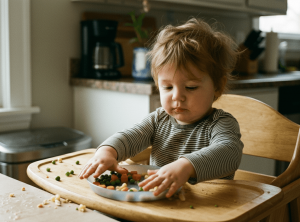
If you thought age one was challenging, age two takes food refusal to Olympic levels. When your toddler won’t eat anything except beige foods, food neophobia is probably why.
What’s happening:
Two-year-olds develop an intense biological fear of unfamiliar foods. Their brain says “stick to foods you know won’t poison you.” Furthermore, their taste buds are genuinely more sensitive than yours.
Foods that taste mildly bitter to you taste intensely bitter to them. Brussels sprouts or spinach can trigger their “toxic food” alarm system.
What this looks like:
- They only eat five specific foods
- Foods must be prepared exactly the same way
- Chicken nuggets must be the brand from the red box
- Sandwiches cannot have crusts
- Last week’s favorite food becomes today’s betrayal
The power struggle reality:
Your two-year-old controls one thing absolutely: what goes in their mouth. You cannot force them to swallow. When your toddler won’t eat anything, every mealtime becomes a battle where the more you push, the harder they resist.
Parents who struggle most:
Those who make food a battleground. Bribing with dessert, forcing “just one bite,” or showing visible frustration all backfire. Your toddler learns that food equals attention and control.
If you find yourself losing your temper during mealtimes, you’re not alone. Managing your own emotional reactions is crucial. You can check our article about “Nervous System Regulation for Parents: 5 Ways to Stop Rage” to learn how to stay calm during mealtime battles.
The Three-Year-Old Who Negotiates Everything
By age three, language skills explode. When your toddler won’t eat anything, they can now explain why in elaborate detail. Mealtime becomes negotiation with a tiny lawyer.
What’s happening:
Three-year-olds understand cause and effect, social dynamics, and boundary testing. They watch what other kids eat. They notice you eat different foods. They’re capable of contracts: “If I eat three bites, can I have a cookie?”
The opportunity:
Peer influence becomes powerful. A three-year-old who won’t eat vegetables at home might eat them at preschool because their friend does. Social eating matters now.
What this looks like:
- They help cook, then refuse to eat what they made
- They eat everything at grandma’s house
- The identical meal at home is “gross”
- They create rules about which foods can touch
- They declare “I don’t like this” before looking
The trap parents fall into:
Using food as reward system. “Eat your vegetables for dessert” teaches that vegetables are punishment. You accidentally make healthy food less appealing.
When Your Toddler Won’t Eat Anything: Red Flags to Watch
Most picky eating is behavioral and temporary. Sometimes though, when your toddler won’t eat anything, there’s an underlying medical issue requiring professional attention.
Call your pediatrician if your child:
Weight concerns:
- Has lost weight or isn’t gaining according to growth percentiles
- Shows signs of failure to thrive
- Weight loss in toddlers is never normal
Extreme restriction:
- Eats fewer than 20 different foods total across all food groups
- Has completely eliminated an entire food group for months
- Shows signs of nutritional deficiencies
Physical symptoms:
- Gags, chokes, or vomits during most meals
- Shows intense anxiety or meltdowns around food
- Has pale skin, fatigue, or irritability (possible anemia)
- Chronic constipation not responding to diet changes
Behavioral red flags:
- Refuses food for more than 24 hours
- Shows physical discomfort when eating
- Refusal feels different from typical willfulness
The difference between picky and problem eating:
A picky eater eventually eats when hungry and maintains healthy growth. A problem eater may have sensory processing issues, oral motor delays, gastroesophageal reflux, or food allergies.
These children need evaluation by a pediatrician and possibly a feeding therapist, not just patience.
Trust your parental instincts:
If something feels off beyond normal stubbornness, get professional input. Early intervention for feeding disorders makes massive difference in outcomes.
5 Proven Strategies When Your Toddler Won’t Eat Anything
These strategies work in real homes with real toddlers. They’re backed by pediatric feeding research and proven effective when your toddler won’t eat anything you serve.
Strategy 1: Create a Structured Eating Schedule
Your toddler needs genuine hunger at mealtimes. When your toddler won’t eat anything, constant grazing is often the culprit.
How to implement:
- Offer three meals plus two to three scheduled snacks
- Keep roughly the same times every day
- Between eating times, offer only water
- No crackers in the car
- No constant sippy cup of milk or juice
Why this works:
Toddlers who graze all day never build real hunger. They never have biological motivation to try new foods. When children go 2-3 hours between eating, they come to the table actually hungry.
The hardest part:
Listening to “I’m hungry!” thirty minutes before dinner. Stay consistent. Offer water and acknowledge their feeling: “I know you’re hungry. Dinner will be ready soon.”
They won’t starve in thirty minutes. Additionally, they’ll eat better at dinner because they’re genuinely hungry.
Creating consistent routines around eating helps with overall daily structure.
Strategy 2: Always Include One “Safe” Food
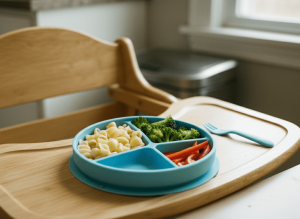
At every meal when your toddler won’t eat anything, include at least one food they will eat. This removes the power struggle because they always have an option.
How to implement:
- Serve small portions (1-2 tablespoons)
- Put new or less-preferred foods on their plate
- No comment about the foods
- Your job: offer
- Their job: decide whether to eat
This is called “division of responsibility”:
It’s the gold standard in pediatric feeding. You control what’s offered, when, and where. Your child controls whether and how much to eat.
What you don’t do:
Make a separate meal when your toddler won’t eat anything served. If they don’t eat, the meal ends. Food gets put away. They’ll have another opportunity at the next scheduled time.
The trust factor:
Toddlers are excellent at self-regulating intake over several days. Individual meals might seem inadequate, but weekly intake balances out.
Strategy 3: Model Adventurous Eating Without Pressure
Your child watches you constantly. When your toddler won’t eat anything new, check your own eating habits first.
How to implement:
- Eat a variety of foods with genuine enjoyment
- Have family meals as often as possible
- Use neutral, sensory language: “These beans are crunchy”
- Don’t say: “Mmm, so yummy, try them!”
- That’s pressure disguised as enthusiasm
When your child tries something:
Keep your reaction low-key. Don’t throw a parade. Don’t offer rewards. Simply acknowledge: “You tried the pepper. Did you notice it was sweet?”
This keeps focus on their experience, not on pleasing you. That’s what you want for long-term healthy eating habits.
Strategy 4: Make Mealtime About More Than Food
When your toddler won’t eat anything, the environment might be part of the problem. Transform mealtimes into pleasant social experiences.
How to implement:
Turn off all screens:
- No TV during meals
- No phones or tablets
- Sit down together
- Talk about your day
Physical comfort matters:
- Chair where feet touch floor or footrest
- Child-sized utensils and plates
- Comfortable seating position
Repair stressful associations:
If mealtimes have become battles, actively change that. Bring relaxed energy to the table. Your calm consistency matters more than any single meal.
If you’re anxious about whether your toddler won’t eat anything, they’ll pick up that anxiety. Your stress becomes their stress.
Strategy 5: Repeated Exposure Without Pressure (The 10-15 Rule)
Research shows children need to see new food 10-15 times before accepting it. Not taste it—just see it. When your toddler won’t eat anything new, this strategy is critical.
How to implement:
- Keep offering rejected foods
- Don’t ask them to try it
- Don’t praise when they take a bite
- Just consistently include the food
What to expect:
One day unexpectedly, they’ll try it. Then they’ll probably reject it again next time. That’s normal. Keep offering anyway.
The patience required:
This feels superhuman when your toddler won’t eat anything for the 47th time. But it works. Children with consistent, pressure-free exposure eventually develop varied diets.
Strategy 6: The “Food Chaining” Trick
If your child hates new textures, don’t jump from “French Fries” to “Boiled Broccoli.” Bridge the gap slowly using Food Chaining:
-
Start with: French Fries (Salted, fried potato).
-
Move to: Sweet Potato Fries (Same shape, different taste).
-
Move to: Roasted Carrot Sticks (Similar shape, different veggie).
-
Goal: Mashed Carrots/Sweet Potato. The Logic: You change one attribute at a time (taste, texture, or shape) so the change isn’t overwhelming.
Frequently Asked Questions: When Your Toddler Won’t Eat Anything
How long can a toddler go without eating before I worry?
A healthy toddler can go 12-24 hours without eating and be fine. They’ll be cranky, but not in danger. Most toddlers self-regulate over 3-5 days rather than meal-to-meal.
When to worry:
If your toddler won’t eat anything for more than 24 hours, contact your pediatrician. Additionally, call immediately if you notice:
- Dry mouth or no tears
- Decreased urination
- Unusual lethargy
- Signs of dehydration
The normal pattern:
Your toddler might eat well Monday and barely anything Tuesday. As long as they’re drinking fluids, peeing normally, and have good energy, they’re getting enough.
Should I give vitamins if my toddler won’t eat anything healthy?
A daily multivitamin designed for toddlers can provide insurance against nutritional gaps. However, it shouldn’t replace offering varied foods.
Talk to your pediatrician about:
- Whether your child needs supplementation
- Iron deficiency concerns (affects brain development)
- Specific nutritional gaps based on their diet
The reality:
Many picky eaters get adequate nutrition from limited foods, especially if those include fortified cereals, bread, and milk. The bigger concern is usually iron deficiency.
Is it normal for eating to vary day-to-day?
Completely normal. When your toddler won’t eat anything one day but devours everything the next, they’re regulating intake over several days.
Factors affecting appetite:
- Teething
- Growth spurts
- Illness (even minor)
- Constipation
- Activity level
- Sleep quality
All of these fluctuate constantly in toddlers. As long as your child grows along their growth curve and has good energy, trust their appetite.
What if my toddler won’t eat anything except snacks?
This usually means grazing is happening between scheduled eating times. When your toddler won’t eat anything at meals but constantly requests snacks, the solution is structured timing.
How to fix it:
- Eliminate all eating between scheduled times
- Offer only water between meals and snacks
- Stick to the schedule for at least one week
- They will eat better at scheduled times once genuinely hungry
The transition period:
Expect complaints for 2-3 days. Stay consistent. Your toddler’s appetite will adjust to the new schedule.
A Word for the Exhausted Parent

You’re reading this after another meal where your toddler won’t eat anything, and wondering if you’re failing at the basic responsibility of feeding your child.
You’re not failing. Because you are parenting a tiny human wired to assert independence in frustrating ways. When your toddler won’t eat anything, they’re developing exactly as intended becoming their own person, testing boundaries, learning to trust hunger cues.
The truth nobody tells you:
Your toddler won’t graduate high school eating only chicken nuggets. This phase is temporary. Children who go through intense picky eating almost always grow into adults with normal, varied diets.
The parents who struggle most:
Those who fight their child’s development instead of working with it. You’re doing better than you think. Your child is growing. You’re both going to be okay.
Conclusion: What to Remember When Your Toddler Won’t Eat Anything
When your toddler won’t eat anything you prepare, it’s not about your cooking or your parenting. It’s about normal development, biological drives, and the natural process of growing up.
Key takeaways:
- Growth slows after age one, so appetite decreases naturally
- Food neophobia peaks around age two as protective mechanism
- Independence drives much of food refusal behavior
- Consistent exposure without pressure works over time
- Most picky eating is temporary and developmentally normal
Your action plan when your toddler won’t eat anything:
- Create structured eating times with 2-3 hours between
- Always include one safe food plus new options
- Model adventurous eating without pressure
- Make mealtimes pleasant, not food-focused
- Offer rejected foods 10-15 times without expectation
Remember this:
Keep showing up with nutritious options, mealtimes pressure-free. with modeling the eating behavior you want to see. Trust that your child knows how to respond to their hunger.
On the really hard days, remember your relationship matters infinitely more than any single vegetable. When your toddler won’t eat anything tonight, they’re still growing, learning, and developing normally.
You’re doing an incredible job. Your child will be okay. This phase will pass.
3 “Picky-Proof” Sample Menu Plans
If you are tired of thinking “What should I cook?”, try these combinations designed to lower mealtime anxiety.
Menu A: The “Texture Sensitive” Eater (Crunchy Focus)
-
Main: Chicken Schnitzel (breaded) or Fish Sticks.
-
Side 1 (Safe Food): Dry Toast or plain Crackers.
-
Side 2 (The Challenge): Raw bell pepper strips (crunchy, not slimy/cooked).
-
Dip: Ketchup or Ranch (Dips make food fun!).
Menu B: The “Beige Food” Lover
-
Main: Macaroni and Cheese.
-
Side 1 (Safe Food): Apple slices (peeled if needed).
-
Side 2 (The Challenge): Roasted Cauliflower florets (tiny).
-
Why it works: Cauliflower looks “beige” like the pasta, making it less scary than bright green broccoli.
Menu C: The “Deconstructed” Taco Night
-
Style: Family Style (Bowls on the table).
-
The Spread: Ground meat/beans, shredded cheese, tortillas, corn, lettuce.
-
The Strategy: Let them build their own. If they only eat a tortilla with cheese, that is okay. They are interacting with the food, which is a win.
You’ve got this. ❤️
Editorial Note: To respect and protect child privacy, the images featured in this article are AI-generated illustrations created solely for educational purposes.