Is My Toddler a Late Talker? 7 Toddler Speech Delay Signs You Shouldn’t Ignore
The signs we noticed at 18 months, what we tried at home, and when we finally called the specialist.

- What Is Toddler Speech Delay?
- 7 Toddler Speech Delay Signs to Watch For
- Sign 1 — No Single Words by 16 Months
- Sign 2 — Fewer Than 50 Words by Age 2
- Sign 3 — Difficulty Following Simple Instructions
- Sign 4 — Preferring Gestures Over Words
- Sign 5 — Not Responding to Their Name Consistently
- Sign 6 — Losing Words They Previously Used
- Sign 7 — Strangers Can’t Understand Them by Age 3
- What We Tried at Home First
- When to Stop Waiting and Call the Doctor
- FAQ — Toddler Speech Delay
- What causes toddler speech delay?
- Can toddler speech delay resolve without therapy?
- Does screen time cause toddler speech delay?
- How is toddler speech delay diagnosed?
- Is toddler speech delay always a sign of autism?
- Save This for Later :
- The One Thing I’d Tell Every Parent
If you’ve ever Googled “is my toddler speech delay normal” at midnight, this article is for you.
I did the same thing when my daughter was 18 months old. She was hitting every physical milestone perfectly. Walking, running, climbing everything in sight.
But words? Maybe 5. On a good day.
Every parent around me said “boys talk late” or “Einstein didn’t talk until he was 3.” I smiled and nodded. Inside I was watching her every single day, counting every sound.
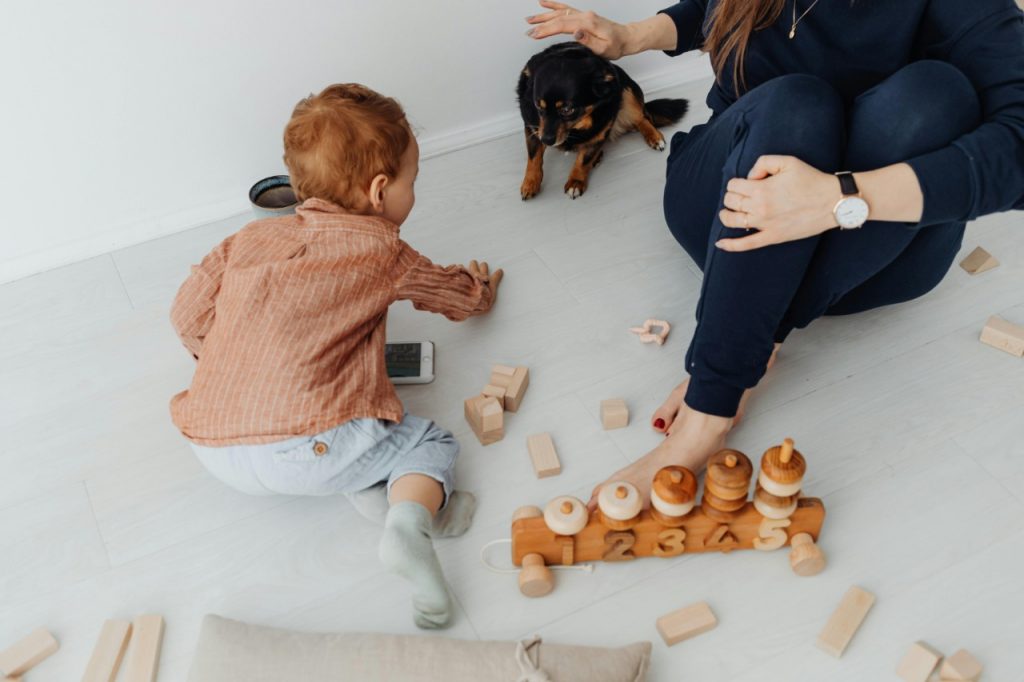
Here’s everything I wish I’d known earlier, the 7 toddler speech delay signs we noticed, what we tried at home, and exactly when we finally made the call to see a specialist.
⚠️ Medical Disclaimer: This article is for educational purposes only and is not medical advice. Always consult your pediatrician or a licensed Speech-Language Pathologist (SLP) if you have concerns about your child’s speech development.
What Is Toddler Speech Delay?
Toddler speech delay means a child is developing language skills more slowly than typical milestones for their age.
It doesn’t always mean something is seriously wrong. Some children are simply late talkers — they catch up completely with the right support.
According to the CDC, approximately 1 in 12 children aged 3-17 has a diagnosed speech or language disorder. Early identification consistently leads to better outcomes — which is why watching for these signs matters.
Source: CDC — Speech and Language Developmental Milestones
7 Toddler Speech Delay Signs to Watch For
Sign 1 — No Single Words by 16 Months
Most toddlers produce their first clear words “mama,” “dada,” “no,” “more” between 12 and 16 months.
If your child hasn’t said any consistent single words by 16 months, that’s one of the earliest toddler speech delay signs worth flagging.
We started keeping a simple notes app list of every word our daughter used consistently. Not occasionally consistently. The list was shorter than we wanted to admit.
If you’ve noticed your toddler isn’t hitting early milestones, our Baby Wake Windows by Age guide can help you understand the full developmental picture.
Sign 2 — Fewer Than 50 Words by Age 2
By their second birthday, most toddlers have a vocabulary of 50+ words and are starting to combine two words “more milk,” “daddy go,” “no ball.”

Toddler speech delay at this stage becomes clearer. If your child has fewer than 50 words or isn’t combining words yet at age 2, bring it up at their next pediatric check-up, don’t wait for the doctor to ask.
Sign 3 — Difficulty Following Simple Instructions
Toddler speech delay isn’t only about the words coming out — it’s also about what’s going in.
By 18-24 months, most toddlers can follow simple two-step instructions like “get your shoes and put them by the door.” Consistent difficulty understanding these requests not just ignoring them is a sign worth discussing.
We noticed our daughter would stare blankly when we gave two-part instructions that her peers seemed to follow easily.
Sign 4 — Preferring Gestures Over Words
Pointing, pulling your hand, and using gestures to communicate is completely normal early on.
But if your toddler is consistently choosing gestures over attempting words past 18 months, especially if they seem frustrated when misunderstood — that’s one of the toddler speech delay signs to watch carefully.
Our daughter had an elaborate pointing system. She could communicate almost everything she needed without a single word. It was impressive and quietly concerning at the same time.
Sign 5 — Not Responding to Their Name Consistently
By 12 months, most children respond reliably when their name is called in a normal voice, not shouted across the room.
Inconsistent response to their name, when hearing issues have been ruled out, can overlap with toddler speech delay and other developmental considerations worth evaluating early.
Sign 6 — Losing Words They Previously Used
This is the toddler speech delay sign that should prompt the fastest action.
If your child was using words and then stopped — a regression in language at any age — that warrants a call to your pediatrician this week, not at the next scheduled visit.
The American Speech-Language-Hearing Association (ASHA) is clear: language regression should always be professionally evaluated without delay.
Source: ASHA — Late Blooming or Language Problem?
For a broader look at how emotional development connects to language, see our guide on Emotional Regulation in Children.
Sign 7 — Strangers Can’t Understand Them by Age 3
By age 2, familiar caregivers should understand roughly 50% of what a toddler says. By age 3, strangers should understand around 75%.
If your child’s speech is significantly unclear to people outside your immediate family by age 3, a formal speech evaluation is the right next step — not “let’s wait another few months.”
What We Tried at Home First
Before our pediatric evaluation, we focused on these evidence-based strategies, recommended consistently by speech-language pathologists for toddler speech delay support at home.
Narrate everything out loud. “I’m opening the fridge now. I’m taking out the milk. I’m pouring it into your cup.” No pressure for them to respond. Just constant, real language input all day.

10 minutes of shared reading daily. Pointing at pictures, naming objects, asking simple questions. We used the same 3 books on rotation for weeks. Repetition builds recognition faster than variety at this age.
Replace one hour of screens with unstructured play. Passive screen time doesn’t build language. Back-and-forth conversation does even if the conversation is one-sided for now.
Sing the same simple songs daily. Nursery rhymes and lullabies with clear, repetitive words. The rhythm helps toddlers hear and internalize language patterns in a way that normal speech doesn’t.
Wait longer before filling the silence. We learned to ask a question and genuinely wait — 10 full seconds minimum. It felt uncomfortable. It made a visible difference within weeks.
For more on supporting your child’s development at home, see our guide on Building Confidence in Shy Children.
When to Stop Waiting and Call the Doctor
Home strategies support development, they don’t replace professional evaluation.
Call your pediatrician or ask for an SLP referral if your toddler:
- Has no words at all by 16 months
- Has fewer than 50 words by age 2
- Loses words they previously used at any age
- Doesn’t respond to their name consistently by 12 months
- Is significantly unclear to strangers by age 3
- Your gut is telling you something is off
That last one matters. Trust it.
Early intervention for toddler speech delay — before age 3 — produces significantly better outcomes according to research published by the Mayo Clinic.
Source: Mayo Clinic — Language Delay in Children
FAQ — Toddler Speech Delay
What causes toddler speech delay?
Causes vary hearing loss, developmental differences, limited language exposure, or individual pace. Only a professional evaluation can identify the specific cause for your child.
Can toddler speech delay resolve without therapy?
Some late talkers catch up completely without intervention. Others benefit significantly from speech therapy. There’s no reliable way to know which category your child falls into without professional assessment which is exactly why early evaluation matters.
Does screen time cause toddler speech delay?
Excessive passive screen time is consistently associated with reduced language development in toddlers under 3. The AAP recommends limiting screens for children under 18-24 months outside of video chatting.
How is toddler speech delay diagnosed?
A Speech-Language Pathologist conducts a formal evaluation — standardized tests combined with direct observation. Your pediatrician can refer you, or you can self-refer in most regions.
Is toddler speech delay always a sign of autism?
Speech delay is one possible sign of autism — but most children with toddler speech delay are not autistic. Only a qualified professional can make that assessment. A blog article cannot and should not.
Save This for Later :
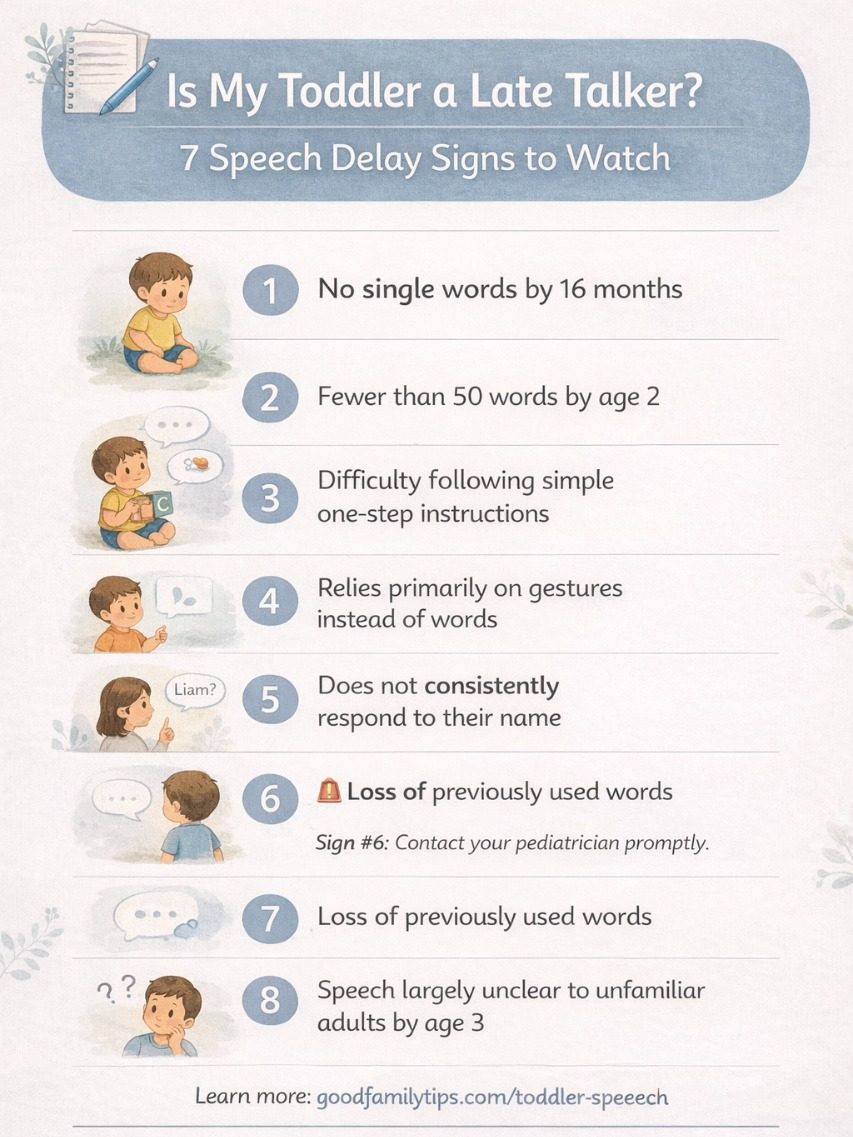
7 Toddler Speech Delay Signs:
- No single words by 16 months
- Fewer than 50 words by age 2
- Can’t follow two-step instructions
- Prefers gestures over words
- Inconsistent response to name
- Loses words previously used.
- Strangers can’t understand by age 3
At-home strategies:
- Narrate everything
- Read 10 min daily
- Less screen time
- Sing repetitive songs
- Wait 10 seconds before filling silence
The One Thing I’d Tell Every Parent
Noticing toddler speech delay signs early isn’t cause for panic.
It’s cause for action, and there’s a real difference.
The earlier you bring it up with your pediatrician, the more options you have. Waiting and hoping is rarely the right strategy when development is involved.
You’re already doing the right thing by paying attention.
⚠️ Medical Disclaimer: This article shares personal experience and general parenting information. It is not medical advice and does not replace professional evaluation. If you have concerns about your toddler’s speech development, consult your pediatrician or a licensed Speech-Language Pathologist.