How to Use ChatGPT for Homework Safely: Parent Guide (2026)
Is ChatGPT Safe for Kids' Homework? Here's What Parents Need to Know

- Quick Answer:
- Introduction
- The Reality Check: Why Banning AI Doesn’t Work
- Is ChatGPT for Homework Cheating? It Depends How They Use It
- The Benefits (When Used Right)
- The Risks (When Misused)
- The Psychological Impact: What We’re Really Trading
- How to Set ChatGPT Rules at Home: The 3-Step Framework
- Step 1: The Calculator Rule
- Step 2: The Prompt Engineer Mindset
- Step 3: Transparency Over Secrecy
- Best AI Homework Tools for Kids (Beyond ChatGPT)
- 1. Khanmigo (by Khan Academy)
- 2. Socratic by Google
- 3. Grammarly (Student Version)
- 4. ChatGPT (With Parental Oversight)
- When ChatGPT for Homework Becomes a Problem: Red Flags
- Frequently Asked Questions About ChatGPT for Homework
- Will using ChatGPT for homework ruin my child’s writing skills?
- How do I spot cheating with ChatGPT for homework?
- Should I tell teachers we use AI at home?
- What if my school bans all AI tools?
- At what age is ChatGPT safe for kids?
- The Bottom Line: It’s About Judgment, Not Technology
Quick Answer:
Yes, your child can use ChatGPT for homework but as a tutor, not a ghostwriter. Set clear boundaries: AI explains concepts, your child does the writing. Think of it like a calculator: helpful for checking work, but they still need to show their process. The key? Transparency and rules from day one.
Introduction
I’ll be honest with you. The first time I caught my daughter asking ChatGPT to “write an essay about photosynthesis,” my stomach dropped.
Was she cheating? Had I failed as a parent? Should I ban AI entirely?
But here’s the thing banning technology your kids need to understand is like teaching them to swim by keeping them out of the pool.
When using ChatGPT for homework, the real question isn’t whether to allow it. It’s how to teach your child to use it responsibly.
The technology isn’t going anywhere. According to Pew Research Center, between 40-60% of high schoolers have already experimented with AI tools for schoolwork. That number is climbing every semester.
So whether you’re ready or not, the conversation about ChatGPT for homework is happening in your child’s classroom right now.
The Reality Check: Why Banning AI Doesn’t Work
Let’s bite the bullet here. Your child’s classmates are already using ChatGPT for homework. Their future employers will expect them to master these tools. And if you ban it entirely at home? They’ll just use it at a friend’s house or on a school library computer.
I learned this the hard way.
When I first enforced a strict “zero-tolerance” policy, my son didn’t stop using AI—he just got better at hiding it. He genuinely didn’t understand why a tool that could explain quadratic equations in three different ways was “off limits” while his peers were getting ahead.
The Turning Point
Walking into his room one night, I found him typing furiously. The ChatGPT interface was glowing on his screen. My first instinct was anger. I thought I’d caught him cheating.
But then I looked closer.
He wasn’t asking the bot to write his history essay. He was typing: “Can you explain why I got this answer wrong?” followed by, “What’s the difference between correlation and causation again?”
That moment changed everything for me.

The reality is simple: Kids are going to use ChatGPT for homework whether we like it or not. The real question is how they will use it:
- Will they do it in secret, with zero guidance?
- Or will they do it with your help, learning to use it ethically?
According to insights from UNESCO on AI in education, the best learning outcomes happen when students use AI as a supplement to critical thinking, not a replacement for it. But that distinction only happens when parents set clear expectations.
So, instead of asking “Should I allow this?” try asking: “How do I teach my child to use this responsibly?”
That shift in perspective is the difference between raising a rule-follower and raising a future-proof critical thinker. And trust me in 2026, critical thinking is the only currency that matters.
Is ChatGPT for Homework Cheating? It Depends How They Use It
Not all AI use is created equal.
Looking at the screen, the difference between productive learning and straight-up cheating became crystal clear to me. Here’s what I mean:
| Productive Use (AI as Tutor) | Cheating (AI as Writer) |
|---|---|
| “Explain how to solve this problem” | “Write my essay for me” |
| “What am I doing wrong in step 3?” | “Give me the answer” |
| “Break this concept into simpler terms” | “Do my homework” |
| “Quiz me on these vocabulary words” | “Paraphrase this so my teacher won’t know” |
| Result: Learning happens | Result: Zero learning |
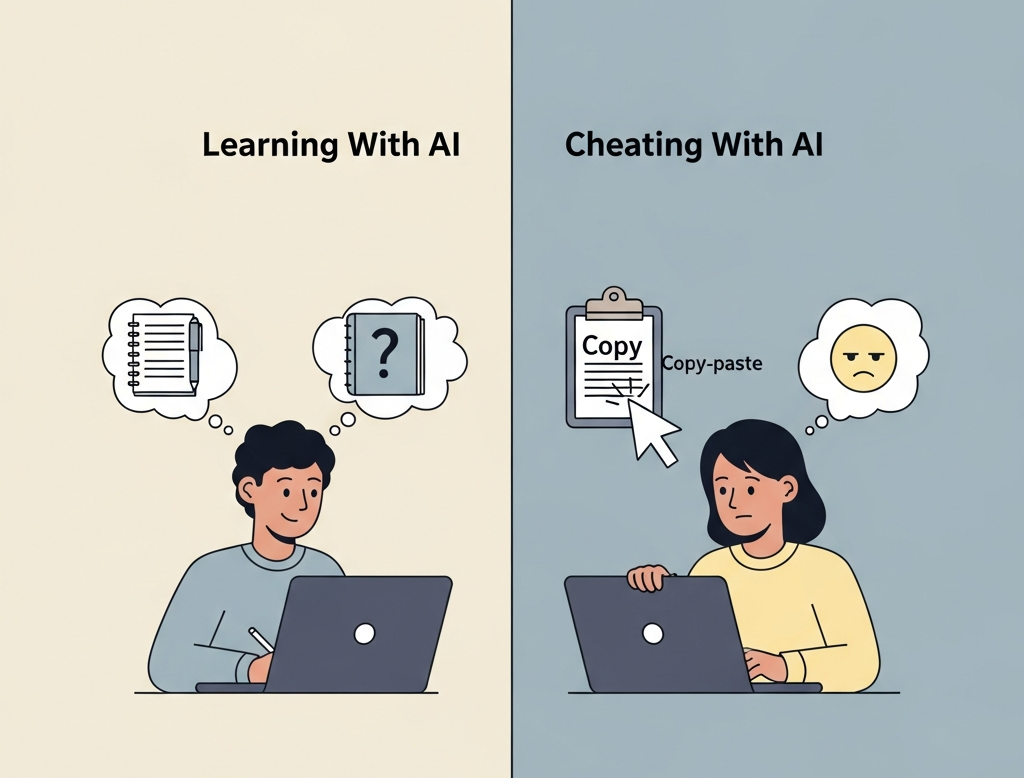
See the pattern?
One asks questions. The other avoids them.
When my kids use ChatGPT for homework help truly help, not ghostwriting, they’re learning. When they use it to skip the thinking part entirely, they’re not.
The line between those two isn’t always obvious to a 13-year-old. That’s where we come in.
The Benefits (When Used Right)
I’m not here to demonize AI. When used properly, ChatGPT for homework isn’t just a shortcut—it’s a transformative tool:
- Teaches Resourcefulness: Learning to prompt AI effectively teaches kids how to ask better questions and troubleshoot independently, a vital life skill for 2026.
- The 24/7 Patient Tutor: No eye-rolling and no frustration. It will explain the same Spanish grammar rule five different ways until it finally clicks.
- Personalized Learning: whether your child needs a complex analogy or a simple story, AI adapts to their unique learning style instantly.
- Confidence Builder: It’s a safe space to ask “dumb questions” without judgment. If your child struggles to speak up in class, using AI can be a massive relief (see our guide on building confidence in shy children for more strategies).
- Ends Homework Meltdowns: The 9 PM tears over confusing algebra? AI can defuse that tension in 30 seconds, saving both of you the stress.
The Risks (When Misused)
But let’s not sugarcoat the downsides. Without strict boundaries, using ChatGPT for homework becomes a crutch, not a tool. Here is the reality of what happens when kids rely on it too much:
- Skill Atrophy: If AI writes the essay, they never learn to organize thoughts or find their own voice. I saw a friend’s teenager submit a “perfect” history paper that sounded robotic. The teacher flagged it immediately because the “voice” was wrong, and the student genuinely didn’t understand why “making it better” was actually cheating.
- The Critical Thinking Gap: Thinking is a muscle. If they copy-paste answers, that muscle never develops. The U.S. Office of Educational Technology warns that “Human in the Loop” is essential meaning if students bypass the struggle of solving the problem, they bypass the actual learning.
- Academic Consequences: Schools are getting sharper. Teachers can spot the telltale signs suspiciously perfect grammar from a student who usually struggles. Getting caught using ChatGPT for homework unethically isn’t just embarrassing; it can mean failing grades or honor code violations.
- AI Dependency: Some kids develop a learned helplessness where they can’t start an assignment without it. One parent told me her son refuses to write a single word until he can “check with the bot first.” That’s not help; that’s crippling.
- Erosion of Curiosity: When answers come too easily, kids stop asking why. I’ve watched my own daughter stop reading the explanations and just skim for the final answer. That is the slippery slope: start with “just this once,” and suddenly, your honor student can’t write a paragraph without a prompt.
The Psychological Impact: What We’re Really Trading
Let’s go deeper for a second.
When kids use ChatGPT for homework excessively, we’re not just talking about grades. We’re talking about identity formation.
Adolescence is when kids figure out who they are intellectually. They discover they’re “good at science” or “love writing” or “can solve hard problems.”
But if ChatGPT does the heavy lifting, they never get those moments of breakthrough. They never experience the pride of figuring something out on their own.
Sitting across from my son after he’d spent an hour stuck on a physics problem, I watched his face light up when he finally got it. “I DID IT!” he yelled.
If ChatGPT had just handed him the answer? He’d have moved on in 30 seconds. But he also would’ve missed that feeling of accomplishment.
That’s what we’re trading when we let kids use ChatGPT for homework without limits: the hard-won confidence that comes from struggle.
How to Set ChatGPT Rules at Home: The 3-Step Framework
Alright, so you’re on the fence about letting your child use ChatGPT for homework. I get it.
Here’s the exact system I use with my kids. It works because it’s simple, enforceable, and actually teaches them something valuable about using ChatGPT for homework responsibly.
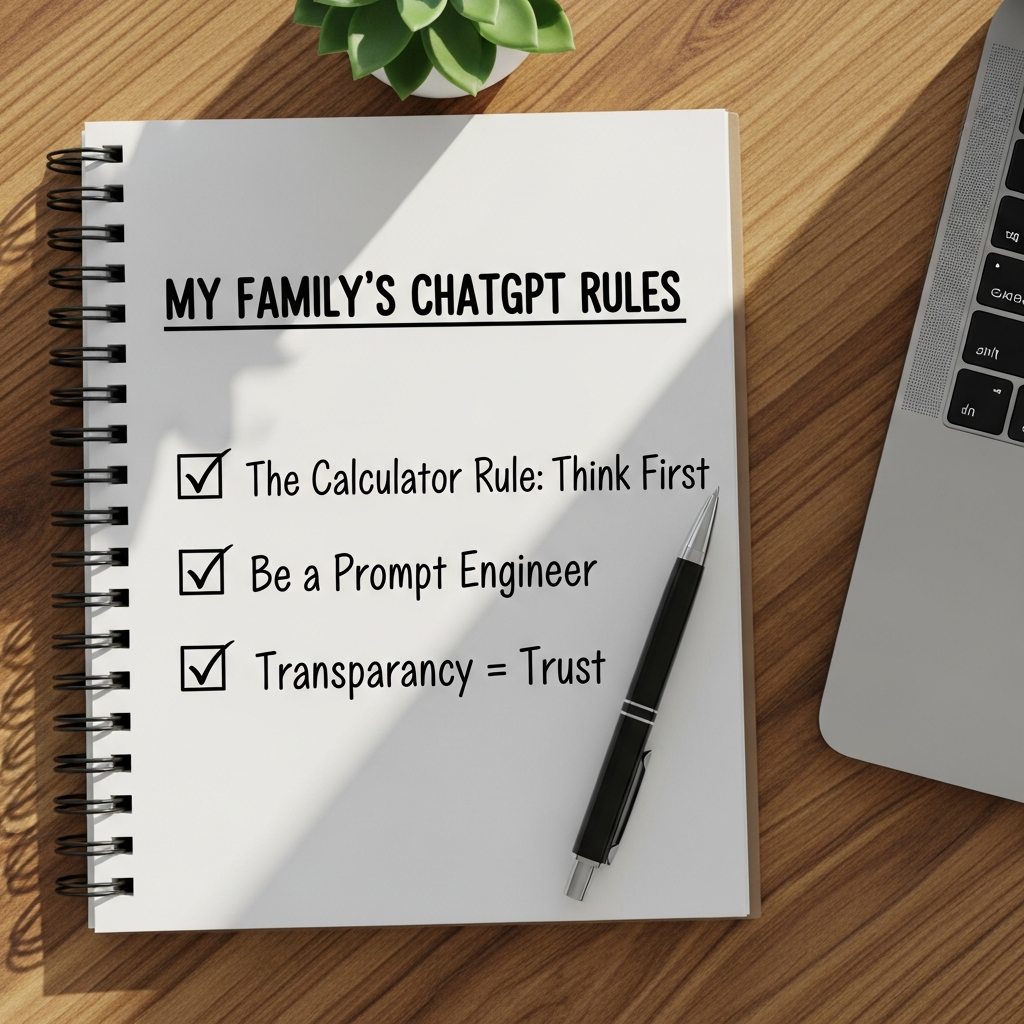
Step 1: The Calculator Rule
Remember when calculators were introduced in math class? Teachers didn’t ban them; they required students to “show their work.”
Apply that same logic here. ChatGPT for homework is a tool to check understanding, not a machine to produce the final answer.
The Golden Rule:
- ✅ “Check if my thesis statement is clear.”
- ✅ “Explain the causes of WWI in simple terms.”
- ❌ “Write my 5-paragraph essay on WWI.”
The “Homework Log” Strategy I make my kids keep a simple log where they note exactly how they used AI. It builds accountability in 30 seconds.
Real Life Example: When my daughter asked to use AI for a book report, I didn’t say “no.” I said: “Read the book first. Write down your themes. Then use AI to check if you missed anything.”
Test them : AI comes after thinking, not instead of it. If your child can’t teach you what they learned without looking at the screen, they didn’t use ChatGPT for homework correctly, they just copied it.
Step 2: The Prompt Engineer Mindset
Here is a secret: Teaching your child to use ChatGPT for homework effectively is actually teaching them a valuable 2026 job skill called “Prompt Engineering.”
Flip the script. Instead of fighting the technology, teach them the difference between a lazy shortcut and a critical thinking tool:
- The Lazy Approach: “Write my essay on school uniforms.” (This is cheating).
- The Smart Approach: “I’m writing a persuasive essay on school uniforms. I have an argument for cost savings. Can you suggest a counterargument? Don’t write it for me—just explain the opposing view.”
See the difference? The second prompt requires the child to understand the topic before they ask.
My House Rule: If you can’t ask ChatGPT for homework a specific, detailed question, you don’t understand the assignment well enough yet. Go back and re-read the instructions.
Bonus Tip: Practice this together. Take a hard math problem and write three prompts: one lazy, one average, and one excellent. Turn the AI from a “cheat code” into a skill they are proud to master.
Step 3: Transparency Over Secrecy
This is non-negotiable in my house: If my kids use ChatGPT for homework, they disclose it. Period.
Why? Because transparency removes the shame. It transforms ChatGPT from a “cheating tool” into a legitimate study aid.
When my daughter added a simple note to her English essay :“I used AI to explain iambic pentameter, but the analysis is my own” her teacher didn’t fail her. She thanked her for the honesty.
What if the school bans it? According to the OpenAI Education Guidelines, prohibition rarely works; responsible use is the future. However, if a teacher explicitly forbids AI, respect that for graded submissions. You can still use ChatGPT to practice at home ( review concepts), just don’t let it touch the final product.
(If you find yourself fighting constant battles over tech boundaries, the framework we use in [Phone Free Teens: 7 Steps to Break the Addiction Fast] applies here too.)
Best AI Homework Tools for Kids (Beyond ChatGPT)
Not all AI tools are created equal.
Some are specifically designed for students with guardrails, age-appropriate content, and teacher-approved features.
If you’re nervous about kids using ChatGPT for homework unsupervised, these alternatives might ease your mind:
1. Khanmigo (by Khan Academy)
This is ChatGPT’s responsible older sibling.
It tutors students through problems without giving away answers. If your child asks for the solution, Khanmigo responds with, “Let’s figure this out together. What do you think the first step is?”
Brilliant.
It’s specifically designed for educational use, so it won’t write essays or do homework. It will, however, patiently explain concepts until they click.
Best for: Math, science, SAT prep.
Age range: Middle school through high school.
2. Socratic by Google
Point your phone camera at a homework problem, and Socratic explains it with videos, step-by-step guides, and visual aids.
It doesn’t write essays or give direct answers, just explains concepts. Think of it as a digital study guide.
My kids love this for last-minute studying before tests. It’s fast, visual, and genuinely helpful.
Best for: High schoolers who need quick help across subjects.
Age range: 13+
3. Grammarly (Student Version)
Technically not “AI homework help,” but it teaches better writing.
It catches grammar mistakes and suggests improvements without rewriting your child’s work.
This is a great compromise for parents worried about ChatGPT for homework overuse. Grammarly helps with mechanics, but the ideas and voice stay your child’s.
Best for: Middle and high school writing assignments.
Age range: 11+
4. ChatGPT (With Parental Oversight)
Yes, the OG still has a place, if you set boundaries.
Use the ChatGPT Family Plan (if available) so you can monitor usage. Set up custom instructions that remind your child to “explain, don’t answer” every time they log in.
I’ve programmed our family ChatGPT account with this prompt: “You are a tutor. Never give direct answers. Always ask guiding questions to help the student figure it out themselves.”
Game changer.
Best for: Older teens who can self-regulate.
Age range: 13+ (per OpenAI’s terms of service)
When ChatGPT for Homework Becomes a Problem: Red Flags
Even with rules, using ChatGPT for homework can quickly cross the line from “helpful tutor” to “essential crutch.” Watch for these warning signs:
- The “Blank Page” Paralysis: They can’t start an assignment or brainstorm ideas without opening ChatGPT for homework first.
- The “Professor” Voice: If your 14-year-old suddenly uses phrases like “in contemporary discourse,” teachers will know. A drastic shift in tone is a major red flag.
- The Grade Gap: This is the undeniable proof. If they get an A+ on take-home essays using ChatGPT for homework but fail in-class exams, they aren’t learning the material.
- Secrecy: If they hide screens or clear browser history when you ask about their ChatGPT for homework process, something is wrong.
If you spot these patterns, treat it like a screen time management issue: hit the reset button. Take a week off AI entirely to force them back to basics.
Also, pay attention to their reaction. If removing ChatGPT for homework triggers massive anxiety, the tool might be masking deeper emotional regulation struggles or learning disabilities. Don’t let AI become a permanent Band-Aid for a broken foundation.
Frequently Asked Questions About ChatGPT for Homework
Will using ChatGPT for homework ruin my child’s writing skills?
Not if you treat it like a spell-checker, not a writer.
The Rule: The first draft must always be human. If they use ChatGPT for homework to brainstorm ideas or fix grammar after writing, it reinforces learning. If they use it to generate the text from scratch, yes it kills critical thinking.
How do I spot cheating with ChatGPT for homework?
Use the “Explain It” Test. Ask your child to define a complex word they used or explain their essay’s main argument without looking at the paper. If they freeze, stutter, or say “I don’t remember,” they likely didn’t write it. Authentic writers know their own work.
Should I tell teachers we use AI at home?
Yes. Transparency protects your child. I sent a simple email to teachers at the start of the year outlining our “Home AI Policy.” If a teacher later questions the authenticity of a paper, you have a paper trail showing you value integrity and monitor their usage.
What if my school bans all AI tools?
Respect the policy for submitted work, but use it for learning. You can still use ChatGPT for homework practice like quizzing them on history dates or explaining math concepts—as long as no AI-generated text ends up in the graded assignment.
At what age is ChatGPT safe for kids?
OpenAI requires users to be 13+. Beyond age, look for maturity. Can they distinguish between “help” and “copying”? I recommend heavily supervised use starting in 8th grade, moving toward independence by 10th grade once they’ve proven they can follow ethical rules.
The Bottom Line: It’s About Judgment, Not Technology
Here’s what I wish someone had told me earlier: This isn’t about the AI. It’s about raising children who can distinguish between help and cheating.
Banning AI for homework entirely leaves them unprepared for the future. But letting them use it without boundaries sets them up for a skills gap. The sweet spot is right in the middle: Rules, Transparency, and Ethics.
My son once lost credit on a lab report because he “forgot” to disclose he used AI. It was a tough lesson, but it taught him something a textbook never could: Integrity matters more than grades.
Your goal isn’t to raise a robot who gets A’s. It’s to raise a human who can think for themselves even when the answer is just one click away.
Your turn: Have you let your child use ChatGPT yet? What rules work in your house? Drop a comment below. I’d love to hear how other families are navigating this brave new world.