Emotional Regulation in Children: 7 Proven Age-Based Strategies
Helping Kids Manage Big Feelings From Toddlers to Preschoolers

- Quick Answer: Emotional Regulation in Children
- What Is Emotional Regulation in Children?
- Emotional Regulation in Toddlers (Ages 1-3)
- Helping Children Regulate Emotions: Preschoolers (Ages 3-5)
- Teaching Emotional Regulation: Early Elementary (Ages 6-8)
- Emotional Self Regulation for Kids: Older Children (Ages 9-12)
- Managing Big Emotions in Children: Teens (Ages 13-18)
- When to Seek Professional Support for Emotional Regulation in Children
- Frequently Asked Questions About Emotional Regulation in Children
- You’re Building Skills That Last a Lifetime
Emotional regulation in children develops slowly and unevenly, which is why meltdowns at different ages look so different.
Teaching emotional regulation in children feels impossible when your toddler is screaming in the grocery store or your ten-year-old slams their bedroom door for the third time this week. I spent years wondering if I was permanently damaging my kids every time I lost my patience during their meltdowns. Turns out, the struggle is the point kids aren’t born knowing how to manage big feelings. They learn through repeated practice, supportive guidance, and a whole lot of patience from us.
Many parents first notice emotional overwhelm during early sleep struggles. If you’re navigating bedtime battles or chronic overtiredness, understanding baby wake windows by age can reduce stress and support emotional regulation in children from the very beginning.
Here’s what actually works at each age and why cutting yourself (and your kid) some slack is part of the process.
Quick Answer: Emotional Regulation in Children
For parents who need answers right now:
- Emotional regulation in children is the ability to manage and respond to emotions in healthy ways
- It develops gradually from birth through early adulthood, your child’s brain literally isn’t finished yet
- Toddlers have almost NO emotional regulation (that’s normal, not bad parenting)
- School-age kids are still learning meltdowns at age 7 don’t mean you’ve failed
- Teaching emotional regulation means co-regulating WITH your child, not demanding they “calm down”
- The goal isn’t eliminating big emotions, it’s teaching kids how to move through them safely
- Your own emotional regulation matters more than any strategy you try with your child
The fastest way to help: Stay calm yourself (even if you’re faking it), name the emotion your child is feeling, and offer physical comfort or space depending on what they need.
What Is Emotional Regulation in Children?
Emotional regulation in children is their ability to notice, understand, and manage their emotional responses. It’s not about suppressing feelings or “being good.” It’s about developing the skills to feel angry without hitting, sad without shutting down, or excited without losing control.
Here’s what most parenting advice gets wrong: emotional regulation isn’t something kids should “just know” by a certain age. The prefrontal cortex, the part of the brain responsible for emotional control doesn’t fully develop until age 25. Your five-year-old literally doesn’t have the brain wiring to “use their words” when they’re flooded with emotion.
Understanding emotional regulation in children helps parents respond with guidance instead of punishment.
Why emotional regulation develops gradually:
Babies are born with zero emotional regulation. They cry when they need something and stop when the need is met. As they grow, their nervous system slowly learns to handle bigger feelings, but this process takes YEARS.
Toddlers can’t regulate because their brain’s alarm system (amygdala) is fully online, but the control center (prefrontal cortex) barely functions yet. It’s like having a fire alarm with no fire extinguisher.
School-age kids have more capacity but still need help, especially when tired, hungry, or overwhelmed. Teens have the brain development but hormones and social pressures complicate everything.
Common misconceptions parents have:
“My child KNOWS better”. Actually, knowing what to do when calm is completely different from accessing that knowledge when flooded with cortisol and adrenaline.
“They can regulate at school but not at home”. Home is where kids feel safe enough to fall apart. School behavior often comes at a cost that shows up at home.
“If I respond to tantrums, I’m rewarding bad behavior”. Tantrums aren’t manipulation. They’re nervous system overload. Responding with support teaches regulation, not defiance.
Emotional Regulation in Toddlers (Ages 1-3)
What emotional regulation looks like at this age:
At this stage, emotional regulation in children depends almost entirely on caregivers.
Spoiler alert: it doesn’t exist yet. Toddlers have big feelings and zero ability to manage them independently. A toddler melting down over the “wrong” cup isn’t being dramatic, their brain genuinely perceives this as a crisis.
What is developmentally normal:
Full-body tantrums that last 5-20 minutes (sometimes longer). Hitting, biting, or throwing when upset. Going from happy to enraged in seconds. Needing YOU to calm down before they can calm down.
This isn’t bad behavior. It’s brain development in action. Emotional regulation skills for kids this age means WE regulate FOR them while they slowly build capacity.
Common parent mistakes:
Trying to reason with a tantruming toddler. Logic doesn’t work when their nervous system is in fight-or-flight mode. Saying “calm down” or “use your words.” They literally can’t access language when dysregulated.
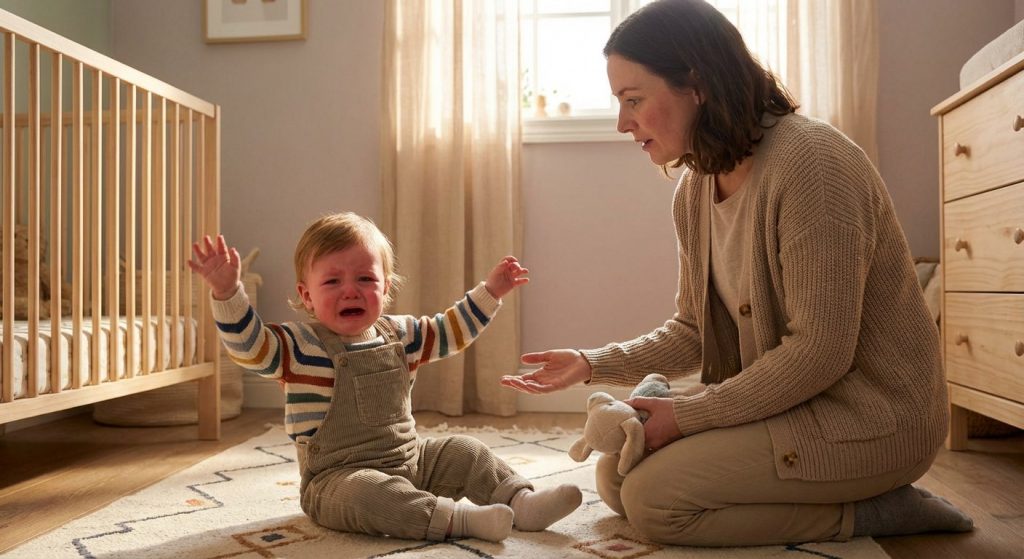
Expecting emotional regulation in children this young leads to unrealistic expectations and frustration.
Punishing emotional outbursts. Timeouts for tantrums teach kids that feelings are bad, not how to manage them. Expecting consistency. Your toddler might handle frustration fine today and completely fall apart tomorrow over the same thing.
Practical strategies for toddlers:
Stay calm (or fake it). Your regulated nervous system is the most powerful tool. Deep breaths, slow voice, relaxed body, even if you’re screaming inside.
Name the emotion simply. “You’re really mad. Mad is okay.” This builds emotional vocabulary while validating their experience.
Offer physical comfort. Hugs, holding, or just sitting nearby (depending on what your child accepts when upset). Physical connection calms their nervous system.
Create a calm-down space. Not a punishment corner, a cozy spot with soft things, books, or quiet toys they can retreat to when overwhelmed.
Language to use:
- “I see you’re upset. I’m here.”
- “That was really frustrating.”
- “You can be mad. I’ll stay with you.”
- “Let’s take some deep breaths together.”
If your toddler’s tantrums involve aggression toward siblings, strategies for managing sibling fighting constantly can help you address both emotional regulation and relationship dynamics.
Gentle reassurance:
If your toddler melts down multiple times daily, that’s NORMAL. If you lose your patience and yell sometimes, that’s also normal. Toddler emotional regulation is about progress over months, not perfection in moments. You’re teaching them through repeated experiences that big feelings are safe and they can recover.
Helping Children Regulate Emotions: Preschoolers (Ages 3-5)
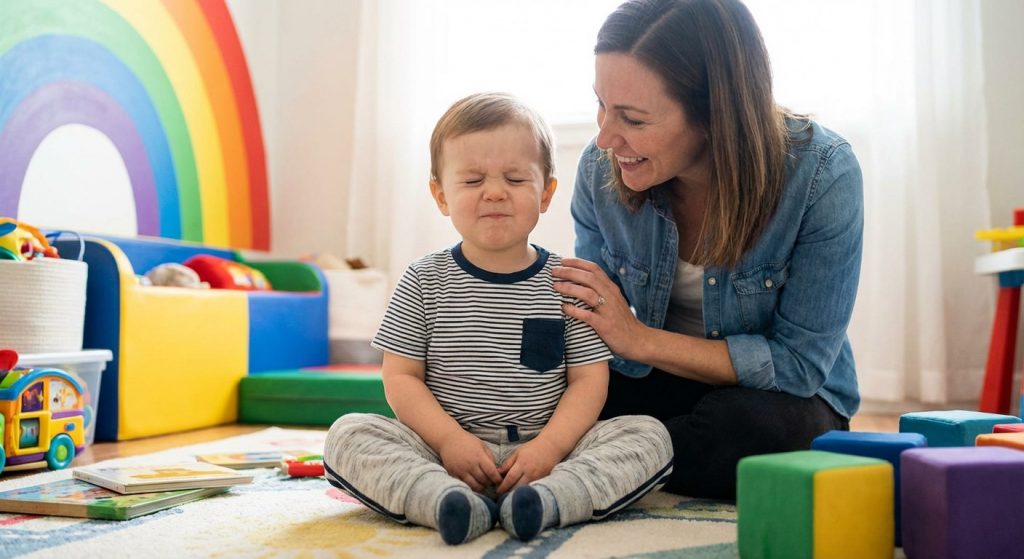
Emotional regulation in children between ages 3–5 is still fragile and highly dependent on adult support.
What emotional regulation looks like at this age:
Preschoolers are starting to understand that feelings exist and have names, but they still can’t consistently manage them alone. They might use some emotional regulation strategies by age 4 or 5, like taking deep breaths, but only when they’re mildly upset not during meltdowns.
What is developmentally normal:
Crying over seemingly small things (a broken cracker, the “wrong” shoes). Emotional swings from happy to devastated in minutes. Physical aggression when frustrated, though less frequent than toddlers.
Some language for feelings but inconsistent use. Needing A LOT of support to calm down. Better emotional control in the morning, total dysregulation by evening.
Common parent mistakes:
Expecting them to “talk it out” during high emotion. Preschoolers need to calm down FIRST, then discuss. Shaming emotional reactions. “Big kids don’t cry about crackers” teaches kids to hide feelings, not manage them.
Skipping connection before correction. Jumping straight to consequences without addressing the underlying emotion. Assuming regression means failure. Even kids who’ve mastered some emotional regulation skills will regress when sick, tired, or stressed.
Practical strategies for preschoolers:
Teach emotion vocabulary actively. Read books about feelings. Name emotions in yourself and others. “I feel frustrated when I can’t find my keys.” The more words they have for feelings, the less they need to act them out.
Use “first/then” language. “First, let’s calm our bodies. Then we can talk about what happened.” This acknowledges the emotion while setting expectations.
Introduce simple calming strategies. Belly breathing (blow out birthday candles, smell flowers). Squeezing a stress ball. Counting to ten together. These only work for mild upset initially, but practicing builds neural pathways.
These activities strengthen emotional regulation in children through repetition, not perfection.
Validate before problem-solving. “You really wanted to stay at the park. Leaving is hard.” THEN: “Let’s think about what might help.”
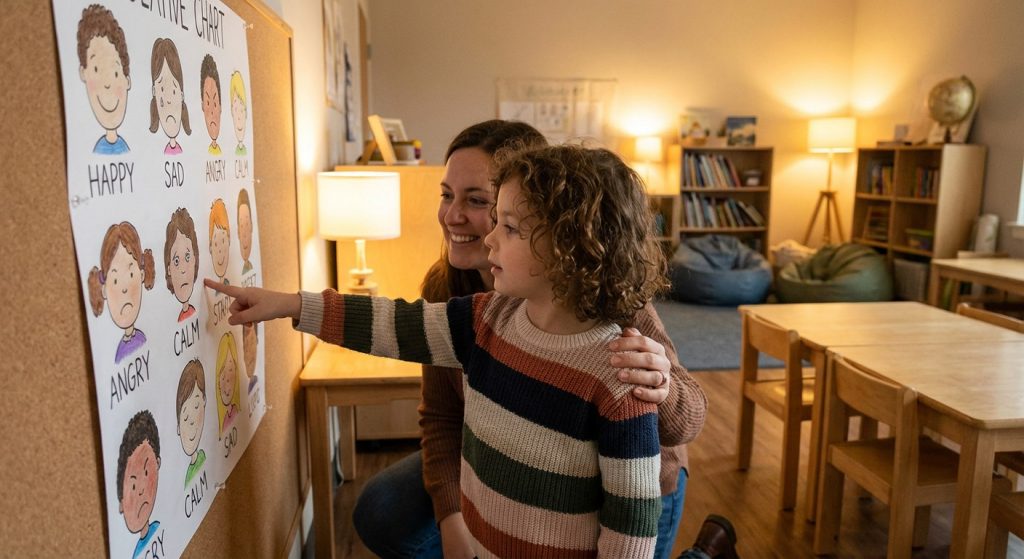
Create visual supports. A feelings chart with faces showing different emotions. A calm-down toolkit with specific strategies they can choose from.
Language to use:
- “Your body feels really big right now. Let’s help it calm down.”
- “I wonder if you’re feeling frustrated?”
- “It’s okay to be sad. Sad feelings don’t last forever.”
- “What does your body need right now?”
Gentle reassurance:
Preschool meltdowns are exhausting, especially when your child is “too old” for tantrums but still having them. This is normal. Emotional development isn’t linear. Some days will feel like regression. That’s part of the process, not evidence you’re failing.
Teaching Emotional Regulation: Early Elementary (Ages 6-8)
Emotional regulation in children ages 6–8 improves, but stress easily overwhelms their skills.
What emotional regulation looks like at this age:
School-age kids have more emotional regulation skills but still need significant support. They’re learning to identify triggers, recognize early warning signs in their body, and sometimes use strategies independently, but this all falls apart under stress, fatigue, or high emotion.
What is developmentally normal:
Holding it together at school and falling apart at home. Better ability to use words but still physical reactions when overwhelmed (slamming doors, throwing things).
Understanding that different situations require different emotional responses, though execution is inconsistent. Embarrassment about emotional reactions, especially in front of peers.
Growing awareness of their own patterns (“I always get mad when I’m hungry”) but limited ability to prevent dysregulation.
Common parent mistakes:
Assuming school-age kids should handle emotions independently. They still need co-regulation, just in different ways than toddlers.
Responding to emotional escalation with lectures. When their fight-or-flight system is activated, the thinking brain is offline, save the lesson for later.
Comparing them to peers. “Your friend doesn’t melt down like this.” Every child develops emotional regulation skills at their own pace.
Taking “I hate you!” or door-slamming personally. These are signs of overwhelm, not actual feelings about you.
Practical strategies for early elementary:
Teach the window of tolerance. Help kids understand that there’s a zone where they can think clearly, and when they’re outside that zone (too hyped up or too shut down), they need calming strategies first.
Practice identifying body signals. “Where do you feel anger in your body? What happens right before you lose control?” This builds self-awareness.
Develop a personal calm-down plan. Work together when everyone is calm to identify strategies that actually help THEM (alone time, physical activity, talking, creative outlet).
Model emotional regulation out loud. “I’m feeling really frustrated right now. I’m going to take a few deep breaths before I decide what to do.” They learn more from watching you than from any strategy you teach.
Modeling calm behavior is one of the fastest ways to improve emotional regulation in children.
Problem-solve together after calm. “That was really hard. What was happening before you got upset? What could we try differently next time?”
Language to use:
- “I notice your voice is getting louder. What’s going on?”
- “Your body looks tense. Want to take a break?”
- “That was a big reaction. Let’s figure out what happened.”
- “Everyone has hard moments. How can I help?”
For children who struggle with confidence or social situations, building confidence in shy children provides additional strategies that support emotional regulation development.
Gentle reassurance:
Six-to-eight-year-olds often seem “too old” for emotional dysregulation, which makes parenting their meltdowns feel more frustrating. But brain development isn’t done. The skills they’re building now will serve them for life even if progress feels painfully slow.
Emotional Self Regulation for Kids: Older Children (Ages 9-12)
Emotional regulation in children ages 9–12 becomes more internal, but struggles still appear under pressure.
What emotional regulation looks like at this age:
Preteens are developing more sophisticated emotional regulation skills but facing increasingly complex emotional situations. Peer relationships, academic pressure, and physical changes create new emotional challenges.
What is developmentally normal:
Mood swings, especially as puberty approaches. Withdrawal or emotional shutdown instead of outward tantrums. Increased self-consciousness about emotional reactions.
Better ability to use strategies independently when stress is moderate, but complete dysregulation when stress is high. Strong opinions about what helps them calm down (which may differ from what you think should help).
Common parent mistakes:
Dismissing feelings as “drama” or “overreacting.” Their feelings are real and intense, even if the trigger seems minor to you.
Forcing conversation when they want space. Some kids need to process internally before talking—pushing makes them shut down more.
Expecting them to just “deal with it.” They still need support, just delivered differently than when they were younger.
Ignoring signs of overwhelm until they explode. Older kids mask stress better, so you need to watch for subtle signs.
Practical strategies for older children:
Offer choices in how they regulate. “Do you want to talk, be alone, or do something physical?” Autonomy matters at this age.
Respecting independence supports emotional regulation in children during this sensitive stage.
Teach the concept of emotional granularity. Help them get specific: “frustrated,” “disappointed,” “embarrassed” instead of just “mad” or “sad.” Naming emotions precisely reduces their intensity.
Normalize the struggle. “Middle school is really hard emotionally for most people. It’s not just you.”
Create opportunities for physical regulation. Movement is one of the fastest ways to shift emotional state sports, dancing, walking, even fidget tools.
Respect their need for privacy while staying available. “I’m here if you want to talk. I’m also okay if you need space right now.”
Language to use:
- “I noticed you seem off today. Everything okay?”
- “That sounds really hard.”
- “What would be helpful right now?”
- “I’m proud of how you handled that, even though it was tough.”
Gentle reassurance:
Preteens seem grown-up enough that their emotional struggles can feel like defiance or attitude. But they’re still building skills. The eye rolls and door slamming don’t mean you’ve failed, they mean your child is learning to navigate increasingly complex emotions with a brain that’s still very much under construction.
Managing Big Emotions in Children: Teens (Ages 13-18)
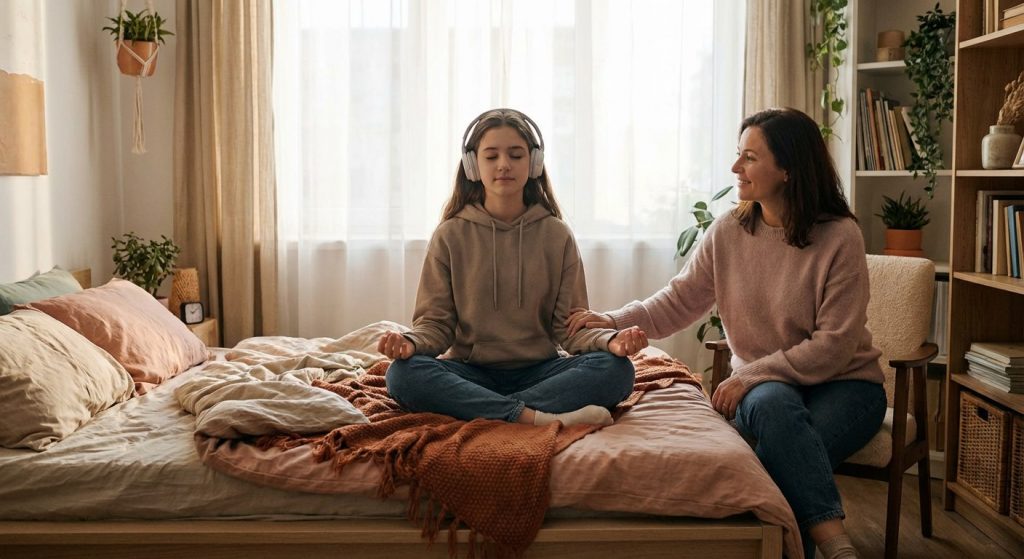
Emotional regulation in children during the teen years is shaped by brain development, hormones, and environment.
What emotional regulation looks like at this age:
Teens have the brain development to understand emotional regulation but face unprecedented challenges: intense hormones, peer pressure, academic stress, identity formation, and constant social comparison through technology.
What is developmentally normal:
Intense emotional reactions that seem disproportionate to the trigger (because their emotional processing is at adult levels while judgment is still developing).
Withdrawal or emotional distance from parents. Emotional openness with peers rather than family. Risk-taking behavior as a way of managing uncomfortable emotions.
Better emotional regulation in some contexts (work, school, extracurriculars) but dysregulation at home. Alternating between wanting independence and needing support.
Common parent mistakes:
Lecturing when they need listening. Teens shut down when they feel judged or told what to do.
Minimizing their problems. “This won’t matter in five years” might be true but isn’t helpful when they’re suffering now.
Taking their emotional distance personally. Separation is developmentally appropriate, even though it hurts.
Trying to “fix” everything instead of building their capacity to handle hard things.
Practical strategies for teens:
Lead with curiosity, not judgment. “Help me understand what’s going on” works better than “Why are you acting like this?”
Acknowledge the reality of their stress. Social media, academic pressure, and peer dynamics create real challenges. Dismissing these invalidates their experience.
Teach the connection between physical and emotional health. Sleep, nutrition, exercise, and screen time all impact emotional regulation capacity. Frame these as tools, not rules.
Respect their autonomy while maintaining boundaries. “I trust you to handle this, but I’m here if you need support” balances independence with safety.
Trust and connection are key to maintaining emotional regulation in children through adolescence.
Model healthy emotional regulation. Talk about how YOU manage stress, disappointment, and overwhelm. They’re watching.
Language to use:
- “That sounds really stressful. What do you need?”
- “I hear you. That would upset me too.”
- “How can I support you through this?”
- “You don’t have to have it all figured out right now.”
Managing your own emotional reactions to teen behavior is crucial. Strategies for nervous system regulation for parents can help you stay grounded when parenting feels impossible.
Gentle reassurance:
Parenting teens is emotionally exhausting because their dysregulation can trigger your own. Remember: their emotional struggles aren’t rejection of you. They’re learning to be adults while still needing you (even if they won’t admit it). The skills they’re building now will carry them through adulthood.
When to Seek Professional Support for Emotional Regulation in Children
When emotional regulation in children causes daily impairment, professional guidance can help.
Emotional regulation in children develops at different rates, and struggles are normal. However, some signs indicate professional support might help:
Consider reaching out if:
Emotional outbursts are frequent and severe beyond what’s typical for their age (your pediatrician can help you assess this). Emotional dysregulation is impacting school performance, friendships, or family functioning significantly.
Your child seems unable to experience joy or shows signs of persistent sadness, anxiety, or withdrawal. Physical aggression continues beyond age 6 or escalates over time.
You’re feeling overwhelmed, burnt out, or unable to stay regulated when your child is dysregulated. (Parent support is crucial too!)
What professional support can look like:
Talk to your pediatrician first, they can assess development and recommend appropriate resources. Child therapists who specialize in emotional regulation can teach your child specific skills in a neutral setting.
Family therapy can address dynamics that contribute to dysregulation cycles. Parent coaching or support groups provide tools and community for the hardest parts of this journey.
Important notes:
Seeking help isn’t admitting failure. It’s recognizing when you need support to support your child. Early intervention with emotional regulation challenges often prevents bigger struggles later.
Professional support works best in partnership with parents, you’re still the most important part of your child’s emotional development.
Frequently Asked Questions About Emotional Regulation in Children
These are practical examples of emotional regulation in children across different ages.
Is it normal for my child to regulate emotions well at school but fall apart at home?
Absolutely. School requires kids to hold it together for hours, which depletes emotional regulation in children capacity. Home is where they feel safe enough to release all that pent-up stress. This pattern is incredibly common and doesn’t mean you’re doing anything wrong. It actually means they trust you enough to fall apart in front of you.
How do I teach emotional regulation when I struggle with it myself?
This is the most honest question parents ask. The truth is, working emotional regulation in children IS teaching your child they learn more from watching you repair and try again than from watching perfection. Model the process: “I got really frustrated and yelled. I’m going to take a few breaths and try again.” Growth is the goal, not perfection.
My child’s emotional reactions seem too big for the situation. Should I be worried?
Intensity of emotional reactions varies by temperament. Some kids feel everything more strongly that’s not inherently a problem. What matters is whether they can recover with support, whether the intensity is impacting their daily functioning, and whether it’s improving over time as they develop skills. If you’re unsure, talk to your pediatrician.
At what age should my child be able to calm themselves down independently?
This varies widely, but most kids don’t consistently self-regulate until late elementary or middle school and even then, they still need support during high stress. Don’t rush it. Co-regulation (calming down together) builds the foundation for eventual self-regulation. Your presence and support during dysregulation is teaching, not enabling.
Does giving in to tantrums teach kids that emotional outbursts work?
No. Supporting a child through dysregulation teaches them that emotions are safe and manageable. “Giving in” would mean changing a boundary because they’re upset that’s different from offering comfort during distress. You can hold a limit (no candy before dinner) while supporting the emotion (I know you’re disappointed, that’s hard). This teaches both boundaries and emotional skills.
You’re Building Skills That Last a Lifetime
If you’re reading this after a particularly hard day, know this: teaching emotional regulation in children is one of the hardest parts of parenting. It requires staying calm when your child is dysregulated, which goes against every stressed-out instinct you have.
Here’s what matters most: progress, not perfection. Your child’s emotional regulation skills will develop gradually, with setbacks and breakthroughs along the way.
Supporting emotional regulation in children is long-term work built through everyday moments.
Remember:
Your child’s emotional struggles aren’t a reflection of your parenting. Every child develops these skills at their own pace, influenced by temperament, development, and environment.
Co-regulation is teaching regulation. When you stay calm while they’re upset, you’re literally training their nervous system how to return to calm.
Repair matters more than getting it right the first time. When you lose your patience (and you will), coming back to apologize and reconnect teaches emotional regulation more effectively than perfection ever could.
The goal isn’t eliminating emotions, it’s teaching kids to move through them without getting stuck or causing harm.
Small shifts make a difference:
Naming one emotion per day. Staying calm through one meltdown this week. Repairing one interaction where you lost it. These aren’t small victories, they’re the foundation of lifelong emotional health.
Some days you’ll handle dysregulation with patience and grace. Other days you’ll yell and immediately regret it. Both days are teaching your child about emotional regulation, on the hard days, they learn about repair, apology, and trying again.
Trust yourself. You know your child better than any expert or article. Emotional regulation in children develops over years, shaped by thousands of small interactions. You’re doing that work right now, even on the days it doesn’t feel like it.
You’ve got this.