Sibling Fighting Constantly? The “Mom Court” Method That Stopped 80% of Battles
A Calm, Fair Way to End Daily Arguments Without Yelling or Picking Sides
- 🚨 YOUR KIDS ARE SCREAMING RIGHT NOW? DO THIS (Takes 3 Minutes)
- Why Everything Else Failed (And Why You’re Not a Bad Parent)
- What Mom Court Actually Is
- What You Need To fix sibling fighting constantly problems
- How to Actually Run Mom Court (The Real Process)
- 1. Call Court Into Session
- 2. Let Them Present Their Cases (And Try Not to Laugh)
- 3. The Evidence Phase (This Is Where It Gets Good)
- 4. Make THEM Come Up With Solutions
- 5. The Final Decision (And Why You Don’t Make It)
- For Little Kids (Ages 3-5): Keep It Super Simple
- For School-Age Kids (Ages 6-9): The Full System Works Great
- For Older Kids/Teens (Ages 10+): Drop the Role-Play
- How Mom Court Builds Real-Life Skills
- Comparison: Mom Court vs. Everything Else
- Common Objections (And My Responses)
- “I don’t have 15 minutes every time they fight.”
- “What if one kid is obviously in the wrong?”
- “My kids are too young/old for this.”
- The Edge Cases: When Mom Court Gets Complicated
- Edge Case #1: When Your Kids Have a Big Age Gap
- Edge Case #2: When the Victim Child Fears Retaliation
- Edge Case #3: When One Child Has ADHD or Executive Function Challenges
- Edge Case #4: When Children Start “Gaming the System”
- What to Expect: The Timeline
- People Also Ask (FAQ)
- What if my kid refuses to come to court?
- What about lying or exaggerated claims?
- What about fights in public or in the car?
- Why This Actually Works (The Science)
- Key Takeaways
- Final Thoughts: You’re Not a Referee Anymore
- Resources (If You Want to Go Deeper)
🚨 YOUR KIDS ARE SCREAMING RIGHT NOW? DO THIS (Takes 3 Minutes)
Listen, I get it. Someone’s crying, someone’s yelling “IT’S NOT FAIR,” and you’re about to lose your mind. Or let’s say sibling fighting constantly. Here’s what you do RIGHT NOW:
- Separate them. Different rooms. I don’t care if they’re mid-sentence—separate them.
- Set your phone timer for 2 minutes. Tell them: “Everyone needs to calm down. We’re doing court in 2 minutes.” (Yes, they’ll ask what that means. Ignore the questions for now.)
- Bring both kids to the kitchen table. Say this exactly: “You each get 30 seconds to tell me what happened. No interrupting or we start over.”
- After they speak, ask: “Give me two ways to fix this.” Make them work together to come up with solutions. Not you—them.
- Ask: “Which one do you both pick?” If they can’t agree? Whatever they’re fighting over goes away for an hour. End of discussion.
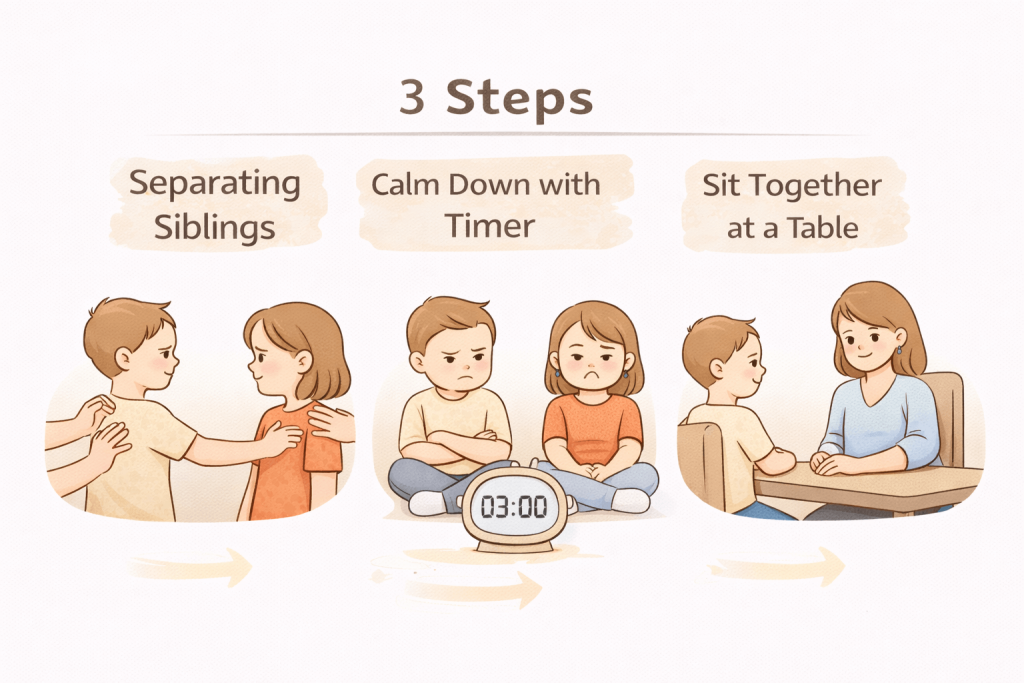
This shortened version will buy you sanity right now. But if you want to actually STOP the next 47 fights this week when sibling fighting constantly disrupts your home, keep reading.
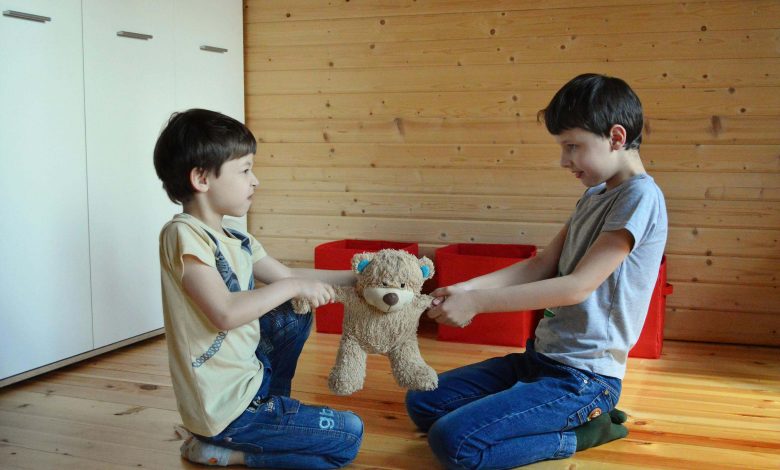
Sibling fighting constantly turned our house into a war zone. I’m talking screaming matches over who got the blue cup, full-body tackles over the TV remote, and that special kind of whining that makes your eye twitch. I tried every parenting book trick: timeouts, forced apologies, taking away toys. Nothing stuck.
Here’s the system that saved my sanity when sibling fighting constantly threatened to break me, and taught my kids how to solve their own problems while building emotional regulation skills they’ll use for life.
Why Everything Else Failed (And Why You’re Not a Bad Parent)
Before Mom Court, I was doing what every parenting article tells you to do. Timeout for both kids. Making them hug it out. Confiscating the disputed toy. I even tried that thing where you make them sit knee-to-knee and take turns talking. (Spoiler: that ended with one kid kicking the other.)
None of it worked because I was treating the symptom, not the problem. The real issue? My kids had no idea HOW to solve a conflict. They just knew how to scream until I came running. The fighting isn’t just about the toy; it’s about the lack of a process.
The “everyone gets timeout” approach is actually terrible. You know what my 7-year-old said after I sent both kids to timeout for fighting? “That’s not fair. He started it!” And he was right. By punishing both kids equally, I was essentially telling the kid who got hit that defending himself was wrong. That breeds resentment, not justice.
And when I played judge? My kids just learned to manipulate me. They’d run to me with their version of events, complete with dramatic tears and “but he ALWAYS does this.” I was exhausted, the conflicts continued, and nobody was learning anything.
What Mom Court Actually Is
Mom Court is essentially a role-play system where kids present their cases, show evidence, and come up with their own solutions when sibling fighting constantly erupts. I know—it sounds formal and weird. But kids LOVE the structure of it. There’s something about having clearly defined roles and rules that makes them take it seriously.

I didn’t invent restorative justice or anything fancy. I just figured out that if I gave my kids a framework, they could actually figure things out on their own. This approach teaches the same social-emotional learning (SEL) competencies that schools emphasize: self-awareness, perspective-taking, problem-solving, and responsible decision-making.
What You Need To fix sibling fighting constantly problems
A “courtroom” space. We use the kitchen table. The point is having one spot where they know “okay, this is where we solve problems.” It doesn’t have to be fancy—just consistent.
Clear roles:
- The Judge (that’s you): You ask questions and keep order. You do NOT decide who wins.
- Plaintiff (the complaining kid): Goes first, explains what happened.
- Defendant (the accused kid): Gets to respond with their version.
- Sometimes a Mediator (an older sibling, if you have one): Suggests compromises.
The Rules (and you need to post these somewhere they can see):
- One person talks at a time
- No name-calling or “you always” statements
- Both kids have to present their side
- Both kids have to agree on the solution
- Break the rules = consequences
How to Actually Run Mom Court (The Real Process)
Okay, here’s where I’m going to walk you through what actually happens when court is in session. Fair warning: the first few times will be a disaster. Your kids will roll their eyes, interrupt constantly, and probably tell you this is stupid. That’s normal. Stick with it. No more sibling fighting constantly.
1. Call Court Into Session
When sibling fighting constantly starts (again), don’t engage. Don’t listen to their stories in the hallway. Don’t try to figure out who started it. Just announce: “Court is in session. Both of you to the table. Now.”
Then you walk away. Let them come to you.
Here’s the magic part: the walk from wherever they were fighting to the kitchen table forces them to calm down a little. This mandatory pause teaches emotional regulation—they’re learning to manage their feelings before presenting their case. You’re not lecturing them. You’re not yelling. You’re just… waiting. By the time they sit down, they’re usually at least 30% less hysterical.
One time my 4-year-old was mid-tantrum and literally stopped crying to ask, “Wait, what’s court?” The distraction alone helped break the cycle. This calming technique works similarly to nervous system regulation strategies for parents that help us manage our own emotional responses.
2. Let Them Present Their Cases (And Try Not to Laugh)
Start with the plaintiff—the kid who’s complaining. Say something like: “Okay, [name], you called court. Tell me what happened, who was involved, and what you want to happen.”
This step practices emotion coaching—a research-backed technique where children learn to identify and articulate their feelings and perspectives before jumping to solutions. When kids verbalize their emotions, they develop better self-regulation and conflict resolution skills.
Here’s the critical rule: the other kid cannot interrupt. I mean it. The second they try, you pause everything and that kid goes to timeout. Not for fighting—for breaking court rules. This is huge. It teaches them that if they want their turn to speak, they have to respect the other person’s turn.
After the first kid talks, you turn to the second kid: “Alright, [name], you heard what they said. What’s your side?”
The first few times, their “sides” will be hilariously biased. My 7-year-old once spent 2 minutes explaining how his sister “looked at him weird” and that’s why he pushed her. But over time, they get better at sticking to facts.
3. The Evidence Phase (This Is Where It Gets Good)
This is my favorite part. Ask: “Do we have evidence?”

Evidence can be:
- A broken toy (proves who was rough with it)
- A timer or clock (proves who had it longer)
- A witness (another sibling or parent who saw what happened)
- House rules written down somewhere
If there’s no evidence? Both stories are equally valid. This teaches kids that “because I said so” doesn’t win arguments. Facts do.
My kids have started gathering evidence before calling court. My 9-year-old once took a photo of the Xbox timer to prove his brother played 10 minutes longer than him. I was oddly proud!
4. Make THEM Come Up With Solutions
This is where most parents screw up. We jump in with our own solutions because it’s faster. Don’t do that.
Ask: “What are three ways you could solve this problem?”
They have to work TOGETHER to come up with three options. Not one. THREE. If they can’t? Court is dismissed and whatever they’re fighting over disappears for 24 hours. Both kids lose.
This step activates their executive function skills—the mental processes that include planning, problem-solving, delayed gratification, and impulse control. These cognitive abilities are crucial for success in school and life.
The first time I did this, my kids sat there for 10 minutes coming up with increasingly ridiculous solutions. (“We could cut the toy in half!” No, sweetie, that’s not helpful.) But eventually, they figured it out.
5. The Final Decision (And Why You Don’t Make It)
Here’s the part that makes Mom Court different from everything else you’ve tried when sibling fighting constantly overwhelms you: You don’t pick the solution.
You ask: “Which solution do you both agree on?”
If they agree, great. Court is over. They go implement the solution themselves. If they CAN’T agree? The automatic consequence kicks in: the thing they’re fighting over goes in “court jail” (a high shelf in my house) for 24 hours. Both kids lose access.
This is the golden rule: When you refuse to compromise, you BOTH lose. Once they understand that, cooperation suddenly becomes very appealing.
For Little Kids (Ages 3-5): Keep It Super Simple
Toddlers and preschoolers can’t handle a five-step process. Their emotional regulation abilities are still developing, so use this shortened version:
- “Tell me what happened” (give each kid 30 seconds max)
- “Show me two ways to fix it” (hold up two fingers and make them pick two options)
- “Pick one together or the toy goes away”
Use pictures if you need to. I printed out images showing: kids sharing, kids taking turns, kids playing together, toy in timeout. My 4-year-old points to the picture of what he wants to happen. It works.

If you’re dealing with younger children, you might also find helpful strategies in our guide on understanding why babies cry to better interpret their needs before conflicts escalate.
For School-Age Kids (Ages 6-9): The Full System Works Great
This is the sweet spot for Mom Court. They’re old enough to understand all the steps but still young enough to think the whole “court” thing is fun.
Let your oldest kid play judge sometimes. You supervise but don’t interfere. It teaches them how to be fair and impartial while reinforcing social-emotional learning competencies like empathy and leadership. This age group is also developing confidence, and you can support that growth with strategies for building confidence in shy children.
For Older Kids/Teens (Ages 10+): Drop the Role-Play
Teenagers will roll their eyes at “court.” Call it “Conflict Mediation” or “Dispute Resolution Session” but keep the same structure to stop sibling fighting constantly in older age groups.
Add these elements:
- Precedent: Reference past rulings.
- Appeals: Let them appeal once per month if new evidence shows up.
- Written Contracts: For ongoing issues like bathroom schedules.
If you’re raising teens, you might also benefit from our article on helping phone-free teens break device addiction as technology disputes often fuel conflicts between siblings.
How Mom Court Builds Real-Life Skills
Beyond stopping the immediate chaos, Mom Court teaches your kids skills they’ll use forever:
Emotional regulation: That mandatory 2-minute calm-down? It’s teaching them to pause and manage their feelings before reacting—a skill most adults still struggle with.
Problem-solving: When they have to come up with three solutions together, they’re practicing creative thinking under pressure.
Perspective-taking: Hearing their sibling’s side teaches them that different people see situations differently—critical for relationships, school, and eventually work.
Evidence-based thinking: Learning that claims need backing (“show me the evidence”) teaches critical thinking that’ll help them navigate everything from playground disputes to social media drama.
These are the same social-emotional learning competencies that schools teach through formal SEL curricula. Mom Court is just the home version. Just like teaching kids about money management prepares them for financial independence, teaching conflict resolution prepares them for healthy relationships.
Comparison: Mom Court vs. Everything Else
| Method | Time It Takes | Teach Anything? | Long-Term Success | Exhaustion Level |
|---|---|---|---|---|
| Mom Court | 15 min teaching, 5 min per conflict | YES (Negotiation, Evidence, Emotional Regulation) | Very effective | Low once they get it |
| Traditional Timeout | 2 minutes per fight | Nope | Not really | Medium-high |
| Forced “I’m Sorry” | 1 minute | Nope | Terrible (breeds resentment) | Low |
| Taking Toy Away | 30 seconds | A little (avoidance) | Okay (temp peace) | Very low |
Common Objections (And My Responses)
“I don’t have 15 minutes every time they fight.”
You won’t need 15 minutes after the first week. By week three, my kids run their own “Mini Court” and only get me involved for serious stuff. Would you rather spend 15 minutes once or 2 minutes yelling 8 times per day?
“What if one kid is obviously in the wrong?”
That’s where the evidence phase shines. If the sibling fighting constantly, the evidence (a red mark) makes it obvious. The evidence proves it, not you. This keeps you out of the “bad guy” role.
“My kids are too young/old for this.”
The role-play works for 4-10. But the structure works at any age. For teenagers, just change the name. For toddlers under 3, redirection is better than a court system.
The Edge Cases: When Mom Court Gets Complicated
Edge Case #1: When Your Kids Have a Big Age Gap
The problem: Your 8-year-old and 3-year-old experience sibling fighting constantly. The 3-year-old can’t fully participate in Mom Court. The 8-year-old claims it’s unfair because the toddler “doesn’t understand rules.”
The solution: Create a “Big Kid Advantage” system.
- The older kid gets more power—BUT they also get “Big Kid Responsibility.” They have to show patience.
- The younger kid gets a “lawyer” (you).
- The older kid presents their case.
- The older kid has to propose a solution that accounts for the fact that their sibling is little.
This teaches accountability to the older kid while protecting the younger one from unfair expectations.
Edge Case #2: When the Victim Child Fears Retaliation
The problem: Your 6-year-old refuses to come to Mom Court because last time they “told on” their older sibling, they faced punishment after you left the room. The older child uses physical intimidation or emotional manipulation outside court sessions. This is a real sibling fighting constantly case.
The solution: This signals a deeper power imbalance requiring two-tier intervention.
Immediate: Implement “Closed Court” sessions where you meet with each child separately. The “victim” presents their case to you alone, and you carry their concerns to the “defendant” without revealing all details. This protects the vulnerable child while maintaining the court process.
Long-term: Establish a “Court Safety Rule”—any retaliation for participation results in automatic consequences for the aggressor (loss of privileges for 48 hours). Post this rule visibly and enforce it consistently.
When to skip Mom Court entirely: If intimidation continues despite these modifications, Mom Court isn’t appropriate yet. This signals a need for professional intervention (family therapy) to address the underlying bullying dynamic. Mom Court works for conflict, not abuse. For parents navigating difficult situations alone, single parent survival strategies after divorce can provide additional support frameworks.
Edge Case #3: When One Child Has ADHD or Executive Function Challenges
The problem: Your 5-year-old has ADHD and cannot sit through the 5-step Mom Court process. They interrupt constantly, forget what they were arguing about, and escalate emotionally when required to wait. That’s how you will understand how sibling fighting constantly.
The solution: Children with executive function challenges need modified protocols:
Visual Court Process: Create a poster board with picture cards for each step. As you complete each step, the child moves a token to the next picture. This externalizes working memory demands.
Shortened Timeline: Use the 3-step version (ages 3-5) with even more compression:
- Step 1: “What happened?” (30 seconds max per child)
- Step 2: “Pick two solutions” (point to picture cards of options)
- Step 3: “Which one?” (immediate choice required)
Movement Breaks: Allow the ADHD child to stand or use a fidget during court. Seated stillness isn’t required for learning.
Scripted Prompts: Provide sentence starters written on cards: “I feel _____ because _____” to reduce language generation demands.
Success Metric Adjustment: For neurotypical siblings, success = independent court sessions by week 6. For ADHD children, success = reduced physical aggression and participating in simplified court without complete meltdown.
When it works: Mom Court’s structured predictability often helps ADHD children because they know exactly what to expect. The role-play element can be motivating if presented as a “game” rather than punishment. For more on recognizing learning differences, see our guide on dyslexia signs in children.
Edge Case #4: When Children Start “Gaming the System”
The problem: Week 8: Your kids have mastered Mom Court… too well. Now they’re calling court sessions for trivial matters (“She looked at me wrong!”) or weaponizing it to get you involved in every small disagreement.
The solution: This signals successful internalization but requires boundary refinement:
Implement Court Fees: Announce that frivolous courts now carry a “filing fee.” If the court determines the complaint was trivial (both you AND the defendant agree it was unnecessary), the plaintiff loses a privilege (5 minutes of screen time, one dessert, etc.).
Threshold Rule: Establish a “Try First” rule: Before calling court, siblings must attempt one of these solutions independently:
- Set a timer and take turns
- Play rock-paper-scissors to decide
- Take a 2-minute break apart
Only if these fail can they call court. Track this on a chart—if they successfully resolve conflicts without court, they earn privileges.
Graduated Response:
- Courts 1-3 per day: Normal process
- Courts 4-5 per day: “Court is overwhelmed. Come back in 1 hour.”
- Courts 6+: “Court is closed for today due to misuse. All disputes are decided by me, and I’m choosing this solution: [usually both lose access].”
This motivates them to reserve court for legitimate conflicts.
Reframe as success: Tell them: “You’ve learned court so well that you’re using it too much! The goal is to solve problems WITHOUT court. Let’s practice that skill now.”
Why this happens: Around week 6-10, children realize court sessions give them your undivided attention and equal voice. This “gaming” phase indicates they value the system, which is positive. Guide them toward independence rather than punishment.
What to Expect: The Timeline
Week 1: They’ll Hate It. They’ll complain it takes too long.
Weeks 2-3: They’ll Test the System. They’ll try to interrupt. Enforce the rules.
Weeks 4-6: Grudging Cooperation. Conflicts decrease because they realize court takes effort.
Weeks 7-8: The Magic Happens. They start running their own mini courts and sibling fighting constantly becomes occasional disputes.
People Also Ask (FAQ)
What if my kid refuses to come to court?
Non-participation = automatic loss. The other person wins by default. This encourages participation.
Frame it clearly: “Court is optional, but if you choose not to participate, you’re choosing to forfeit your case. The other party wins by default.”
This only needs to happen once. Children quickly learn that participation, while annoying, is better than automatic loss.
What about lying or exaggerated claims?
Ask for verification. If they can’t provide evidence, the claim is dismissed.
Over time, children learn that exaggeration backfires. Stick to facts or lose credibility.
For outright lying (you witnessed the opposite of what they claimed), invoke “Perjury Consequences”: Loss of court privileges for 48 hours. During this time, you make all decisions about their disputes (usually unfavorably). They quickly learn honesty is required.
What about fights in public or in the car?
Use “Express Court”: Separate them, stay silent (“Full court when we get home. Until then, both of you have chosen silence.”), and run full court when you get home.
If they fought in public, add a consequence: “Public fighting means you’ve shown you can’t handle public outings together. Next store trip, one stays home with Dad.”
The delayed court process still works because they know resolution is coming and they’ll have to present their cases. This is especially helpful during travel situations—check out our baby sleep in hotel survival hacks for maintaining routines in challenging environments.
Why This Actually Works (The Science)
Procedural Justice: Research shows children as young as 4 years old robustly prefer fair processes over favorable outcomes. When kids perceive the process as fair—even if they don’t get what they wanted—they accept the result more readily. Studies on procedural justice in children demonstrate that giving both sides equal voice satisfies this developmental need for fairness.
Cognitive Commitment: When kids pick the solution themselves, they follow through. This is cognitive dissonance reduction in action—people align their behavior with their commitments. They can’t blame you for unfairness because they literally agreed to the terms.
Emotional Regulation Development: The process forces them to use self-control and calm down. The mandatory waiting period and structured steps build executive function capacities—emotional regulation, perspective-taking, and delayed gratification. These are the exact skills that prevent impulsive conflicts and predict better outcomes throughout life.
Key Takeaways
- Mom Court is a structured five-step system that stops sibling fighting constantly by teaching negotiation, evidence-based thinking, and emotional regulation through role-play: Opening statements → Evidence → Solution proposals → Mutual agreement → Consequences for non-compliance.
- It takes 15 minutes to teach, but reduces fights by 80% in 6 weeks by incentivizing cooperation (both kids lose if they can’t compromise) and building genuine resolution skills rather than superficial apologies.
- It’s adaptable for all ages and special circumstances. From simplified 3-step versions for ages 3-5 to advanced precedent-based negotiations for teens, with special protocols for age gaps, ADHD/executive function challenges, bullying dynamics, and system-gaming behaviors.

Final Thoughts: You’re Not a Referee Anymore
Look, implementing Mom Court changed our house. My kids still fight—they’re siblings. But sibling fighting constantly that used to drain me? Mostly gone.
Start today. Next time someone screams, say: “Court is in session.” Consistency is everything.
Your role is shifting from referee to mediator. That’s the real goal—and why this method works when traditional approaches fail.
Resources (If You Want to Go Deeper)
Related articles on this blog:
- Teaching Kids Money: An Age-by-Age Guide
- Building Confidence in Shy Children: 9 Proven Strategies
- Nervous System Regulation for Parents: 5 Ways to Stop Rage
- Phone Free Teens: 7 Steps to Break the Addiction Fast
- Single Parent After Divorce: 7 Steps to Survive & Thrive
External resources:
- The Whole-Brain Child by Daniel J. Siegel and Tina Payne Bryson – Research-backed approaches to emotion coaching and child development
- Collaborative for Academic, Social, and Emotional Learning (CASEL) – Free resources on social-emotional learning for parents
Have you tried Mom Court? Share your experience in the comments below! I’d love to hear what worked (or what challenges you faced) as you implement this system.
Pin this for later! Save this guide so you can reference the process when sibling fighting constantly erupts in your home.




I get pleasure from, cause I discovered just what I used to be taking a look for.
You have ended my four day long hunt! God Bless you man. Have a nice day.
Bye
Thank you for your feedback, just ask for any help you need, we will keep posting about issues we experience with our children